
All Topics  
African Palm Civet

 
African Palm Civet

   Email Print
   Bookmark   Link


African Palm Civet


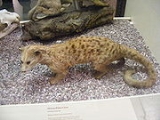
The African Palm Civet (Nandinia binotata), also known as the Two-spotted Palm Civet, is a small mammal
Mammal

Mammals are a class of vertebrate animals whose name is derived from their distinctive feature, mammary glands, with which they feed their young....
, with short legs, small ears, a body resembling a cat
Cat

The cat , also known as the Domestication cat or house cat to distinguish it from other Felinae and Felidae, is a small predationy carnivore species of crepuscular mammal that is valued by humans for its companionship and its ability to hunt vermin, snakes, scorpions, and other unwanted household pests....
, and a long lithe tail as long as its body. Adults usually weigh 1.70 to 2.10 kg. It is native to the forests of eastern Africa
Africa

Africa is the world's second-largest and second most-populous continent, after Asia. At about 30.2 million km? including adjacent islands, it covers 6% of the Earth's total surface area and 20.4% of the total land area....
, where it usually inhabits trees. Its diet is omnivorous, and includes rodent
Rodent

Rodentia is an Order of mammals also known as rodents, characterised by two continuously growing Incisors#The_Rodent_incisor in the upper and lower jaws which must be kept short by gnawing....
s, insect
Insect

Insects are the biggest class of arthropods and the only ones with wings. They are the most diverse group of animals on the planet. They are most diverse at the equator and their diversity declines toward the poles....
s, eggs, carrion, fruit, birds and fruit bats.


Discussion
Ask a question about 'African Palm Civet'
Start a new discussion about 'African Palm Civet'
Answer questions from other users
Full Discussion Forum


Encyclopedia


The African Palm Civet (Nandinia binotata), also known as the Two-spotted Palm Civet, is a small mammal
Mammal

Mammals are a class of vertebrate animals whose name is derived from their distinctive feature, mammary glands, with which they feed their young....
, with short legs, small ears, a body resembling a cat
Cat

The cat , also known as the Domestication cat or house cat to distinguish it from other Felinae and Felidae, is a small predationy carnivore species of crepuscular mammal that is valued by humans for its companionship and its ability to hunt vermin, snakes, scorpions, and other unwanted household pests....
, and a long lithe tail as long as its body. Adults usually weigh 1.70 to 2.10 kg. It is native to the forests of eastern Africa
Africa

Africa is the world's second-largest and second most-populous continent, after Asia. At about 30.2 million km? including adjacent islands, it covers 6% of the Earth's total surface area and 20.4% of the total land area....
, where it usually inhabits trees. Its diet is omnivorous, and includes rodent
Rodent

Rodentia is an Order of mammals also known as rodents, characterised by two continuously growing Incisors#The_Rodent_incisor in the upper and lower jaws which must be kept short by gnawing....
s, insect
Insect

Insects are the biggest class of arthropods and the only ones with wings. They are the most diverse group of animals on the planet. They are most diverse at the equator and their diversity declines toward the poles....
s, eggs, carrion, fruit, birds and fruit bats. The animal is generally solitary
Solitary

Solitary may refer to:* shortened form of solitary confinement in jail* Solitary , an episode of the TV series Lost* Solitary , a reality show made by FOX...
 and nocturnal.

Although resembling other civet
Civet

The family Viverridae is made up of 35 species, including all of the genet , the Binturong, most of the civets, and the four linsangs.Viverrids are native to most of the Old World tropics, nearly all of Africa , Madagascar, and the Iberian Peninsula....
 species (in the family Viverridae) it has been suggested that the African Palm Civet is genetically distinct, and diverged from other civets before the cats did. They are therefore classified as the only species in genus Nandinia and in their own family, Nandiniidae, although this suggestion is not universally accepted.