

African American art

Encyclopedia
African American art is a broad term describing the visual arts of the American
black
community (African American
s). Influenced by various cultural traditions, including those of Africa
, Europe
and the Americas
, traditional African American art forms include the range of plastic arts, from basket weaving
, pottery
, and quilting
to woodcarving and painting
.
 From its early origins in slave communities, through the end of the 20th century, African-American art has made a vital contribution to the art of the United States. During the period between the 17th century and the early 19th century art took the form of small drums, quilts, wrought-iron figures and ceramic vessels in the southern United States; these artifacts have similarities with comparable crafts in West and Central Africa. In contrast, black artisans like the New England–based engraver Scipio Moorhead and the Baltimore portrait painter Joshua Johnson created art that was conceived in a western European fashion for their local markets.
Many slaves arrived from Africa as skilled artisans, having worked in these or similar media in Africa. Others learned their trades or crafts as apprentices to African or white skilled workers. It was often the practice for slave owners to hire out skilled artisans. With the consent of their masters, some slave artisans also were able to keep wages earned in their free time and thereby save enough money to purchase their, and their families', freedom.
G.W. Hobbs, William Simpson
, Robert M. Douglas Jr., Patrick H. Reason
, Joshua Johnson
, and Scipio Moorhead
were among the earliest known portrait artists, from the period of 1773–1887. While there were no schools during this period in the United States where an African-American artist could learn to paint, patronage by some white families allowed for private tutorship in special cases. Many of these sponsoring whites were abolitionists. The artists received more encouragement and were better able to support themselves in cities, of which there were more in the North and border states.
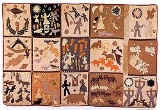
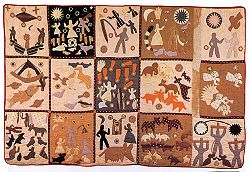
Harriet Powers
1837–1910 was an African American
folk artist and quilt
maker from rural Georgia, United States
born into slavery. Now nationally recognized for her quilts, she used traditional appliqué
techniques to record local legends, Bible stories, and astronomical events on her quilts. Only two of her late quilts have survived: Bible Quilt 1886 and Bible Quilt 1898. Her quilts are considered among the finest examples of 19th-century Southern quilting,. Like Powers, the women of Gee's Bend developed a distinctive, bold, and sophisticated quilting style based on traditional American (and African American) quilts, but with a geometric simplicity. Although widely separated by geography, they have qualities reminiscent of Amish quilts and modern art
. The women of Gee's Bend
passed their skills and aesthetic down through at least six generations to the present. At one time scholars believed slaves sometimes utilized quilt blocks to alert other slaves about escape plans during the time of the Underground Railroad
, but most historians do not agree. Quilting remains alive as form of artistic expression in the African-American community.
, Henry Ossawa Tanner
and Edmonia Lewis
are the most notable of this time. Others include Grafton Tyler Brown, Nelson A. Primus and Meta Vaux Warrick Fuller
. The goal of widespread recognition across racial boundaries was first eased within America's big cities, including Philadelphia, Boston
, Chicago
, New York
, and New Orleans. Even in these places, however, there were discriminatory limitations. Abroad, however, African Americans were much better received. In Europe — especially Paris, France — these artists could express much more freedom in experimentation and education concerning techniques outside of traditional western art. Freedom of expression was much more prevalent in Paris as well as Munich
and Rome
to a lesser extent.
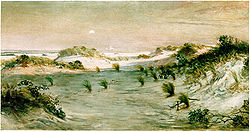 The Harlem Renaissance
was one of the most notable movements in African-American art. Certain freedoms and ideas that were already widespread in many parts of the world at the time had begun to spread into the artistic communities United States during the 1920s. During this period notable artists included Richmond Barthé
, Aaron Douglas
, janitor turned painter, Lawrence Harris
, Palmer Hayden
, William H. Johnson, Sargent Johnson, John T. Biggers
, Earle Wilton Richardson
, Malvin Gray Johnson
, Archibald Motley
, Augusta Savage
, Hale Woodruff
, and photographer James Van Der Zee
.
The establishment of the Harmon Foundation
by art patron William E. Harmon in 1922 sponsored many artists through its Harmon Award
and annual exhibitions. As it did with many such endeavors, the 1929 Great Depression
largely ended funding for the arts for a time. While the Harmon Foundation still existed in this period, its financial support toward artists ended. The Harmon Foundation, however, continued supporting artists until 1967 by mounting exhibitions and offering funding for developing artists such as Jacob Lawrence
.

 The US Treasury Department's Public Works of Art Project ineffectively attempted to provide support for artists in 1933. In 1935, President Franklin D. Roosevelt
created the Works Progress Administration
(WPA). The WPA provided for all American artists and proved especially helpful to African American artists. Artists and writers both gained work that helped them survive the Depression. Among them were Jacob Lawrence
and Richard Wright
. Politics, human and social conditions all became the subjects of accepted art forms. Important cities with significant black populations and important African-American art circles included Philadelphia, Boston, San Francisco and Washington, D.C. The WPA led to a new wave of important black art professors. Mixed media, abstract art, cubism, and social realism became not only acceptable, but desirable. Artists of the WPA united to form the 1935 Harlem Artists' Guild, which developed community art facilities in major cities. Leading forms of art included drawing, sculpture, printmaking, painting, pottery, quilting, weaving and photography. By 1939, the costly WPA and its projects all were terminated.
In 1943, James A. Porter
, a professor in the Department of Art at Howard University, wrote the first major text on African-American art and artists, Modern Negro Art.
In the 1950s and 1960s, few African-American artists were widely known or accepted. Despite this, The Highwaymen
, a loose association of 26 African American
artists from Ft. Pierce, Florida
, created idyllic, quickly realized images of the Florida landscape and peddled some 200,000 of them from the trunks of their cars. In the 1950s and 1960s, it was impossible to find galleries interested in selling artworks by a group of unknown, self-taught African Americans, so they sold their art directly to the public rather than through galleries and art agents. Rediscovered in the mid-1990s, today they are recognized as an important part of American folk history. The current market price for an original Highwaymen painting can easily bring in thousands of dollars. In 2004 the original group of 26 Highwaymen were inducted into the Florida Artists Hall of Fame. Currently 8 of the 26 are deceased, including A.Hair, H.Newton, Ellis and George Buckner, A.Moran, L.Roberts, Hezekiah Baker and most recently Johnny Daniels. The full list of 26 can be found in the Florida Artists Hall of Fame, as well as various highwaymen and Florida art websites.
 After the Second World War, some artists took a global approach, working and exhibiting abroad, in Paris, and as the decade wore on, relocated gradually in other welcoming cities like Copenhagen, Amsterdam, and Stockholm: Barbara Chase-Riboud
, Edward Clark
, Harvey Cropper, Beauford Delaney
, Herbert Gentry
, Bill Hutson, Clifford Jackson, Sam Middleton, Larry Potter, Haywood Bill Rivers, Merton Simpson
, and Walter Williams.
Some African-American artists did make it in to important New York galleries by the 1950s and 1960s: Horace Pippin
, Romare Bearden
, Jacob Lawrence
, William T. Williams
, Norman Lewis (artist)
, Thomas Sills
, and Sam Gilliam
were among the few who had successfully been received in a gallery setting. The Civil Rights Movement
of the 1960s and 1970s led artists to capture and express the times and changes. Galleries and community art centers developed for the purpose of displaying African-American art, and collegiate teaching positions were created by and for African-American artists.
By the 1980s and 1990s, hip hop graffiti became predominate in urban communities. Most major cities had developed museums devoted to African American artists. The National Endowment for the Arts
provided increasing support for these artists.
Important collections of African-American art include the Walter O. Evans Collection of African American Art, the Paul R. Jones
collections at the University of Delaware and University of Alabama
, the David C. Driskell
Art collection, the Harmon and Harriet Kelley Collection of African American Art, and the Arthur Schomburg Center for Research in Black Culture.
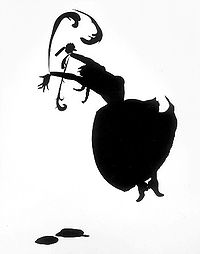
Kara Walker
, a contemporary American artist, is known for her exploration of race, gender, sexuality, violence and identity in her artworks. Walker's silhouette
images work to bridge unfinished folklore in the Antebellum South and are reminiscent of the earlier work of Harriet Powers
. Her nightmarish yet fantastical images incorporate a cinematic feel. In 2007, Walker was listed among Time Magazines "100 Most Influential People in The World, Artists and Entertainers".
Textile artists are part of African American art history. According to the 2010 Quilting in America industry survey, there are 1.6 million quilters in the United States.
Influential contemporary artists include Larry D. Alexander
, Laylah Ali, Amalia Amaki
, Emma Amos
, Jean-Michel Basquiat
, Dawoud Bey
, Camille Billops, Mark Bradford
, Edward Clark
, Willie Cole
, Robert Colescott
, Louis Delsarte
, David C. Driskell
, Leonardo Drew, Mel Edwards
, Ricardo Francis, Charles Gaines, Ellen Gallagher, Herbert Gentry
, Sam Gilliam
, David Hammons
, Jerry Harris
, Richard Hunt
, Martha Jackson-Jarvis, Katie S. Mallory, M. Scott Johnson, Rashid Johnson
, Joe Lewis, Glenn Ligon
, James Little, Al Loving, Kerry James Marshall
, Eugene J. Martin
, Richard Mayhew, Sam Middleton, Howard McCalebb
, Charles McGill, Thaddeus Mosley
, Sana Musasama, Senga Nengudi, Joe Overstreet, Martin Puryear
, Adrian Piper
, Howardena Pindell
, Faith Ringgold
, Gale Fulton Ross
, Alison Saar
, Betye Saar
, Raymond Saunders
, John T. Scott
, Joyce Scott, Gary Simmons
, Lorna Simpson
, Renee Stout
, Kara Walker
, Carrie Mae Weems
, Stanley Whitney, William T. Williams
, John Wilson, Fred Wilson
, Richard Yarde, and Purvis Young
, Kehinde Wiley
, Mickalene Thomas
, Barkley Hendricks, Jeff Sonhouse, William Walker
, Ellsworth Ausby, Che Baraka, Emmett Wigglesworth, Otto Neals, Dinga McCannon, Terry Dixon artist, and many others.
United States
The United States of America is a federal constitutional republic comprising fifty states and a federal district...
black
Black people
The term black people is used in systems of racial classification for humans of a dark skinned phenotype, relative to other racial groups.Different societies apply different criteria regarding who is classified as "black", and often social variables such as class, socio-economic status also plays a...
community (African American
African American
African Americans are citizens or residents of the United States who have at least partial ancestry from any of the native populations of Sub-Saharan Africa and are the direct descendants of enslaved Africans within the boundaries of the present United States...
s). Influenced by various cultural traditions, including those of Africa
Africa
Africa is the world's second largest and second most populous continent, after Asia. At about 30.2 million km² including adjacent islands, it covers 6% of the Earth's total surface area and 20.4% of the total land area...
, Europe
Europe
Europe is, by convention, one of the world's seven continents. Comprising the westernmost peninsula of Eurasia, Europe is generally 'divided' from Asia to its east by the watershed divides of the Ural and Caucasus Mountains, the Ural River, the Caspian and Black Seas, and the waterways connecting...
and the Americas
Americas
The Americas, or America , are lands in the Western hemisphere, also known as the New World. In English, the plural form the Americas is often used to refer to the landmasses of North America and South America with their associated islands and regions, while the singular form America is primarily...
, traditional African American art forms include the range of plastic arts, from basket weaving
Basket weaving
Basket weaving is the process of weaving unspun vegetable fibres into a basket or other similar form. People and artists who weave baskets are called basketmakers and basket weavers.Basketry is made from a variety of fibrous or pliable materials•anything that will bend and form a shape...
, pottery
Pottery
Pottery is the material from which the potteryware is made, of which major types include earthenware, stoneware and porcelain. The place where such wares are made is also called a pottery . Pottery also refers to the art or craft of the potter or the manufacture of pottery...
, and quilting
Quilting
Quilting is a sewing method done to join two or more layers of material together to make a thicker padded material. A quilter is the name given to someone who works at quilting. Quilting can be done by hand, by sewing machine, or by a specialist longarm quilting system.The process of quilting uses...
to woodcarving and painting
Painting
Painting is the practice of applying paint, pigment, color or other medium to a surface . The application of the medium is commonly applied to the base with a brush but other objects can be used. In art, the term painting describes both the act and the result of the action. However, painting is...
.
Antebellum and Civil War eras
Many slaves arrived from Africa as skilled artisans, having worked in these or similar media in Africa. Others learned their trades or crafts as apprentices to African or white skilled workers. It was often the practice for slave owners to hire out skilled artisans. With the consent of their masters, some slave artisans also were able to keep wages earned in their free time and thereby save enough money to purchase their, and their families', freedom.
G.W. Hobbs, William Simpson
William Simpson
William Simpson may refer to:*William Dunlap Simpson , Governor of South Carolina from 1879*William Simpson , Scottish war artist and correspondent*William John Simpson , journalist and political figure in Quebec...
, Robert M. Douglas Jr., Patrick H. Reason
Patrick H. Reason
Patrick Henry Reason, first named Patrice Rison , was one of the earliest African-American engravers in the United States. He was active as abolitionist . He was a leader in a fraternal order, gaining recognition for Hamilton Lodge No...
, Joshua Johnson
Joshua Johnson
Joshua Johnson was an American biracial painter from the Baltimore area. Johnson, often viewed as the first person of color to make a living as a painter in the United States, is known for his naïve paintings of prominent Maryland residents....
, and Scipio Moorhead
Scipio Moorhead
Scipio Moorhead was an enslaved African American artist who lived in Boston. His only surviving work is a portrait of the African American poet, Phillis Wheatley. Moorhead is the main focus of Wheatley's "To S. M. a young African Painter, on seeing his Works", published in Poems on Various...
were among the earliest known portrait artists, from the period of 1773–1887. While there were no schools during this period in the United States where an African-American artist could learn to paint, patronage by some white families allowed for private tutorship in special cases. Many of these sponsoring whites were abolitionists. The artists received more encouragement and were better able to support themselves in cities, of which there were more in the North and border states.
Harriet Powers
Harriet Powers
Harriet Powers was an African American slave, folk artist and quilt maker from rural Georgia. She used traditional appliqué techniques to record local legends, Bible stories, and astronomical events on her quilts...
1837–1910 was an African American
African American
African Americans are citizens or residents of the United States who have at least partial ancestry from any of the native populations of Sub-Saharan Africa and are the direct descendants of enslaved Africans within the boundaries of the present United States...
folk artist and quilt
Quilt
A quilt is a type of bed cover, traditionally composed of three layers of fiber: a woven cloth top, a layer of batting or wadding and a woven back, combined using the technique of quilting. “Quilting” refers to the technique of joining at least two fabric layers by stitches or ties...
maker from rural Georgia, United States
Georgia (U.S. state)
Georgia is a state located in the southeastern United States. It was established in 1732, the last of the original Thirteen Colonies. The state is named after King George II of Great Britain. Georgia was the fourth state to ratify the United States Constitution, on January 2, 1788...
born into slavery. Now nationally recognized for her quilts, she used traditional appliqué
Applique
In its broadest sense, an appliqué is a smaller ornament or device applied to another surface. In the context of ceramics, for example, an appliqué is a separate piece of clay added to the primary work, generally for the purpose of decoration...
techniques to record local legends, Bible stories, and astronomical events on her quilts. Only two of her late quilts have survived: Bible Quilt 1886 and Bible Quilt 1898. Her quilts are considered among the finest examples of 19th-century Southern quilting,. Like Powers, the women of Gee's Bend developed a distinctive, bold, and sophisticated quilting style based on traditional American (and African American) quilts, but with a geometric simplicity. Although widely separated by geography, they have qualities reminiscent of Amish quilts and modern art
Modern art
Modern art includes artistic works produced during the period extending roughly from the 1860s to the 1970s, and denotes the style and philosophy of the art produced during that era. The term is usually associated with art in which the traditions of the past have been thrown aside in a spirit of...
. The women of Gee's Bend
The Quilts of Gees Bend
The Quilts of Gees Bend were created by a group of women who live in the isolated, African American hamlet of Gee's Bend, Alabama. Like many American quilters, the women transformed a necessity into a work of pleasure....
passed their skills and aesthetic down through at least six generations to the present. At one time scholars believed slaves sometimes utilized quilt blocks to alert other slaves about escape plans during the time of the Underground Railroad
Quilts of the Underground Railroad
In 1999 a theory surfaced indicating a possibility slaves used quilt blocks to alert other slaves about escape plans during the time of the Underground Railroad...
, but most historians do not agree. Quilting remains alive as form of artistic expression in the African-American community.
Post-Civil War
After the Civil War, it became increasingly acceptable for African American- created works to be exhibited in museums, and artists increasingly produced works for this purpose. These were works mostly in the European romantic and classical traditions of landscapes and portraits. Edward Mitchell BannisterEdward Mitchell Bannister
-Notes:...
, Henry Ossawa Tanner
Henry Ossawa Tanner
Henry Ossawa Tanner was an African American artist best known for his style of painting. He was the first African American painter to gain international acclaim.-Education:...
and Edmonia Lewis
Edmonia Lewis
Mary Edmonia Lewis was the first African American and Native American woman to gain fame and recognition as a sculptor in the international fine arts world...
are the most notable of this time. Others include Grafton Tyler Brown, Nelson A. Primus and Meta Vaux Warrick Fuller
Meta Vaux Warrick Fuller
Meta Vaux Warrick Fuller was an African American artist. She is best known as the first African American artist to make art celebrating Afrocentric themes. A multi-talented artist who created poetry and paintings, she is mainly known as a sculptor who explored her African-American roots...
. The goal of widespread recognition across racial boundaries was first eased within America's big cities, including Philadelphia, Boston
Boston
Boston is the capital of and largest city in Massachusetts, and is one of the oldest cities in the United States. The largest city in New England, Boston is regarded as the unofficial "Capital of New England" for its economic and cultural impact on the entire New England region. The city proper had...
, Chicago
Chicago
Chicago is the largest city in the US state of Illinois. With nearly 2.7 million residents, it is the most populous city in the Midwestern United States and the third most populous in the US, after New York City and Los Angeles...
, New York
New York City
New York is the most populous city in the United States and the center of the New York Metropolitan Area, one of the most populous metropolitan areas in the world. New York exerts a significant impact upon global commerce, finance, media, art, fashion, research, technology, education, and...
, and New Orleans. Even in these places, however, there were discriminatory limitations. Abroad, however, African Americans were much better received. In Europe — especially Paris, France — these artists could express much more freedom in experimentation and education concerning techniques outside of traditional western art. Freedom of expression was much more prevalent in Paris as well as Munich
Munich
Munich The city's motto is "" . Before 2006, it was "Weltstadt mit Herz" . Its native name, , is derived from the Old High German Munichen, meaning "by the monks' place". The city's name derives from the monks of the Benedictine order who founded the city; hence the monk depicted on the city's coat...
and Rome
Rome
Rome is the capital of Italy and the country's largest and most populated city and comune, with over 2.7 million residents in . The city is located in the central-western portion of the Italian Peninsula, on the Tiber River within the Lazio region of Italy.Rome's history spans two and a half...
to a lesser extent.
The Harlem Renaissance to Contemporary art
Harlem Renaissance
The Harlem Renaissance was a cultural movement that spanned the 1920s and 1930s. At the time, it was known as the "New Negro Movement", named after the 1925 anthology by Alain Locke...
was one of the most notable movements in African-American art. Certain freedoms and ideas that were already widespread in many parts of the world at the time had begun to spread into the artistic communities United States during the 1920s. During this period notable artists included Richmond Barthé
Richmond Barthé
James Richmond Barthé was an African American sculptor known for his many public works, including the Toussaint L’Ouverture Monument in Port-au-Prince, Haiti and a sculpture of Rose McClendon for Frank Lloyd Wright’s Fallingwater House.Barthe once said that “all my life I have be interested in...
, Aaron Douglas
Aaron Douglas
Aaron Douglas was an African American painter and a major figure in the Harlem Renaissance.-Early life:...
, janitor turned painter, Lawrence Harris
Lawrence Harris
Lawrence Harris is an African American painter who was born in Colorado Springs, Colorado in 1937. He has studied art in both the United States and Europe...
, Palmer Hayden
Palmer Hayden
Palmer C. Hayden was an American painter who depicted African American life. He painted in both oils and watercolors, and was a prolific artist of his era.-Early life:...
, William H. Johnson, Sargent Johnson, John T. Biggers
John T. Biggers
John Thomas Biggers was an African American muralist who came to prominence after the Harlem Renaissance and toward the end of World War II. Dr...
, Earle Wilton Richardson
Earle Wilton Richardson
Earle Wilton Richardson, was an African American artist made famous mainly for an oil painting of his dating from 1934 titled Employment of Negroes in Agriculture....
, Malvin Gray Johnson
Malvin Gray Johnson
Malvin Gray Johnson was an African american painter, born and raised in Greensboro, North Carolina. His family moved to New York, where he studied art at the National Academy of Design...
, Archibald Motley
Archibald Motley
Archibald John Motley, Junior was an African-American painter. He studied painting at the School of the Art Institute of Chicago during the 1910s, graduating in 1918...
, Augusta Savage
Augusta Savage
Augusta Savage, born Augusta Christine Fells was an African-American sculptor associated with the Harlem Renaissance. She was also a teacher and her studio was important to the careers of a rising generation of artists who would become nationally known...
, Hale Woodruff
Hale Woodruff
Hale Aspacio Woodruff was an African American artist known for his murals, paintings, and prints. One example of his work, the three-panel Amistad Mutiny murals , can be found at Talladega College in Talladega County, Alabama...
, and photographer James Van Der Zee
James Van Der Zee
James Van Der Zee was an African American photographer best known for his portraits of black New Yorkers. He was a leading figure in the Harlem Renaissance. Aside from the artistic merits of his work, Van Der Zee produced the most comprehensive documentation of the period...
.
The establishment of the Harmon Foundation
Harmon Foundation
The Harmon Foundation was established in 1922 by William E. Harmon. It served as a large scale patron of African American art and helped gain recognition for African American artists who otherwise would have remained largely unknown. Mary B. Brady was the director of the foundation from 1922 until...
by art patron William E. Harmon in 1922 sponsored many artists through its Harmon Award
William E. Harmon Foundation award for distinguished achievement among Negroes
The William E. Harmon Foundation award for Distinguished Achievement among Negroes commonly referred to as the "Harmon award" or "Harmon foundation award", was a philanthropic and cultural award created in 1926 by William E. Harmon and administered by the Harmon Foundation...
and annual exhibitions. As it did with many such endeavors, the 1929 Great Depression
Great Depression
The Great Depression was a severe worldwide economic depression in the decade preceding World War II. The timing of the Great Depression varied across nations, but in most countries it started in about 1929 and lasted until the late 1930s or early 1940s...
largely ended funding for the arts for a time. While the Harmon Foundation still existed in this period, its financial support toward artists ended. The Harmon Foundation, however, continued supporting artists until 1967 by mounting exhibitions and offering funding for developing artists such as Jacob Lawrence
Jacob Lawrence
Jacob Lawrence was an American painter; he was married to fellow artist Gwendolyn Knight. Lawrence referred to his style as "dynamic cubism", though by his own account the primary influence was not so much French art as the shapes and colors of Harlem.Lawrence is among the best-known twentieth...
.
Franklin D. Roosevelt
Franklin Delano Roosevelt , also known by his initials, FDR, was the 32nd President of the United States and a central figure in world events during the mid-20th century, leading the United States during a time of worldwide economic crisis and world war...
created the Works Progress Administration
Works Progress Administration
The Works Progress Administration was the largest and most ambitious New Deal agency, employing millions of unskilled workers to carry out public works projects, including the construction of public buildings and roads, and operated large arts, drama, media, and literacy projects...
(WPA). The WPA provided for all American artists and proved especially helpful to African American artists. Artists and writers both gained work that helped them survive the Depression. Among them were Jacob Lawrence
Jacob Lawrence
Jacob Lawrence was an American painter; he was married to fellow artist Gwendolyn Knight. Lawrence referred to his style as "dynamic cubism", though by his own account the primary influence was not so much French art as the shapes and colors of Harlem.Lawrence is among the best-known twentieth...
and Richard Wright
Richard Wright (author)
Richard Nathaniel Wright was an African-American author of sometimes controversial novels, short stories, poems, and non-fiction. Much of his literature concerns racial themes, especially those involving the plight of African-Americans during the late 19th to mid 20th centuries...
. Politics, human and social conditions all became the subjects of accepted art forms. Important cities with significant black populations and important African-American art circles included Philadelphia, Boston, San Francisco and Washington, D.C. The WPA led to a new wave of important black art professors. Mixed media, abstract art, cubism, and social realism became not only acceptable, but desirable. Artists of the WPA united to form the 1935 Harlem Artists' Guild, which developed community art facilities in major cities. Leading forms of art included drawing, sculpture, printmaking, painting, pottery, quilting, weaving and photography. By 1939, the costly WPA and its projects all were terminated.
In 1943, James A. Porter
James Amos Porter
James Amos Porter was a pioneer in establishing the field of African-American art history. He was instrumental as the first scholar to provide a systematic, critical analysis of African-American artists and their works of art. An artist himself, he provided a unique and critical approach to the...
, a professor in the Department of Art at Howard University, wrote the first major text on African-American art and artists, Modern Negro Art.
In the 1950s and 1960s, few African-American artists were widely known or accepted. Despite this, The Highwaymen
The Highwaymen (artists)
The Highwaymen, also referred to as the Florida Highwaymen, are a group of 26 named and listed landscape artists who have been called "The Last Great American Art Movement of the 20TH century"...
, a loose association of 26 African American
African American
African Americans are citizens or residents of the United States who have at least partial ancestry from any of the native populations of Sub-Saharan Africa and are the direct descendants of enslaved Africans within the boundaries of the present United States...
artists from Ft. Pierce, Florida
Florida
Florida is a state in the southeastern United States, located on the nation's Atlantic and Gulf coasts. It is bordered to the west by the Gulf of Mexico, to the north by Alabama and Georgia and to the east by the Atlantic Ocean. With a population of 18,801,310 as measured by the 2010 census, it...
, created idyllic, quickly realized images of the Florida landscape and peddled some 200,000 of them from the trunks of their cars. In the 1950s and 1960s, it was impossible to find galleries interested in selling artworks by a group of unknown, self-taught African Americans, so they sold their art directly to the public rather than through galleries and art agents. Rediscovered in the mid-1990s, today they are recognized as an important part of American folk history. The current market price for an original Highwaymen painting can easily bring in thousands of dollars. In 2004 the original group of 26 Highwaymen were inducted into the Florida Artists Hall of Fame. Currently 8 of the 26 are deceased, including A.Hair, H.Newton, Ellis and George Buckner, A.Moran, L.Roberts, Hezekiah Baker and most recently Johnny Daniels. The full list of 26 can be found in the Florida Artists Hall of Fame, as well as various highwaymen and Florida art websites.
Barbara Chase-Riboud
Barbara Chase-Riboud is an American novelist, poet, sculptor and visual artist, perhaps best known for her historical fiction. Much of her work has explored themes related to slavery and exploitation of women....
, Edward Clark
Edward Clark (artist)
Edward Clark also known as Ed Clark is an African American abstract expressionist painter and one of the early experimenters with shaped canvas in the 1950s.Edward Clark stated:-Biography:...
, Harvey Cropper, Beauford Delaney
Beauford Delaney
Beauford Delaney was an American modernist painter.-Early life:Beauford Delaney was born in Knoxville, Tennessee, USA, in 1901. Delaney’s parents were prominent and respected members of Knoxville's black community. His father Samuel was both a barber and a Methodist minister...
, Herbert Gentry
Herbert Gentry
Herbert Gentry was an African American Expressionist painter lived and worked in Paris, France, , Copenhagen, Denmark , In the Swedish cities of Gothenburg , Stockholm , and Malmo , and in New York City as a permanent resident of the Hotel Chelsea.-The art of Herbert Gentry:Gentry’s...
, Bill Hutson, Clifford Jackson, Sam Middleton, Larry Potter, Haywood Bill Rivers, Merton Simpson
Merton Simpson
Merton Daniel Simpson is an American abstract expressionist painter and African and tribal art collector.-Early life:...
, and Walter Williams.
Some African-American artists did make it in to important New York galleries by the 1950s and 1960s: Horace Pippin
Horace Pippin
Horace Pippin was a self-taught African-American painter. The injustice of slavery and American segregation figure prominently in many of his works.-Biography:...
, Romare Bearden
Romare Bearden
Romare Bearden was an African American artist and writer. He worked in several media including cartoons, oils, and collage.-Education:...
, Jacob Lawrence
Jacob Lawrence
Jacob Lawrence was an American painter; he was married to fellow artist Gwendolyn Knight. Lawrence referred to his style as "dynamic cubism", though by his own account the primary influence was not so much French art as the shapes and colors of Harlem.Lawrence is among the best-known twentieth...
, William T. Williams
William T. Williams
William T. Williams was born in Cross Creek, North Carolina, United States. He received a BFA degree from Pratt Institute in 1966 and studied at The Skowhegan School of Art. In 1968 he received an MFA degree from Yale University School of Art and Architecture...
, Norman Lewis (artist)
Norman Lewis (artist)
Norman W. Lewis was an African-American painter, scholar, and teacher. He is associated with Abstract Expressionism. Lewis was African-American, of Caribbean descent.-Early life and career:...
, Thomas Sills
Thomas Sills
Thomas Sills was a painter and collagist and a participant in the New York Abstract Expressionist movement.-Early years:Thomas Sills was born and raised in Castalia, North Carolina. Before he got involved with painting, he worked in a greenhouse in Raleigh, North Carolina, where the color around...
, and Sam Gilliam
Sam Gilliam
Sam Gilliam is internationally recognized as one of America's foremost Color Field Painter and Lyrical Abstractionist artists....
were among the few who had successfully been received in a gallery setting. The Civil Rights Movement
Civil rights movement
The civil rights movement was a worldwide political movement for equality before the law occurring between approximately 1950 and 1980. In many situations it took the form of campaigns of civil resistance aimed at achieving change by nonviolent forms of resistance. In some situations it was...
of the 1960s and 1970s led artists to capture and express the times and changes. Galleries and community art centers developed for the purpose of displaying African-American art, and collegiate teaching positions were created by and for African-American artists.
By the 1980s and 1990s, hip hop graffiti became predominate in urban communities. Most major cities had developed museums devoted to African American artists. The National Endowment for the Arts
National Endowment for the Arts
The National Endowment for the Arts is an independent agency of the United States federal government that offers support and funding for projects exhibiting artistic excellence. It was created by an act of the U.S. Congress in 1965 as an independent agency of the federal government. Its current...
provided increasing support for these artists.
Important collections of African-American art include the Walter O. Evans Collection of African American Art, the Paul R. Jones
Paul R. Jones
Paul Raymond Jones was an important American collector of African American art.Jones, one of five children of Will and Ella Jones, grew up in Muscoda, a Tennessee Coal, Iron and Railroad Company mining camp near Bessemer, Alabama...
collections at the University of Delaware and University of Alabama
University of Alabama
The University of Alabama is a public coeducational university located in Tuscaloosa, Alabama, United States....
, the David C. Driskell
David C. Driskell
David C. Driskell is a scholar in the field of African American art and an artist. Driskell is an emeritus professor at the University of Maryland, College Park....
Art collection, the Harmon and Harriet Kelley Collection of African American Art, and the Arthur Schomburg Center for Research in Black Culture.
Kara Walker
Kara Walker
Kara Walker is a contemporary African American artist who explores race, gender, sexuality, violence and identity in her work. She is best known for her room-size tableaux of black cut-paper silhouettes, such as The Means to an End--A Shadow Drama in Five Acts.-Biography:Walker was born in...
, a contemporary American artist, is known for her exploration of race, gender, sexuality, violence and identity in her artworks. Walker's silhouette
Silhouette
A silhouette is the image of a person, an object or scene consisting of the outline and a basically featureless interior, with the silhouetted object usually being black. Although the art form has been popular since the mid-18th century, the term “silhouette” was seldom used until the early decades...
images work to bridge unfinished folklore in the Antebellum South and are reminiscent of the earlier work of Harriet Powers
Harriet Powers
Harriet Powers was an African American slave, folk artist and quilt maker from rural Georgia. She used traditional appliqué techniques to record local legends, Bible stories, and astronomical events on her quilts...
. Her nightmarish yet fantastical images incorporate a cinematic feel. In 2007, Walker was listed among Time Magazines "100 Most Influential People in The World, Artists and Entertainers".
Textile artists are part of African American art history. According to the 2010 Quilting in America industry survey, there are 1.6 million quilters in the United States.
Influential contemporary artists include Larry D. Alexander
Larry D. Alexander
Larry Dell Alexander is an American artist, Christian author and teacher from Dermott, Arkansas in Chicot County. Alexander is best known for his creations of colorful and black & white "pen and ink" drawings in his "crosshatching" technique, and, his personal rendition of a "Clinton Family...
, Laylah Ali, Amalia Amaki
Amalia Amaki
Amalia Amaki is an African American artist, art historian, educator, film critic and curator who currently resides in Tuscaloosa, Alabama where she is a Professor of Modern and Contemporary Art at the University of Alabama at Tuscaloosa since 2007.Amaki graduated from Georgia State University in...
, Emma Amos
Emma Amos (painter)
Emma Amos is a postmodernist African-American painter and printmaker.-Early life:She was born in America's South on March 16, 1938, in Atlanta, Georgia and is of African descent....
, Jean-Michel Basquiat
Jean-Michel Basquiat
Jean-Michel Basquiat was an American artist. His career in art began as a graffiti artist in New York City in the late 1970s, and in the 1980s produced Neo-expressionist painting.-Early life:...
, Dawoud Bey
Dawoud Bey
Dawoud Bey is an American photographer renowned for his large-scale color portraits of adolescents and other often marginalized subjects....
, Camille Billops, Mark Bradford
Mark Bradford
Mark Bradford is an American artist living and working in Los Angeles.-Life and work:He studied at the California Institute of the Arts, located at Valencia, California, U.S., earning an MFA in 1997 and a BFA in 1995....
, Edward Clark
Edward Clark (artist)
Edward Clark also known as Ed Clark is an African American abstract expressionist painter and one of the early experimenters with shaped canvas in the 1950s.Edward Clark stated:-Biography:...
, Willie Cole
Willie Cole
Willie Cole is a noted contemporary African American sculptor and conceptual and visual artist.-Art:Willie Cole’s art is best known for assembling and transforming ordinary domestic and used objects such as irons, ironing boards, high-heeled shoes, hair dryers, bicycle parts, wooden matches, lawn...
, Robert Colescott
Robert Colescott
Robert H. Colescott, was an American painter. He is known for satirical genre and crowd subjects, often conveying his exuberant, comical, or bitter reflections on being African-American. He studied with Fernand Léger in Paris...
, Louis Delsarte
Louis Delsarte
Louis J. Delsarte is an African American artist known for what has sometimes been called his "illusionistic" style. He is a painter, muralist, printmaker, and illustrator. When Delsarte was growing up, he was surrounded by music including jazz, opera, musicals, and the blues...
, David C. Driskell
David C. Driskell
David C. Driskell is a scholar in the field of African American art and an artist. Driskell is an emeritus professor at the University of Maryland, College Park....
, Leonardo Drew, Mel Edwards
Mel Edwards
Mel Edwards is an American sculptor, based in New York City. He has had more than a dozen one-person show exhibits and been in over four dozen group shows. He has had solo exhibitions at the Whitney Museum of American Art in New York City, the Los Angeles County Museum of Art, and the New Jersey...
, Ricardo Francis, Charles Gaines, Ellen Gallagher, Herbert Gentry
Herbert Gentry
Herbert Gentry was an African American Expressionist painter lived and worked in Paris, France, , Copenhagen, Denmark , In the Swedish cities of Gothenburg , Stockholm , and Malmo , and in New York City as a permanent resident of the Hotel Chelsea.-The art of Herbert Gentry:Gentry’s...
, Sam Gilliam
Sam Gilliam
Sam Gilliam is internationally recognized as one of America's foremost Color Field Painter and Lyrical Abstractionist artists....
, David Hammons
David Hammons
David Hammons is an African-American artist mostly known for his works in and around New York City during the 1970s and 1980s.Much of his work, including Spade with Chains , reflects his commitment to the civil rights and Black Power movements...
, Jerry Harris
Jerry Harris
Jerry Harris is an African American abstract sculptor, collagist and writer. Harris is primarily a constructivist sculptor, working in media such as wood, stone, bronze, fiberglass, clay, metal, mixed media , and collage.After graduating from high school in Pittsburgh, he spent a year in Portland,...
, Richard Hunt
Richard Hunt (sculptor)
Richard Hunt is an internationally renowned sculptor.He was born in 1935 on Chicago's South Side. From an early age he was interested in the arts, as his mother was an artist. As a young boy, Hunt began to show enthusiasm and talent in artistic disciplines such as drawing and painting, and also...
, Martha Jackson-Jarvis, Katie S. Mallory, M. Scott Johnson, Rashid Johnson
Rashid Johnson
Rashid Johnson is an African American socio-political photographer who produces conceptual post-black art. Johnson first received critical attention when examples of his work were included in the exhibition "Freestyle", curated by Thelma Golden at the Studio Museum in Harlem in 2001—when he was 24...
, Joe Lewis, Glenn Ligon
Glenn Ligon
Glenn Ligon is an American conceptual artist whose work explores race, language, desire, sexuality, and identity. He engages in intertextuality with other works from the visual arts, literature, and history, as well as his own life.-Early life and career:...
, James Little, Al Loving, Kerry James Marshall
Kerry James Marshall
Kerry James Marshall is an artist born in Birmingham, Alabama. He grew up in South Central Los Angeles and now lives in Chicago where he previously taught at the School of Art and Design at the University of Illinois at Chicago...
, Eugene J. Martin
Eugene J. Martin
Eugene James Martin was a prolific African American visual artist.-Art:Eugene J...
, Richard Mayhew, Sam Middleton, Howard McCalebb
Howard McCalebb
Howard McCalebb is an African American abstract sculptor. He received his M.F.A. in Sculpture from Cornell University in 1972, and his B.A. in Sculpture from California State University at Hayward in 1970...
, Charles McGill, Thaddeus Mosley
Thaddeus Mosley
Thaddeus G. Mosley is a United States sculptor who works mostly in wood and is based in Pittsburgh, Pennsylvania.-Biography:A native of New Castle, Pennsylvania, Mosley enlisted in the U.S. Navy, then graduated from the University of Pittsburgh, where he majored in English and journalism, then...
, Sana Musasama, Senga Nengudi, Joe Overstreet, Martin Puryear
Martin Puryear
Martin Puryear is an African American sculptor. He works in media including wood, stone, tar, and wire, and his work is a union of minimalism and traditional crafts.-Life:...
, Adrian Piper
Adrian Piper
Adrian Margaret Smith Piper is a first-generation conceptual artist and analytic philosopher who was born in New York City and lived for many years on Cape Cod, Massachusetts before emigrating from the United States...
, Howardena Pindell
Howardena Pindell
Howardena Pindell, born in Philadelphia, Pennsylvania, on April 14, 1943, to Howard and Mildred Douglas, is an American abstract artist. Her work explores texture, color, structures, and the process of making art; it is often political, addressing the issues of racism, feminism, violence, slavery,...
, Faith Ringgold
Faith Ringgold
Faith Ringgold is an African American artist, best known for her painted story quilts. She is professor emeritus in the University of California, San Diego visual art department.-Life and artwork:...
, Gale Fulton Ross
Gale Fulton Ross
Gale Fulton Ross is a prolific African American visual artist living in Sarasota, Florida.-Life:Gale Fulton Ross was born in Medford, Massachusetts, in 1947, the oldest of nine children....
, Alison Saar
Alison Saar
Alison Saar is an American artist who was born in Los Angeles, California and grew up in Laurel Canyon, California. Her parents were Betye Saar, a well-known African American artist, and Richard Saar, an art conservationist. Both parents encouraged their three daughters, all artists, to look at...
, Betye Saar
Betye Saar
Betye Irene Saar is an American artist, known for her work in the field of assemblage. Her education included a time at the University of California, Los Angeles, from where she received a degree in design in 1949, and graduate studies in printmaking and education at Pasadena City College,...
, Raymond Saunders
Raymond Saunders (artist)
Raymond Saunders is an American artist born in Pittsburgh, Pennsylvania in 1934. He currently lives and works in Oakland, California. Saunders is currently a professor of Painting at California College of the Arts, Oakland, California. He is a visual artist, with a place in American art history...
, John T. Scott
John T. Scott
John T. Scott was an African American sculptor, painter, printmaker and collagist. He was awarded a Bachelor of arts degree from Xavier University in New Orleans and a Master of Fine Arts degree from Michigan State University in East Lansing, Michigan...
, Joyce Scott, Gary Simmons
Gary Simmons (artist)
-Work and Exhibitions:Using icons and stereotypes of American popular culture, Gary Simmons creates works that address personal and collective experiences of race and class...
, Lorna Simpson
Lorna Simpson
Lorna Simpson is an African American artist and photographer who made her name in the 1980s and 1990s with artworks such as Guarded Conditions and Square Deal. Her work often portrays black women combined with text to express contemporary society's relationship with race, ethnicity and sex...
, Renee Stout
Renee Stout
Renée Stout is a contemporary artist known for assemblage artworks dealing with her personal history and African American heritage....
, Kara Walker
Kara Walker
Kara Walker is a contemporary African American artist who explores race, gender, sexuality, violence and identity in her work. She is best known for her room-size tableaux of black cut-paper silhouettes, such as The Means to an End--A Shadow Drama in Five Acts.-Biography:Walker was born in...
, Carrie Mae Weems
Carrie Mae Weems
Carrie Mae Weems is an award-winning photographer and artist. Her photographs, films, and videos have been displayed in over 50 exhibitions in the United States and abroad and focus on serious issues that face African Americans today, such as racism, gender relations, politics, and personal identity...
, Stanley Whitney, William T. Williams
William T. Williams
William T. Williams was born in Cross Creek, North Carolina, United States. He received a BFA degree from Pratt Institute in 1966 and studied at The Skowhegan School of Art. In 1968 he received an MFA degree from Yale University School of Art and Architecture...
, John Wilson, Fred Wilson
Fred Wilson (artist)
Conceptual artist Fred Wilson describes himself as of "African, Native American, European and Amerindian" descent. Wilson received a MacArthur Foundation Genius Grant in 1999 and the Larry Aldrich Foundation Award in 2003. Wilson represented the United States at the Biennial Cairo in 1992 and the...
, Richard Yarde, and Purvis Young
Purvis Young
Purvis Young was an American artist from the Overtown neighborhood of Miami, Florida. Young's work, often a blend of collage and painting, utilizes found objects and the experience of African Americans in the south...
, Kehinde Wiley
Kehinde Wiley
Kehinde Wiley is a New York-based portrait painter, who is known for his highly naturalistic paintings of contemporary urban African, African-American, Afro-Brazilian, Indian and Ethiopian-Jewish men in heroic poses.-Early life:...
, Mickalene Thomas
Mickalene Thomas
New York-based artist Mickalene Thomas is known for her elaborate paintings adorned with rhinestones, enamel and colorful acrylics. She received her BFA from Pratt Institute in 2000, and her MFA from Yale University in 2002 and currently lives and works in New York...
, Barkley Hendricks, Jeff Sonhouse, William Walker
William Aiken Walker
William Aiken Walker is an American artist who was born to an Irish Protestant father and a mother of South Carolina background in Charleston, South Carolina in 1839...
, Ellsworth Ausby, Che Baraka, Emmett Wigglesworth, Otto Neals, Dinga McCannon, Terry Dixon artist, and many others.
See also
- African American literatureAfrican American literatureAfrican-American literature is the body of literature produced in the United States by writers of African descent. The genre traces its origins to the works of such late 18th century writers as Phillis Wheatley and Olaudah Equiano, reaching early high points with slave narratives and the Harlem...
- African American MusicAfrican American musicAfrican-American music is an umbrella term given to a range of musics and musical genres emerging from or influenced by the culture of African Americans, who have long constituted a large and significant ethnic minority of the population of the United States...
- James A. Porter Colloquium on African American ArtJames A. Porter Colloquium on African American ArtThe James A. Porter Colloquium is a three-day scholarly program at Howard University exploring African American art history and cultural development. Started in 1990 by art historian Dr...
- African American cultureAfrican American cultureAfrican-American culture, also known as black culture, in the United States refers to the cultural contributions of Americans of African descent to the culture of the United States, either as part of or distinct from American culture. The distinct identity of African-American culture is rooted in...
- List of African-American visual artists
- The Highwaymen (artists)The Highwaymen (artists)The Highwaymen, also referred to as the Florida Highwaymen, are a group of 26 named and listed landscape artists who have been called "The Last Great American Art Movement of the 20TH century"...
Sources
- Romare BeardenRomare BeardenRomare Bearden was an African American artist and writer. He worked in several media including cartoons, oils, and collage.-Education:...
, Harry Henderson, A history of African-American Artists. From 1792 to the Present, New York: Pantheon Books 1993 - Driskell, David C. (2001) The Other Side of Color: African American Art in the Collection of Camille O. and William H. Cosby, Jr. Pomegranate. ISBN 978-0-7649-1455-3
- Sylvester, Melvin R. African Americans in Visual Arts: A Historical Perspective. Long Island University. Retrieved January 23, 2005.