
All Topics  
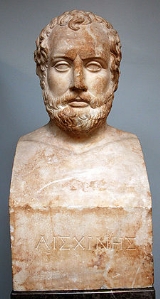
Aeschines


   Email Print
   Bookmark   Link


Aeschines


Aeschines (in Greek
Greek language

Greek is an Indo-European languages native to the southern Balkan peninsula, the language of the Greek people. It forms an independent branch within Indo-European....
 , 389–314 BC), Greek
Ancient Greece

The term Ancient Greece refers to the period of History of Greece lasting from the Greek Dark Ages ca. 1100 BC and the Dorian invasion, to 146 BC and the Roman Republic conquest of Greece after the Battle of Corinth ....
 statesman
Statesman

A statesman or stateswoman or statesperson is usually a politician or other notable figure of state who has had a long and respected career in politics at the national and international level....
 and one of the ten Attic orators
Attic orators

The ten Attic orators were considered the greatest orators and logographer s of the classical antiquity . They are included in the "Alexandrian Canon" compiled by Aristophanes of Byzantium and Aristarchus of Samothrace....
.

Life
Although it is known he was born in Athens
Athens

Athens , the Capital and largest city of Greece, dominates the Attica periphery; as one of the List of cities by time of continuous habitation, its recorded history spans around 3,400 years....
, the records regarding his parentage and early life are conflicting; but it seems probable that his parents, though poor, were respectable. Aeschines' father was Atrometus, an elementary school teacher of letters. His mother Glaukothea assisted in the religious rites of initiation for the poor.


Discussion
Ask a question about 'Aeschines'
Start a new discussion about 'Aeschines'
Answer questions from other users
Full Discussion Forum


Encyclopedia


Aeschines (in Greek
Greek language

Greek is an Indo-European languages native to the southern Balkan peninsula, the language of the Greek people. It forms an independent branch within Indo-European....
 , 389–314 BC), Greek
Ancient Greece

The term Ancient Greece refers to the period of History of Greece lasting from the Greek Dark Ages ca. 1100 BC and the Dorian invasion, to 146 BC and the Roman Republic conquest of Greece after the Battle of Corinth ....
 statesman
Statesman

A statesman or stateswoman or statesperson is usually a politician or other notable figure of state who has had a long and respected career in politics at the national and international level....
 and one of the ten Attic orators
Attic orators

The ten Attic orators were considered the greatest orators and logographer s of the classical antiquity . They are included in the "Alexandrian Canon" compiled by Aristophanes of Byzantium and Aristarchus of Samothrace....
.

Life


Although it is known he was born in Athens
Athens

Athens , the Capital and largest city of Greece, dominates the Attica periphery; as one of the List of cities by time of continuous habitation, its recorded history spans around 3,400 years....
, the records regarding his parentage and early life are conflicting; but it seems probable that his parents, though poor, were respectable. Aeschines' father was Atrometus, an elementary school teacher of letters. His mother Glaukothea assisted in the religious rites of initiation for the poor. After assisting his father in his school, he tried his hand at acting
Acting

Acting is the work of an actor or actress, which is a person in theatre, television, film, or any other storytelling medium who tells the story by portraying a Fictional character and, usually, Speech communication or singing the written text or Play ....
 with indifferent success, served with distinction in the army
Army

An army , in the broadest sense, is the land-based armed forces of a nation. It may also include other branches of the military such as an air force....
, and held several clerkships, amongst them the office of clerk to the Boule
Boule

The term Boule may refer to:* Boule , plural boulai, assembly forming part of city governments in Ancient Greece* Boule , block of synthetically-produced crystal material...
.
Among the campaigns that Aeschines participated in were Phlius in the Peloponnese
Peloponnese

The Peloponnese or Peloponnesus is a large peninsula and Regions of Greece in southern Greece, forming the part of the country south of the Gulf of Corinth....
 (368 BC), Battle of Mantinea
Battle of Mantinea

Several important battles in ancient Greek history were fought at Mantinea:*Battle of Mantinea *Battle of Mantinea *Battle of Mantinea ...
 (362 BC), and Phokion's campaign in Euboea (349 BC). The fall of Olynthus
Olynthus

Olynthus was an ancient city of Chalcidice, built mostly on two flat-topped hills 30–40m in height, in a fertile plain at the head of the Gulf of Torone, near the neck of the peninsula of Pallene, about 2.5 kilometers from the sea, and about 60 stadia from Potidaea....
 (348 BC) brought Aeschines into the political arena, and he was sent on an embassy to rouse the Peloponnese against Philip II of Macedon
Philip II of Macedon

Philip II of Macedon,...
.

In spring of 347 BC, Aeschines addressed the assembly of Ten Thousand in Megalopolis
Megalopolis

Megalopolis may refer to:* Megalopolis , an extensive metropolitan area or a long chain of continuous metropolitan areas.** Jean Gottmann coined this term and later used it as the title of his 1961 book about the northeastern seaboard of the United States....
, Arcadia
Arcadia

Arcadia, Arkad?a , or Arcady is a region of Greece in the Peloponnesus. It takes its name from the mythological character Arcas....
 urging them to unite and defend their independence against Philip. In the summer 347 BC, he was a member of the peace embassy to Philip, who seems to have won him over entirely to his side. His dilatoriness during the second embassy (346 BC) sent to ratify the terms of peace led to him being accused by Demosthenes
Demosthenes

Demosthenes was a prominent Greeks statesman and orator of History of Athens. His oratorys constitute a significant expression of contemporary Athenian intellectual prowess and provide an insight into the politics and culture of ancient Greece during the 4th century BC....
 and Timarchos(Timarchus) on a charge of high treason
High treason

High treason is criminal disloyalty to one's country. Participating in a war against one's country, attempting to overthrow its government, spying on its military, its diplomats, or its secret services for a hostile and foreign power, or attempting to kill its head of state are perhaps the best-known examples of high treason....
. Aeschines counterattacked by claiming that Timarchos had forfeited the right to speak before the people as a consequence of youthful debauches which had left him with the reputation of being a whore and prostituting himself to many men in the port city of Piraeus
Piraeus

Piraeus is a city in the periphery of Attica, Greece, and a municipality within Athens urban area, located 10 km southwest of its center....
. The suit succeeded and Timarchos was sentenced to atimia and politically destroyed, according to Demosthenes. This comment was later interpreted by Pseudo-Plutarch
Pseudo-Plutarch

Pseudo-Plutarch is the conventional name given to the unknown authors of a number of pseudepigrapha attributed to Plutarch.Some of these works were included in some editions of Plutarch's Moralia....
 in his Lives of the Ten Orators as meaning that Timarchos hanged himself upon leaving the assembly, a suggestion contested by some modern historians

This oration, Against Timarchos, is considered important because of the bulk of Athenian laws it cites. As a consequence of his successful attack on Timarchos, Aeschines was cleared of the charge of treason.

In 343 BC the attack on Aeschines was renewed by Demosthenes in his speech On the False Embassy. Aeschines replied in a speech with the same title and was again acquitted. In 339 BC, as one of the Athenian deputies (pylagorae) in the Amphictyonic Council
Amphictyonic League

In the Archaic period in Greece, an amphictyony or Amphictyonic League was an association of ancient Greek tribes formed in the dim past, before the rise of the Greek polis....
, he made a speech which brought about the Sacred War
Third Sacred War

The Third Sacred War was fought between the forces of Thebes and Phocis for control of Delphi. Compared to the Second Sacred War it was longer, more bitter and more violent....
.

By way of revenge, Aeschines endeavoured to fix the blame for these disasters upon Demosthenes. In 336 BC, when Ctesiphon
Ctesiphon (orator)

Ctesiphon was an orator in Athens during the reign of Alexander the Great. He is best known for sparking the controversy that led to Demosthenes' speech On the Crown and Aeschines' speech Against Ctesiphon....
 proposed that his friend Demosthenes should be rewarded with a golden crown for his distinguished services to the state, Aeschines accused him of having violated the law in bringing forward the motion. The matter remained in abeyance till 330 BC, when the two rivals delivered their speeches Against Ctesiphon and On the Crown. The result was a complete victory for Demosthenes.

Aeschines went into voluntary exile at Rhodes
Rhodes

Rhodes is a Greece List of islands of Greece approximately southwest of Turkey in eastern Aegean Sea. It is the largest of the Dodecanese islands in terms of both land area and population, with a population of 117,007 of which 53,709 resided in the Rhodes capital city of the island....
, where he opened a school of rhetoric
Rhetoric

Rhetoric is the art of using language as a means to persuade. Along with logic and dialectic, rhetoric is one of the three ancient arts of discourse....
. He afterwards removed to Samos
Samos Island

Samos is a Greece island in the North Aegean sea, south of Chios, north of Patmos and the Dodecanese, and off the Ionian coast of Turkey....
, where he died aged seventy-five. His three speeches, called by the ancients "the Three Graces," rank next to those of Demosthenes. Photius knew of nine letters by him which he called the Nine Muses
The Nine Muses

The Nine Muses, Or, Poems Written by Nine severall Ladies Upon the death of the late Famous John Dryden, Esq. was an elegiac volume of poetry published Pen name....
; the twelve published under his name (Hercher, Epistolographi Graeci) are not genuine.

Ancient Authorities

Demosthenes, De Corona and De Falsa Legatione; Aeschines, De Falsa Legations and In Ctesiphentem; Lives by Plutarch
Plutarch

Lucius Mestrius Plutarchus , c. AD 46 ? 120 ? commonly known in English as Plutarch ? was a Ancient Rome historian , biographer, essayist, and Middle Platonism....
, Philostratus
Philostratus

Philostratus, was the name of four Greek sophists of the Roman Empire:# "Philostratus I": Very minor author, known only for a dialogue Nero, possibly written by Philostratus II....
 and Libanius
Libanius

Libanius was a Greek-speaking teacher of rhetoric of the later Roman Empire, an educated Pagan of the Sophist school in an Empire that was turning Christian....
; the Exegesis of Apollonius
Apollonius

Apollonius may be:Historical people:* Apollonius Cronus , philosopher of the Megarian school* Apollonius Dyscolus , grammarian* Apollonius Molon , rhetorician...
.

Editions

  • Gustav Eduard Benseler (1855-1860) (trans. and notes)
  • Andreas Weidner (1872)
  • Friedrich Blass
    Friedrich Blass

    Friedrich Blass was a Germany classical scholar from Osnabr?ck.After studying at university of G?ttingen and university of Bonn from 1860 to 1863, he lectured at several gymnasium and at the University of K?nigsberg....
     (Teubner, 1896)
  • Thomas Leland (1722-1785), Weidner (1872), (1878), G. A. Simcox and W. H. Simcox (1866), Drake (1872), Richardson (1889), G. Watkin and Evelyn S. Shuckburgh (1890).
  • Teubner ed. of Orationes: 1997, edited Mervin R. Dilts. ISBN 3-8154-1009-6


See also

  • Stechow, Aeschinis Oratoris vita (1841)
  • Marchand, Charakteristik des Redners Aschines (1876)
  • Castets
    Castets

    Castets is a Communes of France in the Landes Departments of France in Aquitaine in southwestern France....
    , Eschine, l'Orateur (1875)


For the political problems see histories of Greece, esp. A. Holm, vol. iii (Eng. trans., 1896); A. Schafer, Demosth. und seine Zeit (Leipzig, 1856-1858).

On Timarchos see Aechines Dynes, Wayne R. (ed.), Garland Publishing, 1990. pp. 15&16.

External links

  • , by Jona Lendering
  • trans. by Thomas Leland (1722-1785)
  • trans. by Charles Darwin Adams (1856-1938) probably from published 1919.
  • trans. by Charles Darwin Adams (1856-1938) from published 1919.


Sources