
|
|
|
|
Aedes aegypti
|
| |
|
| |
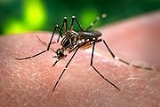
The yellow fever mosquito, Aedes aegypti (=Stegomyia aegypti, =Aedes (Stegomyia) aegypti), is a mosquito that can spread the dengue fever, Chikungunya and yellow fever viruses, and other diseases as well. The mosquito can be recognized by white markings on legs and a marking of the form of a lyre on the thorax. The mosquito originated from Africa but is now found in the tropics worldwide. yellow fever mosquito belongs to the tribe Aedini of the dipteran family Culicidae and to the genus Aedes and subgenus Stegomyia.

Discussion
Ask a question about 'Aedes aegypti'
Start a new discussion about 'Aedes aegypti'
Answer questions from other users
|
Encyclopedia
The yellow fever mosquito, Aedes aegypti (=Stegomyia aegypti, =Aedes (Stegomyia) aegypti), is a mosquito that can spread the dengue fever, Chikungunya and yellow fever viruses, and other diseases as well. The mosquito can be recognized by white markings on legs and a marking of the form of a lyre on the thorax. The mosquito originated from Africa but is now found in the tropics worldwide.
Systematics and name controversy
The yellow fever mosquito belongs to the tribe Aedini of the dipteran family Culicidae and to the genus Aedes and subgenus Stegomyia. According to the recent analyses, some authors raised the subgenus Stegomyia to the level of genus, which was traditionally treated as a subgenus of the genus Aedes. Applied biologists are often resistant to changes to the scientific names of organisms with which they work. The name change has annoyed many medical dipterists and the reaction of some scientific journals as the Journal of Medical Entomology has even been to encourage authors dealing with aedine mosquitoes to continue to use the traditional names. Although the work of taxonomists is important and there are sound reasons to propose substantial modifications and to adopt new classifications and names, specially if they are based on clear scientific arguments, it is important to be consistent and no other one of the recent subgenera raised to genera in the Aedini tribe has been accepted. Even more, if we accept the name Stegomyia aegypti, we are then forced to accept Stegomyia albopicta instead of Aedes albopictus and there are very few scientists and journals that use this name, Wikipedia included.
Genomics
The genome of this species of mosquito was sequenced by a consortium including scientists at the J Craig Venter Institute and the University of Notre Dame, and published in 2007. The effort in sequencing its DNA was intended to provide new avenues for research into insecticides and possible genetic modification to prevent the spread of disease. This was the second mosquito species to have its genome sequenced in full (the first was Anopheles gambiae). The published data included the 1.38 billion base pairs containing the insect's estimated 15,419 protein encoding genes. The sequence indicates that the species diverged from Drosophila melanogaster (the common fruit fly) about 250 million years ago, and that Anopheles gambiae and this species diverged about 150 million years ago.
Spread of disease and prevention
The CDC traveler's page on preventing dengue fever suggests using mosquito repellents that contain DEET (N, N-diethylmetatoluamide). It also explains the following:
- Although it may feed at any time, the mosquito bites humans only between a few hours after dawn until an hour or so after sunset.
- The mosquito's preferred breeding areas are in areas of stagnant water, such as flower vases, uncovered barrels, buckets, and discarded tires, but the most dangerous areas are wet shower floors and toilet tanks, as they allow the mosquitos to breed right in the residence. Research has shown that certain chemicals emanating from bacteria in water containers stimulate the female mosquitoes to lay their eggs. They are particularly motivated to lay eggs in water containers that have just the right amounts of specific fatty acids associated with bacteria involved in the degradation of leaves and other organic matter in water. The chemicals associated with the microbial stew are far more stimulating to discerning female mosquitoes than plain water, for example, or filtered water in which the bacteria once lived.
See also
External links
-
-
-
-
- on the UF / IFAS Featured Creatures Web site
- Distribution, taxonomy, references etc. Excellent image.
-
|
| |
|
|