


Adoration of the Magi in Art

Encyclopedia
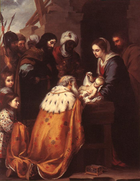
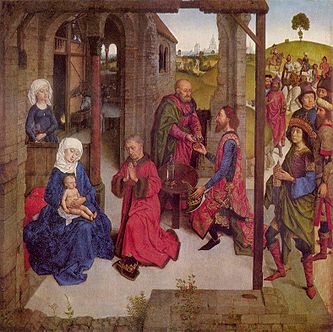
Nativity of Jesus in art
The Nativity of Jesus has been a major subject of Christian art since the 4th century. The artistic depictions of the Nativity or birth of Jesus, celebrated at Christmas, are based on the narratives in the Bible, in the Gospels of Matthew and Luke, and further elaborated by written, oral and...
in which the three Magi
Biblical Magi
The Magi Greek: μάγοι, magoi), also referred to as the Wise Men, Kings, Astrologers, or Kings from the East, were a group of distinguished foreigners who were said to have visited Jesus after his birth, bearing gifts of gold, frankincense and myrrh...
, represented as kings, especially in the West, having found Jesus by following a star
Star of Bethlehem
In Christian tradition, the Star of Bethlehem, also called the Christmas Star, revealed the birth of Jesus to the magi, or "wise men", and later led them to Bethlehem. The star appears in the nativity story of the Gospel of Matthew, where magi "from the east" are inspired by the star to travel to...
, lay before him gifts of gold
Gold
Gold is a chemical element with the symbol Au and an atomic number of 79. Gold is a dense, soft, shiny, malleable and ductile metal. Pure gold has a bright yellow color and luster traditionally considered attractive, which it maintains without oxidizing in air or water. Chemically, gold is a...
, frankincense
Frankincense
Frankincense, also called olibanum , is an aromatic resin obtained from trees of the genus Boswellia, particularly Boswellia sacra, B. carteri, B. thurifera, B. frereana, and B. bhaw-dajiana...
, and myrrh
Myrrh
Myrrh is the aromatic oleoresin of a number of small, thorny tree species of the genus Commiphora, which grow in dry, stony soil. An oleoresin is a natural blend of an essential oil and a resin. Myrrh resin is a natural gum....
, and worship him. It is related in the Bible by Matthew 2:11
Matthew 2:11
Matthew 2:11 is the eleventh verse of the second chapter of the Gospel of Matthew in the New Testament. The magi, dispatched by King Herod, have found the infant Jesus and in this verse present him with gifts in an event known as the Adoration of the Magi....
.
In the church calendar, this event is commemorated in Western Christianity
Western Christianity
Western Christianity is a term used to include the Latin Rite of the Catholic Church and groups historically derivative thereof, including the churches of the Anglican and Protestant traditions, which share common attributes that can be traced back to their medieval heritage...
as the Feast of the Epiphany
Epiphany (Christian)
Epiphany, or Theophany, meaning "vision of God",...
(January 6). The Orthodox Church commemorates the Adoration of the Magi on the Feast of the Nativity
Christmas
Christmas or Christmas Day is an annual holiday generally celebrated on December 25 by billions of people around the world. It is a Christian feast that commemorates the birth of Jesus Christ, liturgically closing the Advent season and initiating the season of Christmastide, which lasts twelve days...
(December 25). Christian iconography has considerably expanded the bare account of the Biblical Magi
Biblical Magi
The Magi Greek: μάγοι, magoi), also referred to as the Wise Men, Kings, Astrologers, or Kings from the East, were a group of distinguished foreigners who were said to have visited Jesus after his birth, bearing gifts of gold, frankincense and myrrh...
given in the second chapter of the Gospel of Matthew
Gospel of Matthew
The Gospel According to Matthew is one of the four canonical gospels, one of the three synoptic gospels, and the first book of the New Testament. It tells of the life, ministry, death, and resurrection of Jesus of Nazareth...
(2:1
Matthew 2:1
Matthew 2:1 is the first verse of the second chapter of the Gospel of Matthew in the New Testament. The previous verse ended with Jesus being named by his father, this verse marks the clear start of a new narrative. This verse deals with the arrival of the Magi at the court of Herod the Great in...
-22
Matthew 2:11
Matthew 2:11 is the eleventh verse of the second chapter of the Gospel of Matthew in the New Testament. The magi, dispatched by King Herod, have found the infant Jesus and in this verse present him with gifts in an event known as the Adoration of the Magi....
) and used it to press the point that Jesus was recognized, from his earliest infancy, as king of the earth.
History
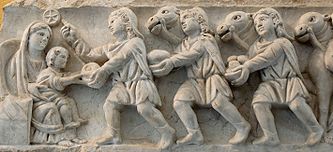
In the earliest depictions, the Magi are shown wearing Persian dress of trousers and Phrygian capPhrygian cap
The Phrygian cap is a soft conical cap with the top pulled forward, associated in antiquity with the inhabitants of Phrygia, a region of central Anatolia. In the western provinces of the Roman Empire it came to signify freedom and the pursuit of liberty, perhaps through a confusion with the pileus,...
s, usually in profile, advancing in step with their gifts held out before them. These images adapt Late Antique
Late Antiquity
Late Antiquity is a periodization used by historians to describe the time of transition from Classical Antiquity to the Middle Ages, in both mainland Europe and the Mediterranean world. Precise boundaries for the period are a matter of debate, but noted historian of the period Peter Brown proposed...
poses for barbarians submitting to an Emperor, and presenting golden wreaths, and indeed relate to images of tribute
Tribute
A tribute is wealth, often in kind, that one party gives to another as a sign of respect or, as was often the case in historical contexts, of submission or allegiance. Various ancient states, which could be called suzerains, exacted tribute from areas they had conquered or threatened to conquer...
-bearers from various Mediterranean and ancient Near Eastern cultures going back many centuries. The earliest are from catacomb paintings and sarcophagus
Sarcophagus
A sarcophagus is a funeral receptacle for a corpse, most commonly carved or cut from stone. The word "sarcophagus" comes from the Greek σαρξ sarx meaning "flesh", and φαγειν phagein meaning "to eat", hence sarkophagus means "flesh-eating"; from the phrase lithos sarkophagos...
reliefs of the 4th century. Crowns are first seen in the 10th century, mostly in the West, where their dress had by now lost any Oriental flavour in most cases.
Later Byzantine images often show small pill-box like hats, whose significance is disputed. They are usually shown as the same age until about this period, but then the idea of depicting the three ages of man is introduced: a particularly beautiful example is seen on the façade of the cathedral of Orvieto. The scene was one of the most indispensable in cycles of the Life of the Virgin
Life of the Virgin
The Life of the Virgin, showing narrative scenes from the life of Mary, the mother of Jesus, is a common subject for pictorial cycles in Christian art, often complementing, or forming part of, a cycle on the Life of Christ. In both cases the number of scenes shown varies greatly with the space...
as well as the Life of Christ
Life of Christ
The Life of Christ as a narrative cycle in Christian art comprises a number of different subjects, which were often grouped in series or cycles of works in a variety of media, narrating the life of Jesus on earth, as distinguished from the many other subjects in art showing the eternal life of...
.
Occasionally from the 12th century, and very often in Northern Europe from the 15th, the Magi are also made to represent the three known parts of the world: Balthasar is very commonly cast as a young African or Moor, and old Caspar is given Oriental features or, more often, dress. Melchior represents Europe and middle age
Middle age
Middle age is the period of age beyond young adulthood but before the onset of old age. Various attempts have been made to define this age, which is around the third quarter of the average life span of human beings....
. From the 14th century onwards, large retinues are often shown, the gifts are contained in spectacular pieces of goldsmith
Goldsmith
A goldsmith is a metalworker who specializes in working with gold and other precious metals. Since ancient times the techniques of a goldsmith have evolved very little in order to produce items of jewelry of quality standards. In modern times actual goldsmiths are rare...
work, and the Magi's clothes are given increasing attention. By the 15th century, the Adoration of the Magi is often a bravura piece in which the artist can display their handling of complex, crowded scenes involving horses and camels, but also their rendering of varied textures: the silk, fur, jewels and gold of the Kings set against the wood of the stable, the straw of Jesus's manger and the rough clothing of Joseph and the shepherds.
The scene often includes a fair diversity of animals as well: the ox and ass from the Nativity scene
Nativity scene
A nativity scene, manger scene, krippe, crèche, or crib, is a depiction of the birth of Jesus as described in the gospels of Matthew and Luke...
are usually there, but also the horses, camels, dogs, and falcons of the kings and their retinue, and sometimes other animals, such as birds in the rafters of the stable. From the 15th century onwards, the Adoration of the Magi is quite often conflated with the Adoration of the Shepherds
Adoration of the shepherds
The Adoration of the shepherds, in the Nativity of Jesus in art, is a scene in which shepherds are near witnesses to the birth of Jesus in Bethlehem. It is often combined with the Adoration of the Magi, in which case it is typically just referred to by the latter title...
from the account in the Gospel of Luke
Gospel of Luke
The Gospel According to Luke , commonly shortened to the Gospel of Luke or simply Luke, is the third and longest of the four canonical Gospels. This synoptic gospel is an account of the life and ministry of Jesus of Nazareth. It details his story from the events of his birth to his Ascension.The...
(2:8-20), an opportunity to bring in yet more human and animal diversity; in some compositions (triptych
Triptych
A triptych , from tri-= "three" + ptysso= "to fold") is a work of art which is divided into three sections, or three carved panels which are hinged together and can be folded shut or displayed open. It is therefore a type of polyptych, the term for all multi-panel works...
s for example), the two scenes are contrasted or set as pendants to the central scene, usually a Nativity
Nativity scene
A nativity scene, manger scene, krippe, crèche, or crib, is a depiction of the birth of Jesus as described in the gospels of Matthew and Luke...
.
The usefulness of the subject to the Church and the technical challenges involved in representing it have made the Adoration of the Magi a favorite subject of Christian art: chiefly painting, but also sculpture and even music (as in Gian-Carlo Menotti's opera Amahl and the Night Visitors
Amahl and the Night Visitors
Amahl and the Night Visitors is an opera in one act by Gian Carlo Menotti with an original English libretto by the composer. It was commissioned by NBC and first performed by the NBC Opera Theatre on December 24, 1951, in New York City at NBC studio 8H in Rockefeller Center, where it was broadcast...
). The subject matter is also found in stained glass. The first figural stained glass window made in the United States is the "Adoration of the Magi" window located at Christ Church, Pelham, New York and designed in 1843 by the founder and first rector's son, William Jay Bolton.
Treatments by individual artists
Many hundreds of artists have treated the subject. A very partial list of the most celebrated is:- Bosch: Museo del PradoMuseo del PradoThe Museo del Prado is the main Spanish national art museum, located in central Madrid. It features one of the world's finest collections of European art, from the 12th century to the early 19th century, based on the former Spanish Royal Collection, and unquestionably the best single collection of...
, MadridMadridMadrid is the capital and largest city of Spain. The population of the city is roughly 3.3 million and the entire population of the Madrid metropolitan area is calculated to be 6.271 million. It is the third largest city in the European Union, after London and Berlin, and its metropolitan... - BotticelliSandro BotticelliAlessandro di Mariano di Vanni Filipepi, better known as Sandro Botticelli was an Italian painter of the Early Renaissance...
: National Gallery of ArtNational Gallery of ArtThe National Gallery of Art and its Sculpture Garden is a national art museum, located on the National Mall between 3rd and 9th Streets at Constitution Avenue NW, in Washington, DC...
, Washington, D.C.Washington, D.C.Washington, D.C., formally the District of Columbia and commonly referred to as Washington, "the District", or simply D.C., is the capital of the United States. On July 16, 1790, the United States Congress approved the creation of a permanent national capital as permitted by the U.S. Constitution....
(see Adoration of the Magi of 1475 (Botticelli)Adoration of the Magi of 1475 (Botticelli)The Adoration of the Magi is a painting by the Italian Renaissance master Sandro Botticelli, dating from 1475 or 1476. It is housed in the Uffizi of Florence.The Adoration of the Magi theme was popular in the Renaissance Florence...
) - Pieter Brueghel the YoungerPieter Brueghel the YoungerPieter Brueghel the Younger /ˈpitəɾ ˈbɾøːxəl/ was a Flemish painter, known for numerous copies after his father Pieter Brueghel the Elder's paintings and nicknamed "Hell Brueghel" for his fantastic treatments of fire and grotesque imagery.-Life:Pieter Brueghel the Younger was the oldest son of the...
: National GalleryNational Gallery in PragueThe National Gallery in Prague is a state-owned art gallery in Prague, Czech Republic. It is housed in different locations within the city, the largest being the Veletržní Palác....
, PraguePraguePrague is the capital and largest city of the Czech Republic. Situated in the north-west of the country on the Vltava river, the city is home to about 1.3 million people, while its metropolitan area is estimated to have a population of over 2.3 million... - Edward Burne-JonesEdward Burne-JonesSir Edward Coley Burne-Jones, 1st Baronet was a British artist and designer closely associated with the later phase of the Pre-Raphaelite movement, who worked closely with William Morris on a wide range of decorative arts as a founding partner in Morris, Marshall, Faulkner, and Company...
: The Star of BethlehemStar of Bethlehem (painting)The Star of Bethlehem is a painting in watercolour by Sir Edward Burne-Jones depicting the Adoration of the Magi with an angel holding the star of Bethlehem. It was commissioned by the Corporation of the City of Birmingham for its new Museum and Art Gallery in 1887, two years after Burne-Jones was...
, Birmingham Museum and Art Gallery - Adoration of the Magi (Andrea della Robbia)Adoration of the Magi (Andrea della Robbia)This depiction of the Adoration of the Magi is by Florentine sculptor Andrea della Robbia . Andrea inherited the family workshop from his famous uncle, Luca della Robbia, who had developed the technique of applying tin glazes, similar to those used by potters, to terracotta to produce sculptures...
, Victoria and Albert MuseumVictoria and Albert MuseumThe Victoria and Albert Museum , set in the Brompton district of The Royal Borough of Kensington and Chelsea, London, England, is the world's largest museum of decorative arts and design, housing a permanent collection of over 4.5 million objects... - DürerAlbrecht DürerAlbrecht Dürer was a German painter, printmaker, engraver, mathematician, and theorist from Nuremberg. His prints established his reputation across Europe when he was still in his twenties, and he has been conventionally regarded as the greatest artist of the Northern Renaissance ever since...
: Uffizi GalleryUffiziThe Uffizi Gallery , is a museum in Florence, Italy. It is one of the oldest and most famous art museums of the Western world.-History:...
, FlorenceFlorenceFlorence is the capital city of the Italian region of Tuscany and of the province of Florence. It is the most populous city in Tuscany, with approximately 370,000 inhabitants, expanding to over 1.5 million in the metropolitan area....
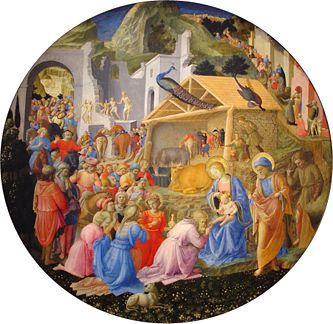
- Fra AngelicoFra AngelicoFra Angelico , born Guido di Pietro, was an Early Italian Renaissance painter described by Vasari in his Lives of the Artists as having "a rare and perfect talent"...
: Museo S. Marco, FlorenceFlorenceFlorence is the capital city of the Italian region of Tuscany and of the province of Florence. It is the most populous city in Tuscany, with approximately 370,000 inhabitants, expanding to over 1.5 million in the metropolitan area.... - Gentile da FabrianoGentile da FabrianoGentile da Fabriano was an Italian painter known for his participation in the International Gothic style. He worked in various places in central Italy, mostly in Tuscany. His best known works are his Adoration of the Magi and the Flight into Egypt.-Biography:Gentile was born in or near Fabriano,...
: Adoration of the MagiAdoration of the Magi (Gentile da Fabriano)The Adoration of the Magi is a painting by the Italian artist Gentile da Fabriano. The work, housed in the Uffizi Gallery in Florence, Italy, is considered his finest work, and has been described as "the culminating work of International Gothic painting"....
, UffiziUffiziThe Uffizi Gallery , is a museum in Florence, Italy. It is one of the oldest and most famous art museums of the Western world.-History:...
Gallery, FlorenceFlorenceFlorence is the capital city of the Italian region of Tuscany and of the province of Florence. It is the most populous city in Tuscany, with approximately 370,000 inhabitants, expanding to over 1.5 million in the metropolitan area.... - GhirlandaioDomenico GhirlandaioDomenico Ghirlandaio was an Italian Renaissance painter from Florence. Among his many apprentices was Michelangelo.-Early years:Ghirlandaio's full name is given as Domenico di Tommaso di Currado di Doffo Bigordi...
: Ospedale degli Innocenti, Florence - Benozzo GozzoliBenozzo GozzoliBenozzo Gozzoli was an Italian Renaissance painter from Florence. He is best known for a series of murals in the Palazzo Medici-Riccardi depicting festive, vibrant processions with wonderful attention to detail and a pronounced International Gothic influence.-Apprenticeship:He was born Benozzo di...
: Convent of S. Marco, Florence - Benozzo GozzoliBenozzo GozzoliBenozzo Gozzoli was an Italian Renaissance painter from Florence. He is best known for a series of murals in the Palazzo Medici-Riccardi depicting festive, vibrant processions with wonderful attention to detail and a pronounced International Gothic influence.-Apprenticeship:He was born Benozzo di...
: Palazzo Medici-Riccardi, FlorenceFlorenceFlorence is the capital city of the Italian region of Tuscany and of the province of Florence. It is the most populous city in Tuscany, with approximately 370,000 inhabitants, expanding to over 1.5 million in the metropolitan area.... - Leonardo da VinciLeonardo da VinciLeonardo di ser Piero da Vinci was an Italian Renaissance polymath: painter, sculptor, architect, musician, scientist, mathematician, engineer, inventor, anatomist, geologist, cartographer, botanist and writer whose genius, perhaps more than that of any other figure, epitomized the Renaissance...
: Uffizi GalleryUffiziThe Uffizi Gallery , is a museum in Florence, Italy. It is one of the oldest and most famous art museums of the Western world.-History:...
, FlorenceFlorenceFlorence is the capital city of the Italian region of Tuscany and of the province of Florence. It is the most populous city in Tuscany, with approximately 370,000 inhabitants, expanding to over 1.5 million in the metropolitan area....
(see also Adoration of the Magi (Leonardo)Adoration of the Magi (Leonardo)-Bibliography:-External links:******...
) - Filippo LippiFilippo LippiFra' Filippo Lippi , also called Lippo Lippi, was an Italian painter of the Italian Quattrocento .-Biography and works:...
: National Gallery of ArtNational Gallery of ArtThe National Gallery of Art and its Sculpture Garden is a national art museum, located on the National Mall between 3rd and 9th Streets at Constitution Avenue NW, in Washington, DC...
, Washington, D.C.Washington, D.C.Washington, D.C., formally the District of Columbia and commonly referred to as Washington, "the District", or simply D.C., is the capital of the United States. On July 16, 1790, the United States Congress approved the creation of a permanent national capital as permitted by the U.S. Constitution.... - Lo SpagnaLo SpagnaLo Spagna was a painter of the High-Renaissance, active in central Italy. His name was Giovanni di Pietro, but known as Lo spagno because he was born in Spain....
: altarpiece, Museo S. Francesco, Trevi - MantegnaAndrea MantegnaAndrea Mantegna was an Italian painter, a student of Roman archeology, and son in law of Jacopo Bellini. Like other artists of the time, Mantegna experimented with perspective, e.g., by lowering the horizon in order to create a sense of greater monumentality...
: Getty MuseumGetty CenterThe Getty Center, in Brentwood, Los Angeles, California, is a campus for cultural institutions founded by oilman J. Paul Getty. The $1.3 billion center, which opened on December 16, 1997, is also well known for its architecture, gardens, and views overlooking Los Angeles... - Masaccio:
predella from the Pisa altarpiece, Gemäldegalerie, Berlin
Berlin
Berlin is the capital city of Germany and is one of the 16 states of Germany. With a population of 3.45 million people, Berlin is Germany's largest city. It is the second most populous city proper and the seventh most populous urban area in the European Union...
- Juan Bautista MaynoJuan Bautista MaynoFriar Juan Bautista Mayno was a Spanish painter of the Baroque period.Born in Pastrana, Juan Mayno's last name has also been spelled Maino. From 1600 to 1608, he lived in Italy...
: Museo del PradoMuseo del PradoThe Museo del Prado is the main Spanish national art museum, located in central Madrid. It features one of the world's finest collections of European art, from the 12th century to the early 19th century, based on the former Spanish Royal Collection, and unquestionably the best single collection of...
, MadridMadridMadrid is the capital and largest city of Spain. The population of the city is roughly 3.3 million and the entire population of the Madrid metropolitan area is calculated to be 6.271 million. It is the third largest city in the European Union, after London and Berlin, and its metropolitan... - MemlingHans MemlingHans Memling was a German-born Early Netherlandish painter.-Life and works:Born in Seligenstadt, near Frankfurt in the Middle Rhein region, it is believed that Memling served his apprenticeship at Mainz or Cologne, and later worked in the Netherlands under Rogier van der Weyden...
: Museo del Prado, Madrid - MurilloBartolomé Estéban MurilloBartolomé Esteban Murillo was a Spanish Baroque painter. Although he is best known for his religious works, Murillo also produced a considerable number of paintings of contemporary women and children...
: Toledo Museum of ArtToledo Museum of ArtThe Toledo Museum of Art is an internationally known art museum located in the Old West End neighborhood of Toledo, Ohio, United States. The museum was founded by Toledo glassmaker Edward Drummond Libbey in 1901, and moved to its present location, a Greek revival building designed by Edward B....
, Toledo, OhioToledo, OhioToledo is the fourth most populous city in the U.S. state of Ohio and is the county seat of Lucas County. Toledo is in northwest Ohio, on the western end of Lake Erie, and borders the State of Michigan... - PeruginoPietro PeruginoPietro Perugino , born Pietro Vannucci, was an Italian Renaissance painter of the Umbrian school, who developed some of the qualities that found classic expression in the High Renaissance...
: fresco, church of the Madonna delle Lacrime, Trevi; fresco, Oratorio dei Bianchi, Città della PieveCittà della PieveCittà della Pieve is a comune in the Province of Perugia in the Italian region Umbria, located about southeast of Perugia. As of 31 December 2004, it had a population of 7,366 and an area of ....
; National Gallery of Umbrian Art, PerugiaPerugiaPerugia is the capital city of the region of Umbria in central Italy, near the River Tiber, and the capital of the province of Perugia. The city is located about north of Rome. It covers a high hilltop and part of the valleys around the area.... - Nicola PisanoNicola PisanoNicola Pisano was an Italian sculptor whose work is noted for its classical Roman sculptural style. Pisano is sometimes considered to be the founder of modern sculpture.- Early life :His birth date or origins are uncertain...
: Baptistry, PisaPisaPisa is a city in Tuscany, Central Italy, on the right bank of the mouth of the River Arno on the Tyrrhenian Sea. It is the capital city of the Province of Pisa... - PoussinNicolas PoussinNicolas Poussin was a French painter in the classical style. His work predominantly features clarity, logic, and order, and favors line over color. His work serves as an alternative to the dominant Baroque style of the 17th century...
: GemäldegalerieGemäldegalerie Alte MeisterThe Gemäldegalerie Alte Meister in Dresden features major works of art. It is located in the gallery wing of the Zwinger....
, DresdenDresdenDresden is the capital city of the Free State of Saxony in Germany. It is situated in a valley on the River Elbe, near the Czech border. The Dresden conurbation is part of the Saxon Triangle metropolitan area.... - Rubens, c 1617-18Adoration of the Magi (Rubens)Peter Paul Rubens painted The Adoration of the Magi more often than any other episode from the life of Christ. The adoration of the Magi offered the Counter-Reformation artist the chance to depict the richest worldly panoply, rich textiles, exotic turbans and other incidents, with a range of human...
: Musée des Beaux-Arts, Lyon - Rubens: King's College Chapel, CambridgeKing's College Chapel, CambridgeKing's College Chapel is the chapel to King's College of the University of Cambridge, and is one of the finest examples of late Gothic English architecture, while its early Renaissance rood screen separating the nave and chancel, erected in 1532-36 in a striking contrast of style, has been called...
- Rubens: Royal Museum of Fine Arts, Antwerp
- TiepoloGiovanni Battista TiepoloGiovanni Battista Tiepolo , also known as Gianbattista or Giambattista Tiepolo, was an Italian painter and printmaker from the Republic of Venice...
: Alte PinakothekAlte PinakothekThe Alte Pinakothek is an art museum situated in the Kunstareal in Munich, Germany. It is one of the oldest galleries in the world and houses one of the most famous collections of Old Master paintings...
, MunichMunichMunich The city's motto is "" . Before 2006, it was "Weltstadt mit Herz" . Its native name, , is derived from the Old High German Munichen, meaning "by the monks' place". The city's name derives from the monks of the Benedictine order who founded the city; hence the monk depicted on the city's coat... - Tissot, JamesJames TissotJames Jacques Joseph Tissot was a French painter, who spent much of his career in Britain.-Biography:Tissot was born in Nantes, France. In about 1856, he began study at the École des Beaux-Arts in Paris under Hippolyte Flandrin and Lamothe, and became friendly with Edgar Degas and James Abbott...
:Brooklyn MuseumBrooklyn MuseumThe Brooklyn Museum is an encyclopedia art museum located in the New York City borough of Brooklyn. At 560,000 square feet, the museum holds New York City's second largest art collection with roughly 1.5 million works.... - VelazquezDiego VelázquezDiego Rodríguez de Silva y Velázquez was a Spanish painter who was the leading artist in the court of King Philip IV. He was an individualistic artist of the contemporary Baroque period, important as a portrait artist...
: Museo del Prado, Madrid (see Adoration of the Magi (Velázquez)Adoration of the Magi (Velázquez)The Adoration of the Magi is a 1619 Baroque painting by the Spanish artist Diego Velázquez now held in the Museo del Prado. It shows two white kings and one black king presenting gifts to the Christ child. The child in the painting, however, is not Jesus Christ but Velasquez's own daughter...
) - Rogier van der WeydenRoger van der WeydenRogier van der Weyden or Rogier de le Pasture was an Early Flemish painter. His surviving works consist mainly of religious triptychs, altarpieces and commissioned single and diptych portraits. Although his life was generally uneventful, he was highly successful and internationally famous in his...
: St Columba Altarpiece, Alte Pinakothek, Munich - Gottfried HelnweinGottfried HelnweinGottfried Helnwein is an Austrian-Irish fine artist, painter, photographer, installation and performance artist.-Work:Helnwein studied at the University of Visual Art in Vienna...
: Denver Art MuseumDenver Art MuseumThe Denver Art Museum is an art museum in Denver, Colorado located in Denver's Civic Center.It is known for its collection of American Indian art,and has a comprehensive collection numbering more than 68,000 works from across the world....
External links
Life of Jesus Gospel harmony A Gospel harmony is an attempt to merge or harmonize the canonical gospels of the Four Evangelists into a single gospel account, the earliest known example being the Diatesseron by Tatian in the 2nd century. A gospel harmony may also establish a chronology for the events of the life of Jesus... : The Nativity Nativity of Jesus The Nativity of Jesus, or simply The Nativity, refers to the accounts of the birth of Jesus in two of the Canonical gospels and in various apocryphal texts.... |
||
New Testament The New Testament is the second major division of the Christian biblical canon, the first such division being the much longer Old Testament.... Events |
||