Home      Discussion      Topics      Dictionary      Almanac
Signup       Login
Adoration of the Magi (Leonardo)

Adoration of the Magi (Leonardo)

Discussion
Ask a question about 'Adoration of the Magi (Leonardo)'
Start a new discussion about 'Adoration of the Magi (Leonardo)'
Answer questions from other users
Full Discussion Forum
 
Encyclopedia
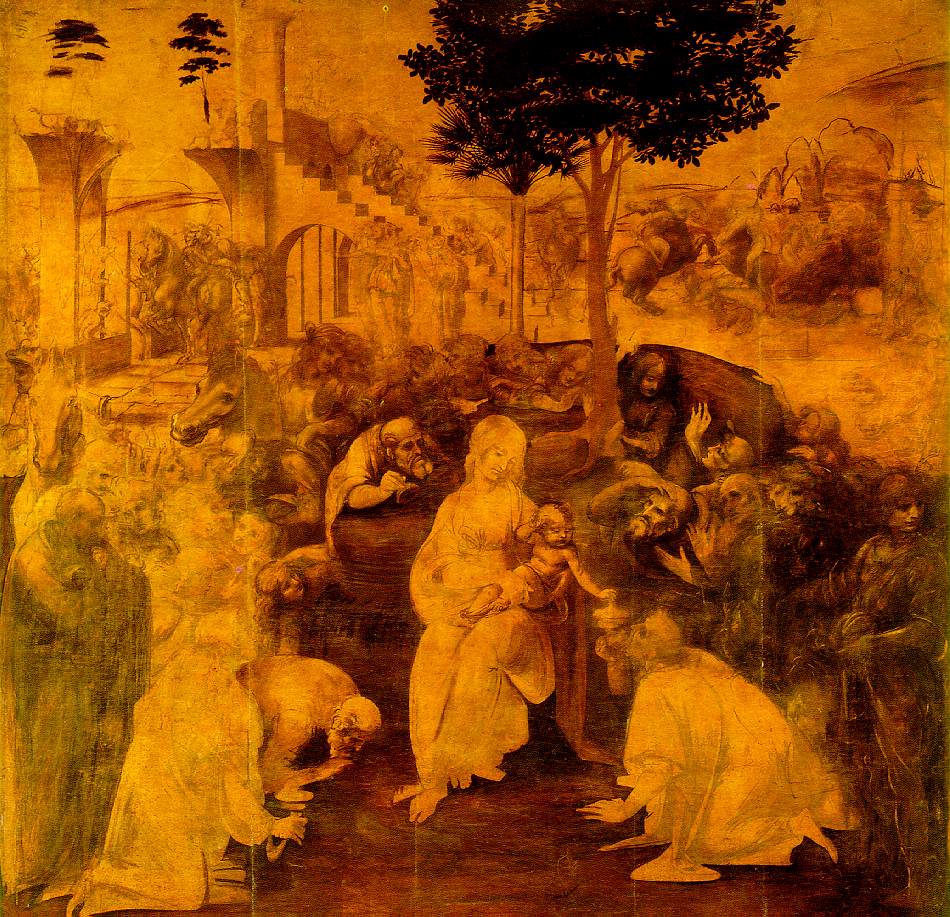
The Adoration of the Magi is an early painting
Painting
Painting is the practice of applying paint, pigment, color or other medium to a surface . In art, the term describes both the act and the result, which is called a painting. Paintings may have for their support such surfaces as walls, paper, canvas, wood, glass, lacquer, clay or concrete...

 by Leonardo da Vinci
Leonardo da Vinci
Leonardo di ser Piero da Vinci was an Italian polymath, scientist, mathematician, engineer, inventor, anatomist, painter, sculptor, architect, botanist, musician and writer....

. Leonardo was given the commission by the Augustinian
Augustinians
The Augustinians, named after Saint Augustine of Hippo , are several Christian monastic orders and congregations of both men and women living according to a guide to religious life known as the Rule of Saint Augustine...

 monks of San Donato
San Donato Milanese
San Donato Milanese is a comune in the Province of Milan in the Italian region Lombardy, located about 10 km southeast of Milan.-History:...

 a Scopeto in Florence
Florence
Florence is the capital city of the Italian region of Tuscany and of the province of Florence...

, but departed for Milan
Milan
Milan in Italy, is the capital of the region of Lombardia and of the province of Milan. The city proper has a population of about 1.3 million, while the urban area is the fifth largest in the E.U. with an estimated population of 4.3 million...

 the following year, leaving the painting unfinished. It has been in the Uffizi
Uffizi
The Uffizi Gallery , is one of the oldest and most famous art museums of the Western world. It's housed in the Palazzo degli Uffizi, a palazzo in Florence, Italy.-History:...

 Gallery in Florence since 1670.

Description


The Virgin Mary and Child
Child Jesus
The Child Jesus represents Jesus from his birth to the age of twelve. At thirteen he was considered to have become adult, in accordance with both the Jewish custom of his own time, and that of most Christian cultures until recent centuries...

 are depicted in the foreground and form a triangular shape with the Magi
Magi
Magi is a term, used since at least the 4th century BCE, to denote a follower of Zoroaster, or rather, a follower of what the Hellenistic world associated Zoroaster with, which was – in the main – the ability to read the stars, and manipulate...

 kneeling in adoration. Behind them is a semicircle of accompanying figures, including what may be a self-portrait of the young Leonardo (on the far right). In the background on the left is the ruin of a pagan building, on which workmen can be seen, apparently repairing it. On the right are men on horseback fighting, and a sketch of a rocky landscape.

The ruins are a possible reference to the Basilica of Maxentius
Basilica of Maxentius
The Basilica of Maxentius and Constantine was the largest building in the Roman Forum.-History:...

, which, according to Medieval legend, the Romans claimed would stand until a virgin gave birth. It is supposed to have collapsed on the night of Christ's birth (in fact it was not even built until a later date). The ruins dominate a preparatory perspective
Perspective (graphical)
Perspective in the graphic arts, such as drawing, is an approximate representation, on a flat surface , of an image as it is perceived by the eye...

 drawing by Leonardo, which also includes the fighting horsemen. The palm tree in the centre has associations with the Virgin Mary, partly due to the phrase 'You are stately as a palm tree' from the Song of Solomon
Song of Solomon
The Song of Songs , is a book of the Hebrew Bible—Tanakh or Old Testament—one of the five megillot...

, which is believed to prefigure her. Another aspect of the palm tree can be the usage of the palm tree as a symbol of victory for ancient Rome, whereas in Christianity it is a representation of martyrdom—triumph over death—so in conclusion we can say that the palm in general represents triumph. The other tree in the painting is from the carob family, the seeds from the tree are used as a unit of measurement. They measure valuable stones and jewels. This tree and its seeds are associated with crowns suggesting Christ as the king of kings or the Virgin as the future Queen of heaven, also that this is nature's gift to the new born Christ. As with Michelangelo
Michelangelo
Michelangelo di Lodovico Buonarroti Simoni , commonly known as Michelangelo, was an Italian Renaissance painter, sculptor, architect, poet, and engineer...

's Doni Tondo
Doni Tondo
The Doni Tondo or Doni Madonna is the earliest of only three surviving panel paintings by the adult Italian Renaissance master Michelangelo Buonarroti , and the only one to be finished. It is in the Uffizi in Florence in its original frame, designed by Michelangelo himself...

the background is probably supposed to represent the Pagan world supplanted by the Christian world, as inaugurated by the events in the foreground.

Leonardo develops his pioneering use of chiaroscuro
Chiaroscuro
Chiaroscuro is a term in art for a contrast between light and dark. The term is usually applied to bold contrasts affecting a whole composition, but is also more technically used by artists and art historians for the use of effects representing contrasts of light, not necessarily strong, to...

 in the image, creating a seemingly chaotic mass of people plunged into darkness and confusion from which the Magi peer towards the brightly lit figures of Mary and Jesus, while the pagan world in the background carries on building and warring unaware of the new revelation.

Other painters involved


Due to Leonardo's inability to complete the painting the commission was handed over to Domenico Ghirlandaio
Domenico Ghirlandaio
Domenico Ghirlandaio was an Italian Renaissance painter from Florence. Among his many apprentices was Michelangelo.-Early years:...

. The final altarpiece
Altarpiece
An altarpiece is a picture or relief representing a religious subject and suspended in a frame behind the altar of a church. The altarpiece is often made up of two or more separate panels created using a technique known as panel painting. It is then called a diptych, triptych or polyptych for two,...

 was painted
Adoration of the Magi (Filippino Lippi)
The Adoration of the Magi is a painting by the Italian Renaissance painter Filippino Lippi. It is signed and dated at 1496. It is housed in the Uffizi of Florence....

 by Filippino Lippi
Filippino Lippi
Filippino Lippi was a well-known painter working during the High Renaissance in Florence, Italy.-Biography:...

 and is now also at the Uffizi.

In 2002 Dr Maurizio Seracini
Maurizio Seracini
Maurizio Seracini is a diagnostician of Italian art. A '73 UCSD Alumnus, graduated in bioengineering from the University of California, San Diego , he founded, in 1977, the first company in Italy for diagnostic and non-destructive analyses on art and architecture, the Editech srl, Diagnostic Center...

, an art diagnostician alumnus of the University of California, San Diego and a native Florentine, was commissioned by the Uffizi to undertake a study of the paint-surface to determine whether the painting could be restored without damaging it. Seracini, who heads Editech,a Florence-based company he founded in 1977 focused on the “diagnostics of cultural heritage", used high-resolution digital scans as well as thermographic, ultra sound, ultra-violet and infra-red diagnostic techniques to conclude that the painting could not be restored without damaging it, and further, that only the underdrawing had been done by Leonardo da Vinci
Leonardo da Vinci
Leonardo di ser Piero da Vinci was an Italian polymath, scientist, mathematician, engineer, inventor, anatomist, painter, sculptor, architect, botanist, musician and writer....

, the paint surface having been added by another artist. He stated that "none of the paint we see on the Adoration today was put there by Leonardo". As a result of his diagnostic survey on the Adoration of the Magi, Seracini completed more than 2400 detailed infrared
Infrared
Infrared radiation is electromagnetic radiation whose wavelength is longer than that of visible light , but shorter than that of terahertz radiation and microwaves...

 photographic records of the painting's elaborate underdrawing
Underdrawing
Underdrawing is the drawing done on a painting ground before paint is applied, for example, an imprimatura or an underpainting. Underdrawing was used extensively by 15th century painters like Jan van Eyck and Rogier van der Weyden. These artists "underdrew" with a brush, using hatching strokes for...

, and scientific analyses. The new images revealed by the diagnostic techniques used by Dr Seracini were initially made public in 2002 in an interview with New York Times reporter Melinda Henneberger. In 2005, nearing the end of his investigation, Seracini gave another interview, this time to Guardian reporter John Hooper. Dr Maurizio finally published his results in 2006 - M. Seracini, "Diagnostic Investigations on the Adoration of the Magi by Leonardo da Vinci (2006) in The Mind of Leonardo – The Universal Genius at Work, exhibit catalogue edited by P. Gauluzzi, Giunti Florence, 2006, pp. 94-101.

The painting is the central item in the Andrei Tarkovsky
Andrei Tarkovsky
Andrei Arsenyevich Tarkovsky was a Russian filmmaker, writer, film editor, film theorist and opera director....

's final film The Sacrifice
The Sacrifice
The Sacrifice , 1986) is the final film by Russian film director Andrei Tarkovsky, who died shortly after completing it.-Synopsis:Alexander, an aging atheist actor/psychologist/writer with a younger actress wife, a teenage daughter, and a young son experiences the opening throes of the end...

.

External links