
All Topics  
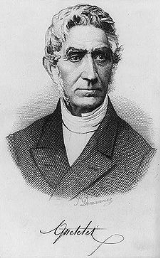
Adolphe Quetelet


   Email Print
   Bookmark   Link


Adolphe Quetelet


Lambert Adolphe Jacques Quételet (22 February 1796 – 17 February 1874) was a Belgian
Demographics of Belgium

This article is about the demographics features of the population of Belgium, including population density, Ethnic group, education level, health of the populace, economic status, religious affiliations and other aspects of the population....
 astronomer
Astronomer

An astronomer is a scientist who studies Celestial body such as planets, stars, and Galaxy.Historically, astronomy was more concerned with the classification and description of phenomena in the sky, while astrophysics attempted to explain these phenomena and the differences between them using physical laws....
, mathematician
Mathematician

A mathematician is a person whose primary area of study and/or research is the field of mathematics....
, statistician
Statistician

Statisticians work with theoretical and applied statistics in both the private and public sectors. The core of that work is to measure, interpret, and describe the world and human activity patterns within it....
 and sociologist. He founded and directed the Brussels Observatory and was influential in introducing statistical methods to the social sciences. Some French-language sources give his last name as Quetelet, with no accent.

ert Adolphe Jacques Quetelet was born in Ghent
Ghent

Ghent is a city and a municipality located in the Flemish region, Belgium. It is the capital and biggest city of the East Flanders province. The city started as a settlement at the confluence of the Rivers Scheldt and Lys River and became in the Middle Ages one of the largest and richest cities of northern Europe....
, Belgium, on 22 February 1796.


Discussion
Ask a question about 'Adolphe Quetelet'
Start a new discussion about 'Adolphe Quetelet'
Answer questions from other users
Full Discussion Forum


Encyclopedia


Lambert Adolphe Jacques Quételet (22 February 1796 – 17 February 1874) was a Belgian
Demographics of Belgium

This article is about the demographics features of the population of Belgium, including population density, Ethnic group, education level, health of the populace, economic status, religious affiliations and other aspects of the population....
 astronomer
Astronomer

An astronomer is a scientist who studies Celestial body such as planets, stars, and Galaxy.Historically, astronomy was more concerned with the classification and description of phenomena in the sky, while astrophysics attempted to explain these phenomena and the differences between them using physical laws....
, mathematician
Mathematician

A mathematician is a person whose primary area of study and/or research is the field of mathematics....
, statistician
Statistician

Statisticians work with theoretical and applied statistics in both the private and public sectors. The core of that work is to measure, interpret, and describe the world and human activity patterns within it....
 and sociologist. He founded and directed the Brussels Observatory and was influential in introducing statistical methods to the social sciences. Some French-language sources give his last name as Quetelet, with no accent.

Biography

Lambert Adolphe Jacques Quetelet was born in Ghent
Ghent

Ghent is a city and a municipality located in the Flemish region, Belgium. It is the capital and biggest city of the East Flanders province. The city started as a settlement at the confluence of the Rivers Scheldt and Lys River and became in the Middle Ages one of the largest and richest cities of northern Europe....
, Belgium, on 22 February 1796. He studied at the lycée in Gent, where he started teaching mathematics in 1815, at the age of 19. In 1819 he moved to the athenaeum in Brussels and in the same year he completed his dissertation (De quibusdam locis geometricis, necnon de curva focal - Of some new properties of the focal distance and some other curves).

Quetelet received a doctorate in mathematics
Mathematics

Mathematics is the study of quantity, structure, space, change, and related topics of pattern and form. Mathematicians seek out patterns whether found in numbers, space, natural science, computers, imaginary abstractions, or elsewhere....
 in 1819 from the University of Ghent. Shortly thereafter, the young man set out to convince government officials and private donors to build an astronomical observatory in Brussels
Brussels

Brussels , officially the Brussels Capital-Region, is the de facto capital city of the European Union and the largest urban area in Belgium....
; he succeeded in 1828. He became a member of the Royal Academy in 1820. He lectured at the museum for sciences and letters and at the Belgian Military School.

Quetelet also founded several statistical journals and societies, and was especially interested in creating international cooperation among statisticians.

In 1855 Quetelet suffered from apoplexy
Apoplexy

Apoplexy is an out-dated medicine term, which can be used to mean 'bleeding'. It can be used non-medically to mean a state of extreme rage or excitement....
, which diminished but did not end his scientific activity. He died in Brussels on 17 February 1874.

Work

His scientific research encompassed a wide range of different scientific disciplines: meteorology, astronomy, mathematics, statistics, demography, sociology, criminology and history of science. He made significant contributions to scientific development, but he also wrote several monographs directed to the general public. He founded the Royal Observatory of Belgium, founded or co-founded several national and international statistical societies and scientific journals, and presided over the first series of the International Statistical Congresses. Quetelet was a liberal and an anticlerical, but not an atheist or materialist nor a socialist.

Social Physics

The new science of probability
Probability

Probability, or wikt:chance, is a way of expressing knowledge or belief that an Event will occur or has occurred. In mathematics the concept has been given an exact meaning in probability theory, that is used extensively in such areas of study as mathematics, statistics, finance, gambling, science, and philosophy to draw conclusions about t...
 and statistics
Statistics

Statistics is a Mathematics pertaining to the collection, analysis, interpretation or explanation, and presentation of data. It also provides tools for prediction and forecasting based on data....
 was mainly used in astronomy at the time, to get a handle on measurement errors
Errors and residuals in statistics

In statistics and Optimization , statistical errors and residuals are two closely related and easily confused measures of "deviation of a sample from the mean": the error of a sample is the deviation of the sample from the population mean or actual function, while the residual of a sample is the difference between the sa...
 with the method of least squares
Least squares

The method of least squares or ordinary least squares is used to solve overdetermined systems. Least squares is often applied in statistical contexts, particularly regression analysis....
. Quetelet was among the first who attempted to apply it to social science, planning what he called a "social physics". He was keenly aware of the overwhelming complexity of social phenomena, and the many variables that needed measurement. His goal was to understand the statistical laws underlying such phenomena as crime rates, marriage rates or suicide rates. He wanted to explain the values of these variables by other social factors. These ideas were rather controversial among other scientists at the time who held that it contradicted a concept of freedom of choice.

His most influential book was Sur l'homme et le développement de ses facultés, ou Essai de physique sociale, published in 1835 (In English translation, entitled Treatise on Man). In it, he outlines the project of a social physics and describes his concept of the "average man" (l'homme moyen) who is characterized by the mean values of measured variables that follow a normal distribution
Normal distribution

The normal distribution, also called the Gaussian distribution, is an important family of continuous probability distributions, applicable in many fields....
. He collected data about many such variables.

When Auguste Comte discovered that Quetelet had appropriated the term 'social physics', which Comte had originally introduced, Comte found it necessary to invent the term 'sociologie' (sociology
Sociology

Sociology is a branch of the social sciences that uses systematic methods of Empiricism and critical theory to develop and refine a body of knowledge about human social structure and activity, sometimes with the goal of applying such knowledge to the pursuit of social welfare....
) because he disagreed with Quetelet's collection of statistics.

Criminology

Quetelet was an influential figure in criminology
Criminology

Criminology is the social science approach to the study of crime as an individual and social phenomenon. Criminological research areas include the incidence and forms of crime as well as its causes and consequences....
. Along with Andre-Michel Guerry
André-Michel Guerry

Andr?-Michel Guerry was a France lawyer and amateur statistician. Together with Adolphe Quetelet he may be regarded as the founder of moral statistics which led to the development of criminology, sociology and ultimately, modern social science....
, he helped to establish the cartographic school and positivist school
Positivist school

In criminology, the Positivist School has attempted to find scientific objectivity for the measurement and quantification of criminal behavior. As the scientific method became the major paradigm in the search for all knowledge, the Classical school social philosophy was replaced by the quest for scientific laws that would be discovered by exp...
s of criminology which made extensive use of statistical techniques. Through statistical analysis, Quetelet gained insight into the relationships between crime
Crime

Societies define Crime as the breach of one or more rules or laws for which some Government or force may ultimately prescribe a punishment.The word crime originates from the Latin crimen , from the Latin root cerno and Greek ????? = "I judge"....
 and other social factors. Among his findings were strong relationships between age and crime, as well as gender
Gender

Gender comprises a range of differences between man and woman, extending from the biological to the social. Biologically, the male gender is defined by the presence of a Y-chromosome, and its absence in the female gender....
 and crime. Other influential factors he found included climate
Climate

Climate encompasses the temperatures, humidity, atmospheric pressure, winds, rainfall, atmospheric particle count and numerous other Meteorology elements in a given region over long periods of time, as opposed to the term weather, which refers to current activity of these same elements....
, poverty
Poverty

Poverty is the shortage of common things such as food, clothing, shelter and safe drinking water, all of which determine our quality of life. It may also include the lack of access to opportunities such as education and employment which aid the escape from poverty and/or allow one to enjoy the respect of fellow citizens....
, education
Education

File:Inukshuk Monterrey 1.jpgEducation can be seen as a product or a process and considered in a broad sense or a technical sense. According to philosophy of education George F....
, and alcohol
Alcoholic beverage

An alcoholic beverage is a drink containing ethanol . Alcoholic beverages are divided into three general classes: beers, wines, and distilled beverage....
 consumption, with his research findings published in Of the Development of the Propensity to Crime.

Public health

Principal among these, in terms of influence over later public health
Public health

Public health is "the science and art of preventing disease, prolonging life and promoting health through the organized efforts and informed choices of society, organizations, public and private, communities and individuals." It is concerned with threats to the overall health of a community based on population health analysis....
 agendas, was Quetelet's establishment of a simple measure for classifying people's weight relative to an ideal weight for their height. His proposal, the body mass index
Body mass index

The body mass index , or Quetelet index, is a statistical measurement which compares a person's weight and height. Though it does not actually measure the Body fat percentage, it is a useful tool to estimate a healthy body weight based on how tall a person is....
 (or Quetelet index), has endured with minor variations to the present day.

Publications

  • 1823. Relation d'un voyage fait à la grotte de Han au mois d'août 1822'. 'With M.M. Kickx.
  • 1827. Recherches sur la population, les naissances, les décès, les prisons, les dépôts de mendicité, etc., dans le royaume des Pays-Bas.
  • 1829. Recherches statistiques sur le royaume des Pays-Bas.
  • 1831. The Propensity to Crime.
  • 1934. Astronomie élémentaire.
  • 1835. Sur l'homme et le développement de ses facultés, ou Essai de physique sociale. 2 volumes.
  • 1838. De l'influence des saisons sur la mortalité aux différens âges dans la Belgique.
  • 1839. Catalogue des principales apparitions d'étoiles filantes.
  • 1842. A Treatise on Man and the Development of His Faculties.
  • 1843. Sur l'emploi de la boussole dans les mines.
  • 1845-1851. Sur le climat de la Belgique. 2 volumes.
  • 1848. Du système social et des lois qui le régissent.
  • 1848. Sur la statistique morale et les principes qui doivent en former la base.
  • 1850. Mémoire sur les lois des naissances et de la mortalité à Bruxelles.
  • 1853. Mémoire sur les variations périodiques et non périodiques de la température, d'après les observations faites, pendant vingt ans, à l'observatoire royal de Bruxelles.
  • 1864. Histoire des sciences mathématiques et physiques chez les Belges.
  • 1867. Météorologie de la Belgique comparée à celle du globe.
  • 1867. Sciences mathématiques et physiques au commencement du XIXe siècle.
  • 1869. Sur la physique du globe en Belgique.
  • 1870. Anthropométrie, ou Mesure des différentes facultés de l'homme.


Further reading

  • Ian Hacking (1990). The Taming of Chance. Cambridge University Press, chapters 13-15.
  • Alain Desrosières (1998). The Politics of Large Numbers: A History of Statistical Reasoning. Harvard University Press, chapter 3.
  • Stigler (1999). Statistics on the Table. Harvard University Press, chapter 2.
  • Philip Ball (2005). Critical Mass: How One Thing Leads to Another. Arrow Books 2005, chapter 3.


External links