

Admiralty Islands

Encyclopedia
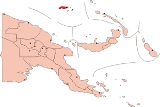
The Admiralty Islands are a group of eighteen island
s in the Bismarck Archipelago
, to the north of New Guinea
in the south Pacific Ocean
. These are also sometimes called the Manus Islands, after the largest island. These rainforest-covered islands form part of Manus Province
, the smallest and least-populous province of Papua New Guinea
. The total area is 2100 km² (810.8 sq mi). Many of the islands are atolls and uninhabited.
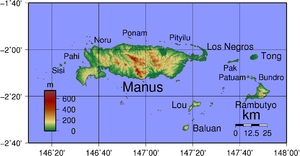
The larger islands in the center of the group are Manus Island
and Los Negros Island
. The other larger islands are Tong Island, Pak Island, Rambutyo Island
, Lou Island and Baluan Island
to the east, Mbuke Island to the south and Bipi Island
to the west of Manus Island. Other islands that have been noted as significant places in the history of Manus include Ndrova Island, Pitylu Island and Ponam Island.
 The temperature of the Admiralty Islands varies little throughout the year, reaching daily highs of 30–32°C (86–90°F) and 20–24°C (68–75°F) at night. Average annual rainfall is 3382 mm (133 in) and is somewhat seasonal, with June–August being the wettest months.
Manus reaches an elevation of 700 m (2,296.6 ft) and is volcanic in origin and probably broke through the ocean's surface in the late Miocene
, 8–10 million years ago. The substrate of the island is either directly volcanic or from uplifted coral limestone.
The main town in the islands is Lorengau
on Manus, connected by road to an airport on nearby Los Negros Island
, otherwise transport around the islands is by boat. There is very little tourism although the seas are attractive to divers, including Jean-Michel Cousteau
who spent time on nearby Wuvulu Island
in the 1970s.
, the Admiralty Islands lowland rain forests. The majority of the forests on Manus still remain, but some of the smaller islands have been cleared for coconut farming. The typical tree species are various Calophyllum
and Sararanga
species.
58.5 km² (22.6 sq mi) Ndrolowa Wildlife Management Area was declared March 1985 south of Lorengau
on Manus Island and contains both terrestrial and marine regions. 240 km² (93 sq mi) protected area has been established around the highest mountain on Manus, Mt. Dremsel, but the level of protection is still undetermined in UNEP World Database on Protected Areas. Further study of this ecoregion is required.
Three of the bird species endemic to Admiralty Islands have been listed as vulnerable
in the IUCN Red List
: Manus Fantail
(Rhipidura semirubra), Superb Pitta
(Pitta superba) and Manus Masked Owl
(Tyto manusi). Three other birds are endemic to Admiralty Islands but are classified as non-threatened or least concern: White-naped Friarbird
(Philemon albitorques), Manus Monarch
(Monarcha infelix) and Manus Hawk Owl
(Ninox meeki). Birds found mainly but not exclusively on the Admiralty Islands include Melanesian Megapode (Megapodius eremita), Yellow-bibbed Fruit-dove
(Ptilinopus solomonensis), Yellowish Imperial-pigeon
(Ducula subflavescens), Pied Cuckoo-dove
(Reinwardtoena browni), Meek's Pygmy Parrot (Micropsitta meeki), Black-headed White-eye
(Zosterops hypoxanthus) and Ebony Myzomela
(Myzomela pammelaena).
Mammals found only here or on nearby island groups include the large fruit bat
s, Admiralty Flying-fox
(Pteropus admiralitatum), Andersen's naked-backed fruit bat
(Dobsonia anderseni) and Seri's Sheathtail-Bat
(Emballonura serii) while the two pure-endemics are Admiralty Island Cuscus
(Spilocuscus kraemeri) and a local Mosaic-Tailed Rat
(Melomys matambuai). The islands are home to two endemic Platymantis
frogs (Platymantis admiraltiensis and Platymantis latro) and four lizards, while the Emerald green snail
of Manus was the first terrestrial snail to be listed as vulnerable by the IUCN.
, the Bismarck Archipelago
and the Solomon Islands
, the Admiralty Islands were first inhabited approximately 40,000 years ago, in the initial wave of migration out of Southeast Asia
that also populated Australia
. This early society appears to have cultivated taro, and to have deliberately introduced wild animals from New Guinea such as bandicoots and large rats. Obsidian was gathered and traded throughout the Admiralty Islands archipelago.
The Lapita
culture arose around 3500 years ago, and its extent ranged from the Admiralty Islands to Tonga
and Samoa
. Its origins are contested, but it may well have been a product of another wave of migration from South-East Asia. Lapita society featured renowned pottery
, stilt houses, the introduction of domestic animals such as pig
s, dog
s, and chicken
s, and substantial developments in agriculture and boat technology, allowing long distance trade to develop. Lapita society, as a distinct culture and extended trade network, collapsed around 2000 years ago.
The first European to visit the islands was the Dutch navigator Willem Schouten
in 1616. The name Admiralty
Islands was devised by Captain
Philip Carteret
RN
in 1767.
Between 1884 and 1914 the area was administered as a German colony
. In November 1914, the islands were occupied by troops of the Australian Naval and Military Expeditionary Force
landed from the SS Siar. A few shots fired from a machine gun on Siar over the heads of the tiny German garrison at Lorengau were the last shots fired in the battle. After the war, the islands were governed by the Commonwealth of Australia under a League of Nations mandate
.
Japanese troops landed on Manus Island
on 7 April 1942. In 1944, Japanese
forces occupying the islands were attacked and defeated by Allied
forces in Operation Brewer
. Subsequently a large American airbase was built at Lombrum near Lorengau.
Island
An island or isle is any piece of sub-continental land that is surrounded by water. Very small islands such as emergent land features on atolls can be called islets, cays or keys. An island in a river or lake may be called an eyot , or holm...
s in the Bismarck Archipelago
Bismarck Archipelago
The Bismarck Archipelago is a group of islands off the northeastern coast of New Guinea in the western Pacific Ocean and is part of the Islands Region of Papua New Guinea.-History:...
, to the north of New Guinea
New Guinea
New Guinea is the world's second largest island, after Greenland, covering a land area of 786,000 km2. Located in the southwest Pacific Ocean, it lies geographically to the east of the Malay Archipelago, with which it is sometimes included as part of a greater Indo-Australian Archipelago...
in the south Pacific Ocean
Pacific Ocean
The Pacific Ocean is the largest of the Earth's oceanic divisions. It extends from the Arctic in the north to the Southern Ocean in the south, bounded by Asia and Australia in the west, and the Americas in the east.At 165.2 million square kilometres in area, this largest division of the World...
. These are also sometimes called the Manus Islands, after the largest island. These rainforest-covered islands form part of Manus Province
Manus Province
Manus Province is the smallest province in Papua New Guinea with a land area of 2,100 km², but with more than 220,000 km² of water. The capital of the province is Lorengau and the total population is 43,387 ....
, the smallest and least-populous province of Papua New Guinea
Papua New Guinea
Papua New Guinea , officially the Independent State of Papua New Guinea, is a country in Oceania, occupying the eastern half of the island of New Guinea and numerous offshore islands...
. The total area is 2100 km² (810.8 sq mi). Many of the islands are atolls and uninhabited.
The larger islands in the center of the group are Manus Island
Manus Island
Manus Island is part of Manus Province in northern Papua New Guinea and is the largest island of the Admiralty Islands. It is the fifth largest island in Papua New Guinea with an area of 2,100 km², measuring around 100 km × 30 km. According to the 2000 census, Manus Island had a...
and Los Negros Island
Los Negros Island
Los Negros Island is the third largest of the Admiralty Islands. It is significant because it contains the main airport of Manus Province on its eastern coastline, at Momote. It is connected to Lorengau, the capital of the province, on Manus Island via a highway and bridge...
. The other larger islands are Tong Island, Pak Island, Rambutyo Island
Rambutyo Island
Rambutyo Island is one of the Admiralty Islands in the Bismarck Archipelago, located at . Politically, Rambutyo Island is part of Manus Province, Papua New Guinea....
, Lou Island and Baluan Island
Baluan Island
Baluan Island is the southern most island of the Admiralty Islands group which make up the majority of Manus Province in Papua New Guinea. It is formed from an extinct volcano. Baluan is a beautiful island with many adventures even though it's small...
to the east, Mbuke Island to the south and Bipi Island
Bipi Island
Bipi Island is a flat coral island located off the west coast of the main island of Manus in the Admiralty Group, Papua New Guinea. Adjacent and to the North West of Bipi Island is Sisi Island...
to the west of Manus Island. Other islands that have been noted as significant places in the history of Manus include Ndrova Island, Pitylu Island and Ponam Island.
Geography
Manus reaches an elevation of 700 m (2,296.6 ft) and is volcanic in origin and probably broke through the ocean's surface in the late Miocene
Miocene
The Miocene is a geological epoch of the Neogene Period and extends from about . The Miocene was named by Sir Charles Lyell. Its name comes from the Greek words and and means "less recent" because it has 18% fewer modern sea invertebrates than the Pliocene. The Miocene follows the Oligocene...
, 8–10 million years ago. The substrate of the island is either directly volcanic or from uplifted coral limestone.
The main town in the islands is Lorengau
Lorengau
Lorengau is the major town in Manus Province, Papua New Guinea. The town is located on the edge of Seeadler Harbour on Manus Island, in the Admiralty Islands, and in 2000 Lorengau was recorded to have a population of 5,829....
on Manus, connected by road to an airport on nearby Los Negros Island
Los Negros Island
Los Negros Island is the third largest of the Admiralty Islands. It is significant because it contains the main airport of Manus Province on its eastern coastline, at Momote. It is connected to Lorengau, the capital of the province, on Manus Island via a highway and bridge...
, otherwise transport around the islands is by boat. There is very little tourism although the seas are attractive to divers, including Jean-Michel Cousteau
Jean-Michel Cousteau
Jean-Michel Cousteau is a French explorer, environmentalist, educator, and film producer. The first son of ocean explorer Jacques Cousteau, he is the father of Fabien Cousteau and Celine Cousteau.-Biography:...
who spent time on nearby Wuvulu Island
Wuvulu Island
Wuvulu Island is part of the Western Islands of the Bismarck Archipelago in the western Pacific Ocean, part of Manus Province, Papua New Guinea. It is the westernmost island of the thirteen island groups that make up island chain in the archipelago...
in the 1970s.
Ecology
Due to the isolated location, the rain forests of the Admiralty Islands are home to rare and endemic species of birds, bats and other animals and are considered a separate ecoregionEcoregion
An ecoregion , sometimes called a bioregion, is an ecologically and geographically defined area that is smaller than an ecozone and larger than an ecosystem. Ecoregions cover relatively large areas of land or water, and contain characteristic, geographically distinct assemblages of natural...
, the Admiralty Islands lowland rain forests. The majority of the forests on Manus still remain, but some of the smaller islands have been cleared for coconut farming. The typical tree species are various Calophyllum
Calophyllum
Calophyllum is a flowering plant genus of around 180-200 species of tropical evergreen trees in the family Calophyllaceae. The generic name is derived from the Greek words καλος , meaning "beautiful", and φυλλον , meaning "leaf." Its members are native to Australasia, Madagascar, Eastern Africa,...
and Sararanga
Sararanga
Sararanga is a genus of flowering plants with two species originating from the Philippines to New Guinea. It belongs to the family Pandanaceae. They occurring in the northern part of New Guinea, in Bismarck Archipelago and Solomon Islands...
species.
58.5 km² (22.6 sq mi) Ndrolowa Wildlife Management Area was declared March 1985 south of Lorengau
Lorengau
Lorengau is the major town in Manus Province, Papua New Guinea. The town is located on the edge of Seeadler Harbour on Manus Island, in the Admiralty Islands, and in 2000 Lorengau was recorded to have a population of 5,829....
on Manus Island and contains both terrestrial and marine regions. 240 km² (93 sq mi) protected area has been established around the highest mountain on Manus, Mt. Dremsel, but the level of protection is still undetermined in UNEP World Database on Protected Areas. Further study of this ecoregion is required.
Three of the bird species endemic to Admiralty Islands have been listed as vulnerable
Vulnerable species
On 30 January 2010, the IUCN Red List of Threatened Species identified 9694 Vulnerable species, subspecies and varieties, stocks and sub-populations.-References:...
in the IUCN Red List
IUCN Red List
The IUCN Red List of Threatened Species , founded in 1963, is the world's most comprehensive inventory of the global conservation status of biological species. The International Union for Conservation of Nature is the world's main authority on the conservation status of species...
: Manus Fantail
Manus Fantail
The Manus Fantail Rhipidura semirubra is a fantail endemic to the Admiralty Islands of Papua New Guinea.-External links:*...
(Rhipidura semirubra), Superb Pitta
Superb Pitta
The Superb Pitta, Pitta superba, is a large pitta, approximately 22cm long. It has black plumage with turquoise blue wings, a scarlet belly and green-tipped secondaries. Both sexes are almost similar. The female is a slightly smaller and duller than the male.The Superb Pitta is distributed and...
(Pitta superba) and Manus Masked Owl
Manus Masked Owl
The Manus Masked Owl is a barn owl endemic to Manus Island in Admiralty Islands, Papua New Guinea. Some authors consider it a subspecies of Australian Masked Owl ....
(Tyto manusi). Three other birds are endemic to Admiralty Islands but are classified as non-threatened or least concern: White-naped Friarbird
White-naped Friarbird
The White-naped Friarbird is a species of bird in the Meliphagidae family. It is endemic to Papua New Guinea.Its natural habitat is subtropical or tropical moist lowland forests.-References:...
(Philemon albitorques), Manus Monarch
Manus Monarch
The Manus Monarch is a species of bird in the Monarchidae family.It is endemic to Papua New Guinea.Its natural habitats are subtropical or tropical moist lowland forests and subtropical or tropical mangrove forests....
(Monarcha infelix) and Manus Hawk Owl
Manus Hawk Owl
The Manus Boobook, Ninox meeki, is a small owl. It has an unmarked brown facial disk, rufous crown and back, barred white flight feathers and tail, and whitish underparts with rufous streaking....
(Ninox meeki). Birds found mainly but not exclusively on the Admiralty Islands include Melanesian Megapode (Megapodius eremita), Yellow-bibbed Fruit-dove
Yellow-bibbed Fruit-dove
The Yellow-bibbed Fruit Dove is a species of bird in the Columbidae family.It is found in Indonesia, Papua New Guinea, and Solomon Islands.Its natural habitat is subtropical or tropical moist lowland forests.-References:...
(Ptilinopus solomonensis), Yellowish Imperial-pigeon
Yellowish Imperial-pigeon
The Yellowish Imperial Pigeon , also known as the Yellow-tinted Imperial Pigeon or Bismarck Imperial Pigeon , is a relatively large species of bird in the Columbidae family. It is endemic to forest and woodland in the Bismarck Archipelago...
(Ducula subflavescens), Pied Cuckoo-dove
Pied Cuckoo-dove
The Pied Cuckoo-Dove is a bird species in the family Columbidae. It is endemic to Papua New Guinea.Formerly classified as a Species of Least Concern by the IUCN, it was suspected to be rarer than generally assumed...
(Reinwardtoena browni), Meek's Pygmy Parrot (Micropsitta meeki), Black-headed White-eye
Black-headed White-eye
The Bismarck White-eye or Black-headed White-eye is a species of bird in the Zosteropidae family.It is endemic to the Bismarck Archipelago in Papua New Guinea, where is occurs in New Britain, New Ireland and a number of smaller islands. It is sometimes considered to be the same species as the...
(Zosterops hypoxanthus) and Ebony Myzomela
Ebony Myzomela
The Ebony Myzomela is a species of bird in the Meliphagidae family.It is endemic to Papua New Guinea.Its natural habitat is subtropical or tropical moist lowland forests.-References:...
(Myzomela pammelaena).
Mammals found only here or on nearby island groups include the large fruit bat
Fruit Bat
Fruit Bat can refer to:* Megabats, a species of bat which eats fruit* Les "Fruitbat" Carter, guitarist of Carter the Unstoppable Sex Machine* Fruit Bats , an American band...
s, Admiralty Flying-fox
Admiralty Flying-fox
The Admiralty Flying Fox is a species of megabat in the Pteropodidae family. It is found in Papua New Guinea and the Solomon Islands.-References:* Chiroptera Specialist Group 1996. . Downloaded on 30 July 2007....
(Pteropus admiralitatum), Andersen's naked-backed fruit bat
Andersen's Naked-backed Fruit Bat
The Andersen's Naked-backed Fruit Bat or Andersen's Bare-backed Fruit Bat is a large cave-dwelling species of megabat in the Pteropodidae family. It is endemic to the Bismarck Archipelago including the Admiralty Islands in Papua New Guinea."It is a common species that may have increased in...
(Dobsonia anderseni) and Seri's Sheathtail-Bat
Seri's Sheathtail-Bat
Seri's Sheath-tailed Bat is a species of sac-winged bat in the family Emballonuridae.It is found in Papua New Guinea and Indonesia.Its natural habitat is caves....
(Emballonura serii) while the two pure-endemics are Admiralty Island Cuscus
Admiralty Island Cuscus
The Admiralty Island Cuscus or Manus Island Spotted Cuscus is a species of marsupial in the Phalangeridae family. It is endemic to the Admiralty Islands of Papua New Guinea. It is the smallest member of the genus Spilocuscus, and the female has a black back, while the male has blackish spots on a...
(Spilocuscus kraemeri) and a local Mosaic-Tailed Rat
Melomys
Melomys is a genus of rodent in the family Muridae.It contains the following species:* Dusky Mosaic-tailed Rat * Rossel Island Mosaic-tailed Rat...
(Melomys matambuai). The islands are home to two endemic Platymantis
Platymantis
Platymantis is a genus of true frogs.-Species:* Platymantis acrochorda * Platymantis aculeodactyla Brown, 1952* Platymantis adiastola Brown et al., 2006* Platymantis admiraltiensis Richards, Mack & Austin, 2007...
frogs (Platymantis admiraltiensis and Platymantis latro) and four lizards, while the Emerald green snail
Emerald green snail
The emerald green snail, green tree snail, or manus green tree snail, scientific name Papustyla pulcherrima, sometimes listed as Papuina pulcherrima, is a species of large air-breathing land snail, a terrestrial pulmonate gastropod mollusk in the family Camaenidae. Their attractive green shells are...
of Manus was the first terrestrial snail to be listed as vulnerable by the IUCN.
History
Along with New GuineaNew Guinea
New Guinea is the world's second largest island, after Greenland, covering a land area of 786,000 km2. Located in the southwest Pacific Ocean, it lies geographically to the east of the Malay Archipelago, with which it is sometimes included as part of a greater Indo-Australian Archipelago...
, the Bismarck Archipelago
Bismarck Archipelago
The Bismarck Archipelago is a group of islands off the northeastern coast of New Guinea in the western Pacific Ocean and is part of the Islands Region of Papua New Guinea.-History:...
and the Solomon Islands
Solomon Islands
Solomon Islands is a sovereign state in Oceania, east of Papua New Guinea, consisting of nearly one thousand islands. It covers a land mass of . The capital, Honiara, is located on the island of Guadalcanal...
, the Admiralty Islands were first inhabited approximately 40,000 years ago, in the initial wave of migration out of Southeast Asia
Southeast Asia
Southeast Asia, South-East Asia, South East Asia or Southeastern Asia is a subregion of Asia, consisting of the countries that are geographically south of China, east of India, west of New Guinea and north of Australia. The region lies on the intersection of geological plates, with heavy seismic...
that also populated Australia
Australia
Australia , officially the Commonwealth of Australia, is a country in the Southern Hemisphere comprising the mainland of the Australian continent, the island of Tasmania, and numerous smaller islands in the Indian and Pacific Oceans. It is the world's sixth-largest country by total area...
. This early society appears to have cultivated taro, and to have deliberately introduced wild animals from New Guinea such as bandicoots and large rats. Obsidian was gathered and traded throughout the Admiralty Islands archipelago.
The Lapita
Lapita
Lapita is a term applied to an ancient Pacific Ocean archaeological culture which is believed by many archaeologists to be the common ancestor of several cultures in Polynesia, Micronesia, and some coastal areas of Melanesia...
culture arose around 3500 years ago, and its extent ranged from the Admiralty Islands to Tonga
Tonga
Tonga, officially the Kingdom of Tonga , is a state and an archipelago in the South Pacific Ocean, comprising 176 islands scattered over of ocean in the South Pacific...
and Samoa
Samoa
Samoa , officially the Independent State of Samoa, formerly known as Western Samoa is a country encompassing the western part of the Samoan Islands in the South Pacific Ocean. It became independent from New Zealand in 1962. The two main islands of Samoa are Upolu and one of the biggest islands in...
. Its origins are contested, but it may well have been a product of another wave of migration from South-East Asia. Lapita society featured renowned pottery
Pottery
Pottery is the material from which the potteryware is made, of which major types include earthenware, stoneware and porcelain. The place where such wares are made is also called a pottery . Pottery also refers to the art or craft of the potter or the manufacture of pottery...
, stilt houses, the introduction of domestic animals such as pig
Pig
A pig is any of the animals in the genus Sus, within the Suidae family of even-toed ungulates. Pigs include the domestic pig, its ancestor the wild boar, and several other wild relatives...
s, dog
Dog
The domestic dog is a domesticated form of the gray wolf, a member of the Canidae family of the order Carnivora. The term is used for both feral and pet varieties. The dog may have been the first animal to be domesticated, and has been the most widely kept working, hunting, and companion animal in...
s, and chicken
Chicken
The chicken is a domesticated fowl, a subspecies of the Red Junglefowl. As one of the most common and widespread domestic animals, and with a population of more than 24 billion in 2003, there are more chickens in the world than any other species of bird...
s, and substantial developments in agriculture and boat technology, allowing long distance trade to develop. Lapita society, as a distinct culture and extended trade network, collapsed around 2000 years ago.
The first European to visit the islands was the Dutch navigator Willem Schouten
Willem Schouten
Willem Cornelisz Schouten was a Dutch navigator for the Dutch East India Company. He was the first to sail the Cape Horn route to the Pacific Ocean.- Biography :Willem Cornelisz Schouten was born in c...
in 1616. The name Admiralty
Admiralty
The Admiralty was formerly the authority in the Kingdom of England, and later in the United Kingdom, responsible for the command of the Royal Navy...
Islands was devised by Captain
Captain (Royal Navy)
Captain is a senior officer rank of the Royal Navy. It ranks above Commander and below Commodore and has a NATO ranking code of OF-5. The rank is equivalent to a Colonel in the British Army or Royal Marines and to a Group Captain in the Royal Air Force. The rank of Group Captain is based on the...
Philip Carteret
Philip Carteret
Philip Carteret, Seigneur of Trinity was a British naval officer and explorer who participated in two of the Royal Navy's circumnavigation expeditions in 1764-66 and 1766-69.-Biography:...
RN
Royal Navy
The Royal Navy is the naval warfare service branch of the British Armed Forces. Founded in the 16th century, it is the oldest service branch and is known as the Senior Service...
in 1767.
Between 1884 and 1914 the area was administered as a German colony
German New Guinea
German New Guinea was the first part of the German colonial empire. It was a protectorate from 1884 until 1914 when it fell to Australia following the outbreak of the First World War. It consisted of the northeastern part of New Guinea and several nearby island groups...
. In November 1914, the islands were occupied by troops of the Australian Naval and Military Expeditionary Force
Australian Naval and Military Expeditionary Force
The Australian Naval and Military Expeditionary Force was a small volunteer force of approximately 2,000 men, raised in Australia shortly after the outbreak of the First World War to seize and destroy German wireless stations in German New Guinea in the south-west Pacific...
landed from the SS Siar. A few shots fired from a machine gun on Siar over the heads of the tiny German garrison at Lorengau were the last shots fired in the battle. After the war, the islands were governed by the Commonwealth of Australia under a League of Nations mandate
League of Nations mandate
A League of Nations mandate was a legal status for certain territories transferred from the control of one country to another following World War I, or the legal instruments that contained the internationally agreed-upon terms for administering the territory on behalf of the League...
.
Japanese troops landed on Manus Island
Manus Island
Manus Island is part of Manus Province in northern Papua New Guinea and is the largest island of the Admiralty Islands. It is the fifth largest island in Papua New Guinea with an area of 2,100 km², measuring around 100 km × 30 km. According to the 2000 census, Manus Island had a...
on 7 April 1942. In 1944, Japanese
Empire of Japan
The Empire of Japan is the name of the state of Japan that existed from the Meiji Restoration on 3 January 1868 to the enactment of the post-World War II Constitution of...
forces occupying the islands were attacked and defeated by Allied
Allies of World War II
The Allies of World War II were the countries that opposed the Axis powers during the Second World War . Former Axis states contributing to the Allied victory are not considered Allied states...
forces in Operation Brewer
Admiralty Islands campaign
The Admiralty Islands campaign was a series of battles in the New Guinea campaign of World War II in which the United States Army's 1st Cavalry Division occupied the Japanese-held Admiralty Islands....
. Subsequently a large American airbase was built at Lombrum near Lorengau.