

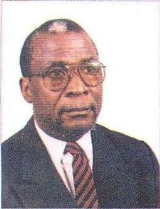
Adiele Afigbo

Encyclopedia
Adiele Eberechukwu Afigbo (born 22 November 1937 — 9 March 2009) was a Nigeria
n historian known for the history and historiography of Africa
, more particularly Igbo
history and the history of Southeastern Nigeria. Themes emphasized include pre-colonial and colonial history, inter-group relations, the Aro and the slave trade, the art and science of history in Africa, and nation-building
.
Afigbo took up his career as a historian in the 1950s with the celebrated Ibadan School
of History, which for about three decades was the most prominent school of history in Africa. He become a prominent member of that school, which devoted its time to demonstrating the need for African history and historiography
as specific genres of the world history. In pursuing the mission of this school through teaching and scholarly work, Afigbo produced works that established reconstructionist history, of African historical methodologies, and links between history and statecraft
. He gave rein to eclecticism of sources and methods, using as the occasion demands and warrants elements from myth
, oral sources
, from archaeology
, linguistics
, material artifacts and written sources. In the last analysis he defined a historian as a clinical student of human experience who seeks to tell the story as it is and to explain it.
, in present day Imo State
. His formal education began in 1944 at Methodist Central School, Ihube where he came under the influence of remarkably dedicated teachers, the most outstanding of whom was Mr. Oji Iheukumere, the head teacher, a native of Uzuakoli, in today's Abia State
who was a noted church musician and disciplinarian. At Ihube Central School Afigbo's brilliance manifested early which made his teachers encourage him to go to secondary school in spite of the opposition of his parents who were intimidated by the cost of post-primary education. He succeeded in his bid and went to St. Augustine's (CMS) Grammar School, Nkwerre Orlu in Imo State. with an Okigwe Native Administration scholarship won in a competitive examination. There again he came across a crop of teachers who left a definite imprint on him. Foremost among those were Mazi F,C. Ogbalu, a teacher of Igbo language and culture and the founder of the Society for The Promotion of Igbo Language and Culture, C.G.I. Eneli a history graduate of the University College, Ibadan and E. C. Ezekwesili, the principal of the college and a history graduate of the University of Southampton, UK. These three helped to determine his future academic career. From St. Augustine's Grammar School Afigbo gained admission to study history at University College, Ibadan (then affiliated with University of London
), with a scholarship from the government of Eastern Nigeria. There again, he met scholars noted for their brilliance and beneficent influence – J.D. Omer-Cooper, J.C. Anene, J.F. Ade Ajayi and K.O. Dike. There were also his colleagues – Obaro Ikime and Philip Igbafe who not only read history with him, but with him went on to pioneer the “made in Nigeria PhD” at the infant University of Ibadan with the help of post-graduate scholarships awarded by the university to the best graduating students. Adiele Afigbo had not only graduated top of his class, but also was the first among his colleagues to complete his Ph.D. With this, he became the first person to receive a doctoral degree in History from a Nigerian university.
, Nsukka in the wake of the Nigerian civil war
. During the duration of hostilities, he served in the Directorate for Propaganda of the Ministry of Information, Republic of Biafra. He resumed his interrupted academic duties after the war, and rose on the academic ladder – from Lecturer to Professor in 1972, thus reaching the top of his profession after only five years. A year after attaining to professorship, he was appointed the Head of the Department of History and Archaeology. The year after, he became also the Dean of the Faculty of Arts. On more than one occasion he held the Directorship of the Leo Hansbury Institute of African Studies. He held the following public appointments among others – pioneer Director of Research at the National Institute for policy and Strategic Studies, Kuru, Jos; Commissioner first for Education and then for Local Government in the Government of Imo State; Chairman of the Michael Okpara College of Agriculture, Umuagwo
in Imo State
and Sole Administrator of the Alvan Ikoku College of Education, Owerri. He has also was awareded an Honorary Member of the Historical Association of Great Britain, Fellow of the Historical Society of Nigeria, the Nigerian National Order of Merit, the Fellowship of the Nigerian Academy of Letters. His traditional chieftaincy titles include Ogbute-Okewe-Ibe, Ogbuzuo, and Olaudah.
Afigbo broke away from the action-reaction thesis that ruled the new African historiography when he joined the history profession. He did so by emphasizing in his works basic reconstructionist history, the study of peoples and cultures in their own right.
Nigeria
Nigeria , officially the Federal Republic of Nigeria, is a federal constitutional republic comprising 36 states and its Federal Capital Territory, Abuja. The country is located in West Africa and shares land borders with the Republic of Benin in the west, Chad and Cameroon in the east, and Niger in...
n historian known for the history and historiography of Africa
Africa
Africa is the world's second largest and second most populous continent, after Asia. At about 30.2 million km² including adjacent islands, it covers 6% of the Earth's total surface area and 20.4% of the total land area...
, more particularly Igbo
Igbo people
Igbo people, also referred to as the Ibo, Ebo, Eboans or Heebo are an ethnic group living chiefly in southeastern Nigeria. They speak Igbo, which includes various Igboid languages and dialects; today, a majority of them speak English alongside Igbo as a result of British colonialism...
history and the history of Southeastern Nigeria. Themes emphasized include pre-colonial and colonial history, inter-group relations, the Aro and the slave trade, the art and science of history in Africa, and nation-building
Nation-building
For nation-building in the sense of enhancing the capacity of state institutions, building state-society relations, and also external interventions see State-building....
.
Afigbo took up his career as a historian in the 1950s with the celebrated Ibadan School
Ibadan School
The Ibadan School was the first, and for many years the dominant, school in the study of the history of Nigeria. It originated at the University of Ibadan in the 1950s and remained dominant until the 1970s...
of History, which for about three decades was the most prominent school of history in Africa. He become a prominent member of that school, which devoted its time to demonstrating the need for African history and historiography
Historiography
Historiography refers either to the study of the history and methodology of history as a discipline, or to a body of historical work on a specialized topic...
as specific genres of the world history. In pursuing the mission of this school through teaching and scholarly work, Afigbo produced works that established reconstructionist history, of African historical methodologies, and links between history and statecraft
Public administration
Public Administration houses the implementation of government policy and an academic discipline that studies this implementation and that prepares civil servants for this work. As a "field of inquiry with a diverse scope" its "fundamental goal.....
. He gave rein to eclecticism of sources and methods, using as the occasion demands and warrants elements from myth
Mythology
The term mythology can refer either to the study of myths, or to a body or collection of myths. As examples, comparative mythology is the study of connections between myths from different cultures, whereas Greek mythology is the body of myths from ancient Greece...
, oral sources
Oral history
Oral history is the collection and study of historical information about individuals, families, important events, or everyday life using audiotapes, videotapes, or transcriptions of planned interviews...
, from archaeology
Archaeology
Archaeology, or archeology , is the study of human society, primarily through the recovery and analysis of the material culture and environmental data that they have left behind, which includes artifacts, architecture, biofacts and cultural landscapes...
, linguistics
Linguistics
Linguistics is the scientific study of human language. Linguistics can be broadly broken into three categories or subfields of study: language form, language meaning, and language in context....
, material artifacts and written sources. In the last analysis he defined a historian as a clinical student of human experience who seeks to tell the story as it is and to explain it.
Early life and education
Afigbo was born at Ihube, OkigweOkigwe
-See also:Roman Catholic Diocese of Okigwe...
, in present day Imo State
Imo State
Imo State is one of the 36 states of Nigeria and lies to the south of Nigeria with Owerri as its capital and largest city.-History:Imo State came into existence in 1976 along with other new states created under the leadership of the late military ruler of Nigeria, Murtala Muhammad, having been...
. His formal education began in 1944 at Methodist Central School, Ihube where he came under the influence of remarkably dedicated teachers, the most outstanding of whom was Mr. Oji Iheukumere, the head teacher, a native of Uzuakoli, in today's Abia State
Abia State
Abia State is a state in southeastern Nigeria. The capital is Umuahia, although the major commercial city is Aba, formerly a British colonial government outpost. The state was created in 1991 from part of Imo State and its citizens are predominantly Igbo people...
who was a noted church musician and disciplinarian. At Ihube Central School Afigbo's brilliance manifested early which made his teachers encourage him to go to secondary school in spite of the opposition of his parents who were intimidated by the cost of post-primary education. He succeeded in his bid and went to St. Augustine's (CMS) Grammar School, Nkwerre Orlu in Imo State. with an Okigwe Native Administration scholarship won in a competitive examination. There again he came across a crop of teachers who left a definite imprint on him. Foremost among those were Mazi F,C. Ogbalu, a teacher of Igbo language and culture and the founder of the Society for The Promotion of Igbo Language and Culture, C.G.I. Eneli a history graduate of the University College, Ibadan and E. C. Ezekwesili, the principal of the college and a history graduate of the University of Southampton, UK. These three helped to determine his future academic career. From St. Augustine's Grammar School Afigbo gained admission to study history at University College, Ibadan (then affiliated with University of London
University of London
-20th century:Shortly after 6 Burlington Gardens was vacated, the University went through a period of rapid expansion. Bedford College, Royal Holloway and the London School of Economics all joined in 1900, Regent's Park College, which had affiliated in 1841 became an official divinity school of the...
), with a scholarship from the government of Eastern Nigeria. There again, he met scholars noted for their brilliance and beneficent influence – J.D. Omer-Cooper, J.C. Anene, J.F. Ade Ajayi and K.O. Dike. There were also his colleagues – Obaro Ikime and Philip Igbafe who not only read history with him, but with him went on to pioneer the “made in Nigeria PhD” at the infant University of Ibadan with the help of post-graduate scholarships awarded by the university to the best graduating students. Adiele Afigbo had not only graduated top of his class, but also was the first among his colleagues to complete his Ph.D. With this, he became the first person to receive a doctoral degree in History from a Nigerian university.
Early career
On obtaining the Ph.D., Afigbo was appointed a lecturer in history, a position he held for two years before fleeing to the University of NigeriaUniversity of Nigeria
The University of Nigeria, commonly referred to as UNN, is a federal university located in Nsukka, Enugu State, Nigeria. Founded in 1955 and formally opened on 7 October 1960, the University of Nigeria has four campuses – Nsukka, Enugu and Ituku-Ozalla – located in Enugu State and one in Aba, Abia...
, Nsukka in the wake of the Nigerian civil war
Nigerian Civil War
The Nigerian Civil War, also known as the Nigerian-Biafran War, 6 July 1967–15 January 1970, was a political conflict caused by the attempted secession of the southeastern provinces of Nigeria as the self-proclaimed Republic of Biafra...
. During the duration of hostilities, he served in the Directorate for Propaganda of the Ministry of Information, Republic of Biafra. He resumed his interrupted academic duties after the war, and rose on the academic ladder – from Lecturer to Professor in 1972, thus reaching the top of his profession after only five years. A year after attaining to professorship, he was appointed the Head of the Department of History and Archaeology. The year after, he became also the Dean of the Faculty of Arts. On more than one occasion he held the Directorship of the Leo Hansbury Institute of African Studies. He held the following public appointments among others – pioneer Director of Research at the National Institute for policy and Strategic Studies, Kuru, Jos; Commissioner first for Education and then for Local Government in the Government of Imo State; Chairman of the Michael Okpara College of Agriculture, Umuagwo
Umuagwo
Umuagwo is a town in the Ohaji/Egbema Local Government Area of Imo State in Nigeria. The population is mostly Christian and Igbo-speaking...
in Imo State
Imo State
Imo State is one of the 36 states of Nigeria and lies to the south of Nigeria with Owerri as its capital and largest city.-History:Imo State came into existence in 1976 along with other new states created under the leadership of the late military ruler of Nigeria, Murtala Muhammad, having been...
and Sole Administrator of the Alvan Ikoku College of Education, Owerri. He has also was awareded an Honorary Member of the Historical Association of Great Britain, Fellow of the Historical Society of Nigeria, the Nigerian National Order of Merit, the Fellowship of the Nigerian Academy of Letters. His traditional chieftaincy titles include Ogbute-Okewe-Ibe, Ogbuzuo, and Olaudah.
Work as historian
Afigbo was a historian of Africa, of Nigeria, of Southeastern Nigeria, and finally a historian of the Igbo. He was a political historian, an economic and social historian, and of historiography. Myth, History and Society, one of the three volumes of his essays edited by Toyin Falola is devoted to theorising on the methods of doing history in Africa, on the sources of history in Africa, on the place and purpose of history in Africa and other related issues. In many publications he sought to use the particular to illuminate the universal, and the universal to illuminate the particular. Thus, for instance, he used a detailed study of the textile process in Southern Nigeria to throw much helpful light on the socio-cultural dynamics of the societies of the region. In a similar manner he used the rise and expansion of the pre-colonial great states such as Benin to show that the so-called segmentary societies as well as the so-called mini-states of pre-colonial Africa are, among other things, fossilized reminders of the conditions from which the great states arose.Afigbo broke away from the action-reaction thesis that ruled the new African historiography when he joined the history profession. He did so by emphasizing in his works basic reconstructionist history, the study of peoples and cultures in their own right.
Death
Adiele Eberechukwu Afigbo died in Enugu, Nigeria in the early hours of Monday , March 9, 2009 after a brief illness.Works
- The Warrant Chiefs: Indirect Rule in Southeastern Nigeria 1891-1929 (Longman, London, 1972
- Ropes of Sand: Studies in Igbo History and Culture (University Press Limited, Ibadan 1981)
- The Igbo and Their Neighbours: Inter-group Relations In Southeastern Nigeria to 1953 (University Press Limited, Ibadan, 1987)
- Groundwork of Igbo History (Vista Books Limited, Lagos,1992)
- Image of the Igbo (vista Books Limited, Lagos, 1992)
- The Abolition of the Slave Trade in Southeastern Nigeria 1885-1950 (University of Rochester Press, 2006)
Collected Works Edited by Toyin Falola
- Nigerian History Politics and Affairs (Africa World Press, Trenton New Jersey, 2005)
- Igbo History and Society (Africa World Press, Trenton New Jersey, 2005)
- Myth, History and Society (Africa World Press, Trenton New Jersey, 2006)