

Adenocarcinoma

Encyclopedia
Adenocarcinoma is a cancer
of an epithelium
that originates in gland
ular tissue. Epithelial tissue includes, but is not limited to, the surface layer of skin, glands and a variety of other tissue that lines the cavities and organs of the body. Epithelium can be derived embryologically from ectoderm
, endoderm
or mesoderm
. To be classified as adenocarcinoma, the cells do not necessarily need to be part of a gland
, as long as they have excretory properties. This form of carcinoma can occur in some higher mammal
s, including human
s. Well differentiated adenocarcinomas tend to resemble the glandular tissue that they are derived from, while poorly differentiated adenocarcinomas may not. By staining the cells from a biopsy
, a pathologist can determine whether the tumor is an adenocarcinoma or some other type of cancer. Adenocarcinomas can arise in many tissues of the body due to the ubiquitous nature of glands within the body. While each gland may not be excreting the same substance, as long as there is an exocrine function to the cell, it is considered glandular and its malignant form is therefore named adenocarcinoma. Endocrine gland tumors, such as a VIPoma
, an insulinoma
, a pheochromocytoma
, etc., are typically not referred to as adenocarcinomas, but rather, are often called neuroendocrine tumors
. If the glandular tissue is abnormal, but benign, it is said to be an adenoma
. Benign adenomas typically do not invade other tissue and rarely metastasize. Malignant adenocarcinomas invade other tissues and often metastasize given enough time to do so.
.
Adenocarcinoma not otherwise specified is often a preliminary diagnosis and can frequently be clarified by a pathologist with the use of immunohistochemistry
.
Cancer for which a primary site cannot be found is called cancer of unknown primary.
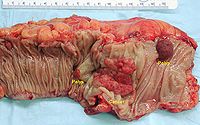
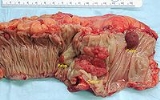
_endoscopic_resection.jpg) The vast majority of colorectal cancer
The vast majority of colorectal cancer
is an adenocarcinoma. This is because the colon
has numerous glands within the tissue. Normal colonic glands tend to be simple and tubular in appearance with a mixture of mucus
secreting goblet cells and water absorbing cells. These glands are called glands because they secrete a substance into the lumen
of the colon, this substance being mucus. The purpose of these glands are twofold. The first is to absorb water from the feces back into the blood. The second purpose is to secrete mucus into the colon lumen to lubricate the now dehydrated feces. This is crucial as a failure to lubricate the feces can result in colonic damage by the feces as it passes towards the rectum.
When these glands undergo a number of changes at the genetic level, they proceed in a predictable manner as they move from benign to an invasive, malignant colon cancer. In their research paper "Lessons from Hereditary Colorectal Cancer", Vogelstein, et al., suggested that colon cells lose the APC tumor suppressor gene and become a small polyp. Next, they suggested that k-Ras
becomes activated and the polyp becomes a small, benign, adenoma. The adenoma, lacking the "carcinoma" attached to the end of it, suggests that it is a benign version of the malignant adenocarcinoma. The gastroenterologist uses a colonoscopy to find and remove these adenomas and polyps to prevent them from continuing to acquire genetic changes that will lead to an invasive adenocarcinoma. Volgelstein et al. went on to suggest that loss of the DCC
gene and of p53
result in a malignant adenocarcinoma.
Grossly, one will see a mass that looks of a different color than the surrounding tissue. Bleeding from the tumor is often apparent as the tumor tends to grow blood vessels into it in a haphazard manner via secretion of a number of angiogenesis
promoting factors such as VEGF
. Histologically, a glandular structure, similar to the healthy normal surrounding glands may be seen. If they look very similar, this is a low grade
, well differentiated tumor. Often these glands will be disorganized and they will be seen growing back to back. However, if the tumor does not look like a gland anymore, it is a high grade tumor with poor differentiation. Regardless of the grade, malignant tumors tend to have a large nucleus with prominent nucleoli. There will also be a noticeable increase in the incidence of mitoses, or cell divisions.
is currently the most common type of lung cancer
in lifelong non-smokers.
', which describes a cancer that has developed in the epithelial cells.
Cancer
Cancer , known medically as a malignant neoplasm, is a large group of different diseases, all involving unregulated cell growth. In cancer, cells divide and grow uncontrollably, forming malignant tumors, and invade nearby parts of the body. The cancer may also spread to more distant parts of the...
of an epithelium
Epithelium
Epithelium is one of the four basic types of animal tissue, along with connective tissue, muscle tissue and nervous tissue. Epithelial tissues line the cavities and surfaces of structures throughout the body, and also form many glands. Functions of epithelial cells include secretion, selective...
that originates in gland
Gland
A gland is an organ in an animal's body that synthesizes a substance for release of substances such as hormones or breast milk, often into the bloodstream or into cavities inside the body or its outer surface .- Types :...
ular tissue. Epithelial tissue includes, but is not limited to, the surface layer of skin, glands and a variety of other tissue that lines the cavities and organs of the body. Epithelium can be derived embryologically from ectoderm
Ectoderm
The "ectoderm" is one of the three primary germ cell layers in the very early embryo. The other two layers are the mesoderm and endoderm , with the ectoderm as the most exterior layer...
, endoderm
Endoderm
Endoderm is one of the three primary germ cell layers in the very early embryo. The other two layers are the ectoderm and mesoderm , with the endoderm as the intermost layer...
or mesoderm
Mesoderm
In all bilaterian animals, the mesoderm is one of the three primary germ cell layers in the very early embryo. The other two layers are the ectoderm and endoderm , with the mesoderm as the middle layer between them.The mesoderm forms mesenchyme , mesothelium, non-epithelial blood corpuscles and...
. To be classified as adenocarcinoma, the cells do not necessarily need to be part of a gland
Gland
A gland is an organ in an animal's body that synthesizes a substance for release of substances such as hormones or breast milk, often into the bloodstream or into cavities inside the body or its outer surface .- Types :...
, as long as they have excretory properties. This form of carcinoma can occur in some higher mammal
Mammal
Mammals are members of a class of air-breathing vertebrate animals characterised by the possession of endothermy, hair, three middle ear bones, and mammary glands functional in mothers with young...
s, including human
Human
Humans are the only living species in the Homo genus...
s. Well differentiated adenocarcinomas tend to resemble the glandular tissue that they are derived from, while poorly differentiated adenocarcinomas may not. By staining the cells from a biopsy
Biopsy
A biopsy is a medical test involving sampling of cells or tissues for examination. It is the medical removal of tissue from a living subject to determine the presence or extent of a disease. The tissue is generally examined under a microscope by a pathologist, and can also be analyzed chemically...
, a pathologist can determine whether the tumor is an adenocarcinoma or some other type of cancer. Adenocarcinomas can arise in many tissues of the body due to the ubiquitous nature of glands within the body. While each gland may not be excreting the same substance, as long as there is an exocrine function to the cell, it is considered glandular and its malignant form is therefore named adenocarcinoma. Endocrine gland tumors, such as a VIPoma
VIPoma
A VIPoma is a rare endocrine tumor, usually originating in the pancreas, that produces vasoactive intestinal peptide ....
, an insulinoma
Insulinoma
An insulinoma is a tumour of the pancreas that is derived from beta cells and secretes insulin.Beta cells secrete insulin in response to increases in blood glucose. The resulting increase in insulin acts to lower blood glucose back to normal levels at which point further secretion of insulin is...
, a pheochromocytoma
Pheochromocytoma
A pheochromocytoma or phaeochromocytoma is a neuroendocrine tumor of the medulla of the adrenal glands , or extra-adrenal chromaffin tissue that failed to involute after birth and secretes excessive amounts of catecholamines, usually noradrenaline , and adrenaline to a lesser extent...
, etc., are typically not referred to as adenocarcinomas, but rather, are often called neuroendocrine tumors
Neuroendocrine tumors
Neuroendocrine tumors are neoplasms that arise from cells of the endocrine and nervous systems. Many are benign, while some are cancers...
. If the glandular tissue is abnormal, but benign, it is said to be an adenoma
Adenoma
An adenoma is a benign tumor of glandular origin. Adenomas can grow from many organs including the colon, adrenal glands, pituitary gland, thyroid, prostate, etc. Although these growths are benign, over time they may progress to become malignant, at which point they are called adenocarcinomas...
. Benign adenomas typically do not invade other tissue and rarely metastasize. Malignant adenocarcinomas invade other tissues and often metastasize given enough time to do so.
Diagnostic significance
A diagnosis of adenocarcinoma which is not further described, known as adenocarcinoma not otherwise specified or adenocarcinoma NOS, is significant because it indicates a cancerous process is present. However, it is not very useful for treatment decisions and prognosis, as these are determined by the tissue from which the tumour cells arose, i.e. the tissue of origin; an adenocarcinoma of the colon has a different prognosis and treatment than an adenocarcinoma of the ovaryOvarian cancer
Ovarian cancer is a cancerous growth arising from the ovary. Symptoms are frequently very subtle early on and may include: bloating, pelvic pain, difficulty eating and frequent urination, and are easily confused with other illnesses....
.
Adenocarcinoma not otherwise specified is often a preliminary diagnosis and can frequently be clarified by a pathologist with the use of immunohistochemistry
Immunohistochemistry
Immunohistochemistry or IHC refers to the process of detecting antigens in cells of a tissue section by exploiting the principle of antibodies binding specifically to antigens in biological tissues. IHC takes its name from the roots "immuno," in reference to antibodies used in the procedure, and...
.
Cancer for which a primary site cannot be found is called cancer of unknown primary.
Colon
Colorectal cancer
Colorectal cancer, commonly known as bowel cancer, is a cancer caused by uncontrolled cell growth , in the colon, rectum, or vermiform appendix. Colorectal cancer is clinically distinct from anal cancer, which affects the anus....
is an adenocarcinoma. This is because the colon
Colon (anatomy)
The colon is the last part of the digestive system in most vertebrates; it extracts water and salt from solid wastes before they are eliminated from the body, and is the site in which flora-aided fermentation of unabsorbed material occurs. Unlike the small intestine, the colon does not play a...
has numerous glands within the tissue. Normal colonic glands tend to be simple and tubular in appearance with a mixture of mucus
Mucus
In vertebrates, mucus is a slippery secretion produced by, and covering, mucous membranes. Mucous fluid is typically produced from mucous cells found in mucous glands. Mucous cells secrete products that are rich in glycoproteins and water. Mucous fluid may also originate from mixed glands, which...
secreting goblet cells and water absorbing cells. These glands are called glands because they secrete a substance into the lumen
Lumen (anatomy)
A lumen in biology is the inside space of a tubular structure, such as an artery or intestine...
of the colon, this substance being mucus. The purpose of these glands are twofold. The first is to absorb water from the feces back into the blood. The second purpose is to secrete mucus into the colon lumen to lubricate the now dehydrated feces. This is crucial as a failure to lubricate the feces can result in colonic damage by the feces as it passes towards the rectum.
When these glands undergo a number of changes at the genetic level, they proceed in a predictable manner as they move from benign to an invasive, malignant colon cancer. In their research paper "Lessons from Hereditary Colorectal Cancer", Vogelstein, et al., suggested that colon cells lose the APC tumor suppressor gene and become a small polyp. Next, they suggested that k-Ras
KRAS
GTPase KRas also known as V-Ki-ras2 Kirsten rat sarcoma viral oncogene homolog and KRAS, is a protein that in humans is encoded by the KRAS gene. Like other members of the Ras family, the KRAS protein is a GTPase and is an early player in many signal transduction pathways...
becomes activated and the polyp becomes a small, benign, adenoma. The adenoma, lacking the "carcinoma" attached to the end of it, suggests that it is a benign version of the malignant adenocarcinoma. The gastroenterologist uses a colonoscopy to find and remove these adenomas and polyps to prevent them from continuing to acquire genetic changes that will lead to an invasive adenocarcinoma. Volgelstein et al. went on to suggest that loss of the DCC
Deleted in Colorectal Cancer
Deleted in Colorectal Carcinoma, also known as DCC, is a protein which in humans is encoded by the DCC gene. DCC has long been implicated in colorectal cancer. While the official, full name of this gene is Deleted in Colorectal Carcinoma, it is almost universally called Deleted in Colorectal Cancer...
gene and of p53
P53
p53 , is a tumor suppressor protein that in humans is encoded by the TP53 gene. p53 is crucial in multicellular organisms, where it regulates the cell cycle and, thus, functions as a tumor suppressor that is involved in preventing cancer...
result in a malignant adenocarcinoma.
Grossly, one will see a mass that looks of a different color than the surrounding tissue. Bleeding from the tumor is often apparent as the tumor tends to grow blood vessels into it in a haphazard manner via secretion of a number of angiogenesis
Angiogenesis
Angiogenesis is the physiological process involving the growth of new blood vessels from pre-existing vessels. Though there has been some debate over terminology, vasculogenesis is the term used for spontaneous blood-vessel formation, and intussusception is the term for the formation of new blood...
promoting factors such as VEGF
Vascular endothelial growth factor
Vascular endothelial growth factor is a signal protein produced by cells that stimulates vasculogenesis and angiogenesis. It is part of the system that restores the oxygen supply to tissues when blood circulation is inadequate....
. Histologically, a glandular structure, similar to the healthy normal surrounding glands may be seen. If they look very similar, this is a low grade
Grading (tumors)
In pathology, grading is a measure of the cell appearance in tumors and other neoplasms. Some pathology grading systems apply only to malignant neoplasms ; others apply also to benign neoplasms. The neoplastic grading is a measure of cell anaplasia in the sampled tumors arising from the...
, well differentiated tumor. Often these glands will be disorganized and they will be seen growing back to back. However, if the tumor does not look like a gland anymore, it is a high grade tumor with poor differentiation. Regardless of the grade, malignant tumors tend to have a large nucleus with prominent nucleoli. There will also be a noticeable increase in the incidence of mitoses, or cell divisions.
Lung
Adenocarcinoma of the lungLung
The lung is the essential respiration organ in many air-breathing animals, including most tetrapods, a few fish and a few snails. In mammals and the more complex life forms, the two lungs are located near the backbone on either side of the heart...
is currently the most common type of lung cancer
Lung cancer
Lung cancer is a disease characterized by uncontrolled cell growth in tissues of the lung. If left untreated, this growth can spread beyond the lung in a process called metastasis into nearby tissue and, eventually, into other parts of the body. Most cancers that start in lung, known as primary...
in lifelong non-smokers.
Urogenital
- Most cervical cancerCervical cancerCervical cancer is malignant neoplasm of the cervix uteri or cervical area. One of the most common symptoms is abnormal vaginal bleeding, but in some cases there may be no obvious symptoms until the cancer is in its advanced stages...
is squamous cell cancer, but a sizeable minority of cervical cancers are adenocarcinomas. - prostateProstateThe prostate is a compound tubuloalveolar exocrine gland of the male reproductive system in most mammals....
- urachusUrachusThe urachus is a fibrous remnant of the allantois, a canal that drains the urinary bladder of the fetus that joins and runs within the umbilical cord...
- vaginaVaginaThe vagina is a fibromuscular tubular tract leading from the uterus to the exterior of the body in female placental mammals and marsupials, or to the cloaca in female birds, monotremes, and some reptiles. Female insects and other invertebrates also have a vagina, which is the terminal part of the...
Other
- breastBreastThe breast is the upper ventral region of the torso of a primate, in left and right sides, which in a female contains the mammary gland that secretes milk used to feed infants.Both men and women develop breasts from the same embryological tissues...
- esophagusEsophagusThe esophagus is an organ in vertebrates which consists of a muscular tube through which food passes from the pharynx to the stomach. During swallowing, food passes from the mouth through the pharynx into the esophagus and travels via peristalsis to the stomach...
- pancreasPancreasThe pancreas is a gland organ in the digestive and endocrine system of vertebrates. It is both an endocrine gland producing several important hormones, including insulin, glucagon, and somatostatin, as well as a digestive organ, secreting pancreatic juice containing digestive enzymes that assist...
(95% of pancreatic cancerPancreatic cancerPancreatic cancer refers to a malignant neoplasm of the pancreas. The most common type of pancreatic cancer, accounting for 95% of these tumors is adenocarcinoma, which arises within the exocrine component of the pancreas. A minority arises from the islet cells and is classified as a...
s are ductal adenocarcinomas.)
- stomachStomachThe stomach is a muscular, hollow, dilated part of the alimentary canal which functions as an important organ of the digestive tract in some animals, including vertebrates, echinoderms, insects , and molluscs. It is involved in the second phase of digestion, following mastication .The stomach is...
Etymology
The term adenocarcinoma is derived from 'adeno' meaning 'pertaining to a gland' and 'carcinomaCarcinoma
Carcinoma is the medical term for the most common type of cancer occurring in humans. Put simply, a carcinoma is a cancer that begins in a tissue that lines the inner or outer surfaces of the body, and that generally arises from cells originating in the endodermal or ectodermal germ layer during...
', which describes a cancer that has developed in the epithelial cells.