
Home      Discussion      Topics      Dictionary      Almanac
Signup       Login
Actinomyces

Actinomyces

Overview
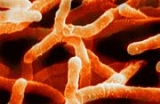
Actinomyces is a genus
Genus
In biology, a genus is a taxonomic unit used in the classification of living and fossil organisms. The term comes from Latin genus "descent, family, type, gender" , cognate with – genos, "race, stock, kin" ..In addition, genus is a taxonomic rank in the hierarchy In biology, a genus (plural:...

 of the actinobacteria
Actinobacteria
Actinobacteria are a group of Gram-positive bacteria with high G+C ratio. They can be terrestrial or aquatic.Use of the ferric uptake regulator has been suggested for classification...

 class of bacteria
Bacteria
The bacteria are a large group of unicellular microorganisms. Typically a few micrometres in length, bacteria have a wide range of shapes, ranging from spheres to rods and spirals...

. They are all Gram-positive
Gram-positive
Gram-positive bacteria are those that are stained dark blue or violet by Gram staining. This is in contrast to Gram-negative bacteria, which cannot retain the crystal violet stain, instead taking up the counterstain and appearing red or pink...

 and can be either anaerobic
Anaerobic organism
An anaerobic organism or anaerobe is any organism that does not require oxygen for growth and may even die in its presence. There are three types: obligate anaerobes, which cannot use oxygen for growth and are even harmed by it; aerotolerant organisms, which cannot use oxygen for growth, but...

 or facultatively anaerobic
Facultative anaerobic organism
A facultative anaerobic organism is an organism, usually a bacterium, that makes ATP by aerobic respiration if oxygen is present but is also capable of switching to fermentation...

 . Actinomyces species do not form endospore
Endospore
An endospore is a dormant, tough, and non-reproductive structure produced by Gram-positive bacteria from the Firmicute phylum that forms when a bacterium produces a thick internal wall that encloses its DNA and part of its cytoplasm...

s, and, while individual bacteria are rod-shaped, morphologically Actinomyces colonies form fungus
Fungus
A fungus is any member of a large group of eukaryotic organisms that includes microorganisms such as yeasts and molds, as well as the more familiar mushrooms. The Fungi are classified as a kingdom that is separate from plants, animals and bacteria...

-like branched networks of hypha
Hypha
A hypha is a long, branching filamentous cell of a fungus, and also of unrelated Actinobacteria. In most fungi, hyphae are the main mode of vegetative growth, and are collectively called a mycelium; yeasts are unicellular fungi that do not grow as hyphae.-Structure:A hypha consists of one or more...

e.
Actinomyces are known for causing disease in humans, and for the important role they play in soil ecology
Soil ecology
Soil ecology is the study of the interactions among soil organisms, and between biotic and abiotic aspects of the soil environment. It is particularly concerned with the cycling of nutrients, formation and stabilization of the pore structure, the spread and vitality of pathogens, and the...

. They produce a number of enzymes that help degrade organic plant material, lignin
Lignin
Lignin or lignen is a complex chemical compound most commonly derived from wood, and an integral part of the secondary cell walls of plants and some algae. The term was introduced in 1819 by de Candolle and is derived from the Latin word lignum, meaning wood...

 and chitin
Chitin
Chitin n is a long-chain polymer of a N-acetylglucosamine, a derivative of glucose, and is found in many places throughout the natural world. It is the main component of the cell walls of fungi, the exoskeletons of arthropods, such as crustaceans Chitin...

.
Discussion
Ask a question about 'Actinomyces'
Start a new discussion about 'Actinomyces'
Answer questions from other users
Full Discussion Forum
 
Encyclopedia
Actinomyces is a genus
Genus
In biology, a genus is a taxonomic unit used in the classification of living and fossil organisms. The term comes from Latin genus "descent, family, type, gender" , cognate with – genos, "race, stock, kin" ..In addition, genus is a taxonomic rank in the hierarchy In biology, a genus (plural:...

 of the actinobacteria
Actinobacteria
Actinobacteria are a group of Gram-positive bacteria with high G+C ratio. They can be terrestrial or aquatic.Use of the ferric uptake regulator has been suggested for classification...

 class of bacteria
Bacteria
The bacteria are a large group of unicellular microorganisms. Typically a few micrometres in length, bacteria have a wide range of shapes, ranging from spheres to rods and spirals...

. They are all Gram-positive
Gram-positive
Gram-positive bacteria are those that are stained dark blue or violet by Gram staining. This is in contrast to Gram-negative bacteria, which cannot retain the crystal violet stain, instead taking up the counterstain and appearing red or pink...

 and can be either anaerobic
Anaerobic organism
An anaerobic organism or anaerobe is any organism that does not require oxygen for growth and may even die in its presence. There are three types: obligate anaerobes, which cannot use oxygen for growth and are even harmed by it; aerotolerant organisms, which cannot use oxygen for growth, but...

 or facultatively anaerobic
Facultative anaerobic organism
A facultative anaerobic organism is an organism, usually a bacterium, that makes ATP by aerobic respiration if oxygen is present but is also capable of switching to fermentation...

 . Actinomyces species do not form endospore
Endospore
An endospore is a dormant, tough, and non-reproductive structure produced by Gram-positive bacteria from the Firmicute phylum that forms when a bacterium produces a thick internal wall that encloses its DNA and part of its cytoplasm...

s, and, while individual bacteria are rod-shaped, morphologically Actinomyces colonies form fungus
Fungus
A fungus is any member of a large group of eukaryotic organisms that includes microorganisms such as yeasts and molds, as well as the more familiar mushrooms. The Fungi are classified as a kingdom that is separate from plants, animals and bacteria...

-like branched networks of hypha
Hypha
A hypha is a long, branching filamentous cell of a fungus, and also of unrelated Actinobacteria. In most fungi, hyphae are the main mode of vegetative growth, and are collectively called a mycelium; yeasts are unicellular fungi that do not grow as hyphae.-Structure:A hypha consists of one or more...

e.
Actinomyces are known for causing disease in humans, and for the important role they play in soil ecology
Soil ecology
Soil ecology is the study of the interactions among soil organisms, and between biotic and abiotic aspects of the soil environment. It is particularly concerned with the cycling of nutrients, formation and stabilization of the pore structure, the spread and vitality of pathogens, and the...

. They produce a number of enzymes that help degrade organic plant material, lignin
Lignin
Lignin or lignen is a complex chemical compound most commonly derived from wood, and an integral part of the secondary cell walls of plants and some algae. The term was introduced in 1819 by de Candolle and is derived from the Latin word lignum, meaning wood...

 and chitin
Chitin
Chitin n is a long-chain polymer of a N-acetylglucosamine, a derivative of glucose, and is found in many places throughout the natural world. It is the main component of the cell walls of fungi, the exoskeletons of arthropods, such as crustaceans Chitin...

. As such, their presence is important in the formation of compost
Compost
Compost is a combination of food material and other organic material that is being decomposed through aerobic decomposition into a rich black soil. The process of composting is simple and practiced by individuals in their homes, farmers on their land, and industrially by cities.Compost soil is...

.

Many Actinomyces species are opportunistic pathogens of humans and other mammals, particularly in the oral cavity. In rare cases, these bacteria can cause actinomycosis
Actinomycosis
Actinomycosis , is a rare infectious bacterial disease of humans caused by Actinomyces species such as Actinomyces israelii or A. gerencseriae. It can also be caused by Propionibacterium propionicus, and the condition is likely to be polymicrobial.Actinomycosis occurs rather frequently in cattle as...

, a disease characterized by the formation of abscess
Abscess
An abscess is a collection of pus that has accumulated in a cavity formed by the tissue on the basis of an infectious process or other foreign materials...

es in the mouth, lungs, or the gastrointestinal tract
Gastrointestinal tract
The human gastrointestinal tract , digestive tract, guts or gut is the system of organs within humans that takes in food, digests it to extract energy and nutrients, and expels the remaining matter...

.

Some species are responsible for the smell of topsoil, which is often particularly noticeable after rain. The main chemical responsible from this smell is geosmin
Geosmin
Geosmin, which literally translates to "earth smell", is an organic compound with a distinct earthy flavour and aroma, and is responsible for the earthy taste of beets and a contributor to the strong scent that occurs in the air when rain falls after a dry spell of weather or when soil is disturbed...

.

Actinomyces, a thermophilic bacteria, is usually the causative agent of farmer's lung
Farmer's lung
Farmer's lung, not to be confused with silo-filler's disease, hypersensitivity pneumonitis induced by the inhalation of biologic dusts coming from hay dust or mould spores or other agricultural products. It results in a type III hypersensitivity inflammatory response and can progress to become a...

, and bagassosis
Bagassosis
Bagassosis, an interstitial lung disease, is a type of hypersensitivity pneumonitis attributed to exposure to molasses ....

.

Actinomycosis is most frequently caused by Actinomyces israelii
Actinomyces israelii
Actinomyces israelii is a species of Actinomyces.Actinomycosis is most frequently caused by Actinomyces israelii and is sometimes known as the "most misdiagnosed disease," as it is frequently confused with neoplasms. A. israelii is a normal colonizer of the vagina, colon, and mouth...

.

External links