

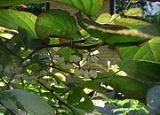
Actinidia

Encyclopedia
Actinidia is a genus of woody
and, with few exceptions, dioecious
plants native to temperate eastern Asia
, occurring throughout most of China
, Taiwan
, Korea
and Japan
, and extending north to southeast Siberia
and south into Indochina
. The genus includes shrub
s growing to 6 m tall, and vigorous, strong-growing vine
s, growing up to 30 m in tree
canopies.
The leaves
are alternate, simple, with a dentate margin and a long petiole
. The flower
s are solitary or in axillary cymes, usually white, with five small petal
s. Most of the species are dioecious
with separate male and female plants, but some are monoecious
. The fruit
is a large berry
containing numerous small seed
s; in most species the fruit is edible. In particular this genus is known for the species Actinidia deliciosa
, the kiwifruit, and for the hardy A. kolomikta
of gardens.
of Actinidia:
, which is a Cultivar Group
of Actinidia deliciosa
, and Hardy Kiwi
, of the species Actinidia arguta. Some species are grown as ornamental plant
s, notably A. kolomikta.
Actinidia arguta has small fruit 10–15 g, with green edible skins and green flesh; hardier than A. deliciosa.
In Japan, Actinidia polygama
(silver vine) is noted for having an effect on cats much like that of catnip. It is mentioned in the saying 猫にまたたび、女郎に小判 (neko ni matatabi, jorō ni koban, "Silver vine to a cat, a coin to a prostitute"), meaning to put someone in a good mood by providing that which they most desire.
Actinidia kolomikta
is the hardiest species (to about -40°C), and has distinctive white- and pink-variegated
foliage even on wild plants, an unusual phenomenon. Its fruit is very small, 8 g or smaller.
Woody plant
A woody plant is a plant that uses wood as its structural tissue. These are typically perennial plants whose stems and larger roots are reinforced with wood produced adjacent to the vascular tissues. The main stem, larger branches, and roots of these plants are usually covered by a layer of...
and, with few exceptions, dioecious
Dioecious
Dioecy is the property of a group of biological organisms that have males and females, but not members that have organs of both sexes at the same time. I.e., those whose individual members can usually produce only one type of gamete; each individual organism is thus distinctly female or male...
plants native to temperate eastern Asia
Asia
Asia is the world's largest and most populous continent, located primarily in the eastern and northern hemispheres. It covers 8.7% of the Earth's total surface area and with approximately 3.879 billion people, it hosts 60% of the world's current human population...
, occurring throughout most of China
China
Chinese civilization may refer to:* China for more general discussion of the country.* Chinese culture* Greater China, the transnational community of ethnic Chinese.* History of China* Sinosphere, the area historically affected by Chinese culture...
, Taiwan
Taiwan
Taiwan , also known, especially in the past, as Formosa , is the largest island of the same-named island group of East Asia in the western Pacific Ocean and located off the southeastern coast of mainland China. The island forms over 99% of the current territory of the Republic of China following...
, Korea
Korea
Korea ) is an East Asian geographic region that is currently divided into two separate sovereign states — North Korea and South Korea. Located on the Korean Peninsula, Korea is bordered by the People's Republic of China to the northwest, Russia to the northeast, and is separated from Japan to the...
and Japan
Japan
Japan is an island nation in East Asia. Located in the Pacific Ocean, it lies to the east of the Sea of Japan, China, North Korea, South Korea and Russia, stretching from the Sea of Okhotsk in the north to the East China Sea and Taiwan in the south...
, and extending north to southeast Siberia
Siberia
Siberia is an extensive region constituting almost all of Northern Asia. Comprising the central and eastern portion of the Russian Federation, it was part of the Soviet Union from its beginning, as its predecessor states, the Tsardom of Russia and the Russian Empire, conquered it during the 16th...
and south into Indochina
Indochina
The Indochinese peninsula, is a region in Southeast Asia. It lies roughly southwest of China, and east of India. The name has its origins in the French, Indochine, as a combination of the names of "China" and "India", and was adopted when French colonizers in Vietnam began expanding their territory...
. The genus includes shrub
Shrub
A shrub or bush is distinguished from a tree by its multiple stems and shorter height, usually under 5–6 m tall. A large number of plants may become either shrubs or trees, depending on the growing conditions they experience...
s growing to 6 m tall, and vigorous, strong-growing vine
Vine
A vine in the narrowest sense is the grapevine , but more generally it can refer to any plant with a growth habit of trailing or scandent, that is to say climbing, stems or runners...
s, growing up to 30 m in tree
Tree
A tree is a perennial woody plant. It is most often defined as a woody plant that has many secondary branches supported clear of the ground on a single main stem or trunk with clear apical dominance. A minimum height specification at maturity is cited by some authors, varying from 3 m to...
canopies.
The leaves
Leaf
A leaf is an organ of a vascular plant, as defined in botanical terms, and in particular in plant morphology. Foliage is a mass noun that refers to leaves as a feature of plants....
are alternate, simple, with a dentate margin and a long petiole
Petiole (botany)
In botany, the petiole is the stalk attaching the leaf blade to the stem. The petiole usually has the same internal structure as the stem. Outgrowths appearing on each side of the petiole are called stipules. Leaves lacking a petiole are called sessile, or clasping when they partly surround the...
. The flower
Flower
A flower, sometimes known as a bloom or blossom, is the reproductive structure found in flowering plants . The biological function of a flower is to effect reproduction, usually by providing a mechanism for the union of sperm with eggs...
s are solitary or in axillary cymes, usually white, with five small petal
Petal
Petals are modified leaves that surround the reproductive parts of flowers. They often are brightly colored or unusually shaped to attract pollinators. Together, all of the petals of a flower are called a corolla. Petals are usually accompanied by another set of special leaves called sepals lying...
s. Most of the species are dioecious
Plant sexuality
Plant sexuality covers the wide variety of sexual reproduction systems found across the plant kingdom. This article describes morphological aspects of sexual reproduction of plants....
with separate male and female plants, but some are monoecious
Plant sexuality
Plant sexuality covers the wide variety of sexual reproduction systems found across the plant kingdom. This article describes morphological aspects of sexual reproduction of plants....
. The fruit
Fruit
In broad terms, a fruit is a structure of a plant that contains its seeds.The term has different meanings dependent on context. In non-technical usage, such as food preparation, fruit normally means the fleshy seed-associated structures of certain plants that are sweet and edible in the raw state,...
is a large berry
Berry
The botanical definition of a berry is a fleshy fruit produced from a single ovary. Grapes are an example. The berry is the most common type of fleshy fruit in which the entire ovary wall ripens into an edible pericarp. They may have one or more carpels with a thin covering and fleshy interiors....
containing numerous small seed
Seed
A seed is a small embryonic plant enclosed in a covering called the seed coat, usually with some stored food. It is the product of the ripened ovule of gymnosperm and angiosperm plants which occurs after fertilization and some growth within the mother plant...
s; in most species the fruit is edible. In particular this genus is known for the species Actinidia deliciosa
Actinidia deliciosa
Actinidia deliciosa or kiwifruit is native to southern China, and has been declared the national fruit of that country. Other species of Actinidia are also found in China and range east to Japan and north into southeastern Siberia...
, the kiwifruit, and for the hardy A. kolomikta
Actinidia kolomikta
Actinidia kolomikta is a species of deciduous dioecious woody vine in the genus Actinidia native to temperate mixed forests of the Russian Far East, Korea, Japan and China . It is a very long-lived woody scrambler, which ultimately grows to 8-10 m . A...
of gardens.
Species
There are about 40–60 speciesSpecies
In biology, a species is one of the basic units of biological classification and a taxonomic rank. A species is often defined as a group of organisms capable of interbreeding and producing fertile offspring. While in many cases this definition is adequate, more precise or differing measures are...
of Actinidia:
|
Actinidia pilosula Actinidia pilosula is a species of plant in the Actinidiaceae family. It is endemic to China.-References:* China Plant Specialist Group 2004. . Downloaded on 20 August 2007.... Actinidia polygama Actinidia polygama is a non-toxic plant in the Actinidiaceae family. It grows in the mountainous areas of Japan and China at elevations between 500–1900 meters.... (Silver Vine) Actinidia rudis Actinidia rudis is a species of plant in the Actinidiaceae family. It is endemic to China.-References:* China Plant Specialist Group 2004. . Downloaded on 20 August 2007.... Actinidia suberifolia Actinidia suberifolia is a species of plant in the Actinidiaceae family. It is endemic to China.-References:* China Plant Specialist Group 2004. . Downloaded on 20 August 2007.... Actinidia ulmifolia Actinidia ulmifolia is a species of plant in the Actinidiaceae family. It is endemic to China.-References:* China Plant Specialist Group 2004. . Downloaded on 20 August 2007.... Actinidia vitifolia Actinidia vitifolia is a species of plant in the Actinidiaceae family. It is endemic to China.-References:* China Plant Specialist Group 2004. . Downloaded on 20 August 2007.... |
Uses
For the edible fruit, see KiwifruitKiwifruit
The kiwifruit, often shortened to kiwi in many parts of the world, is the edible berry of a cultivar group of the woody vine Actinidia deliciosa and hybrids between this and other species in the genus Actinidia....
, which is a Cultivar Group
Cultivar group
In naming cultivated plants, a Group is a formal classification category, under the International Code of Nomenclature for Cultivated Plants :The term "Group" was introduced in the 2004 ICNCP, replacing the "Cultivar-group" of the 1995 ICNCP.A Group is united by some common trait; for example...
of Actinidia deliciosa
Actinidia deliciosa
Actinidia deliciosa or kiwifruit is native to southern China, and has been declared the national fruit of that country. Other species of Actinidia are also found in China and range east to Japan and north into southeastern Siberia...
, and Hardy Kiwi
Hardy Kiwi
Actinidia arguta is a perennial vine native to Korea, Northern China, and Russian Siberia, producing a small fruit resembling the kiwifruit....
, of the species Actinidia arguta. Some species are grown as ornamental plant
Ornamental plant
Ornamental plants are plants that are grown for decorative purposes in gardens and landscape design projects, as house plants, for cut flowers and specimen display...
s, notably A. kolomikta.
Actinidia arguta has small fruit 10–15 g, with green edible skins and green flesh; hardier than A. deliciosa.
In Japan, Actinidia polygama
Actinidia polygama
Actinidia polygama is a non-toxic plant in the Actinidiaceae family. It grows in the mountainous areas of Japan and China at elevations between 500–1900 meters....
(silver vine) is noted for having an effect on cats much like that of catnip. It is mentioned in the saying 猫にまたたび、女郎に小判 (neko ni matatabi, jorō ni koban, "Silver vine to a cat, a coin to a prostitute"), meaning to put someone in a good mood by providing that which they most desire.
Actinidia kolomikta
Actinidia kolomikta
Actinidia kolomikta is a species of deciduous dioecious woody vine in the genus Actinidia native to temperate mixed forests of the Russian Far East, Korea, Japan and China . It is a very long-lived woody scrambler, which ultimately grows to 8-10 m . A...
is the hardiest species (to about -40°C), and has distinctive white- and pink-variegated
Variegation
Variegation is the appearance of differently coloured zones in the leaves, and sometimes the stems, of plants. This may be due to a number of causes...
foliage even on wild plants, an unusual phenomenon. Its fruit is very small, 8 g or smaller.
External links
- Images : Actinidia kolomikta (Maxim. et Rupr.) Maxim. - Flavon's Secret Flower Garden