


Acta Eruditorum

Encyclopedia
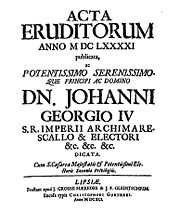
Scientific journal
In academic publishing, a scientific journal is a periodical publication intended to further the progress of science, usually by reporting new research. There are thousands of scientific journals in publication, and many more have been published at various points in the past...
of the German lands
Germany
Germany , officially the Federal Republic of Germany , is a federal parliamentary republic in Europe. The country consists of 16 states while the capital and largest city is Berlin. Germany covers an area of 357,021 km2 and has a largely temperate seasonal climate...
, published from 1682 to 1782.
It was founded in 1682 in Leipzig
Leipzig
Leipzig Leipzig has always been a trade city, situated during the time of the Holy Roman Empire at the intersection of the Via Regia and Via Imperii, two important trade routes. At one time, Leipzig was one of the major European centres of learning and culture in fields such as music and publishing...
by Otto Mencke
Otto Mencke
Otto Mencke was a 17th-century German philosopher and scientist. He obtained his doctorate at the University of Leipzig in 1666 with a thesis entitled: Ex Theologia naturali — De Absoluta Dei Simplicitate, Micropolitiam, id est Rempublicam In Microcosmo Conspicuam.He is notable as being the...
, published by Johann Friedrich Gleditsch
Johann Friedrich Gleditsch
Johann Friedrich Gleditsch was a major book publisher in the late 17th and early 18th centuries.-Early career:...
, and patterned after the French Journal des savants and Italian Giornale de'letterati. Acta Eruditorum was a monthly edited in Latin language and contained excerpts from new writings, reviews, small essays and notes. Most of them were devoted to the natural sciences and mathematics. Since its inception many eminent scientists published there – Isaac Newton
Isaac Newton
Sir Isaac Newton PRS was an English physicist, mathematician, astronomer, natural philosopher, alchemist, and theologian, who has been "considered by many to be the greatest and most influential scientist who ever lived."...
, Gottfried Leibniz
Gottfried Leibniz
Gottfried Wilhelm Leibniz was a German philosopher and mathematician. He wrote in different languages, primarily in Latin , French and German ....
, Jakob Bernoulli, Humphry Ditton
Humphry Ditton
Humphry Ditton was an English mathematician.-Life:Ditton was born at Salisbury. He studied theology, and was for some years a dissenting minister at Tonbridge, but on the death of his father he devoted himself to the congenial study of mathematics...
, Ehrenfried Walther von Tschirnhaus
Ehrenfried Walther von Tschirnhaus
Ehrenfried Walther von Tschirnhaus was a German mathematician, physicist, physician, and philosopher...
, Pierre-Simon Laplace
Pierre-Simon Laplace
Pierre-Simon, marquis de Laplace was a French mathematician and astronomer whose work was pivotal to the development of mathematical astronomy and statistics. He summarized and extended the work of his predecessors in his five volume Mécanique Céleste...
and Jérôme Lalande
Jérôme Lalande
Joseph Jérôme Lefrançois de Lalande was a French astronomer and writer.-Biography:Lalande was born at Bourg-en-Bresse...
but also humanists and philosophers as Veit Ludwig von Seckendorff
Veit Ludwig von Seckendorff
Veit Ludwig von Seckendorf , German statesman and scholar, was a member of a German noble family, which took its name from the village of Seckendorf between Nuremberg and Langenzenn....
, Stephan Bergler
Stephan Bergler
Stephan Bergler was a Transylvanian Saxon classical scholar and antiquarian.-Biography:Born in Kronstadt , he studied at the University of Leipzig, after which he went to Amsterdam, where he edited the works of Homer and the Onomasticon of Julius Pollux...
, Christian Thomasius
Christian Thomasius
Christian Thomasius was a German jurist and philosopher.- Biography :He was born at Leipzig and was educated by his father, Jakob Thomasius , at that time head master of Thomasschule zu Leipzig...
and Christian Wolff
Christian Wolff (philosopher)
Christian Wolff was a German philosopher.He was the most eminent German philosopher between Leibniz and Kant...
.
After Otto Mencke
Otto Mencke
Otto Mencke was a 17th-century German philosopher and scientist. He obtained his doctorate at the University of Leipzig in 1666 with a thesis entitled: Ex Theologia naturali — De Absoluta Dei Simplicitate, Micropolitiam, id est Rempublicam In Microcosmo Conspicuam.He is notable as being the...
's death Acta Eruditorum were directed by his son, Johann Burckhardt Mencke, who died in 1732. The magazine changed its name by then and was called Nova Acta Eruditorum. Since 1754 it was led by Karl Andreas Bel.