
Home      Discussion      Topics      Dictionary      Almanac
Signup       Login
Acroterion

Acroterion

Overview

Discussion
Ask a question about 'Acroterion'
Start a new discussion about 'Acroterion'
Answer questions from other users
Full Discussion Forum
 
Unanswered Questions
Encyclopedia

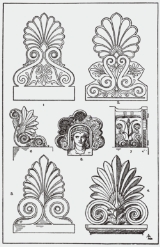
An acroterion or acroterium is an architectural ornament placed on a flat base called the acroter or plinth
Plinth
In architecture, a plinth is the base or platform upon which a column, pedestal, statue, monument or structure rests. Gottfried Semper's The Four Elements of Architecture posited that the plinth, the hearth, the roof, and the wall make up all of architectural theory. The plinth usually rests...

, and mounted at the apex of the pediment
Pediment
A pediment is a classical architectural element consisting of the triangular section found above the horizontal structure , typically supported by columns. The gable end of the pediment is surrounded by the cornice moulding...

 of a building in the Classical
Classical architecture
Classical architecture is a mode of architecture employing vocabulary derived in part from the Greek and Roman architecture of classical antiquity, enriched by classicizing architectural practice in Europe since the Renaissance...

 style. It may also be placed at the outer angles of the pediment; such acroteria are referred to as acroteria angularia. The acroterion may take a wide variety of forms, such as a statue, tripod, disc, urn, palmette
Palmette
The palmette is a motif in decorative art which, in its most characteristic expression, resembles the fan-shaped leaves of a palm tree. It has an extremely long history, originating in Ancient Egypt with a subsequent development through the art of most of Eurasia, often in forms that bear...

 or some other sculpted feature. Acroteria are also found in gothic architecture
Gothic architecture
Gothic architecture is a style of architecture that flourished during the high and late medieval period. It evolved from Romanesque architecture and was succeeded by Renaissance architecture....

.

The word comes from the Greek
Greek language
Greek is an independent branch of the Indo-European family of languages. Native to the southern Balkans, it has the longest documented history of any Indo-European language, spanning 34 centuries of written records. Its writing system has been the Greek alphabet for the majority of its history;...

  'summit'; it was Latinized by the Romans
Ancient Rome
Ancient Rome was a thriving civilization that grew on the Italian Peninsula as early as the 8th century BC. Located along the Mediterranean Sea and centered on the city of Rome, it expanded to one of the largest empires in the ancient world....

 as acroterium.

See also

  • Palmette
    Palmette
    The palmette is a motif in decorative art which, in its most characteristic expression, resembles the fan-shaped leaves of a palm tree. It has an extremely long history, originating in Ancient Egypt with a subsequent development through the art of most of Eurasia, often in forms that bear...

  • Ornament
    Ornament (architecture)
    In architecture and decorative art, ornament is a decoration used to embellish parts of a building or object. Large figurative elements such as monumental sculpture and their equivalents in decorative art are excluded from the term; most ornament does not include human figures, and if present they...

  • Finial
    Finial
    The finial is an architectural device, typically carved in stone and employed decoratively to emphasize the apex of a gable or any of various distinctive ornaments at the top, end, or corner of a building or structure. Smaller finials can be used as a decorative ornament on the ends of curtain rods...

  • List of classical architecture terms

External links