
All Topics  
Acropora


   Email Print
   Bookmark   Link


Acropora


Acropora is a genus of coral
Coral

Corals are marine organisms from the class Anthozoa and exist as small sea anemone?like polyps, typically in colonies of many identical individuals....
 in the phylum Cnidaria
Cnidaria

Cnidaria Cnidarians were for a long time grouped with Ctenophores in the phylum Coelenterata, but increasing awareness of their differences caused them to be placed in separate phyla....
.

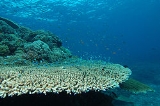
nding on the species and location, Acropora may grow as plates or slender or broad branches. Like other corals, Acropora corals are actually colonies of individuals, known as polyps, which are about 2 mm across and share tissue and a nerve net
Nerve net

For the album by Brian Eno, see Nerve Net .A nerve net is a type of simple nervous system that is found in members of the phylum cnidaria....
. The polyps can withdraw back into the coral in response to movement or disturbance by possible predators, but when undisturbed they protrude slightly.


Discussion
Ask a question about 'Acropora'
Start a new discussion about 'Acropora'
Answer questions from other users
Full Discussion Forum


Recent Posts


Encyclopedia


Acropora is a genus of coral
Coral

Corals are marine organisms from the class Anthozoa and exist as small sea anemone?like polyps, typically in colonies of many identical individuals....
 in the phylum Cnidaria
Cnidaria

Cnidaria Cnidarians were for a long time grouped with Ctenophores in the phylum Coelenterata, but increasing awareness of their differences caused them to be placed in separate phyla....
.

Anatomy and Distribution


Depending on the species and location, Acropora may grow as plates or slender or broad branches. Like other corals, Acropora corals are actually colonies of individuals, known as polyps, which are about 2 mm across and share tissue and a nerve net
Nerve net

For the album by Brian Eno, see Nerve Net .A nerve net is a type of simple nervous system that is found in members of the phylum cnidaria....
. The polyps can withdraw back into the coral in response to movement or disturbance by possible predators, but when undisturbed they protrude slightly. The polyps usually extend further at night as they capture zooplankton from the water.

Acropora genus corals are most common in shallow reef environments with bright light and moderate to high water motion. Many small reef fishes live near acropora colonies and retreat into the thicket of branches if threatened.

Threats


These corals have zooxanthellae, symbiotic algae
Algae

Algae are a large and diverse group of simple, typically autotrophic organisms, ranging from unicellular to multicellular forms. The largest and most complex marine forms are called seaweeds....
 that live in the corals' cell
Cell (biology)

The cell is the structural and functional unit of all known Life organisms. It is the smallest unit of an organism that is classified as living, and is often called the building bricks of life....
s and produce energy for the animals through photosynthesis
Photosynthesis

File:Seawifs global biosphere.jpgPhotosynthesis is a metabolic pathway that converts carbon dioxide into organic compounds, especially sugars, using the energy from sunlight....
. Environmental destruction has led to a dwindling of populations of Acropora, along with other coral species. Acropora corals are especially succeptible to bleaching when stressed. Bleaching is due to the loss of the coral's zooxanthellae, which are a golden-brown color. Bleached corals are stark white and may die if new zooxanthellae cannot be assimilated. Common causes of bleaching and coral death include pollution, abnormally warm water temperatures, increased ocean acidification, sedimentation, and eutrophication.

Reefkeeping


Most acropora corals are brown or green but a few are brightly colored and those rare corals are prized by aquarists. Captive propagation of acropora corals is widespread in the reefkeeping community. If given the right conditions, acropora corals grow quickly and individual colonies can exceed 1 meter across in the wild. In a well maintained reef aquarium, finger-sized fragments can easily grow into basketball-sized colonies in 1 to 2 years. Acropora species present themselves as challenging to keep in the home aquarium. They do require bright light, stable temperatures, and turbulent water movement. Providing these elements can financially exceed more than the average hobbyist is willing to part with. It is this factor that seems to keep aquarists from acquiring this beautiful species.

External links