


Acheiropoieta

Encyclopedia
Icon
An icon is a religious work of art, most commonly a painting, from Eastern Christianity and in certain Eastern Catholic churches...
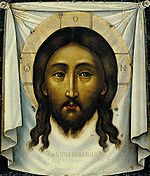
which are alleged to have come into existence miraculously, not created by a human painter. Invariably these are images of Jesus or the Virgin Mary. The most notable examples are, in the Eastern church the Image of Edessa
Image of Edessa
According to Christian legend, the Image of Edessa was a holy relic consisting of a square or rectangle of cloth upon which a miraculous image of the face of Jesus was imprinted — the first icon ....
or Mandylion, and in the West, the Veil of Veronica
Veil of Veronica
The Veil of Veronica, or Sudarium , often called simply "The Veronica" and known in Italian as the Volto Santo or Holy Face is a Catholic relic, which, according to legend, bears the likeness of the Face of Jesus not made by human hand The Veil of Veronica, or Sudarium (Latin for sweat-cloth),...
and the Shroud of Turin
Shroud of Turin
The Shroud of Turin or Turin Shroud is a linen cloth bearing the image of a man who appears to have suffered physical trauma in a manner consistent with crucifixion. It is kept in the royal chapel of the Cathedral of Saint John the Baptist in Turin, northern Italy. The image on the shroud is...
.
Background
Relic
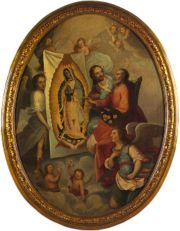
In religion, a relic is a part of the body of a saint or a venerated person, or else another type of ancient religious object, carefully preserved for purposes of veneration or as a tangible memorial...
s as well as icons, and their images were naturally seen as especially authoritative as to the true appearance of the subject. Like icons believed to be painted from the live subject, they therefore acted as important references for other images in the tradition. They therefore were copied on an enormous scale, and the belief that such images existed, and authenticated certain facial types, played an important role in the conservatism of the Byzantine tradition. Beside, and conflated with, the developed legend of the Image of Edessa
Image of Edessa
According to Christian legend, the Image of Edessa was a holy relic consisting of a square or rectangle of cloth upon which a miraculous image of the face of Jesus was imprinted — the first icon ....
, was the tale of the Veil of Veronica
Veil of Veronica
The Veil of Veronica, or Sudarium , often called simply "The Veronica" and known in Italian as the Volto Santo or Holy Face is a Catholic relic, which, according to legend, bears the likeness of the Face of Jesus not made by human hand The Veil of Veronica, or Sudarium (Latin for sweat-cloth),...
, whose very name signifies "true icon" or "true image", the fear of a "false image" remaining strong.
Acheiropoieta of 836
Such icons were seen as powerful arguments against iconoclasmIconoclasm
Iconoclasm is the deliberate destruction of religious icons and other symbols or monuments, usually with religious or political motives. It is a frequent component of major political or religious changes...
. In a document apparently produced in the circle of the Patriarch of Constantinople, which purports to be the record of a (fictitious) Church council
Ecumenical council
An ecumenical council is a conference of ecclesiastical dignitaries and theological experts convened to discuss and settle matters of Church doctrine and practice....
of 836, a list of acheiropoieta and icons miraculously protected is given as evidence for divine approval of icons. The acheiropoieta listed are:
- 1. the Image of EdessaImage of EdessaAccording to Christian legend, the Image of Edessa was a holy relic consisting of a square or rectangle of cloth upon which a miraculous image of the face of Jesus was imprinted — the first icon ....
, described as still at EdessaEdessa, MesopotamiaEdessa is the Greek name of an Aramaic town in northern Mesopotamia, as refounded by Seleucus I Nicator. For the modern history of the city, see Şanlıurfa.-Names:...
; - 2. the image of the Virgin at LyddaLodLod is a city located on the Sharon Plain southeast of Tel Aviv in the Center District of Israel. At the end of 2010, it had a population of 70,000, roughly 75 percent Jewish and 25 percent Arab.The name is derived from the Biblical city of Lod...
in Israel, which was said to have miraculously appeared imprinted on a column of a church built by the apostles Peter and John; - 3. another image of the Virgin, three cubitCubitThe cubit is a traditional unit of length, based on the length of the forearm. Cubits of various lengths were employed in many parts of the world in Antiquity, in the Middle Ages and into Early Modern Times....
s high, at LyddaLodLod is a city located on the Sharon Plain southeast of Tel Aviv in the Center District of Israel. At the end of 2010, it had a population of 70,000, roughly 75 percent Jewish and 25 percent Arab.The name is derived from the Biblical city of Lod...
in Israel, which was said to have miraculously appeared in another church.
The nine other miracles listed deal with the maintenance rather than creation of icons, which resist or repair the attacks of assorted pagans, Arabs, Persians, scoffers, madmen, iconoclasts and Jews.
This list seems to have had a regional bias, as other then-famous images are not mentioned, such as the Christ of Camuliana, later brought to the capital. Another example, and the only one which indisputably still exists, is a mosaic of the young Christ from the sixth century in the church of the Latomos monastery in Thessaloniki
Thessaloniki
Thessaloniki , historically also known as Thessalonica, Salonika or Salonica, is the second-largest city in Greece and the capital of the region of Central Macedonia as well as the capital of the Decentralized Administration of Macedonia and Thrace...
(now dedicated to Saint David). This was apparently covered by plaster during the Iconoclastic period, towards the end of which an earthquake caused the plaster to fall down, revealing the image (during the reign of Leo V, 813-20). However this was only a subsidiary miracle, according to the account we have. This says that the mosaic was being constructed secretly, during the 4th century persecution of Galerius, as an image of the Virgin, when it suddenly was transformed overnight into the present image of Christ.
Image of Edessa
Christian
A Christian is a person who adheres to Christianity, an Abrahamic, monotheistic religion based on the life and teachings of Jesus of Nazareth as recorded in the Canonical gospels and the letters of the New Testament...
legend, the Image of Edessa, (known to Orthodox
Eastern Orthodox Church
The Orthodox Church, officially called the Orthodox Catholic Church and commonly referred to as the Eastern Orthodox Church, is the second largest Christian denomination in the world, with an estimated 300 million adherents mainly in the countries of Belarus, Bulgaria, Cyprus, Georgia, Greece,...
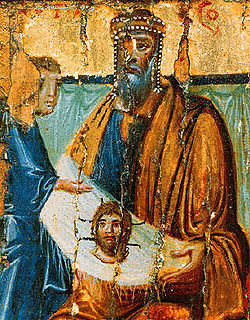
Christians as the Mandylion, a Byzantine Greek word not applied in any other context), was a holy relic consisting of a square or rectangle of cloth upon which a miraculous image of the face of Jesus
Jesus
Jesus of Nazareth , commonly referred to as Jesus Christ or simply as Jesus or Christ, is the central figure of Christianity...
was imprinted — the first icon
Icon
An icon is a religious work of art, most commonly a painting, from Eastern Christianity and in certain Eastern Catholic churches...
("image").
According to the legend, King Abgar of Edessa
Abgar V of Edessa
Abgar V the black or Abgarus V of Edessa BC - AD 7 and AD 13 - 50) was a historical Syriac ruler of the Syriac kingdom of Osroene, holding his capital at Edessa....
wrote to Jesus, asking him to come cure him of an illness. Abgar received an answering letter from Jesus, declining the invitation, but promising a future visit by one of his disciples. Along with the letter went a likeness of Jesus. This legend was first recorded in the early fourth century by Eusebius of Caesarea
Eusebius of Caesarea
Eusebius of Caesarea also called Eusebius Pamphili, was a Roman historian, exegete and Christian polemicist. He became the Bishop of Caesarea in Palestine about the year 314. Together with Pamphilus, he was a scholar of the Biblical canon...
, who said that he had transcribed and translated the actual letter in the Syriac chancery documents of the king of Edessa. Instead, the apostle "Thaddaeus" is said to have come to Edessa, bearing the words of Jesus, by the virtues of which the king was miraculously healed.
The Veil of Veronica
Veronica's Veil, known in Italian as the Volto Santo or Holy Face (but not to be confused with the carved crucifix
Crucifix
A crucifix is an independent image of Jesus on the cross with a representation of Jesus' body, referred to in English as the corpus , as distinct from a cross with no body....
Volto Santo of Lucca
Holy Face of Lucca
The Holy Face of Lucca is a venerated wooden corpus of a crucifix, located in the free-standing octagonal Carrara marble chapel , which was built in 1484 by Matteo Civitali, the sculptor-architect of Lucca, to contain it. The tempietto stands in the right-hand nave of the cathedral of San...
) is a legendary religious relic
Relic
In religion, a relic is a part of the body of a saint or a venerated person, or else another type of ancient religious object, carefully preserved for purposes of veneration or as a tangible memorial...
. Some people believe that Veronica
Saint Veronica
Saint Veronica or Berenice, according to the "Acta Sanctorum" published by the Bollandists , was a pious woman of Jerusalem who, moved with pity as Jesus carried his cross to Golgotha, gave him her veil that he might wipe his forehead...
from Jerusalem encountered Jesus
Jesus
Jesus of Nazareth , commonly referred to as Jesus Christ or simply as Jesus or Christ, is the central figure of Christianity...
along the Via Dolorosa
Via Dolorosa
The Via Dolorosa is a street, in two parts, within the Old City of Jerusalem, held to be the path that Jesus walked, carrying his cross, on the way to his crucifixion. The current route has been established since the 18th century, replacing various earlier versions...
on the way to Calvary
Calvary
Calvary or Golgotha was the site, outside of ancient Jerusalem’s early first century walls, at which the crucifixion of Jesus is said to have occurred. Calvary and Golgotha are the English names for the site used in Western Christianity...
. When she paused to wipe the sweat (Latin suda) off his face with her veil, his image was imprinted on the cloth. The event is commemorated by one of the Stations of the Cross
Stations of the Cross
Stations of the Cross refers to the depiction of the final hours of Jesus, and the devotion commemorating the Passion. The tradition as chapel devotion began with St...
. According to legend, Veronica later traveled to Rome to present the cloth to the Roman Emperor Tiberius
Tiberius
Tiberius , was Roman Emperor from 14 AD to 37 AD. Tiberius was by birth a Claudian, son of Tiberius Claudius Nero and Livia Drusilla. His mother divorced Nero and married Augustus in 39 BC, making him a step-son of Octavian...
. Legend has it that it has miraculous properties, being able to quench thirst, restore sight, and sometimes even raise the dead.
After being for centuries the most revered and copied Catholic image of Christ, in recent times it has rather been overshadowed by the Shroud of Turin.
Shroud of Turin
The ShroudShroud
Shroud usually refers to an item, such as a cloth, that covers or protects some other object. The term is most often used in reference to burial sheets, winding-cloths or winding-sheets, such as the famous Shroud of Turin or Tachrichim that Jews are dressed in for burial...
of Turin (or Turin Shroud) is a linen
Linen
Linen is a textile made from the fibers of the flax plant, Linum usitatissimum. Linen is labor-intensive to manufacture, but when it is made into garments, it is valued for its exceptional coolness and freshness in hot weather....
cloth bearing the hidden image of a man who appears to have been physically traumatized in a manner consistent with crucifixion
Crucifixion
Crucifixion is an ancient method of painful execution in which the condemned person is tied or nailed to a large wooden cross and left to hang until dead...
. The image is most clearly visible as a photographic negative, as was first observed in 1898 on the reverse photographic plate when amateur photographer Secondo Pia
Secondo Pia
Secondo Pia was an Italian lawyer and amateur photographer. He is best known for taking the first photographs of the Shroud of Turin on May 28, 1898...
was unexpectedly allowed to photograph it. The shroud is kept in the royal chapel of the Cathedral of Saint John the Baptist
Cathedral of Saint John the Baptist (Turin)
Turin Cathedral is the major Roman Catholic church of Turin, northern Italy. Dedicated to Saint John the Baptist , it was built during 1491-1498 and it is adjacent to an earlier campanile...
in Turin
Turin
Turin is a city and major business and cultural centre in northern Italy, capital of the Piedmont region, located mainly on the left bank of the Po River and surrounded by the Alpine arch. The population of the city proper is 909,193 while the population of the urban area is estimated by Eurostat...
, Italy
Italy
Italy , officially the Italian Republic languages]] under the European Charter for Regional or Minority Languages. In each of these, Italy's official name is as follows:;;;;;;;;), is a unitary parliamentary republic in South-Central Europe. To the north it borders France, Switzerland, Austria and...
. The Roman Catholic Church has approved this image in association with the devotion to the Holy Face of Jesus
Holy Face of Jesus
The Holy Face of Jesus is a title for specific images which some Catholics believe to have been miraculously formed representations of the face of Jesus Christ...
and some believe it is the cloth that covered Jesus
Jesus
Jesus of Nazareth , commonly referred to as Jesus Christ or simply as Jesus or Christ, is the central figure of Christianity...
at burial. Skeptics contend the shroud is a medieval hoax
Hoax
A hoax is a deliberately fabricated falsehood made to masquerade as truth. It is distinguishable from errors in observation or judgment, or rumors, urban legends, pseudosciences or April Fools' Day events that are passed along in good faith by believers or as jokes.-Definition:The British...
or forgery
Forgery
Forgery is the process of making, adapting, or imitating objects, statistics, or documents with the intent to deceive. Copies, studio replicas, and reproductions are not considered forgeries, though they may later become forgeries through knowing and willful misrepresentations. Forging money or...
—or even a devotional work of artistic verisimilitude
Verisimilitude
Verisimilitude is the quality of realism in something .-Competing ideas:The problem of verisimilitude is the problem of articulating what it takes for one false theory to be closer to the truth than another false theory...
. It is the subject of intense debate among some scientists, believers, historians, and writers regarding where, when, and how the shroud and its images were created.
Lateran Palace Image – Rome
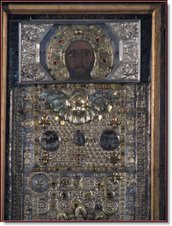
Lateran Palace
The Lateran Palace , formally the Apostolic Palace of the Lateran , is an ancient palace of the Roman Empire and later the main Papal residence....
in Rome. The legend is that this image was begun by St Luke and finished by angels.
It is thought that the icon was painted in Rome
Rome
Rome is the capital of Italy and the country's largest and most populated city and comune, with over 2.7 million residents in . The city is located in the central-western portion of the Italian Peninsula, on the Tiber River within the Lazio region of Italy.Rome's history spans two and a half...
between the 5th and 6th century. Today only slight traces under overpainting
Overpainting
Overpainting can mean the final layers of paint, over some type of underpainting, in a system of working in layers. It can also mean later paint added by restorers, or an artist or dealer wishing to "improve" or update an old image—a very common practice in the past. The underpainting gives a...
remain of the original image of an enthroned Christ
Christ in Majesty
Christ in Majesty, or Christ in Glory, in Latin Majestas Domini, is the Western Christian image of Christ seated on a throne as ruler of the world, always seen frontally in the centre of the composition, and often flanked by other sacred figures, whose membership changes over time and according to...
with a crossed halo
Halo (religious iconography)
A halo is a ring of light that surrounds a person in art. They have been used in the iconography of many religions to indicate holy or sacred figures, and have at various periods also been used in images of rulers or heroes...
, in the classic pose of the Teacher holding the roll of the law in His left hand with His right raised in benediction. Many times restored, the face completely changed when Pope Alexander III
Pope Alexander III
Pope Alexander III , born Rolando of Siena, was Pope from 1159 to 1181. He is noted in history for laying the foundation stone for the Notre Dame de Paris.-Church career:...
(1159–1181) had the present one, painted on silk, placed over the original. Innocent III (1189–1216) covered the rest of the holy icon with embossed silver, but other later embellishments have by now completely disguised its surface. It has also been cleaned during the recent restoration. The doors protecting the icon, again in embossed silver, are of the 15th century. It has a baldachin
Baldachin
A baldachin, or baldaquin , is a canopy of state over an altar or throne. It had its beginnings as a cloth canopy, but in other cases it is a sturdy, permanent architectural feature, particularly over high altars in cathedrals, where such a structure is more correctly called a ciborium when it is...
in metal and gilded wood over it, replacing the one by Caradaossi (1452–1527), lost during the sack of Rome in 1527. The image itself was last inspected by the Jesuit art historian J. Wilpert in 1907.
As early as the reign of Pope Sergius I
Pope Sergius I
Pope Saint Sergius I was pope from 687 to 701. Selected to end a schism between Antipope Paschal and Antipope Theodore, Sergius I ended the last disputed sede vacante of the Byzantine Papacy....
(687–701) there are records of the image being carried in annual procession at certain feasts, and Stephen II
Pope Stephen II
Pope Stephen II was Pope from 752 to 757, succeeding Pope Zachary following the death of Pope-elect Stephen. Stephen II marks the historical delineation between the Byzantine Papacy and the Frankish Papacy.-Allegiance to Constantinople:...
(752–757) carried the image on his shoulders in a procession to counter a threat from the Lombards
Lombards
The Lombards , also referred to as Longobards, were a Germanic tribe of Scandinavian origin, who from 568 to 774 ruled a Kingdom in Italy...
. By the ninth century its elaborate procession had become a focus of the Feast of the Assumption. In the Middle Ages the Pope and the seven cardinal-bishops would celebrate masses in the small sanctuary where it was housed, and at times would kiss its feet. Although no longer a specific liturgical object, some Romans still venerate this icon, considering it a last hope in disasters and memorable events in the capital, a veneration which can be compared with that for the other ancient icon of the Madonna “Salus Populi Romani
Salus Populi Romani
Salus Populi Romani -Protectress translates literally as "salvation or health" -is a title given in the 19th century to the Byzantine icon of the Madonna and Child, reputed to date to the Early Christian era, in the Borghese or Pauline Chapel of the Santa Maria Maggiore Basilica in Rome.It has...
” in St. Mary Major, again in Rome. The former icon used to be taken across Rome annually in procession to "meet" the latter on the Feast of the Assumption.