
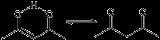
Acetylacetone is an
organic compoundAn organic compound is any member of a large class of gaseous, liquid, or solid chemical compounds whose molecules contain carbon. For historical reasons discussed below, a few types of carbon-containing compounds such as carbides, carbonates, simple oxides of carbon, and cyanides, as well as the...
that famously exists in two
tautomerTautomers are isomers of organic compounds that readily interconvert by a chemical reaction called tautomerization. This reaction commonly results in the formal migration of a hydrogen atom or proton, accompanied by a switch of a single bond and adjacent double bond...
ic forms that rapidly interconvert. The less stable tautomer is a
diketoneA diketone is a molecule containing two ketone groups. The simpliest diketone is diacetyl, also known as 2,3-butanedione. Diacetyl, acetylacetone, and hexane-2,5-dione are examples of 1,2-, 1,3-, and 1,4-diketones, respectively...
formally named pentane-2,4-dione. The more common tautomer is the enol form. The pair of tautomers rapidly interconvert and are treated as a single compound in most applications. It is a colourless liquid that is a precursor to acetylacetonate (
acac), a common bidentate
ligandIn coordination chemistry, a ligand is an ion or molecule that binds to a central metal atom to form a coordination complex. The bonding between metal and ligand generally involves formal donation of one or more of the ligand's electron pairs. The nature of metal-ligand bonding can range from...
. It is also a building block for the synthesis of
heterocyclic compoundA heterocyclic compound is a cyclic compound which has atoms of at least two different elements as members of its ring. The counterparts of heterocyclic compounds are homocyclic compounds, the rings of which are made of a single element....
s.
Properties
| Solvent | Kketo-enol |
| Gas Phase |
11.7 |
| Cyclohexane |
42 |
| Toluene |
10 |
| THF |
7.2 |
| DMSO |
2 |
| Water |
0.23 |
The keto and enol forms of acetylacetone coexist in solution; these forms are tautomers. The C
2v symmetryMolecular symmetry in chemistry describes the symmetry present in molecules and the classification of molecules according to their symmetry. Molecular symmetry is a fundamental concept in chemistry, as it can predict or explain many of a molecule's chemical properties, such as its dipole moment...
for the enol form displayed on the left in
Scheme 1 has been verified by many methods, most prominently being
NMR spectroscopyNuclear magnetic resonance spectroscopy, most commonly known as NMR spectroscopy, is a research technique that exploits the magnetic properties of certain atomic nuclei to determine physical and chemical properties of atoms or the molecules in which they are contained...
and IR spectroscopy. In the gas phase, the
equilibrium constant, K
keto-enol is 11.7, favoring the enol form. The equilibrium constant tends to remain high in nonpolar solvents; the keto form becomes more favorable in polar, hydrogen-bonding solvents, such as water. The enol form is a
vinylogousVinylogous is an adjective used to apply the concept of vinylogy taught in intermediate undergraduate through graduate/research organic chemistry. Vinylogy has been defined as the transmission of electronic effects through a conjugated organic bonding system...
analogue of a
carboxylic acidCarboxylic acids are organic acids characterized by the presence of at least one carboxyl group. The general formula of a carboxylic acid is R-COOH, where R is some monovalent functional group...
.
Acid-base properties
Acetylacetone is a
weak acidA weak acid is an acid that dissociates incompletely. It does not release all of its hydrogens in a solution, donating only a partial amount of its protons to the solution...
:
- C5H8O2 C5H7O2− + H+
IUPAC recommended
pKaAn acid dissociation constant, Ka, is a quantitative measure of the strength of an acid in solution. It is the equilibrium constant for a chemical reaction known as dissociation in the context of acid-base reactions...
values for this equilibrium in aqueous solution at 25 °C are 8.99±0.04 (I = 0), 8.83±0.02 (I = 0.1 M NaClO
4) and 9.00±0.03 (I=1.0 M NaClO
4) (I=
Ionic strengthThe ionic strength of a solution is a measure of the concentration of ions in that solution. Ionic compounds, when dissolved in water, dissociate into ions. The total electrolyte concentration in solution will affect important properties such as the dissociation or the solubility of different salts...
). Values for mixed solvents are avalable. Very strong bases, such as organolithium compounds, will deprotonate acetylacetone twice. The resulting dilithio species can then be alkylated at C-1.
| solvent | T/°C | pKa |
40% ethanolEthanol, also called ethyl alcohol, pure alcohol, grain alcohol, or drinking alcohol, is a volatile, flammable, colorless liquid. It is a psychoactive drug and one of the oldest recreational drugs. Best known as the type of alcohol found in alcoholic beverages, it is also used in thermometers, as a... /water |
30 |
9.8 |
| 70% dioxane/water |
28 |
12.5 |
80% DMSODimethyl sulfoxide is an organosulfur compound with the formula 2SO. This colorless liquid is an important polar aprotic solvent that dissolves both polar and nonpolar compounds and is miscible in a wide range of organic solvents as well as water... /water |
25 |
10.16 |
DMSODimethyl sulfoxide is an organosulfur compound with the formula 2SO. This colorless liquid is an important polar aprotic solvent that dissolves both polar and nonpolar compounds and is miscible in a wide range of organic solvents as well as water...
|
25 |
13.41 |
Preparation
Acetylacetone is prepared industrially by the thermal rearrangement of isopropenylacetate.
- CH2(CH3)COC(O)Me → MeC(O)CH2C(O)Me
Laboratory routes to acetylacetone begin also with
acetoneAcetone is the organic compound with the formula 2CO, a colorless, mobile, flammable liquid, the simplest example of the ketones.Acetone is miscible with water and serves as an important solvent in its own right, typically as the solvent of choice for cleaning purposes in the laboratory...
. Acetone and
acetic anhydrideAcetic anhydride, or ethanoic anhydride, is the chemical compound with the formula 2O. Commonly abbreviated Ac2O, it is the simplest isolatable acid anhydride and is a widely used reagent in organic synthesis...
upon the addition of
BF3Boron trifluoride is the chemical compound with the formula BF3. This pungent colourless toxic gas forms white fumes in moist air. It is a useful Lewis acid and a versatile building block for other boron compounds.-Structure and bonding:...
catalyst:
2O + CH
3C(O)CH
3 → CH
3C(O)CH
2C(O)CH
3
A second synthesis involves the base-catalyzed condensation of acetone and
ethyl acetateEthyl acetate is the organic compound with the formula CH3COOCH2CH3. This colorless liquid has a characteristic sweet smell and is used in glues, nail polish removers, and cigarettes...
, followed by acidification:
- NaOEt + EtO2CCH3 + CH3C(O)CH3 → NaCH3C(O)CHC(O)CH3 + 2 EtOH
- NaCH3C(O)CHC(O)CH3 + HCl → CH3C(O)CH2C(O)CH3 + NaCl
Because of the ease of these syntheses, many analogues of acetylacetonates are known. Some examples include C
6H
5C(O)CH
2C(O)C
6H
5 (dbaH) and (CH
3)
3CC(O)CH
2C(O)CC(CH
3)
3. Hexafluoroacetylacetonate is also widely used to generate volatile metal complexes.
Condensations
Acetylacetone is a versatile bifunctional precursor to heterocycles because both keto groups undergo condensation.
HydrazineHydrazine is an inorganic compound with the formula N2H4. It is a colourless flammable liquid with an ammonia-like odor. Hydrazine is highly toxic and dangerously unstable unless handled in solution. Approximately 260,000 tons are manufactured annually...
reacts to produce
pyrazolePyrazole refers both to the class of simple aromatic ring organic compounds of the heterocyclic diazole series characterized by a 5-membered ring structure composed of three carbon atoms and two nitrogen atoms in adjacent positions, and to the unsubstituted parent compound...
s.
UreaUrea or carbamide is an organic compound with the chemical formula CO2. The molecule has two —NH2 groups joined by a carbonyl functional group....
gives
pyrimidinePyrimidine is a heterocyclic aromatic organic compound similar to benzene and pyridine, containing two nitrogen atoms at positions 1 and 3 of the six-member ring...
s. Condensation with aryl- and alkylamines to gives the mono- and then the di
diketimineDiketimines or diimines are a family of ligands and ligand precursors derived from 1,2- and 1,3-diketones by replacement of the carbonyl oxygen atoms with NR groups, where R = aryl, alkyl...
s wherein the O atoms in acetylacetone are replaced by NR (R = aryl, alkyl).
Coordination chemistry
The acetylacetonate anion, acac
-, forms complexes with many
transition metalThe term transition metal has two possible meanings:*The IUPAC definition states that a transition metal is "an element whose atom has an incomplete d sub-shell, or which can give rise to cations with an incomplete d sub-shell." Group 12 elements are not transition metals in this definition.*Some...
ions. A general method of synthesis is to react the metal ion with acetylacetone in the presence of a base (B):
- Mz+ + z (acacH) M(acac)z +z BH+
which assists the removal of a proton from acetylacetone and shifts the equilibrium in favour of the complex. Both oxygen atoms bind to the metal to form a six-membered chelate ring. In some cases the chelate effect is so strong that no added base is needed to form the complex. Since the metal complex carries no electrical charge, it is soluble in non-polar organic solvents.
Biodegradation
Enzymatic breakdown: The enzyme
acetylacetone dioxygenaseIn enzymology, an acetylacetone-cleaving enzyme is an enzyme that catalyzes the chemical reactionThus, the two substrates of this enzyme are pentane-2,4-dione and O2, whereas its two products are acetate and 2-oxopropanal....
cleaves the carbon-carbon bond of acetyacetone, producing acetate and 2-oxopropanal. The enzyme is Fe(II)-dependent, but it has been proven to bind to zinc as well. Acetylacetone degradation has been characterized in the bacterium
Acinetobacter johnsonii.
- C5H8O2 + O2 → C2H4O2 + C3H4O2