

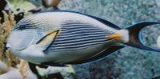
Acanthuridae

Encyclopedia
Acanthuridae is the family
of surgeonfishes, tangs, and unicornfishes
. The family includes about 80 species in six genera, all of which are marine
fish living in tropical seas, usually around coral reef
s. Many of the species are brightly colored and popular for aquaria
.
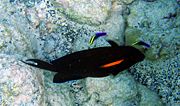
The distinctive characteristic of the family is the spines, one or more on either side of the tail, which are dangerously sharp. The dorsal
, anal and caudal fins are large, extending for most of the length of the body. The small mouths have a single row of teeth used for grazing on algae.
Surgeonfishes sometimes feed as solitary individuals, but they also often travel and feed in schools. It has been suggested that feeding in schools is a mechanism for overwhelming the highly aggressive defense responses of small territorial damselfish
es that vigorously guard small patches of algae on coral reefs.
Most species are relatively small and have a maximum length of 15–40 cm (6–16 in), but some members of the genus Acanthurus, some members of the genus Prionurus, and most members of the genus Naso can grow larger, with the whitemargin unicornfish
(N. annulatus), the largest species in the family, reaching a length of up to a metre (3,3 ft). These fishes can grow quickly in aquariums so it is advisable to check the average growth size and suitability before adding to a marine aquarium.
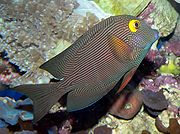
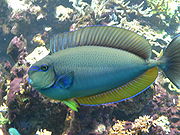
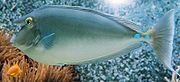
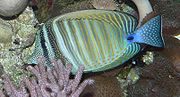
.jpg)
" found each member's caudal peduncle.
In the early 1900s, the family was called Hepatidae.
Adults range from 15–40 cm (6-15 in.) in length and most grow quickly even in aquariums. When considering a tang for an aquarium it is important to consider the size to which these fish can grow. Larger species such as the popular Pacific Blue tang surgeonfish (of Finding Nemo fame), Naso
or lipstick tang, clown and sohal tangs can grow to 40 cm (15 in.) and require swimming room and hiding places.
Many also suggest adding aggressive tangs to the aquarium last as they are territorial and may fight and possibly kill other fish.
Tangs primarily graze on macroalgae, such as caulerpa and gracilias, although they have been observed in an aquarium setting to eat meat-based fish foods. A popular technique for aquarists, is to grow macroalgae in a sump
or refugium
. This technique not only is economically beneficial, but serves to promote enhanced water quality through nitrate
absorption. The growth of the algae can then be controlled by feeding it to the tang.
Family (biology)
In biological classification, family is* a taxonomic rank. Other well-known ranks are life, domain, kingdom, phylum, class, order, genus, and species, with family fitting between order and genus. As for the other well-known ranks, there is the option of an immediately lower rank, indicated by the...
of surgeonfishes, tangs, and unicornfishes
Naso (genus)
The unicorn fishes are 17 species of tropical, herbivorous marine surgeonfishes in the genus Naso. They are so named because of a spike that protrudes from the forehead. Some species have a bulbous protrusion rather than a pronounced spike, and some lack a spike altogether...
. The family includes about 80 species in six genera, all of which are marine
Ocean
An ocean is a major body of saline water, and a principal component of the hydrosphere. Approximately 71% of the Earth's surface is covered by ocean, a continuous body of water that is customarily divided into several principal oceans and smaller seas.More than half of this area is over 3,000...
fish living in tropical seas, usually around coral reef
Coral reef
Coral reefs are underwater structures made from calcium carbonate secreted by corals. Coral reefs are colonies of tiny living animals found in marine waters that contain few nutrients. Most coral reefs are built from stony corals, which in turn consist of polyps that cluster in groups. The polyps...
s. Many of the species are brightly colored and popular for aquaria
Aquarium
An aquarium is a vivarium consisting of at least one transparent side in which water-dwelling plants or animals are kept. Fishkeepers use aquaria to keep fish, invertebrates, amphibians, marine mammals, turtles, and aquatic plants...
.
The distinctive characteristic of the family is the spines, one or more on either side of the tail, which are dangerously sharp. The dorsal
Dorsal fin
A dorsal fin is a fin located on the backs of various unrelated marine and freshwater vertebrates, including most fishes, marine mammals , and the ichthyosaurs...
, anal and caudal fins are large, extending for most of the length of the body. The small mouths have a single row of teeth used for grazing on algae.
Surgeonfishes sometimes feed as solitary individuals, but they also often travel and feed in schools. It has been suggested that feeding in schools is a mechanism for overwhelming the highly aggressive defense responses of small territorial damselfish
Damselfish
Damselfish comprise the family Pomacentridae except those of the genera Amphiprion and Premnas. They can grow up to long. While most are marine, a few species inhabit the lower stretches of rivers in freshwater. Damselfish usually have bright colors. in tropical coral reefs, and many of those are...
es that vigorously guard small patches of algae on coral reefs.
Most species are relatively small and have a maximum length of 15–40 cm (6–16 in), but some members of the genus Acanthurus, some members of the genus Prionurus, and most members of the genus Naso can grow larger, with the whitemargin unicornfish
Whitemargin unicornfish
The whitemargin unicornfish is a tropical fish found throughout the Indo-Pacific. It can reach a length of 100 cm making it one of the largest members of the family Acanthuridae.-Description:...
(N. annulatus), the largest species in the family, reaching a length of up to a metre (3,3 ft). These fishes can grow quickly in aquariums so it is advisable to check the average growth size and suitability before adding to a marine aquarium.
Species
- Genus AcanthurusAcanthurusAcanthurus is the type genus of the family Acanthuridae. Approximately half of all members of the family are members of the genus Acanthurus. They are found in tropical oceans, especially near coral reefs, with most species in the Indo-Pacific, but a few are found in the Atlantic Ocean...
- Achilles tang, Acanthurus achilles Shaw, 1803.
- Whitefin surgeonfish, Acanthurus albipectoralis Allen & Ayling, 1987.
- Orange-socket surgeonfish, Acanthurus auranticavus Randall, 1956.
- Ocean surgeon, Acanthurus bahianus Castelnau, 1855.
- Black-spot surgeonfish, Acanthurus barieneAcanthurus barieneAcanthurus bariene is a tropical fish also commonly known as the Bariene surgeonfish, Black-spot surgeonfish, or Eye-spot surgeonfish. It was first named by René Primevère Lesson in 1831....
LessonRené-Primevère LessonRené Primevère Lesson was a French surgeon, naturalist, ornithologist, and herpetologist.Lesson was born at Rochefort, and at the age of sixteen he entered the Naval Medical School there...
, 1831. - Ringtail surgeonfish, Acanthurus blochii ValenciennesAchille ValenciennesAchille Valenciennes was a French zoologist.Valenciennes was born in Paris, and studied under Georges Cuvier. Valenciennes' study of parasitic worms in humans made an important contribution to the study of parasitology...
, 1835. - Doctorfish tangDoctorfish tangAcanthurus chirurgus, commonly called the Doctor fish and the Doctorfish tang in English or the Barbero rayado and the Cirujano rayado in Spanish, is a tropical marine fish common in the Atlantic Ocean.-Description:...
, Acanthurus chirurgus (BlochMarcus Elieser BlochMarcus Elieser Bloch was a German medical doctor and naturalist. He is generally considered one of the most important ichthyologists of the 18th century.- Life :...
, 1787). - Chronixis surgeonfish, Acanthurus chronixisAcanthurus chronixisAcanthurus chronixis is a tropical fish known commonly as the Chronixis surgeonfish or the Mimic surgeonfish. It was first named by Randall in 1960. The species lives in coral reefs in the western Pacific....
Randall, 1960. - Atlantic Blue tang surgeonfish, Acanthurus coeruleusAcanthurus coeruleusAcanthurus coeruleus is a surgeonfish found commonly in the Atlantic Ocean.- Description :...
BlochMarcus Elieser BlochMarcus Elieser Bloch was a German medical doctor and naturalist. He is generally considered one of the most important ichthyologists of the 18th century.- Life :...
& SchneiderJohann Gottlob SchneiderJohann Gottlob Theaenus Schneider was a German classicist and naturalist.-Biography:Schneider was born at Collm in Saxony...
, 1801. - Eyestripe surgeonfish, Acanthurus dussumieri ValenciennesAchille ValenciennesAchille Valenciennes was a French zoologist.Valenciennes was born in Paris, and studied under Georges Cuvier. Valenciennes' study of parasitic worms in humans made an important contribution to the study of parasitology...
, 1835. - Fowler's surgeonfish, Acanthurus fowleriAcanthurus fowleriAcanthurus fowleri is a tropical fish which is found in coral reefs in the Philippines, Indonesia, Papua New Guinea, Solomon Islands, and Australia. It is also commonly known as the Fowler's surgeonfish or the Horse-shoe surgeonfish....
de Beaufort, 1951. - Black surgeonfish, Acanthurus gahhmAcanthurus gahhmAcanthurus gahhm is a tropical fish also known as the Black surgeonfish. It is found in the western Indian Ocean, and is often used in aquariums....
(ForsskålPeter ForsskålPeter Forsskål, sometimes spelled Pehr Forsskål, Peter Forskaol, Petrus Forskål or Pehr Forsskåhl, was a Swedish explorer, orientalist, naturalist and an apostle of Carl Linnaeus.-Early life:...
, 1775). - Finelined surgeonfish, Acanthurus grammoptilusAcanthurus grammoptilusAcanthurus grammoptilus is a tropical fish which is found in the Philippines, Indonesia and Australia. Also known, commonly, as the Finelined-surgeonfish, it is used commercially in fisheries, and can be used for food....
RichardsonJohn Richardson (naturalist)Sir John Richardson was a Scottish naval surgeon, naturalist and arctic explorer.Richardson was born at Dumfries. He studied medicine at Edinburgh University, and became a surgeon in the navy in 1807. He traveled with John Franklin in search of the Northwest Passage on the Coppermine Expedition of...
, 1843. - Whitespotted surgeonfish, Acanthurus guttatus ForsterJohann Reinhold ForsterJohann Reinhold Forster was a German Lutheran pastor and naturalist of partial Scottish descent who made contributions to the early ornithology of Europe and North America...
, 1801. - Japan surgeonfish, Acanthurus japonicus (Schmidt, 1931).
- Palelipped surgeonfish, Acanthurus leucocheilusAcanthurus leucocheilusAcanthurus leucocheilus is a tropical fish also known as the Palelipped surgeonfish or the White-spine surgeonfish. It is used commercially in aquariums....
Herre, 1927. - Whitebar surgeonfish, Acanthurus leucopareiusAcanthurus leucopareiusAcanthurus leucopareius is a sub-tropical fish known commonly as the Whitebar surgeonfish or the Head-band surgeonfish. It is somewhat commercial in fisheries and is used in aquariums. It was first named by Jenkins in 1903....
(Jenkins, 1903). - Powderblue surgeonfish, Acanthurus leucosternon Bennett, 1833.
- Lined surgeonfish, Acanthurus lineatus (LinnaeusCarolus LinnaeusCarl Linnaeus , also known after his ennoblement as , was a Swedish botanist, physician, and zoologist, who laid the foundations for the modern scheme of binomial nomenclature. He is known as the father of modern taxonomy, and is also considered one of the fathers of modern ecology...
, 1758). - White-freckled surgeonfish, Acanthurus maculiceps] (Ahl, 1923).
- Elongate surgeonfishElongate surgeonfishAcanthurus mata is a tropical fish with the common name Elongate Surgeonfish.-Appearance:The elongate surgeonfish is light blue with numerous brown stripes running down the length of its body, although over time it is able to change colour to become blue overall. It has a band of yellowish green...
, Acanthurus mata (CuvierGeorges CuvierGeorges Chrétien Léopold Dagobert Cuvier or Jean Léopold Nicolas Frédéric Cuvier , known as Georges Cuvier, was a French naturalist and zoologist...
, 1829). - Monrovia doctorfish, Acanthurus monroviaeAcanthurus monroviaeAcanthurus monroviae is a tropical fish which is found in the eastern Atlantic ocean. It is commercial in fisheries, and is also used in aquariums. It was first named by Franz Steindachner in 1876, and is known commonly as the Monrovia doctorfish....
SteindachnerFranz SteindachnerFranz Steindachner was an Austrian zoologist.- Work and career :Being interested in natural history, Steindachner took up the study of fossil fishes on the recommendation of his friend Eduard Suess...
, 1876. - Whitecheek surgeonfish, Acanthurus nigricans (LinnaeusCarolus LinnaeusCarl Linnaeus , also known after his ennoblement as , was a Swedish botanist, physician, and zoologist, who laid the foundations for the modern scheme of binomial nomenclature. He is known as the father of modern taxonomy, and is also considered one of the fathers of modern ecology...
, 1758). - Epaulette surgeonfish, Acanthurus nigricaudaAcanthurus nigricaudaAcanthurus nigricauda is a tropical fish with the common name epaulette surgeonfish....
Duncker & Mohr, 1929. - Brown surgeonfish, Acanthurus nigrofuscus (ForsskålPeter ForsskålPeter Forsskål, sometimes spelled Pehr Forsskål, Peter Forskaol, Petrus Forskål or Pehr Forsskåhl, was a Swedish explorer, orientalist, naturalist and an apostle of Carl Linnaeus.-Early life:...
, 1775). - Bluelined surgeonfish, Acanthurus nigroris ValenciennesAchille ValenciennesAchille Valenciennes was a French zoologist.Valenciennes was born in Paris, and studied under Georges Cuvier. Valenciennes' study of parasitic worms in humans made an important contribution to the study of parasitology...
, 1835. - Bluelined surgeon, Acanthurus nubilusAcanthurus nubilusAcanthurus nubilus is a tropical fish also known as the Bluelined surgeon or the Pin-striped surgeon. It was first named by Fowler and Bean in 1929, and despite being a rare species, is used in aquariums....
(Fowler & Bean, 1929). - Orangespot surgeonfish, Acanthurus olivaceus BlochMarcus Elieser BlochMarcus Elieser Bloch was a German medical doctor and naturalist. He is generally considered one of the most important ichthyologists of the 18th century.- Life :...
& SchneiderJohann Gottlob SchneiderJohann Gottlob Theaenus Schneider was a German classicist and naturalist.-Biography:Schneider was born at Collm in Saxony...
, 1801. - Black-barred surgeonfish, Acanthurus polyzonaAcanthurus polyzonaAcanthurus polyzona is a tropical fish found in coral reefs situated in the western Indian Ocean. It was first named by Pieter Bleeker in 1868, and is commonly known as the Black-barred surgeonfish....
(BleekerPieter BleekerPieter Bleeker was a Dutch medical doctor and ichthyologist, famous for his work on the fishes of East Asia – Atlas Ichthyologique des Orientales Neerlandaises – which was published 1862–1877....
, 1868). - Chocolate surgeonfish, Acanthurus pyroferus Kittlitz, 1834.
- Gulf surgeonfish, Acanthurus randalliAcanthurus randalliAcanthurus randalli is a tropical fish found in the western Atlantic ocean. It was first named by Briggs and Caldwell in 1957, and is commonly known as the Gulf surgeonfish....
Briggs & Caldwell, 1957. - Acanthurus reversusAcanthurus reversusAcanthurus reversus is a tropical fish found in coral reefs in the Marquesas Islands. It was first named by Randall and Earle in 1999....
Randall & Earle, 1999. - Sohal surgeonfishSohal surgeonfishThe sohal surgeonfish or sohal tang, Acanthurus sohal, is a Red Sea endemic which grows to 16 inches in the wild. Its striking blue and white horizontal stripes has made it what many consider the 'poster fish' for the Red Sea reef environment...
, Acanthurus sohal (ForsskålPeter ForsskålPeter Forsskål, sometimes spelled Pehr Forsskål, Peter Forskaol, Petrus Forskål or Pehr Forsskåhl, was a Swedish explorer, orientalist, naturalist and an apostle of Carl Linnaeus.-Early life:...
, 1775). - Doubleband surgeonfish, Acanthurus tennentii Günther, 1861.
- Thompson's surgeonfish, Acanthurus thompsoniAcanthurus thompsoniAcanthurus thompsoni is a tropical fish found in the Pacific and Indian Oceans. It was first named by Fowler in 1923, and is commonly known as the Thompson's surgeonfish. It is commercial in aquarium use....
(Fowler, 1923). - Convict surgeonfish, Acanthurus triostegus (LinnaeusCarolus LinnaeusCarl Linnaeus , also known after his ennoblement as , was a Swedish botanist, physician, and zoologist, who laid the foundations for the modern scheme of binomial nomenclature. He is known as the father of modern taxonomy, and is also considered one of the fathers of modern ecology...
, 1758). - Indian Ocean mimic surgeonfish, Acanthurus tristis Randall, 1993.
- Yellowfin surgeonfish, Acanthurus xanthopterus ValenciennesAchille ValenciennesAchille Valenciennes was a French zoologist.Valenciennes was born in Paris, and studied under Georges Cuvier. Valenciennes' study of parasitic worms in humans made an important contribution to the study of parasitology...
, 1835.
- Genus CtenochaetusCtenochaetusCtenochaetus, or bristletooth tangs, is a genus of fish in the Acanthuridae family.It contains the following nine species, listed alphabetically:* Ctenochaetus binotatus Randall, 1955 – Twospot surgeonfish...
- Twospot surgeonfish, Ctenochaetus binotatus Randall, 1955.
- Ctenochaetus cyanocheilusCtenochaetus cyanocheilusCtenochaetus cyanocheilus, is a marine reef tang in the fish family Acanthuridae, endemic to Oceania. It is also known commonly as the bluelip bristletooth. This fish grows to 6.3 inches in the wild.-References:*...
Randall & Clements, 2001. - Ctenochaetus flavicaudaCtenochaetus flavicaudaCtenochaetus flavicauda is a Tang from the Pacific Ocean. It occasionally makes its way into the aquarium trade. It grows to a size of 11.8 cm in length, making it the smallest ctenochaetus tang, and also the smallest acanthurid...
Fowler, 1938. - Ctenochaetus hawaiiensisCtenochaetus hawaiiensisCtenochaetus hawaiiensis is a Tang from the Pacific Ocean. It occasionally makes its way into the aquarium trade. It grows to a size of 25 cm in length. As a juvenile it is a yellow to orange color with purple markings, as an adult it is dark brown with light colored fine horizontal striping....
- Striped-fin surgeonfish, Ctenochaetus marginatusCtenochaetus marginatusCtenochaetus marginatus is a tropical fish found in coral reefs in the Pacific Ocean. It was first named by Achille Valenciennes in 1835, and is commonly known as the Striped-fin surgeonfish, the Blue-spotted bristletooth, or the Bluespotted surgeonfish. It is used in aquariums....
(ValenciennesAchille ValenciennesAchille Valenciennes was a French zoologist.Valenciennes was born in Paris, and studied under Georges Cuvier. Valenciennes' study of parasitic worms in humans made an important contribution to the study of parasitology...
, 1835). - Striated surgeonfish, Ctenochaetus striatus (QuoyJean René Constant QuoyJean René Constant Quoy was a French zoologist.Along with Joseph Paul Gaimard he served as naturalist aboard La Coquille under Louis Isidore Duperrey during its circumnavigation of the globe , and the Astrolabe under the command of Jules Dumont d'Urville...
& GaimardJoseph Paul GaimardJoseph Paul Gaimard was a French naval surgeon and naturalist.Along with Jean René Constant Quoy he served as naturalist on the ships L'Uranie under Louis de Freycinet 1817-1820, and L'Astrolabe under Jules Dumont d'Urville 1826-1829...
, 1825). - Kole Tang, Ctenochaetus strigosus (Bennett, 1828).
- Tomini surgeonfish, Ctenochaetus tominiensis Randall, 1955.
- Ctenochaetus truncatusCtenochaetus truncatusCtenochaetus truncatus is a tropical fish found in the Indian Ocean. It was first named by Randall and Clements in 2001, and is known commonly as the Indian gold-ring bristletooth....
Randall & Clements, 2001.
- Genus NasoNaso (genus)The unicorn fishes are 17 species of tropical, herbivorous marine surgeonfishes in the genus Naso. They are so named because of a spike that protrudes from the forehead. Some species have a bulbous protrusion rather than a pronounced spike, and some lack a spike altogether...
- Whitemargin unicornfishWhitemargin unicornfishThe whitemargin unicornfish is a tropical fish found throughout the Indo-Pacific. It can reach a length of 100 cm making it one of the largest members of the family Acanthuridae.-Description:...
, Naso annulatus (QuoyJean René Constant QuoyJean René Constant Quoy was a French zoologist.Along with Joseph Paul Gaimard he served as naturalist aboard La Coquille under Louis Isidore Duperrey during its circumnavigation of the globe , and the Astrolabe under the command of Jules Dumont d'Urville...
& GaimardJoseph Paul GaimardJoseph Paul Gaimard was a French naval surgeon and naturalist.Along with Jean René Constant Quoy he served as naturalist on the ships L'Uranie under Louis de Freycinet 1817-1820, and L'Astrolabe under Jules Dumont d'Urville 1826-1829...
, 1825). - Humpback unicornfishHumpback unicornfishThe humpback unicornfish is a species of Unicornfish commonly found in tropical reefs, so named because of its distinctive humped back. The habitat of the Humpback unicornfish includes most of the coastline of the Indonesian islands and some areas off the coast of Africa....
, Naso brachycentron (ValenciennesAchille ValenciennesAchille Valenciennes was a French zoologist.Valenciennes was born in Paris, and studied under Georges Cuvier. Valenciennes' study of parasitic worms in humans made an important contribution to the study of parasitology...
, 1835). - Spotted unicornfishSpotted unicornfishThe spotted unicornfish is a type of Unicornfish in the family Acanthuridae found in the Indian and Pacific oceans.. Another species, Naso maculatus also may be called the spotted unicornfish....
, Naso brevirostris (CuvierGeorges CuvierGeorges Chrétien Léopold Dagobert Cuvier or Jean Léopold Nicolas Frédéric Cuvier , known as Georges Cuvier, was a French naturalist and zoologist...
, 1829). - Naso caeruleacaudaNaso caeruleacaudaNaso caeruleacauda is a tropical fish found in coral reefs around Indonesia and the Philippines. It was first named by J.E. Randall in 1994, and is known commonly as the Blue unicorn....
Randall, 1994. - Gray unicornfish, Naso caesiusNaso caesiusNaso caesius is a tropical fish found in coral reefs in the Pacific Ocean. It was first named by J.E. Randall and L.J. Bell in 1992, and is known commonly as the gray unicornfish....
Randall & Bell, 1992. - Elegant unicornfish, Naso elegansNaso elegansNaso elegans is a tropical fish found in coral reefs in the Indian Ocean. It was first named by Eduard Rüppell in 1829, and is commonly known as the Elegant unicornfish, Indian orange-spine unicorn, Orange-spine unicorn, and Smoothheaded unicornfish. It is commercial in fisheries....
(RüppellEduard RüppellWilhelm Peter Eduard Simon Rüppell was a German naturalist and explorer. Rüppell is occasionally transliterated to "Rueppell" for the English alphabet....
, 1829). - Horseface unicornfish, Naso fageniNaso fageniNaso fageni is a tropical fish found in the west Pacific and Indian Oceans. It was first named by Morrow in 1954, and is known commonly as the Horseface unicornfish or the Horseface unicorn. It is commercial in fisheries....
Morrow, 1954. - Sleek unicornfish, Naso hexacanthusNaso hexacanthusNaso hexacanthus is a tropical fish found in coral reefs in the Pacific and Indian Oceans. It was first named by Pieter Bleeker in 1855, and is commonly known as the Sleek unicornfish, Sleek unicorn, Blacktongue unicorn, Blacktounge unicornfish, Thorpe's unicornfish, or the Nohorn unicorn...
(BleekerPieter BleekerPieter Bleeker was a Dutch medical doctor and ichthyologist, famous for his work on the fishes of East Asia – Atlas Ichthyologique des Orientales Neerlandaises – which was published 1862–1877....
, 1855). - Orangespine unicornfish, Naso lituratusNaso lituratusNaso lituratus or the Orangespine unicornfish or Naso tang is a tang from the Indian Ocean and the Pacific Ocean. It occasionally makes its way into the aquarium trade. It grows to a size of 46 cm in length....
(ForsterJohann Reinhold ForsterJohann Reinhold Forster was a German Lutheran pastor and naturalist of partial Scottish descent who made contributions to the early ornithology of Europe and North America...
, 1801). - Elongate unicornfish, Naso lopeziNaso LopeziNaso lopezi is a Tang from the Western Pacific Ocean. It occasionally makes its way into the aquarium trade. It grows to a size of 60 cm in length....
Herre, 1927. - Naso maculatusNaso maculatusNaso maculatus is a tropical fish found in coral reefs in the Pacific ocean. It was first named by Randall and Struhsaker in 1981, and is commonly known as the spotted unicornfish,but this name may also refer to Naso brevirostris. It has a maximum length of 60 cm....
Randall & Struhsaker, 1981. - Squarenose unicornfish, Naso mcdadeiNaso mcdadeiNaso mcdadei is a tropical fish found in coral reefs in the Pacific and Indian Oceans. It was first named by Jeffrey W. Johnson in 2002 and is commonly known as the Squarenose unicornfish....
Johnson, 2002. - Slender unicorn, Naso minorNaso minorNaso minor is a tropical fish found in coral reefs around Mozambique and the Philippines. It was first named by Smith in 1966 and is commonly known as the Slender unicorn, Blackspine unicornfish, or the Little unicorn....
(Smith, 1966). - Naso reticulatusNaso reticulatusNaso reticulatus is a temperate fish found in coral reefs around Taiwan and Indonesia. It was first named by John E. Randall in 2001....
Randall, 2001. - Oneknife unicornfish, Naso thynnoidesNaso thynnoidesNaso thynnoides is a tropical fish found in coral reefs in the Pacific and Indian Oceans. It was first named by Georges Cuvier in 1829, and is commonly known as the Oneknife unicornfish, Oneknife unicorn, Thunny unicornfish, Singlespine unicornfish, One-spine unicorn, or the Barred unicornfish...
(CuvierGeorges CuvierGeorges Chrétien Léopold Dagobert Cuvier or Jean Léopold Nicolas Frédéric Cuvier , known as Georges Cuvier, was a French naturalist and zoologist...
, 1829). - Bulbnose unicornfish, Naso tonganusNaso tonganusNaso tonganus is a tropical fish found in coral reefs in the Pacific and Indian Oceans. It was first named by Achille Valenciennes in 1835, and is commonly known as the Bulbnose unicornfish, Hump-nosed unicornfish, Humphead unicornfish, or the Humpnose unicorn. It is commercial in fisheries....
(ValenciennesAchille ValenciennesAchille Valenciennes was a French zoologist.Valenciennes was born in Paris, and studied under Georges Cuvier. Valenciennes' study of parasitic worms in humans made an important contribution to the study of parasitology...
, 1835). - Humpnose unicornfish, Naso tuberosusNaso tuberosusNaso tuberosus is a tropical fish found in coral reefs in the central Pacific and Indian Oceans. It was first named by Bernard Germain de Lacépède in 1801, and is commonly known as the Humpnose unicornfish. It feeds primarily on Caulerpa....
Lacépède, 1801. - Bluespine unicornfishBluespine unicornfishThe bluespine unicornfish or short-nose unicornfish is a tang from the Indo-Pacific. It occasionally makes its way into the aquarium trade. It grows to a size of 70 cm in length. It is called kala in Hawaiian, and dawa in New Caledonia....
, Naso unicornis (ForsskålPeter ForsskålPeter Forsskål, sometimes spelled Pehr Forsskål, Peter Forskaol, Petrus Forskål or Pehr Forsskåhl, was a Swedish explorer, orientalist, naturalist and an apostle of Carl Linnaeus.-Early life:...
, 1775). - Bignose unicornfish, Naso vlamingii (ValenciennesAchille ValenciennesAchille Valenciennes was a French zoologist.Valenciennes was born in Paris, and studied under Georges Cuvier. Valenciennes' study of parasitic worms in humans made an important contribution to the study of parasitology...
, 1835).
- Whitemargin unicornfish
- Genus Paracanthurus
- Palette surgeonfish, Paracanthurus hepatus (LinnaeusCarolus LinnaeusCarl Linnaeus , also known after his ennoblement as , was a Swedish botanist, physician, and zoologist, who laid the foundations for the modern scheme of binomial nomenclature. He is known as the father of modern taxonomy, and is also considered one of the fathers of modern ecology...
, 1766).
- Palette surgeonfish, Paracanthurus hepatus (Linnaeus
- Genus PrionurusPrionurusPrionurus is a genus of fish in the family Acanthuridae.-Species:** Biafra doctorfish, Prionurus biafraensis .** Prionurus chrysurus Randall, 2001....
- Biafra doctorfish, Prionurus biafraensisPrionurus biafraensisPrionurus biafraensis is a tropical fish found in coral reefs in the eastern Atlantic ocean. It was first named by Blache & Rossignol in 1961, and is commonly known as the Biafra doctorfish. It is commercial in fisheries....
(Blache & Rossignol, 1961). - Prionurus chrysurusPrionurus chrysurusPrionurus chrysurus is a tropical fish found in coral reefs around Indonesia. It was first named by John E. Randall in 2001, and is commonly known as the Indonesian sawtail. It reaches a maximum length of ....
Randall, 2001. - Razor surgeonfish, Prionurus laticlaviusPrionurus laticlaviusPrionurus laticlavius is a tropical fish found in coral reefs in the eastern central Pacific Ocean. It was first named by Achille Valenciennes in 1846, and is commonly known as the Razor surgeonfish. It is sometimes used in aquariums....
(ValenciennesAchille ValenciennesAchille Valenciennes was a French zoologist.Valenciennes was born in Paris, and studied under Georges Cuvier. Valenciennes' study of parasitic worms in humans made an important contribution to the study of parasitology...
, 1846). - Yellowspotted sawtailYellowspotted sawtailThe yellowspotted sawtail, Prionurus maculatus, is a tang of the family Acanthuridae, found in the southwest Pacific Ocean.-References:* Tony Ayling & Geoffrey Cox, Collins Guide to the Sea Fishes of New Zealand, ISBN 0-00-216987-8...
, Prionurus maculatus (Randall & Struhsaker, 1981). - Sixplate sawtail, Prionurus microlepidotusPrionurus microlepidotusPrionurus microlepidotus is a subtropical fish found in coral reefs in the western Pacific ocean. It was first named by Bernard Germain de Lacépède in 1804, and is commonly known as the Sixplate sawtail. It is sometimes used in aquariums....
Lacépède, 1804. - Yellowtail surgeonfish, Prionurus punctatusPrionurus punctatusPrionurus punctatus is a tropical fish found in coral reefs from the Gulf of California to El Salvador. It was first named by Theodore Gill in 1862, and is commonly known as the Yellowtail surgeonfish. It is sometimes used in aquariums.....
GillTheodore GillTheodore Nicholas Gill was an American ichthyologist, mammalogist, malacologist and librarian.Born and educated in New York City under private tutors, Gill early showed interest in natural history. He was associated with J...
, 1862. - Scalpel sawtail, Prionurus scalprumPrionurus scalprumPrionurus scalprum is a subtropical fish found in coral reefs in the northwest Pacific ocean. It was first named by Achille Valenciennes in 1835, and is commonly known as the Scalpel sawtail. It is sometimes used in aquariums....
ValenciennesAchille ValenciennesAchille Valenciennes was a French zoologist.Valenciennes was born in Paris, and studied under Georges Cuvier. Valenciennes' study of parasitic worms in humans made an important contribution to the study of parasitology...
, 1835.
- Biafra doctorfish, Prionurus biafraensis
- Genus ZebrasomaZebrasomaZebrasoma is a genus of marine fish composed of seven species of pointed-snout, disc-like bodied, sail-like finned, single peduncular-spined fishes. Zebrasoma are usually placid community fish, many forming large groups or shoals, although fiercely territorial against other tangs or similar shaped...
- Red Sea sailfin tangRed Sea sailfin tangThe Red Sea sailfin tang or Desjardin's sailfin tang is a marine reef tang in the fish family Acanthuridae. They originate in the lagoons and reefs of the Indian Ocean from the southern Red Sea to KwaZulu-Natal Province in South Africa and as far east as India and Java. They may live at water...
, Zebrasoma desjardinii (Bennett, 1836). - Yellow tangYellow tangThe yellow tang is a saltwater fish species of the family Acanthuridae. It is one of the most popular aquarium fish.-Appearance:...
, Zebrasoma flavescens (Bennett, 1828). - Spotted tang, Zebrasoma gemmatum (ValenciennesAchille ValenciennesAchille Valenciennes was a French zoologist.Valenciennes was born in Paris, and studied under Georges Cuvier. Valenciennes' study of parasitic worms in humans made an important contribution to the study of parasitology...
, 1835). - Longnose surgeonfish, Zebrasoma rostratum (Günther, 1875).
- Twotone tang, Zebrasoma scopas (CuvierGeorges CuvierGeorges Chrétien Léopold Dagobert Cuvier or Jean Léopold Nicolas Frédéric Cuvier , known as Georges Cuvier, was a French naturalist and zoologist...
, 1829). - Sailfin tang, Zebrasoma veliferum (BlochMarcus Elieser BlochMarcus Elieser Bloch was a German medical doctor and naturalist. He is generally considered one of the most important ichthyologists of the 18th century.- Life :...
, 1795). - Purple tangZebrasoma xanthurumThe purple tang is a marine reef tang in the fish family Acanthuridae. The fish grows to a maximum length of 25 centimeters in the wild but rarely surpasses 20 centimetres in captivity...
, Zebrasoma xanthurum (Blyth, 1852). - Zebrasoma xanthurusZebrasoma xanthurusZebrasoma xanthurus is a Tang from the Western Indian Ocean. It occasionally makes its way into the aquarium trade. It grows to a size of 22 cm in length....
- Red Sea sailfin tang
Etymology and taxonomic history
The name of the family is derived from the Greek words akantha and oura, which loosely translate to "thorn" and "tail", respectively. This refers to the distinguishing characteristic of the family, the "scalpelScalpel
A scalpel, or lancet, is a small and extremely sharp bladed instrument used for surgery, anatomical dissection, and various arts and crafts . Scalpels may be single-use disposable or re-usable. Re-usable scalpels can have attached, resharpenable blades or, more commonly, non-attached, replaceable...
" found each member's caudal peduncle.
In the early 1900s, the family was called Hepatidae.
In the aquarium
Tangs are very sensitive to disease in the home aquarium. However if the tang is fed enough algae and the aquarium is properly maintained disease should not be a problem. It is usually necessary to quarantine the animals for a period before introducing them to the aquarium.Adults range from 15–40 cm (6-15 in.) in length and most grow quickly even in aquariums. When considering a tang for an aquarium it is important to consider the size to which these fish can grow. Larger species such as the popular Pacific Blue tang surgeonfish (of Finding Nemo fame), Naso
Naso (genus)
The unicorn fishes are 17 species of tropical, herbivorous marine surgeonfishes in the genus Naso. They are so named because of a spike that protrudes from the forehead. Some species have a bulbous protrusion rather than a pronounced spike, and some lack a spike altogether...
or lipstick tang, clown and sohal tangs can grow to 40 cm (15 in.) and require swimming room and hiding places.
Many also suggest adding aggressive tangs to the aquarium last as they are territorial and may fight and possibly kill other fish.
Tangs primarily graze on macroalgae, such as caulerpa and gracilias, although they have been observed in an aquarium setting to eat meat-based fish foods. A popular technique for aquarists, is to grow macroalgae in a sump
Sump
A sump is a low space that collects any often-undesirable liquids such as water or chemicals. A sump can also be an infiltration basin used to manage surface runoff water and recharge underground aquifers....
or refugium
Refugium
Refugium may refer to:* Refugium , an appendage to a marine, brackish, or freshwater fish tank that shares the same water supply...
. This technique not only is economically beneficial, but serves to promote enhanced water quality through nitrate
Nitrate
The nitrate ion is a polyatomic ion with the molecular formula NO and a molecular mass of 62.0049 g/mol. It is the conjugate base of nitric acid, consisting of one central nitrogen atom surrounded by three identically-bonded oxygen atoms in a trigonal planar arrangement. The nitrate ion carries a...
absorption. The growth of the algae can then be controlled by feeding it to the tang.