
Home      Discussion      Topics      Dictionary      Almanac
Signup       Login
Acacia Fraternity

Acacia Fraternity

Overview
Acacia Fraternity is a Greek social fraternity
Fraternities and sororities
Fraternities and sororities are fraternal social organizations for undergraduate students. In English, the term refers mainly to such organizations at colleges and universities in North America, although it is also applied to analogous European groups also known as corporations...

 originally based out of Masonic
Freemasonry
Freemasonry is a fraternal organisation that arose from obscure origins in the late 16th to early 17th century. Freemasonry now exists in various forms all over the world, with a membership estimated at around 5 million, including just under two million in the United States and around 480,000 in...

 tradition. At its founding in 1904, membership was originally restricted to those who had taken the Masonic obligations, and the organization was built on those ideals and principles. Within one year, four other Masonic clubs received Acacia charters, which led to a rapid expansion in the following years. Today the bonds with the Free and Accepted Masons vary amongst Acacia chapters, for some the tie is more distant and informal while others work closely with their local Masonic lodge(s).
Discussion
Ask a question about 'Acacia Fraternity'
Start a new discussion about 'Acacia Fraternity'
Answer questions from other users
Full Discussion Forum
 
Encyclopedia
Acacia Fraternity is a Greek social fraternity
Fraternities and sororities
Fraternities and sororities are fraternal social organizations for undergraduate students. In English, the term refers mainly to such organizations at colleges and universities in North America, although it is also applied to analogous European groups also known as corporations...

 originally based out of Masonic
Freemasonry
Freemasonry is a fraternal organisation that arose from obscure origins in the late 16th to early 17th century. Freemasonry now exists in various forms all over the world, with a membership estimated at around 5 million, including just under two million in the United States and around 480,000 in...

 tradition. At its founding in 1904, membership was originally restricted to those who had taken the Masonic obligations, and the organization was built on those ideals and principles. Within one year, four other Masonic clubs received Acacia charters, which led to a rapid expansion in the following years. Today the bonds with the Free and Accepted Masons vary amongst Acacia chapters, for some the tie is more distant and informal while others work closely with their local Masonic lodge(s). Acacia distinguishes itself from other fraternities by being one of three (inter)national fraternities that uses a word instead of Greek
Greek alphabet
The Greek alphabet is a set of twenty-four letters that has been used to write the Greek language since the late 9th or early 8th century BCE. It is the first and oldest alphabet in the narrow sense that it notes each vowel and consonant with a separate symbol. It is as such in continuous use to...

 letters; Acacia is the only (inter)national fraternity to have a Greek
Greek language
Greek , an independent branch of the Indo-European family of languages, is the language of the Greeks. Native to the southern Balkans, it has the longest documented history of any Indo-European language, spanning 34 centuries of written records. In its ancient form, it is the language of classical...

 word rather than Greek letters as its name. Greek does not contain the letter "c"; however, so the proper Greek spelling of the name is Ακακια. Acacia was one of the charter members of the North-American Interfraternity Conference
North-American Interfraternity Conference
The North-American Interfraternity Conference , is an association of collegiate men's fraternities that was formally organized in 1910, although it began on November 27, 1909. The power of the organization rests in a House of Delegates where each member fraternity is represented by a single delegate...

 in 1909. Acacia's fundamental principles are scholarship, leadership, brotherhood and human service/philanthropy.

General history


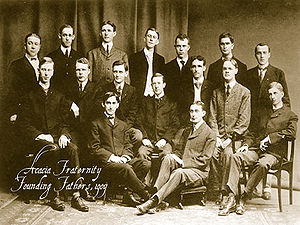
Acacia Fraternity was founded on May 12, 1904 by a group of 14 Freemasons attending the University of Michigan at Ann Arbor. 13 of the founders were Christians and one was Jewish. The first chapter was designated the Aleph(א) chapter. Subsequent chapters of Acacia were designated by Hebrew letters
Hebrew alphabet
The Hebrew alphabet , known variously by scholars as the Jewish script, square script, block script, and because of its place of origin, the Assyrian script is the better-known of two script standards used to write the...

 until 1913 when this system was replaced by naming each chapter by the school in which it resides (e.g., the Acacia chapter at Rensselaer Polytechnic Institute
Rensselaer Polytechnic Institute
Rensselaer Polytechnic Institute, or RPI, is a private research university located in Troy, New York, United States.RPI was founded in 1824 by Stephen Van Rensselaer for the "application of science to the common purposes of life", and is the oldest technological university in the English-speaking...

 is designated the Rensselaer Chapter of The Acacia Fraternity). Likewise, the Chapter at the University of Missouri-Columbia has historically been called the Mem chapter, 13 in Hebrew respectively, but is more commonly referred to as the Missouri Chapter. Acacia Fraternity became International in 1988 at the 45th Conclave with the petitioning of two Canadian chapters the University of Western Ontario
University of Western Ontario
The University of Western Ontario is a public research university located in London, Ontario. It was founded in 1878 by Bishop Isaac Hellmuth of Bishop's University and the Anglican Diocese of Huron as The Western University of London Ontario.Huron College, established in 1863 as an Anglican...

 Chapter and the Carleton University
Carleton University
Carleton University is an international, comprehensive university located in Canada's capital of Ottawa, Ontario. Founded as a small college in 1942, Carleton now offers over 65 programs in a diverse range of disciplines, including public affairs, journalism, film studies, engineering, high...

 Chapter.
The Acacia flag was adopted in 1950. It consists of a vertical triband of gold-black-gold with the fraternity arms on the center (or on a fess cotised sable three right triangles of the field) and the name in gold Old English lettering in an arc at the top.

Founding members


The founding members of the Acacia Fraternity are:

James M. Cooper,
Benjamin E. DeRoy,
Edward E. Gallup,
Jared W. Hawkins,
Clarence G. Hill,
Harvey J. Howard,
George A. Malcolm
George A. Malcolm
George A. Malcolm was an American lawyer who emerged as an influential figure in the development of the practice of law in the Philippines in the 20th century. At age 35, he was appointed Associate Justice of the Supreme Court of the Philippines, where he would serve for 19 years...

,
William J. Marshall,
Ernest R. Ringo,
Harlan P. Rowe,
Ralph B. Scatterday,
Charles A. Sink,
Harry B. Washburn,
Walter S. Wheeler

Symbolism


Symbolism
Symbolism
Symbolism is the use of symbols to represent things such as ideas and emotions. Symbolism is sometimes used to refer specifically to totemic symbols that stand on their own, as opposed to linguistic symbols....

 is very important in any fraternity, and Acacia is no different. The main symbol and representation of Acacia occurs within a 3-4-5 (base
Triangle
A triangle is one of the basic shapes of geometry: a polygon with three corners or vertices and three sides or edges which are line segments. A triangle with vertices A, B, and C is denoted ....

-altitude
Altitude (triangle)
In geometry, an altitude of a triangle is a straight line through a vertex and perpendicular to the opposite side or an extension of the opposite side. The intersection between the side and the altitude is called the foot of the altitude. This opposite side is called the base of the altitude...

-hypotenuse
Hypotenuse
A hypotenuse is the longest side of a right triangle , the side opposite the right angle. The length of the hypotenuse of a right triangle can be found using the Pythagorean theorem, which states that the square of the length of the hypotenuse equals the sum of the squares of the lengths of the...

)
right triangle
Right triangle
A right triangle or right-angled triangle is a triangle in which one angle is a right angle .-Terminology:...

 of the first quadrant. This triangle holds very special significance to the fraternity and its members. Unless specified otherwise, whenever a triangle is mentioned in this article, a 3-4-5 right triangle
Right triangle
A right triangle or right-angled triangle is a triangle in which one angle is a right angle .-Terminology:...

 of the first quadrant is what is meant.

The present Acacia badge
Heraldic badge
In heraldry, a badge is an emblem or personal device used to indicate allegiance to or property of an individual or family.Physical badges were common in the Middle Ages particularly in England. They would be made of base metal and worn on the clothing of the followers of the person in question....

 is a right triangle of the first quadrant whose sides are of the proportions 3, 4, 5, with the shortest side being the base. The sides are set with twelve pearls—three on the base, four on the altitude, and five on the hypotenuse. The corners are set with garnets. Within the triangle are three small right triangles of the same proportion, outlined in gold on a black enamel background. The badge of Acacia as it appears today was adopted at the second Grand Council of Acacia, which was held on December 6, 1913.

The crest
Crest (heraldry)
A crest is a component of an heraldic display, so called because it stands on top of a helmet, as the crest of a jay stands on the bird's head....

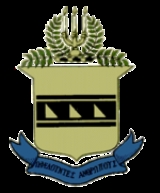
 of Acacia, shown above, depicts a three taper candelabrum surrounded by a wreath of Acacia
Acacia
Acacia is a genus of shrubs and trees belonging to the subfamily Mimosoideae of the family Fabaceae, first described in Africa by the Swedish botanist Carolus Linnaeus in 1773. The plants tend to be thorny and pod-bearing, with sap and leaves typically bearing large amounts of tannins...

. Below the candelabrum is a shield of old gold with two bands of black surrounding a thicker band of black. In this thicker band of black there reside three 3-4-5 right triangle
Right triangle
A right triangle or right-angled triangle is a triangle in which one angle is a right angle .-Terminology:...

s. Below the shield is a blue ribbon holding the motto of the fraternity in Greek
Ancient Greek
Ancient Greek is the historical stage in the development of the Greek language spanning across the Archaic , Classical , and Hellenistic periods of ancient Greece and the ancient world. It is predated in the 2nd millennium BC by Mycenaean Greek...

:
ΩΦΕΛΟΥΝΤΕΣ ΑΝΘΡΩΠΟΥΣ, which means "Human Service" or "In Service of Humanity".

International Operations


Acacia Fraternity's International Councilhttp://acacia.org/about_intlcouncil.htm serves as the organization's supreme executive and judicial body. It is composed of eight officers: six alumni and two undergraduates. Alumni officers' terms run four years, while undergraduate counselors' terms are two years in length.

The Acacia Fraternity Foundation (AFF)http://acacia.org/aff_main.htm, founded in 1989, is Acacia Fraternity's non-profit educational foundation. A 501(c)(3) tax-exempt organization, the AFF exists to provide scholarships to student Acacians and to support the worthy educational and leadership activities of the fraternity.

International Events


In even numbered years, a selected chapter of The Acacia Fraternity hosts the biennial conclave, forming the legislative body of the fraternity. Each chapter in good standing is allowed two votes (usually the Venerable Dean and Chapter Advisor). In odd numbered years, Acacia's Indiana Chapter hosts the Acacia Leadership Academy (ALA).

Chapter Operations


The leadership of each chapter of Acacia is composed of at least five major officers: the Venerable Dean, Senior Dean, Junior Dean, Treasurer, and Secretary. Most chapters also include in some capacity a Director of Service and Philanthropy, Director(s) of Recruitment, and Risk Manager. The Venerable Dean is often referred to out of the house as the president of the chapter and performs such duties as running meetings and overseeing general house operations. The Senior Dean acts as the vice president of the chapter, stepping in for the Venerable Dean in his absence. In most cases, the Senior Dean is also the pledge educator. The Junior Dean is in charge of all socials including brotherhood events, formals, and mixers. The other two officers perform such functions as are normal for their positions. Some chapters assign additional responsibilities to various officers, so there may be slight variations from chapter to chapter.

Politics & Government

  • Conrad G Selvig Minnesota 1906 - US Congressmen, Minnesota
  • Harry 'Skillet' Leslie Purdue 1907 - Governor of Indiana
  • William Jennings Bryan
    William Jennings Bryan
    William Jennings Bryan was the Democratic Party nominee for President of the United States in 1896, 1900 and 1908, a lawyer, and the 41st United States Secretary of State under President Woodrow Wilson. One of the most popular speakers in American history, he was noted for a deep, commanding voice...

    , Nebraska 1908 - Secretary of State under Woodrow Wilson, Orator
  • Clarence M Young, Yale 1910 - Assistant Secretary of Commerce for Aeronautics, Appointed by President Hoover.
  • William Howard Taft
    William Howard Taft
    William Howard Taft was the 27th President of the United States and later the 10th Chief Justice of the United States....

    , Yale 1913 - 27th President of the United States of America
  • Paul V. McNutt
    Paul V. McNutt
    Paul Vories McNutt was an American politician who served as governor of Indiana during the Great Depression, high commissioner to the Philippines, administrator of the Federal Security Agency, chairman of the War Manpower Commission and ambassador to the Philippines.-Family and education:Paul V...

    , Harvard 1914 - Governor of Indiana
  • David Sholtz
    David Sholtz
    David Sholtz was the twenty-sixth governor of Florida.- Early life and Education :Sholtz was born to Jewish parents in Brooklyn, New York, and after graduating from Yale in 1914 he went on and earned a law degree from Stetson University Law School. With his law degree, he started a law practice in...

    , Yale 1914 - Governor of Florida
  • Arthur Capper
    Arthur Capper
    Arthur Capper was an American politician from Kansas. He was Governor of Kansas from 1915 to 1919 and a United States Senator from 1919 to 1949....

    , Kansas State 1916 - Governor and US Senator, Kansas
  • Wilburn Cartwright
    Wilburn Cartwright
    Wilburn Cartwright was a lawyer, educator, U.S. Representative from Oklahoma, and United States Army officer in World War II...

    , Oklahoma 1920 - US Congressmen, Oklahoma
  • Francis H Case, Northwestern 1923 - US Congressmen, South Dakota
  • Wendell Berge, Nebraska 1924 - US Assistant Attorney General
  • Ralph Yarborough, Texas 1926 - US Senator, Texas
  • Ovie Clark Fisher, Texas 1926 - US Congressman, Texas, Writer
  • John Moore Allison, Nebraska 1927 - Diplomat, Ambassador to Japan, Assistant Secretary of State under Truman
  • William G Bray, Indiana 1927 - US Congressman, Indiana
  • Homer Thornberry
    Homer Thornberry
    William Homer Thornberry was a United States Representative from the 10th congressional district of Texas from 1948 to 1963, and then was a federal judge.-Biography:...

    , Texas 1930 - US Congressmen, Texas
  • J. Edward Hutchinson
    Edward Hutchinson
    J. Edward Hutchinson was a politician from the U.S. state of Michigan.Hutchinson was born in Fennville, Michigan and graduated from Fennville High School in 1932, and from the University of Michigan in Ann Arbor in 1936...

    , Michigan 1933 - US Congressmen, Michigan
  • Frank Carlson
    Frank Carlson
    Frank Carlson was an American politician who served as thirtieth Governor of Kansas and United States Representative and United States Senator from Kansas.-Biography:...

    , Kansas State 1948 - US Congressmen, US Senator, Governor of Kansas
  • Homer E Capehart
    Homer E. Capehart
    Homer Earl Capehart , American business innovator and politician, was born in Algiers, Indiana, in Pike County. During the First World War, he served as a Sergeant in the United States Army Supply Corps, but was never sent overseas.Capehart attained fame as the father of the jukebox industry...

    , Indiana 1959 - US Senator, Indiana
  • James 'Jim' Kolbe
    Jim Kolbe
    James Thomas "Jim" Kolbe is a former Republican member of the United States House of Representatives from Arizona, serving from 1985 to 2007.-Early life:...

    , Northwestern 1961 - US House Representative, Arizona
  • Steve Scalise
    Steve Scalise
    Stephen Joseph "Steve" Scalise is a Representative of the United States House of Representatives from Louisiana's 1st congressional district. Previous to his Congressional service Scalise served in the Louisiana State Senate for five months in 2008 and the Louisiana House for the preceding twelve...

    , LSU 1986 - Current US Congressmen, Louisiana
  • Jim Watson
    Jim Watson
    James Alexander Watson is a politician in Ontario, Canada. He is a former Ottawa city councillor and mayor , and currently represents the riding of Ottawa West—Nepean in the Legislative Assembly of Ontario and is a Minister in the Cabinet of Premier Dalton McGuinty.-Early life:Mr...

     (Honorary), Carleton University 1998 - Member of Provincial Parliament (Minister), Canada

Sports

  • Chester L Brewer
    Chester Brewer
    Chester L. Brewer was a college football, baseball, track, and basketball coach and athletic director. From 1903 to 1910, and from 1917 to 1919, he coached at Michigan State, where he compiled a 58-23-7 record, making him one of the school's most prolific coaches...

    , Missouri 1911 - Past head football coach at both Missouri and Michigan State, past Athletic Director of Missouri
  • Thomas E Jones, Wisconsin 1913 - Hall of Fame Track Coach
  • John L Griffith, Illinois 1921 - Past Commissioner of what is now the Big Ten Conference
  • Edwin Weir
    Ed Weir
    Samuel Edwin Weir was the first Nebraska Cornhusker football player elected to the College Football Hall of Fame and is known as one of Nebraska's greatest athletes. In 2005 the Omaha World-Herald, as part of a series on the 100 Greatest Athletes of Nebraska, named Weir the 19th best athlete in...

    , Nebraska 1925 - Hall of Fame college football player
  • Addison 'Kayo' Exum Warren, North Carolina 1927 - Professional and Collegiate Boxer
  • Jack Van Bebber
    Jack van Bebber
    Jack van Bebber was an American wrestler and olympic champion. He competed at the 1932 Olympic Games in Los Angeles, where he received a gold medal in freestyle welterweight....

    , Oklahoma State 1931 - Olympic wrestler
  • Calvin Griffith
    Calvin Griffith
    Calvin Robertson Griffith , born Calvin Robertson in Montreal, Canada, was a Major League Baseball team owner . He was famous for his devotion to the game and for his sayings....

    , George Washington 1935 - Owner of Washington Senators/ Minnesota Twins
  • Arthur L Valpey, Michigan 1936 - Head football coach of Harvard and UConn
  • Thomas “Tommy” James, Ohio State 1942 - Professional football player, Cleavland Browns
  • Dee Andros
    Dee Andros
    Demosthenes "Dee" Konstandies Andrecopoulos was an American football player and coach. He was the head coach for the University of Idaho from 1962-64, and for Oregon State University from 1965-75...

    , Oklahoma 1948 - Head football coach and athletic director, Oregon State
  • Gene Conley
    Gene Conley
    Donald Eugene Conley is a former Major League Baseball pitcher who played eleven seasons from to for four different teams. Conley also played forward in the 1952-1953 season and from 1958 to 1964 for two teams in the National Basketball Association...

    , Washington State 1949 - Professional Baseball Player and Basketball Player
  • Roger Nelson, Oklahoma 1951 - Canadian Football Hall of Fame
  • Richard ‘Dick’ Farley
    Dick Farley (basketball)
    Richard L. Farley was an American professional basketball player.A 6'4" guard/forward from Winslow, Indiana, Farley played for the 1953 Indiana University national championship team...

    , Indiana 1951 - Star IU Basketball player for the 1953 National Championship team, NBA player
  • David 'Wes' Santee, Kansas 1952 - Olympic runner
  • Clive A Follmer, Illinois 1953 - 1953 Big 10 Athlete of the Year, professional baseball player
  • Frank Allen Indiana 1956 - Former IU Athletic Director
  • Paul Coward, Purdue 1956 - All-America soccer player
  • Ron Fairly
    Ron Fairly
    Ronald Ray Fairly is a former Major League Baseball player and broadcaster. He has either played in or broadcast over 7,000 major league games from through .-College career:...

    , USC 1957 - Professional baseball player and broadcaster
  • Tony Crosby Texas 1963 - Star Kicker/Halfback for UT's 1963 National Championship football team
  • Pat Jones
    Pat Jones
    Pat Jones , is a former American football coach.Pat grew up in Little Rock and played linebacker/nose guard at Arkansas Tech before transferring to Arkansas...

     Oklahoma State - Head Football Coach at Oklahoma State, Assistant Coach of Miami Dolphins
  • Gary Patterson Kansas State 1980 - Head Football Coach, TCU (Current)

Business

  • Herbert A Kern, Minnesota 1914 - Founder Chicago Chemical Company, later changed to Nalco
  • Lewis H Wentz, Oklahoma 1927 - Oil businessman
  • J. Dennis Bassett, Kansas State 1956 - President, Worldwide Poultry/ Cargill Co.
  • Robert Pfahl, Cornell 1958 - VP of iNEML, recipient of Electronic Goes Green Award
  • Edgar H Grubb, Penn State 1959 - Executive VP and CFO, Transamerica Corp.
  • Leonard ‘Lee’ Kearney, Oregon State 1959 - Senior Executive, Peter Kiewit Sons’ Construction
  • Robert Forney, Indiana 1960 - Former President of Chicago Stock Exchange, current President Global Foodbank Network
  • David Baum, Indiana 1961 - President, SSI Technologies Inc.
  • Dennis Chookaszian, Northwestern 1962 - Chairman & CEO, CAN Insurance Companies
  • Kriss Cloninger III, Texas 1966 - President & CEO, Aflac
  • John F Hoffner, Purdue 1966 - Executive VP and CFO, Jack in the Box Inc.
  • Edward S Knight, Texas 1971 - Executive VP & General Counsel, NASDAQ Stock Market, Inc.
  • William H Strong, Purdue 1971 - Vice Chairman, Morgan Stanley
  • Andy Westlund, Oregon State 1971 - VP of Global Logistics, Amazon.com
  • Ronald Kase, Purdue 1978 - Venture capitalist, NEA
  • Cameron G Herold, Carleton 1988 - COO of 1-800-GOT-JUNK

Higher Education

  • Roscoe Pound
    Roscoe Pound
    Nathan Roscoe Pound was a distinguished American legal scholar and educator.-Early life:Pound was born in Lincoln, Nebraska, USA to Stephen Bosworth Pound and Laura Pound....

    , Nebraska 1905, Harvard 1913 - Educator, Bushnell Hall at KSU dedicated in his name
  • Albert B Storms, Iowa State 1909 - President, Iowa State University
  • Walter Williams, Missouri 1909 - President, University of Missouri; founder of Missouri School of Journalism
  • Arthur Simeon Watts, Ohio State 1911 - Educator, Watts Hall dedicated in his name at Ohio State
  • Leland David Bushnell, Kansas State 1913 - Educator, Bushnell Hall at KSU dedicated in his name
  • Audrey A Potter, Kansas State 1920 - Educator in field of engineering, buildings dedicated in his name at Purdue and Purdue-Calumet
  • Ernest H Hahne, Nebraska 1921 - Past President of Miami University (Ohio), Hahne Hall dedicated in his name
  • Bland L Stradley, Ohio State 1921 - Educator, Stradley Hall is dedicated to his name at Ohio State
  • Raymond A Pearson, Iowa State 1924 - President, Iowa State University
  • Stratton D Brooks, Missouri 1925 - President of University of Oklahoma (1912) and University of Missouri (1923)
  • Samuel Justus McKinley, Harvard 1928 - Past President of Emerson College, Boston
  • Burton W Gorman, Indiana 1930 - Educator, Burton W Gorman Teaching Award is dedicated in his name
  • William L Henning, Wisconsin 1931 - Educator, Henning Building dedicated in his name at Penn State
  • Charles E MacQuigg, Cornell 1935 - Educator, MacQuigg Hall dedicated in his name at Ohio State
  • Robert E Vivian, USC 1947 - Educator, Vivian Hall dedicated in his name at USC
  • Claude R Sowle, Northwestern 1947 - Past President of Ohio University
  • L. Dennis Smith, Indiana 1956 - President Emeritus, University of Nebraska
  • Ken Schwab, Purdue 1966 - President, Centenary College

Science

  • William F Durand, Stanford 1904 - NASA pioneer
  • Wallace E Pratt, Kansas 1907- Pioneer in petroleum field
  • Wheeler P Davey, Penn State 1910 - X-ray pioneer, Davey Lab dedicated in his name at Penn State
  • F. Alexander Wetmore, Kansas 1912 - World-renowned ornithologist
  • Karl M Dallenbach, Cornell 1913 - Internationally renowned psychologist
  • Emmett B Carmichael, Colorado 1918 - Renowned chemist
  • Harold E. Edgerton, Nebraska 1924 - Pioneer in electronic flash, pertaining to photography
  • Lloyd Berkner, Minnesota 1926 - Renowned physicist
  • Theodore P Hall, Syracuse 1927 - Pioneer in airplane design
  • James E. Webb
    James E. Webb
    James Edwin Webb was the second administrator of NASA, serving from 14 February 1961 to 7 October 1968.Webb oversaw NASA from the beginning of the Kennedy administration through the end of the Johnson administration, thus overseeing all the critical first manned launches in the Mercury through...

    , North Carolina 1927 - High-ranking NASA official in 60’s
  • Jack Kilby
    Jack Kilby
    Jack St. Clair Kilby was a Nobel Prize laureate in physics in 2000 for his invention of the integrated circuit in 1958 while working at Texas Instruments . He is also the inventor of the handheld calculator and thermal printer.-Biography:Kilby's life began in Great Bend, Kansas where he grew up...

    , Illinois 1942 - Nobel Prize laureate in physics, inventor of the integrated circuit
  • Laurence Snyder, Oklahoma 1949 - Pioneer in genetics
  • David Fischell Cornell 1972 - Biomedical engineer, inventor of the heart-stent

Arts & Entertainment


Miscellaneous or Multiple

  • Walter Elmer Ekblaw
    Walter Elmer Ekblaw
    Walter Elmer Ekblaw , was a geology professor who taught at the University of Illinois from 1910-1913. He is credited as the founder of the concept of Homecoming at universities. Ekblaw and Maurice Cole Tanquary were on the 1913 Crocker Land Expedition....

     Illinois 1907 - Originator of ‘Homecoming’
  • Hiram Bingham III
    Hiram Bingham III
    Hiram Bingham, formally Hiram Bingham III, was an American academic, explorer and politician. He rediscovered the Inca settlement of Machu Picchu in 1911...

    , Yale 1915 - Explorer, discovered Machu Picchu, US Senator
  • H. L. 'Tom' Sebring, Kansas State 1920 - Judge for Nuremberg Trials; Head football coach University of Florida
  • David P Osborne, Penn State 1935 - Naval Surgeon, performed the JFK autopsy, worked on LBJ
  • Clifton Hillegass
    Clifton Hillegass
    Clifton K. Hillegass was the creator and publisher ofCliffsNotes.CliffsNotes are literary study guides in their familiar black and yellow covers that assist college and high school students in their literature course work. There are currently about 300 titles available in 7,000 retail outlets...

    , Nebraska 1938 - Creator of CliffsNotes
  • Frank S. Land
    Frank S. Land
    Frank Sherman "Dad" Land was the Founder of the Order of DeMolay. A business and community leader in Kansas City, Land served as Imperial Potentate of the Shriners and is revered today as the Founder of DeMolay....

    , Missouri - Founder of DeMolay

External links