

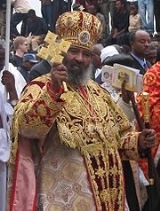
Abuna

Encyclopedia
Also see Leaders of Christianity
Abun (in Europe erroneously known as Abuna , which is the status constructus form used when a name follows: Ge'ez
አቡነ ’abuna/abune, 'our father'; Amh.
, Tgn.
) is the honorific title used for any bishop of the Ethiopian Orthodox Tewahedo Church
as well as of the Eritrean Orthodox Tewahedo Church. It was historically used solely for the head of the Coptic Orthodox Church in Ethiopia during the thousand plus years when the Patriarchate of Alexandria only appointed one bishop at a time to serve its Ethiopian flock. When referred to without a name following, it is Abun, and if a name follows, it becomes Abuna ... (e.g., Abuna Pawlos).
and the rest of Africa, at the request of the Emperor -- and, in historic times, after paying a substantial fee to the Muslim government for the privilege. The Abun would be selected from the membership of the Monastery of Saint Anthony
. Although several Abuns might be appointed at one time, a request in 1140 to appoint enough to consecrate a metropolitan was refused.
The candidate frequently lacked not only knowledge of the native language but was unfamiliar with the local customs of the Ethiopian church. As a result, most Abuns had a minimal influence on both Ethiopian religion and politics. His authority eventually was filled in ecclesiastical matters by the Ichege or Abbot of the Monastery of Debre Libanos
in Shewa, the sole possessor of this particular title in Ethiopia. (This title is now customarily held by the patriarch of the Ethiopian Orthodox Tewahedo Church.)
Visitors to Ethiopia at this time, such as Francisco Álvares
in the 16th century and Remedius Prutky in the 18th century, were amazed at the mass ordination of deacon
s and priest
s with little more than a wave of the cross and a prayer -- which was the Abuns principal duty.
After many centuries, Emperor Haile Selassie I of Ethiopia, the last reigning Orthodox Christian monarch in the world, reached an agreement with the Coptic Orthodox Church in Alexandria, Egypt, on 13 July 1948. This led to the promotion of the Church of Ethiopia to the rank of an autocephalous
Patriarch
ate. Five bishops were immediately consecrated by the Coptic Orthodox Pope of Alexandria. They later elected an Ethiopian patriarch for their church following the death of Abuna Qerellos IV, the last Copt to lead the Church of Ethiopia. The first Patriarch of Ethiopia was Abuna Basilios
, who was consecrated 14 January 1951.
The current Patriarch of Ethiopia is Abune Paulos
.
The Syriac-Aramaic
word ܐܒܘܢܐ Abuna is used for bishops by Syriac Churches
, literally meaning 'our father'.
Abuna (Syriac
: ܐܒܘܢܐ Abuna, Arabic
: أبونا ’abūnā, literally 'our father') is also a title used among Syriac Christians to refer to a priest
. The title is used either by itself, or with the priest's given name, for example 'Abuna Tuma' for 'Father Thomas'. This title is not used in self-reference, rather the priest would refer to himself as al-Ab (الأب al-’ab, literally 'the father').
Abun (in Europe erroneously known as Abuna , which is the status constructus form used when a name follows: Ge'ez
Ge'ez alphabet
Ge'ez , also called Ethiopic, is a script used as an abugida for several languages of Ethiopia and Eritrea but originated in an abjad used to write Ge'ez, now the liturgical language of the Ethiopian and Eritrean Orthodox Church...
አቡነ ’abuna/abune, 'our father'; Amh.
Amharic language
Amharic is a Semitic language spoken in Ethiopia. It is the second most-spoken Semitic language in the world, after Arabic, and the official working language of the Federal Democratic Republic of Ethiopia. Thus, it has official status and is used nationwide. Amharic is also the official or working...
, Tgn.
Tigrinya language
Tigrinya , also spelled Tigrigna, Tigrnia, Tigrina, Tigriña, less commonly Tigrinian, Tigrinyan, is a Semitic language spoken by the Tigrinya people in central Eritrea , where it is one of the two main languages of Eritrea, and in the Tigray Region of Ethiopia , where it...
) is the honorific title used for any bishop of the Ethiopian Orthodox Tewahedo Church
Ethiopian Orthodox Tewahedo Church
The Ethiopian Orthodox Tewahedo Church is the predominant Oriental Orthodox Christian church in Ethiopia. The Ethiopian Church was administratively part of the Coptic Orthodox Church until 1959, when it was granted its own Patriarch by Coptic Orthodox Pope of Alexandria and Patriarch of All...
as well as of the Eritrean Orthodox Tewahedo Church. It was historically used solely for the head of the Coptic Orthodox Church in Ethiopia during the thousand plus years when the Patriarchate of Alexandria only appointed one bishop at a time to serve its Ethiopian flock. When referred to without a name following, it is Abun, and if a name follows, it becomes Abuna ... (e.g., Abuna Pawlos).
History
Historically the Abun of the Ethiopian Church was appointed by the Pope of Alexandria and Patriarch of All Africa, who had diocesan authority over EthiopiaEthiopia
Ethiopia , officially known as the Federal Democratic Republic of Ethiopia, is a country located in the Horn of Africa. It is the second-most populous nation in Africa, with over 82 million inhabitants, and the tenth-largest by area, occupying 1,100,000 km2...
and the rest of Africa, at the request of the Emperor -- and, in historic times, after paying a substantial fee to the Muslim government for the privilege. The Abun would be selected from the membership of the Monastery of Saint Anthony
Monastery of Saint Anthony
The Monastery of Saint Anthony is a Coptic Orthodox monastery standing in an oasis in the Eastern Desert of Egypt, in the southern part of the Suez Governorate. Hidden deep in the Red Sea mountains, it is located southeast of Cairo. It is one of the oldest monasteries in the world, together with...
. Although several Abuns might be appointed at one time, a request in 1140 to appoint enough to consecrate a metropolitan was refused.
The candidate frequently lacked not only knowledge of the native language but was unfamiliar with the local customs of the Ethiopian church. As a result, most Abuns had a minimal influence on both Ethiopian religion and politics. His authority eventually was filled in ecclesiastical matters by the Ichege or Abbot of the Monastery of Debre Libanos
Debre Libanos
Debre Libanos is a monastery in Ethiopia, lying northwest of Addis Ababa in the Oromia Region. Founded in the thirteenth century by Saint Tekle Haymanot, the monastery's chief abbot, called the Ichege, was the second most powerful official in the Ethiopian Church after the Abuna.The monastery...
in Shewa, the sole possessor of this particular title in Ethiopia. (This title is now customarily held by the patriarch of the Ethiopian Orthodox Tewahedo Church.)
Visitors to Ethiopia at this time, such as Francisco Álvares
Francisco Álvares
Francisco Álvares was a Portuguese missionary and explorer. In 1515 he traveled to Ethiopia as part of the Portuguese embassy to emperor Lebna Dengel accompanied by returning Ethiopian ambassador Matheus. The embassy arrived only in 1520 to Ethiopia where he joined long sought Portuguese envoy...
in the 16th century and Remedius Prutky in the 18th century, were amazed at the mass ordination of deacon
Deacon
Deacon is a ministry in the Christian Church that is generally associated with service of some kind, but which varies among theological and denominational traditions...
s and priest
Priest
A priest is a person authorized to perform the sacred rites of a religion, especially as a mediatory agent between humans and deities. They also have the authority or power to administer religious rites; in particular, rites of sacrifice to, and propitiation of, a deity or deities...
s with little more than a wave of the cross and a prayer -- which was the Abuns principal duty.
After many centuries, Emperor Haile Selassie I of Ethiopia, the last reigning Orthodox Christian monarch in the world, reached an agreement with the Coptic Orthodox Church in Alexandria, Egypt, on 13 July 1948. This led to the promotion of the Church of Ethiopia to the rank of an autocephalous
Autocephaly
Autocephaly , in hierarchical Christian churches and especially Eastern Orthodox and Oriental Orthodox churches, is the status of a hierarchical church whose head bishop does not report to any higher-ranking bishop...
Patriarch
Patriarch
Originally a patriarch was a man who exercised autocratic authority as a pater familias over an extended family. The system of such rule of families by senior males is called patriarchy. This is a Greek word, a compound of πατριά , "lineage, descent", esp...
ate. Five bishops were immediately consecrated by the Coptic Orthodox Pope of Alexandria. They later elected an Ethiopian patriarch for their church following the death of Abuna Qerellos IV, the last Copt to lead the Church of Ethiopia. The first Patriarch of Ethiopia was Abuna Basilios
Abuna Basilios
His Holiness Abuna Basilios was the first Ethiopian born Archbishop or Abuna, and later the first Patriarch, of the Ethiopian Church.-Early life :...
, who was consecrated 14 January 1951.
The current Patriarch of Ethiopia is Abune Paulos
Abune Paulos
Abune Paulos is Abuna and Patriarch of the Ethiopian Orthodox Tewahedo Church . His full title is "His Holiness Abuna Paulos, Fifth Patriarch and Catholicos of Ethiopia, Ichege of the See of St...
.
The Syriac-Aramaic
Syriac language
Syriac is a dialect of Middle Aramaic that was once spoken across much of the Fertile Crescent. Having first appeared as a script in the 1st century AD after being spoken as an unwritten language for five centuries, Classical Syriac became a major literary language throughout the Middle East from...
word ܐܒܘܢܐ Abuna is used for bishops by Syriac Churches
Syriac Christianity
Syriac or Syrian Christianity , the Syriac-speaking Christians of Mesopotamia, comprises multiple Christian traditions of Eastern Christianity. With a history going back to the 1st Century AD, in modern times it is represented by denominations primarily in the Middle East and in Kerala, India....
, literally meaning 'our father'.
Abuna (Syriac
Syriac language
Syriac is a dialect of Middle Aramaic that was once spoken across much of the Fertile Crescent. Having first appeared as a script in the 1st century AD after being spoken as an unwritten language for five centuries, Classical Syriac became a major literary language throughout the Middle East from...
: ܐܒܘܢܐ Abuna, Arabic
Arabic language
Arabic is a name applied to the descendants of the Classical Arabic language of the 6th century AD, used most prominently in the Quran, the Islamic Holy Book...
: أبونا ’abūnā, literally 'our father') is also a title used among Syriac Christians to refer to a priest
Priest
A priest is a person authorized to perform the sacred rites of a religion, especially as a mediatory agent between humans and deities. They also have the authority or power to administer religious rites; in particular, rites of sacrifice to, and propitiation of, a deity or deities...
. The title is used either by itself, or with the priest's given name, for example 'Abuna Tuma' for 'Father Thomas'. This title is not used in self-reference, rather the priest would refer to himself as al-Ab (الأب al-’ab, literally 'the father').
See also
- Ab (Semitic)Ab (Semitic)Ab means "father" in most Semitic languages, sometimes extended to Abba or Aba.-Arabic:Ab , from a theoretical, abstract form ʼabawun is Arabic for "father"...
- Ethiopian aristocratic and religious titles
- List of Abunas of Ethiopia