

Aardwolf

Encyclopedia
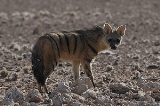
The aardwolf is a small, insectivorous
mammal
, native to Eastern
and Southern Africa
. The name means "earth wolf" in Afrikaans
/Dutch
. It is also called "maanhaar jackal". It is related to hyenas, but unlike its relatives, it does not hunt large prey. This unusual animal preys on insects. It feeds mainly on termite
s and can eat more than 200,000 in a single night, using its long, sticky tongue to collect them.
The aardwolf is the only surviving species of the subfamily Protelinae. Two subspecies are recognized: Proteles cristatus cristatus of Southern Africa
, and Proteles cristatus septentrionalis of eastern
and northeastern Africa. It is usually placed in the Hyaenidae, though formerly separated into the family Protelidae. The aardwolf lives in the scrublands of eastern and southern Africa. These are the areas of land covered with stunted trees or shrub
s. The aardwolf hides in a burrow
during the day and comes out at night to search for food. Its diet almost completely consists of termites, other insect larva
e and carrion
.
. They have a more slender muzzle
, sharper ear
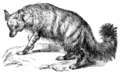
s utilized in the hunt for harvester termites, black vertical stripes on a coat of yellowish fur, and a long, distinct mane
down the middle line of the neck and back, which is raised during a confrontation to make the aardwolf appear bigger. It is 55–80 cm (22–31 in) long, excluding its bushy 20–30 cm (8–12 in) tail, stands about 40–50 cm (16–20 in) at the shoulder, and weighs between 9 and 14 kg (20–31 lb). Its front feet have 5 toes, unlike other hyenas which have four toes. Its teeth and skull are similar to that of the hyena, although the cheek teeth are specialised for eating insects, and its tongue for licking them up. As the aardwolf ages, it will normally lose some of its teeth, though this has little impact on their feeding habits due to the soft nature of the insects they consume. It has two glands at the rear that secrete a musky fluid for marking territory and communicating with other aardwolves.
, avoiding mountainous areas. Due to its specific food requirements, the animal is only found in regions where termites of the family Hodotermitidae occur. Termites of this family depend on dead and withered grass and are most populous in heavily grazed grassland
s and savannah
s, including farmland
. For most of the year, aardwolves spend time in shared territories consisting of up to a dozen dens which are occupied for six weeks at a time.
There are two distinct populations: one in Southern Africa, and another in East and Northeast Africa. The species does not occur in the intermediary miombo
forests.
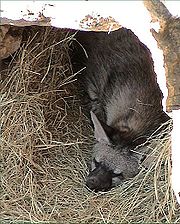 Aardwolves are shy and nocturnal
, sleeping in underground burrows by day. They usually use existing burrows of aardvark
s, porcupine
s or springhare
s, despite being capable of creating their own. By night, an aardwolf can consume up to 200,000 harvester termites using its sticky, long tongue. They take special care not to destroy the termite mound or consume the entire colony, which ensures that the termites can rebuild and provide a continuous supply of food. They will often memorise the location of such nests and return to them to save the trouble of finding a new one. They are also known to feed on other insects, larvae, and eggs, and occasionally small mammals and birds. Unlike other hyena
s, aardwolves do not scavenge or kill larger animals.
The adult aardwolf is primarily solitary while foraging for food, necessary because of the scarcity and homogeneous distribution of their insect prey. They have often been mistaken for solitary animals. In fact, they live as monogamous pairs, with their young, defending the same territory. Young aardwolves generally achieve sexual maturity
after two years, and the breeding season
varies depending on their location, but normally takes place during the autumn or spring. During the breeding season, unpaired male aardwolves will search their own territory as well as others' for a female to mate with. Dominant males will also mate opportunistically with the females of less dominant neighboring aardwolves. This can often result in conflict between two male aardwolves when one has wandered into another's territory. Gestation
lasts between 90 and 110 days, producing one to five cubs
(most often two or three) during the rainy season, when termites are active. The first six to eight weeks are spent in the den
with the mother. After three months, they begin supervised foraging and by four months are normally independent. However, they will often use the same den as their mother until the next breeding season. They can achieve a lifespan
of up to 15 years when in captivity
.
may create a negative impact on their population due to use of poisons by farmers. They are often considered useful, non-dangerous animals by farmers. However, in some areas the aardwolf is hunted for its fur. Encounters with dog
s are another threat.
}
}}
Entomophagy
Entomophagy is the consumption of insects as food. Insects are eaten by many animals, but the term is generally used to refer to human consumption of insects; animals that eat insects are known as insectivores...
mammal
Mammal
Mammals are members of a class of air-breathing vertebrate animals characterised by the possession of endothermy, hair, three middle ear bones, and mammary glands functional in mothers with young...
, native to Eastern
East Africa
East Africa or Eastern Africa is the easterly region of the African continent, variably defined by geography or geopolitics. In the UN scheme of geographic regions, 19 territories constitute Eastern Africa:...
and Southern Africa
Southern Africa
Southern Africa is the southernmost region of the African continent, variably defined by geography or geopolitics. Within the region are numerous territories, including the Republic of South Africa ; nowadays, the simpler term South Africa is generally reserved for the country in English.-UN...
. The name means "earth wolf" in Afrikaans
Afrikaans
Afrikaans is a West Germanic language, spoken natively in South Africa and Namibia. It is a daughter language of Dutch, originating in its 17th century dialects, collectively referred to as Cape Dutch .Afrikaans is a daughter language of Dutch; see , , , , , .Afrikaans was historically called Cape...
/Dutch
Dutch language
Dutch is a West Germanic language and the native language of the majority of the population of the Netherlands, Belgium, and Suriname, the three member states of the Dutch Language Union. Most speakers live in the European Union, where it is a first language for about 23 million and a second...
. It is also called "maanhaar jackal". It is related to hyenas, but unlike its relatives, it does not hunt large prey. This unusual animal preys on insects. It feeds mainly on termite
Termite
Termites are a group of eusocial insects that, until recently, were classified at the taxonomic rank of order Isoptera , but are now accepted as the epifamily Termitoidae, of the cockroach order Blattodea...
s and can eat more than 200,000 in a single night, using its long, sticky tongue to collect them.
The aardwolf is the only surviving species of the subfamily Protelinae. Two subspecies are recognized: Proteles cristatus cristatus of Southern Africa
Southern Africa
Southern Africa is the southernmost region of the African continent, variably defined by geography or geopolitics. Within the region are numerous territories, including the Republic of South Africa ; nowadays, the simpler term South Africa is generally reserved for the country in English.-UN...
, and Proteles cristatus septentrionalis of eastern
East Africa
East Africa or Eastern Africa is the easterly region of the African continent, variably defined by geography or geopolitics. In the UN scheme of geographic regions, 19 territories constitute Eastern Africa:...
and northeastern Africa. It is usually placed in the Hyaenidae, though formerly separated into the family Protelidae. The aardwolf lives in the scrublands of eastern and southern Africa. These are the areas of land covered with stunted trees or shrub
Shrub
A shrub or bush is distinguished from a tree by its multiple stems and shorter height, usually under 5–6 m tall. A large number of plants may become either shrubs or trees, depending on the growing conditions they experience...
s. The aardwolf hides in a burrow
Burrow
A burrow is a hole or tunnel dug into the ground by an animal to create a space suitable for habitation, temporary refuge, or as a byproduct of locomotion. Burrows provide a form of shelter against predation and exposure to the elements, so the burrowing way of life is quite popular among the...
during the day and comes out at night to search for food. Its diet almost completely consists of termites, other insect larva
Larva
A larva is a distinct juvenile form many animals undergo before metamorphosis into adults. Animals with indirect development such as insects, amphibians, or cnidarians typically have a larval phase of their life cycle...
e and carrion
Carrion
Carrion refers to the carcass of a dead animal. Carrion is an important food source for large carnivores and omnivores in most ecosystems. Examples of carrion-eaters include vultures, hawks, eagles, hyenas, Virginia Opossum, Tasmanian Devils, coyotes, Komodo dragons, and burying beetles...
.
Physical characteristics
The aardwolf looks somewhat like a very small Striped HyenaStriped Hyena
The Striped Hyena is a species of true hyena native to North and East Africa, the Caucasus, the Middle East, Middle and Central Asia and the Indian Subcontinent...
. They have a more slender muzzle
Snout
The snout, or muzzle, is the protruding portion of an animal's face, consisting of its nose, mouth, and jaw.-Terminology:The term "muzzle", used as a noun, can be ambiguous...
, sharper ear
Ear
The ear is the organ that detects sound. It not only receives sound, but also aids in balance and body position. The ear is part of the auditory system....
s utilized in the hunt for harvester termites, black vertical stripes on a coat of yellowish fur, and a long, distinct mane
Mane
- Biology :* mane of a horse, the line of hair along the spine of the neck* mane of a lion, found around the male mammal's neck- Places :* Mane Department, a department in the Sanmatenga Province of Burkina Faso* French communes:...
down the middle line of the neck and back, which is raised during a confrontation to make the aardwolf appear bigger. It is 55–80 cm (22–31 in) long, excluding its bushy 20–30 cm (8–12 in) tail, stands about 40–50 cm (16–20 in) at the shoulder, and weighs between 9 and 14 kg (20–31 lb). Its front feet have 5 toes, unlike other hyenas which have four toes. Its teeth and skull are similar to that of the hyena, although the cheek teeth are specialised for eating insects, and its tongue for licking them up. As the aardwolf ages, it will normally lose some of its teeth, though this has little impact on their feeding habits due to the soft nature of the insects they consume. It has two glands at the rear that secrete a musky fluid for marking territory and communicating with other aardwolves.
Distribution and habitat
The aardwolf lives on open, dry plains and bushlandBushland
Bushland is any area in Australia that is predominantly indigenous flora and fauna.Bushland is the term commonly used by conservation protection groups and other environmental groups as a blanket term for natural vegetation, which may cover any kind of habitat from open shrubby country with few...
, avoiding mountainous areas. Due to its specific food requirements, the animal is only found in regions where termites of the family Hodotermitidae occur. Termites of this family depend on dead and withered grass and are most populous in heavily grazed grassland
Grassland
Grasslands are areas where the vegetation is dominated by grasses and other herbaceous plants . However, sedge and rush families can also be found. Grasslands occur naturally on all continents except Antarctica...
s and savannah
Savannah
Savannah or savanna is a type of grassland.It can also mean:-People:* Savannah King, a Canadian freestyle swimmer* Savannah Outen, a singer who gained popularity on You Tube...
s, including farmland
Arable land
In geography and agriculture, arable land is land that can be used for growing crops. It includes all land under temporary crops , temporary meadows for mowing or pasture, land under market and kitchen gardens and land temporarily fallow...
. For most of the year, aardwolves spend time in shared territories consisting of up to a dozen dens which are occupied for six weeks at a time.
There are two distinct populations: one in Southern Africa, and another in East and Northeast Africa. The species does not occur in the intermediary miombo
Miombo
Miombo is the Swahili word for Brachystegia, a genus of tree comprising a large number of species. Miombo woodland is classified in the tropical and subtropical grasslands, savannas, and shrublands biome...
forests.
Behavior
Nocturnal animal
Nocturnality is an animal behavior characterized by activity during the night and sleeping during the day. The common adjective is "nocturnal"....
, sleeping in underground burrows by day. They usually use existing burrows of aardvark
Aardvark
The aardvark is a medium-sized, burrowing, nocturnal mammal native to Africa...
s, porcupine
Old World porcupine
The Old World porcupines, or Hystricidae, are large terrestrial rodents, distinguished by the spiny covering from which they take their name. They range over the south of Europe, most of Africa, India, and the Maritime Southeast Asia as far east as Borneo...
s or springhare
Springhare
The springhare , or springhaas, is not actually a hare, but a member of the order Rodentia. It is one of a number of species in the genus Pedetes, and is native to southern Africa. Synonyms are P. caffer or P...
s, despite being capable of creating their own. By night, an aardwolf can consume up to 200,000 harvester termites using its sticky, long tongue. They take special care not to destroy the termite mound or consume the entire colony, which ensures that the termites can rebuild and provide a continuous supply of food. They will often memorise the location of such nests and return to them to save the trouble of finding a new one. They are also known to feed on other insects, larvae, and eggs, and occasionally small mammals and birds. Unlike other hyena
Hyena
Hyenas or Hyaenas are the animals of the family Hyaenidae of suborder feliforms of the Carnivora. It is the fourth smallest biological family in the Carnivora , and one of the smallest in the mammalia...
s, aardwolves do not scavenge or kill larger animals.
The adult aardwolf is primarily solitary while foraging for food, necessary because of the scarcity and homogeneous distribution of their insect prey. They have often been mistaken for solitary animals. In fact, they live as monogamous pairs, with their young, defending the same territory. Young aardwolves generally achieve sexual maturity
Sexual maturity
Sexual maturity is the age or stage when an organism can reproduce. It is sometimes considered synonymous with adulthood, though the two are distinct...
after two years, and the breeding season
Breeding season
The breeding season is the most suitable season, usually with favourable conditions and abundant food and water, for breeding among some wild animals and birds . Species with a breeding season have naturally evolved to have sexual intercourse during a certain time of year in order to achieve the...
varies depending on their location, but normally takes place during the autumn or spring. During the breeding season, unpaired male aardwolves will search their own territory as well as others' for a female to mate with. Dominant males will also mate opportunistically with the females of less dominant neighboring aardwolves. This can often result in conflict between two male aardwolves when one has wandered into another's territory. Gestation
Gestation
Gestation is the carrying of an embryo or fetus inside a female viviparous animal. Mammals during pregnancy can have one or more gestations at the same time ....
lasts between 90 and 110 days, producing one to five cubs
Cubs
Cubs may refer to:*Chicago Cubs, a baseball team of the National League of Major League Baseball**Iowa Cubs, a minor league baseball team of the Pacific Coast League**Daytona Cubs, a minor league baseball team of the Florida State League...
(most often two or three) during the rainy season, when termites are active. The first six to eight weeks are spent in the den
Den
Den may refer to:*Den , a part of a house similar to the living room: a den is about the size of a living room, but smaller than a family room*Den , a Ukrainian newspaper*Den , a Pharaoh of Egypt...
with the mother. After three months, they begin supervised foraging and by four months are normally independent. However, they will often use the same den as their mother until the next breeding season. They can achieve a lifespan
Life expectancy
Life expectancy is the expected number of years of life remaining at a given age. It is denoted by ex, which means the average number of subsequent years of life for someone now aged x, according to a particular mortality experience...
of up to 15 years when in captivity
Captivity (animal)
Animals that live under human care are in captivity. Captivity can be used as a generalizing term to describe the keeping of either domesticated animals or wild animals. This may include for example farms, private homes and zoos...
.
Interaction with humans
AgricultureAgriculture
Agriculture is the cultivation of animals, plants, fungi and other life forms for food, fiber, and other products used to sustain life. Agriculture was the key implement in the rise of sedentary human civilization, whereby farming of domesticated species created food surpluses that nurtured the...
may create a negative impact on their population due to use of poisons by farmers. They are often considered useful, non-dangerous animals by farmers. However, in some areas the aardwolf is hunted for its fur. Encounters with dog
Dog
The domestic dog is a domesticated form of the gray wolf, a member of the Canidae family of the order Carnivora. The term is used for both feral and pet varieties. The dog may have been the first animal to be domesticated, and has been the most widely kept working, hunting, and companion animal in...
s are another threat.
External links
}
}}