
Home      Discussion      Topics      Dictionary      Almanac
Signup       Login
AMC Javelin

AMC Javelin

Overview
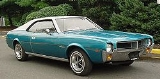
The AMC Javelin was a “pony car
Pony car
Pony car is an American class of automobile launched and inspired by the Ford Mustang in 1964. The term describes an affordable, compact, highly styled car with a sporty or performance-oriented image. "It was small by Detroit standards, with sporty styling.....

” built by the American Motors Corporation between 1968 and 1974.

Its production can be classified into two generations: 1968 to 1970 (with a separate design in 1970) and 1971 to 1974. Javelins competed successfully in Trans-Am
Trans-Am Series
The Trans-Am Series is an automobile racing series which was created in 1966 by the Sports Car Club of America . Originally known as the Trans-American Sedan Championship it has evolved over time from its original format as a manufacturers championship for modified racing sedans to its current form...

 racing and won the series with AMC sponsorship in 1971, 1972, and independently in 1975.

Javelins were assembled under license in Europe
Europe
Europe is, by convention, one of the world's seven continents. Comprising the westernmost peninsula of Eurasia, Europe is generally divided from Asia to its east by the water divide of the Ural Mountains, the Ural River, the Caspian Sea, the Caucasus Mountains , and the Black Sea to the southeast...

, Mexico
Mexico
The United Mexican States , commonly known as Mexico , is a federal constitutional republic in North America. It is bordered on the north by the United States; on the south and west by the Pacific Ocean; on the southeast by Guatemala, Belize, and the Caribbean Sea; and on the east by the Gulf of...

, and Australia
Australia
Australia , officially the Commonwealth of Australia, is a country in the Southern Hemisphere comprising the continental mainland , the island of Tasmania, and numerous smaller islands in the Indian and Pacific Oceans...

, and sold in other export markets.

The Javelin was a production version of one of the AMC AMX
AMC AMX
border=0 align=right|-|The AMX was a touring-sports car produced by American Motors Corporation between 1968 and 1970. More GT in style and approach than a true sports car, the muscular AMX was introduced to compete head-to-head with America's only other two-seater of the era, the Chevrolet...

 prototypes shown during the 1966 AMX project nationwide tour.
Discussion
Ask a question about 'AMC Javelin'
Start a new discussion about 'AMC Javelin'
Answer questions from other users
Full Discussion Forum
 
Encyclopedia
The AMC Javelin was a “pony car
Pony car
Pony car is an American class of automobile launched and inspired by the Ford Mustang in 1964. The term describes an affordable, compact, highly styled car with a sporty or performance-oriented image. "It was small by Detroit standards, with sporty styling.....

” built by the American Motors Corporation between 1968 and 1974.

Its production can be classified into two generations: 1968 to 1970 (with a separate design in 1970) and 1971 to 1974. Javelins competed successfully in Trans-Am
Trans-Am Series
The Trans-Am Series is an automobile racing series which was created in 1966 by the Sports Car Club of America . Originally known as the Trans-American Sedan Championship it has evolved over time from its original format as a manufacturers championship for modified racing sedans to its current form...

 racing and won the series with AMC sponsorship in 1971, 1972, and independently in 1975.

Javelins were assembled under license in Europe
Europe
Europe is, by convention, one of the world's seven continents. Comprising the westernmost peninsula of Eurasia, Europe is generally divided from Asia to its east by the water divide of the Ural Mountains, the Ural River, the Caspian Sea, the Caucasus Mountains , and the Black Sea to the southeast...

, Mexico
Mexico
The United Mexican States , commonly known as Mexico , is a federal constitutional republic in North America. It is bordered on the north by the United States; on the south and west by the Pacific Ocean; on the southeast by Guatemala, Belize, and the Caribbean Sea; and on the east by the Gulf of...

, and Australia
Australia
Australia , officially the Commonwealth of Australia, is a country in the Southern Hemisphere comprising the continental mainland , the island of Tasmania, and numerous smaller islands in the Indian and Pacific Oceans...

, and sold in other export markets.

1968–1969


The Javelin was a production version of one of the AMC AMX
AMC AMX
border=0 align=right|-|The AMX was a touring-sports car produced by American Motors Corporation between 1968 and 1970. More GT in style and approach than a true sports car, the muscular AMX was introduced to compete head-to-head with America's only other two-seater of the era, the Chevrolet...

 prototypes shown during the 1966 AMX project nationwide tour. Intended to rival other pony cars such as the Ford Mustang
Ford Mustang
The Ford Mustang is an automobile manufactured by the Ford Motor Company. It was initially based on the second generation North American Ford Falcon, a compact car. Production began in Dearborn, Michigan on March 9, 1964 and the car was introduced to the public on April 17, 1964 at the New York...

 and Chevrolet Camaro
Chevrolet Camaro
The Chevrolet Camaro is an automobile manufactured by the Chevrolet division of General Motors, classified as a pony car. The "F" Body owes its creation to John Delorean who wanted to build a "sport car" called "Banshee" it was much like the Chevy "vette" but for Pontiac Motor Division, after a...

, it debuted in 1968. Available engines were a
The AMC Javelin was a “pony car
Pony car
Pony car is an American class of automobile launched and inspired by the Ford Mustang in 1964. The term describes an affordable, compact, highly styled car with a sporty or performance-oriented image. "It was small by Detroit standards, with sporty styling.....

” built by the American Motors Corporation between 1968 and 1974.

Its production can be classified into two generations: 1968 to 1970 (with a separate design in 1970) and 1971 to 1974. Javelins competed successfully in Trans-Am
Trans-Am Series
The Trans-Am Series is an automobile racing series which was created in 1966 by the Sports Car Club of America . Originally known as the Trans-American Sedan Championship it has evolved over time from its original format as a manufacturers championship for modified racing sedans to its current form...

 racing and won the series with AMC sponsorship in 1971, 1972, and independently in 1975.

Javelins were assembled under license in Europe
Europe
Europe is, by convention, one of the world's seven continents. Comprising the westernmost peninsula of Eurasia, Europe is generally divided from Asia to its east by the water divide of the Ural Mountains, the Ural River, the Caspian Sea, the Caucasus Mountains , and the Black Sea to the southeast...

, Mexico
Mexico
The United Mexican States , commonly known as Mexico , is a federal constitutional republic in North America. It is bordered on the north by the United States; on the south and west by the Pacific Ocean; on the southeast by Guatemala, Belize, and the Caribbean Sea; and on the east by the Gulf of...

, and Australia
Australia
Australia , officially the Commonwealth of Australia, is a country in the Southern Hemisphere comprising the continental mainland , the island of Tasmania, and numerous smaller islands in the Indian and Pacific Oceans...

, and sold in other export markets.

1968–1969


The Javelin was a production version of one of the AMC AMX
AMC AMX
border=0 align=right|-|The AMX was a touring-sports car produced by American Motors Corporation between 1968 and 1970. More GT in style and approach than a true sports car, the muscular AMX was introduced to compete head-to-head with America's only other two-seater of the era, the Chevrolet...

 prototypes shown during the 1966 AMX project nationwide tour. Intended to rival other pony cars such as the Ford Mustang
Ford Mustang
The Ford Mustang is an automobile manufactured by the Ford Motor Company. It was initially based on the second generation North American Ford Falcon, a compact car. Production began in Dearborn, Michigan on March 9, 1964 and the car was introduced to the public on April 17, 1964 at the New York...

 and Chevrolet Camaro
Chevrolet Camaro
The Chevrolet Camaro is an automobile manufactured by the Chevrolet division of General Motors, classified as a pony car. The "F" Body owes its creation to John Delorean who wanted to build a "sport car" called "Banshee" it was much like the Chevy "vette" but for Pontiac Motor Division, after a...

, it debuted in 1968. Available engines were a
The AMC Javelin was a “pony car
Pony car
Pony car is an American class of automobile launched and inspired by the Ford Mustang in 1964. The term describes an affordable, compact, highly styled car with a sporty or performance-oriented image. "It was small by Detroit standards, with sporty styling.....

” built by the American Motors Corporation between 1968 and 1974.

Its production can be classified into two generations: 1968 to 1970 (with a separate design in 1970) and 1971 to 1974. Javelins competed successfully in Trans-Am
Trans-Am Series
The Trans-Am Series is an automobile racing series which was created in 1966 by the Sports Car Club of America . Originally known as the Trans-American Sedan Championship it has evolved over time from its original format as a manufacturers championship for modified racing sedans to its current form...

 racing and won the series with AMC sponsorship in 1971, 1972, and independently in 1975.

Javelins were assembled under license in Europe
Europe
Europe is, by convention, one of the world's seven continents. Comprising the westernmost peninsula of Eurasia, Europe is generally divided from Asia to its east by the water divide of the Ural Mountains, the Ural River, the Caspian Sea, the Caucasus Mountains , and the Black Sea to the southeast...

, Mexico
Mexico
The United Mexican States , commonly known as Mexico , is a federal constitutional republic in North America. It is bordered on the north by the United States; on the south and west by the Pacific Ocean; on the southeast by Guatemala, Belize, and the Caribbean Sea; and on the east by the Gulf of...

, and Australia
Australia
Australia , officially the Commonwealth of Australia, is a country in the Southern Hemisphere comprising the continental mainland , the island of Tasmania, and numerous smaller islands in the Indian and Pacific Oceans...

, and sold in other export markets.

1968–1969


The Javelin was a production version of one of the AMC AMX
AMC AMX
border=0 align=right|-|The AMX was a touring-sports car produced by American Motors Corporation between 1968 and 1970. More GT in style and approach than a true sports car, the muscular AMX was introduced to compete head-to-head with America's only other two-seater of the era, the Chevrolet...

 prototypes shown during the 1966 AMX project nationwide tour. Intended to rival other pony cars such as the Ford Mustang
Ford Mustang
The Ford Mustang is an automobile manufactured by the Ford Motor Company. It was initially based on the second generation North American Ford Falcon, a compact car. Production began in Dearborn, Michigan on March 9, 1964 and the car was introduced to the public on April 17, 1964 at the New York...

 and Chevrolet Camaro
Chevrolet Camaro
The Chevrolet Camaro is an automobile manufactured by the Chevrolet division of General Motors, classified as a pony car. The "F" Body owes its creation to John Delorean who wanted to build a "sport car" called "Banshee" it was much like the Chevy "vette" but for Pontiac Motor Division, after a...

, it debuted in 1968. Available engines were a {{auto CID straight-six
Straight-6
The straight-six engine or inline-six engine is a six cylinder internal combustion engine with all six cylinders mounted in a straight line along the crankcase. The single bank of cylinders may be oriented in either a vertical or an inclined plane with all the pistons driving a common crankshaft...

 and three V8
V8 engine
A V8 engine is a V engine with eight cylinders mounted on the crankcase in two banks of four cylinders, in most cases set at a right angle to each other but sometimes at a narrower angle, with all eight pistons driving a common crankshaft....

s.

With its standard engine, the Javelin cruised at {{convert|80|mph|0}}, while the {{auto CID|290}} V8 boosted top speed to {{convert|100|mph|0}}.

The optional "Go Package" included a four-barrel carbureted
Carburetor
A carburetor or carburettor is a device that blends air and fuel for an internal combustion engine. It was invented by Karl Benz before 1885 and patented in 1886...

 {{auto CID, power front disc brake
Disc brake
The disc brake or disk brake is a device for slowing or stopping the rotation of a wheel. A brake disc , usually made of cast iron or ceramic composites , is connected to the wheel and/or the axle...

s, dual exhausts, and wide tires, that delivered the {{convert|60|mph|0}} dash in eight seconds and a top speed approaching {{convert|120|mph|0}}. Also available was the SST trim level that provided a greater degree of luxury.

In mid-1968 the AMX {{auto CID|390}} engine was offered as a Javelin option. Its impressive {{Convert|315|hp|kW PS|0|abbr=on}} and {{Auto lbft|425}} of torque could send the Javelin from zero-to-sixty [{{convert|60|mph|0}}] in the seven-second range. American Motors supported the AMX and Javelin with a "Group 19" range of dealer-installed performance accessories. These included a dual four-barrel cross-ram intake manifold, a high performance camshaft kit, needle-bearing roller rocker arms and dual-point ignition.

Road & Track
Road & Track
Road & Track is an American automotive enthusiast magazine. It is owned by Hachette Filipacchi Media, and is published monthly. The editorial offices are located in Newport Beach, California.-History:...

compared the Javelin favorably to its competitors on its introduction in 1968,{{fact|date=June 2008}} describing the "big, heavy, super-powerful engine" as "an asset in such a small vehicle", and the styling as "pleasant." The car was longer and roomier than its competition (Ford Mustang
Ford Mustang
The Ford Mustang is an automobile manufactured by the Ford Motor Company. It was initially based on the second generation North American Ford Falcon, a compact car. Production began in Dearborn, Michigan on March 9, 1964 and the car was introduced to the public on April 17, 1964 at the New York...

, Chevrolet Camaro
Chevrolet Camaro
The Chevrolet Camaro is an automobile manufactured by the Chevrolet division of General Motors, classified as a pony car. The "F" Body owes its creation to John Delorean who wanted to build a "sport car" called "Banshee" it was much like the Chevy "vette" but for Pontiac Motor Division, after a...

, and Plymouth Barracuda
Plymouth Barracuda
The Plymouth Barracuda is a 2-door car that was manufactured by the Plymouth division of the Chrysler Corporation from 1964 through 1974.The first-generation Barracuda, a fastback A-body coupé based on the Plymouth Valiant, had a distinctive wraparound back glass and was available from 1964 to...

), and the Javelin's styling was arguably the cleanest of the lot. With its exciting and beautiful shape, the Javelin sold like "hotcakes" with production of over 56,000 in 1968. However, the disc/drum brakes and the non-power-assisted "quick-steering" option were criticized, and journalists also complained about AMC’s safety-style interior, saying it was dull or bland.{{fact|date=June 2008}}

1969


The Javelin's second year saw only slight changes, featuring revised striping, grille, and trim. The “Mod Javelin” Package was also introduced mid-year in 1969 and included an unusual roof mounted spoiler and twin blacked-out simulated air scoops on the hood. A “Big Bad” paint (neon brilliant blue, orange and green) option was available on Javelins starting in mid-1969 and through 1970.

Production - 40,675 units

Racing


American Motors was intent on changing the image of the company and its new pony car competitor. It formed a racing team and entered the Javelin in dragstrip
Dragstrip
For the Transformers character Drag Strip, see StunticonsA dragstrip is a facility for conducting automobile and motorcycle acceleration events such as drag racing. Although a quarter mile is the best known measure for a drag track, many tracks are eighth mile tracks...

 and Trans-Am Series
Trans-Am Series
The Trans-Am Series is an automobile racing series which was created in 1966 by the Sports Car Club of America . Originally known as the Trans-American Sedan Championship it has evolved over time from its original format as a manufacturers championship for modified racing sedans to its current form...

 racing.

The Javelin's first Trans-Am attempt was in the 12 Hours of Sebring
12 Hours of Sebring
The 12 Hours of Sebring is an annual motorsport endurance race held at Sebring International Raceway, a former Army Air Force base in Sebring, Florida.- History :...

 in 1968. Starting in January, two Javelins were prepared by Kaplan Engineering with engines by Traco Engineering. Power was provided by the basic {{auto CID|290|1}} V8 that was bored out to {{auto CID|304.3|2}}. Ronnie Kaplan recalls that "... we never had enough time to properly develop the Javelins because of our time factor and most of our testing and development took place at the race track." Starting with a 68-car field, only 36 cars finished, with Peter Revson
Peter Revson
Peter Jeffrey Revson was a racecar driver from United States who had successes in Formula One and the Indianapolis 500.-Background:Peter Revson was born in New York City....

 and Skip Scott driving one of the Javelins to 12th overall and 5th in the O-class, a "remarkable" performance considering the program was initiated so quickly. For the 1968 season, although the Javelins finished in third place, AMC established a record by being the only manufacturer's entry to finish every Trans-Am race entered.

{{clear}}

1970


The 1970 Javelins featured a new front end design with a wide "twin-venturi" front grille and a longer hood, as well as a new rear end with full-width taillamps and a single center mounted backup light. This was a one-year only design. Underneath the restyle was a new front suspension featuring ball joint
Ball joint
In an automobile, ball joints are spherical bearings that connect the control arms to the steering knuckles. More specifically, a ball joint is a steel bearing stud and socket enclosed in a steel casing. The bearing stud is tapered and threaded. It fits into a tapered hole in the steering knuckle....

s, upper and lower control arm
Control arm
thumb|right|300px|Double Wishbone SuspensionIn automotive suspension, a control arm is a nearly flat and roughly triangular member , that pivots in two places. The broad end of the triangle attaches at the frame and pivots on a bushing...

s, coil spring
Coil spring
A Coil spring, also known as a helical spring, is a mechanical device, which is typically used to store energy and subsequently release it, to absorb shock, or to maintain a force between contacting surfaces...

s, and shock absorber
Shock absorber
A shock absorber in common parlance is a mechanical device designed to smooth out or damp shock impulse, and dissipate kinetic energy.- Explanation :...

s above the upper control arms, as well as trailing struts on the lower control arms.


The engine lineup for 1970 was changed with the introduction of two new V8 engines: a base {{auto CID|304}} and an optional {{Auto CID|360}} to replace the 290 and the 343 versions. The top optional {{auto CID|390}} continued, but it was upgraded to new heads with 51 cc combustion chambers increasing power to ({{Convert|325|hp|kW|0|abbr=on}}. The code remained "X" for the engine on the vehicle identification number
Vehicle identification number
A Vehicle Identification Number, commonly abbreviated to VIN , is a unique serial number used by the automotive industry to identify individual motor vehicles...

 (VIN). Also new was the “power blister” hood with two large openings that were a functional cold ram-air induction system that was included with the "Go Package" option. The "Go Package" with the four-barrel engines was selected by many buyers and it also included front disk brakes, dual exhaust system, heavy-duty suspension with anti-sway bar, and performance tires with white letters on styled wheels.

The interiors were also a one-year design featuring a broad new dashboard and bucket seats with clam shell integral headrests.

Capitalizing on the Javelin's successes in racing, AMC began advertising and promoting special models. Among the special models during 1970 was the Mark Donohue
Mark Donohue
Mark Neary Donohue, Jr. was an American racecar driver known for his ability to set up his own race car and drive it consistently on the absolute limit. Donohue is probably best-known as the driver of the 1500+ bhp “Can-Am Killer” Porsche 917-30, and as winner of the 1972 Indianapolis 500...

 Javelin SST
. A total of 2,501 were built to homologate the Donohue-designed, and emblazoned with his signature, rear ducktail spoiler. These were designed to prepare the Javelin for Trans Am racing. The original plan was to have all Donohue Javelins built in SST trim with the special spoiler, as well as the "Go Package" with Ram Air hood, a choice of a four-speed or automatic transmission on the floor, and a {{Auto CID|360}} engine with thicker webbing that allowed it to have four bolt mains. The cars could be ordered in any color (including "Big Bad" exteriors) and upholstery, as well as with any combination of extra cost options. However, AMC did not include any specific identification (VIN
Vehicle identification number
A Vehicle Identification Number, commonly abbreviated to VIN , is a unique serial number used by the automotive industry to identify individual motor vehicles...

 code, door tag, etc.) and some cars came through with significant differences in equipment making it easy to replicate yet difficult to authenticate a "real" Mark Donohue Javelin.

An estimated 100 Trans-Am Javelins were also produced. The cars not only featured the front and rear spoilers, but were painted in AMC racing team's distinctive matador red, frost white, and commodore blue paint scheme.

{{clear}}

1971–1974


The AMC Javelin was restyled in 1971. It became longer, lower, wider, and heavier than its predecessor. The second-generation Javelin incorporated an integral roof spoiler
Spoiler (automotive)
A spoiler is an automotive aerodynamic device whose intended design function is to 'spoil' unfavorable air movement across a body of a vehicle in motion. Spoilers on the front of a vehicle are often called air dams, because in addition to directing air flow they also reduce the amount of air...

 and sculpted fender bulges. The new body departed from the gentle, tucked-in look of the original. The media criticized the revised fenders (originally designed to accommodate oversized racing tires) as "...like the Corvette, but less graceful..."{{fact|date=June 2008}} The car's dashboard was asymmetrical, with nearly every component{{fact|date=June 2008}} facing the driver, unlike the symmetrical interior of the economy-focused 1966 Hornet
AMC Hornet
The AMC Hornet was a compact automobile made by the American Motors Corporation beginning with the 1970 model year and continuing through the 1977 model year. The Hornet replaced the compact Rambler American marking the end of the Rambler marque in the American and Canadian markets.The new Hornet...

 (Cavalier
AMC Cavalier
The AMC Cavalier was a concept car built by American Motors in 1965. It was innovative by its symmetrical design and use of interchangeable body parts.-Origin:...

) prototype.

AMC offered a choice of engines and transmissions. Engines included a {{auto CID|232}} I6 and a four-barrel {{auto CID|401}} AMC V8 with high compression ratio
Compression ratio
The compression ratio of an internal-combustion engine or external combustion engine is a value that represents the ratio of the volume of its combustion chamber; from its largest capacity to its smallest capacity...

, forged steel crankshaft and connecting rods engineered for 8000 rpm.
Racing versions competed successfully in the Trans-Am Series
Trans-Am Series
The Trans-Am Series is an automobile racing series which was created in 1966 by the Sports Car Club of America . Originally known as the Trans-American Sedan Championship it has evolved over time from its original format as a manufacturers championship for modified racing sedans to its current form...

 with the Penske Racing
Penske Racing
Penske Championship Racing is a racing team that competes in the Indy Racing League, ALMS, and NASCAR. They also previously competed in road racing, Formula One and CART. Penske Racing is a division of Penske Corporation, and is owned and chaired by Roger Penske...

/Mark Donohue
Mark Donohue
Mark Neary Donohue, Jr. was an American racecar driver known for his ability to set up his own race car and drive it consistently on the absolute limit. Donohue is probably best-known as the driver of the 1500+ bhp “Can-Am Killer” Porsche 917-30, and as winner of the 1972 Indianapolis 500...

 team, as well as with the Roy Woods ARA team sponsored by American Motors Dealers. The Javelin won the Trans-Am title in 1971, 1972, and 1975. Drivers included George Follmer
George Follmer
George Follmer is a retired American race car driver, and one of the most successful road racers of the 1970s. He was born in Phoenix, Arizona....

 and Mark Donohue
Mark Donohue
Mark Neary Donohue, Jr. was an American racecar driver known for his ability to set up his own race car and drive it consistently on the absolute limit. Donohue is probably best-known as the driver of the 1500+ bhp “Can-Am Killer” Porsche 917-30, and as winner of the 1972 Indianapolis 500...

, the latter lending his name and signature to a limited-edition 1970 Javelin-SST model with a special rear spoiler of his own design.

From 1971 the AMX
AMC AMX
border=0 align=right|-|The AMX was a touring-sports car produced by American Motors Corporation between 1968 and 1970. More GT in style and approach than a true sports car, the muscular AMX was introduced to compete head-to-head with America's only other two-seater of the era, the Chevrolet...

 was no longer available as a two-seater. It evolved into a premium High-Performance edition of the Javelin. The new Javelin-AMX incorporated several racing modifications and AMC advertised it as “the closest thing you can buy to a Trans-Am champion.” The car had a stainless steel mesh screen over the grille opening, a fiberglass
Fiberglass
Fiberglass, , is material made from extremely fine fibers of glass. It is used as a reinforcing agent for many polymer products; the resulting composite material, properly known as fiber-reinforced polymer or glass-reinforced plastic , is called "fiberglass" in popular usage...

 full width cowl induction hood, and spoilers front and rear for high-speed traction. The performance-upgrade "Go Package" included the choice of a 360 or 401 4-barrel engine; also "Rally-Pac" instruments, handling package for the suspension, limited-slip “Twin-Grip” differential, heavy-duty cooling, power disk brakes, white-letter E60x15 Goodyear Polyglas tire
Goodyear Polyglas tire
Goodyear Polyglas tire is a trademark of Goodyear. It was the name of a bias belted tire introduced in 1967 which generally had a wider tread than most other tires on the market at the time and used belts made of fiberglass...

s on 15x7-inch styled slotted steel wheels) used on the Rebel Machine
AMC Rebel
}The AMC Rebel is a mid-size car produced by American Motors Corporation from 1967 to 1970. It replaced the Rambler Classic...

, T-stripe hood decal, and a blacked-out rear taillight panel. The 3244-pound 1971 Javelin AMX with a {{Auto CID|401}} was able to run the quarter-mile in the credible mid-14s at around {{convert|93|mph|0}} on low lead, low octane gas.
Honoring the 1971 and 1972 Javelin Trans-Am victories, a special Trans-Am winner sticker was available for any trim level.

1972


American Motors achieved record sales in 1972 by focusing on quality and including an innovative “Buyer Protection Plan” to back its products. This was the first time an automaker promised to repair anything wrong with the car (except for tires) for one year or {{convert|12000|mi|km}}. Owners were provided with a toll-free telephone to AMC, as well as a free loaner car if a repair to their car took overnight. One commentator has said that “[d]espite the Javelin's “great lines and commendable road performance, it never quite matched the competition in the sales arena ... primarily because the small independent auto maker did not have the reputation and/or clout to compete with GM, Ford, and Chrysler.”

Pierre Cardin


During the 1972 and 1973 model years 4,152 Javelins were produced with a special interior option designed by fashion design
Fashion design
Fashion design is the applied art dedicated to clothing and lifestyle accessories created within the cultural and social influences of a specific time.It is considered to have a built in obsolescence usually of one to two seasons...

  Pierre Cardin
Pierre Cardin
Pierre Cardin is an Italian-born French fashion designer, who was born on July 7, 1922, at San Biagio di Callalta near Treviso.Cardin was known for his avant-garde style and his space age designs. He prefers geometric shapes and motifs, often ignoring the female form. He advanced into unisex...

 (official on-sale date was March 1, 1972). It has a multi-colored pleated stripe pattern in tones of Chinese red, plum, white, and silver on a black background. Six multi-colored stripes, in a tough satin
Satin
Satin is a weave that typically has a glossy surface and a dull back. It is a warp-dominated weaving technique that forms a minimum number of interlacings in a fabric. If a fabric is formed with a satin weave using filament fibers such as silk, nylon, or polyester, the corresponding fabric is...

-like nylon
Nylon
Nylon is a generic designation for a family of synthetic polymers known generically as polyamides and first produced on February 28, 1935 by Wallace Carothers at DuPont...

 with a stain-resistant silicone
Silicone
Silicones are largely inert, man-made compounds with a wide variety of forms and uses. Typically heat-resistant, nonstick, and rubber-like, they are commonly used in cookware, medical applications, sealants, adhesives, lubricants, insulation, and breast implants.Silicones are polymers that include...

 finish, run from the front seats, up the doors, onto the headliner, and down to the rear seats. The fabric for the seat faces was produced for AMC by Chatham Mills
Chatham Manufacturing Company
Chatham Manufacturing Company is a textile mill in located in Elkin, North Carolina and is one of the oldest in North Carolina.-History:...

, a veteran maker of interior fabrics. Cardin's crest appeared on the front fenders. MSRP
MSRP
MSRP may refer to:* Manufacturer's suggested retail price, in business* Message Session Relay Protocol, an IP network protocol...

 of the option was US$
United States dollar
The United States dollar is the unit of currency of the United States. The U.S. dollar is normally abbreviated as the dollar sign, $, or as USD or US$ to distinguish it from other dollar-denominated currencies and from others that use the $ symbol. It is divided into 100 cents .The U.S...

84.95. The trend for fashion designers doing special interiors goes on, but Cardin's continues to be the “most daring and outlandish.”

1973


The 1973 Javelin was updated slightly. Most noticeable changes were to the taillights and grille, though the AMX grille remained the same. A new roof stamping this year gave the Javelin a completely flat roof without "twin-cove" indentations, meaning a full vinyl top was now available. Also, front seat design was changed. Gone were the "Turtle Back" seats of 1970-72 in favor of a more slim design which was not only lighter than the previous seat, but also more comfortable and gave more rear passenger leg room.

1974


By 1974, the automobile marketplace had changed. Chrysler abandoned the pony car market. Whereas Ford replaced its original Mustang with a smaller four-cylinder
Straight-4
The inline-four engine or straight-four engine is a four-cylinder internal combustion engine with all four cylinders mounted in a straight line, or plane along the crankcase. The single bank of cylinders may be oriented in either a vertical or an inclined plane with all the pistons driving a...

 version, and other pony car manufacturers also downsized engines, the Javelin's big engine option continued until the production of the model ended in October/November 1974 amidst the Arab oil embargo
1973 oil crisis
The 1973 oil crisis started in October 1973, when the members of Organization of Arab Petroleum Exporting Countries or the OAPEC proclaimed an oil embargo" in response to the U.S. decision to re-supply the Israeli military" during the Yom Kippur war; it lasted until March 1974...

 and overall declining interest in high performance vehicles. American Motors also needed a manufacturing line to build its all-new AMC Pacer
AMC Pacer
The AMC Pacer is a two-door compact automobile produced in the United States by the American Motors Corporation between 1975 and 1980. Its initial design idea was started in 1971. The car's unusual rounded shape with massive glass area greatly contrasted with the mostly boxy, slab-sided models of...

. Nevertheless, the 1974 Javelin production reached its highest point among the second-generation models with 27,696 units, of which 4,980 (about 15 percent) were Javelin AMX models.

Police


Javelins equipped with the {{auto CID|401}} engine were used by the Alabama Highway Patrol
Alabama Highway Patrol
The Alabama Highway Patrol is a division of the Alabama Department of Public Safety and is the highway patrol agency for Alabama, which has jurisdiction anywhere in the state. It was created to protect the lives, property and constitutional rights of people in Alabama.In 1971, the Alabama Highway...

 beginning in 1971 and ending with the last ADPS Javelin's retirement in 1974. They were the first pony cars to be used as a normal highway patrol police car
Police car
A police car is the description for a vehicle used by police, to assist with their duties in patrolling and responding to incidents. Typical uses of a police car include transportation for officers to reach the scene of an incident quickly, to transport criminal suspects, or to patrol an area,...

 by any U.S. police organization.

Export


Javelins were also in Europe, primarily because they had the largest and most usable rear seat of the American pony cars.
  • German coach builder, Wilhelm Karmann GmbH
    Karmann
    Wilhelm Karmann GmbH, commonly known simply as Karmann, in Osnabrück, Germany is the largest independent motor vehicle manufacturing company in Germany...

     assembled 280 CKD (Completely Knocked Down) Javelins between 1968 and 1970 that were sold in Europe. This deal was very significant because it was a completely American designed car that was made in Germany
    Germany
    Germany , officially the Federal Republic of Germany , is a country in Central Europe. It is bordered to the north by the North Sea, Denmark, and the Baltic Sea; to the east by Poland and the Czech Republic; to the south by Austria and Switzerland; and to the west by France, Luxembourg, Belgium,...

    . Karmann’s “Javelin 79-K” came with the {{auto CID|343}}. 90% of the parts and components used came in crates from the USA. At Karmann’s facility in Rheine
    Rheine
    Rheine is a city in the district of Steinfurt in Westphalia, Germany. It is the largest city in the district and the location of Rheine Air Base.- Geography :Rheine is located on the river Ems, approx. north of Münster, approx...

     the cars were assembled, painted, and test-driven prior to shipment to customers.
  • Right hand drive versions of both the first and second generation models were assembled in Australia by Australian Motor Industries
    Australian Motor Industries
    Australian Motor Industries was an automobile assembly firm that was significant in the early history of the automobile industry in Australia.- Start of production :...

     (AMI) from CKD kits. The right hand drive dash and other required components were locally manufactured.
  • VAM
    Vehículos Automotores Mexicanos
    Vehiculos Automotores Mexicanos S.A. was an automaker in Mexico. The original organization, a distributor for Willys-Overland vehicles, became government controlled in 1963 with American Motors Corporation holding a minority interest. The company imported and produced automobiles and light...

     assembled Javelins in Mexico.

Collectibility


Chicago Sun-Times auto editor Dan Jedlicka says that the Javelin, which he describes as "beautifully sculpted" and "one of the best-looking cars of the 1960s", is "finally gaining the respect of collectors, along with higher prices." The first generation Javelin has also been described as a "fun and affordable American classic with a rich racing pedigree and style that will always stand out from the omnipresent packs of Ford, General Motors, and Chrysler pony cars." The basic version of the car does not command the high prices of some other muscle car
Muscle car
Muscle car is a term used to refer to a variety of high performance automobiles. At its most widely accepted the term refers to American 2-door rear wheel drive mid-size cars of the late 1960s and early 1970s equipped with large, powerful V8s and sold at an affordable price for street use and drag...

s and pony car
Pony car
Pony car is an American class of automobile launched and inspired by the Ford Mustang in 1964. The term describes an affordable, compact, highly styled car with a sporty or performance-oriented image. "It was small by Detroit standards, with sporty styling.....

s. However, in its day the car sold in respectable numbers, regularly outselling both the Plymouth Barracuda
Plymouth Barracuda
The Plymouth Barracuda is a 2-door car that was manufactured by the Plymouth division of the Chrysler Corporation from 1964 through 1974.The first-generation Barracuda, a fastback A-body coupé based on the Plymouth Valiant, had a distinctive wraparound back glass and was available from 1964 to...

 and Dodge Challenger
Dodge Challenger
The Dodge Challenger is the name of three different automobile models marketed by the Dodge division of Chrysler LLC since 1970.- :...

 so popular today.

1971 through 1974 AMX versions command higher prices, according to collector-car price guides.

There are many active AMC automobile clubs, including for owners interested in racing in vintage events. The Javelin shared numerous mechanical, body, and trim parts with other AMC models, and there are vendors specializing in new old stock
New old stock
New old stock are old parts for obsolete equipment that have never been sold at retail.The term refers to merchandise being offered for sale which was manufactured long ago but that has never been used...

(NOS) as well as reproduction components.

External links


{{Commonscat|AMC Javelin}}

{{American Motors}}

{{amc_Timeline}}