
Home      Discussion      Topics      Dictionary      Almanac
Signup       Login
AMC Eagle

AMC Eagle

Overview
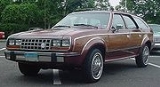
The AMC Eagle is a compact-sized four-wheel drive
Four-wheel drive
Four-wheel drive, 4WD, or 4×4 is a four-wheeled vehicle with a drivetrain that allows all four wheels to receive torque from the engine simultaneously...

 passenger vehicle that was produced by American Motors Corporation
American Motors
American Motors Corporation was an American automobile company formed by the 1954 merger of Nash-Kelvinator Corporation and Hudson Motor Car Company. At the time, it was the largest corporate merger in U.S. history.George W...

 (AMC). The AMC Eagle line of vehicles inaugurated a new product category of "sport-utility" or crossover SUV
Crossover SUV
A crossover SUV is a vehicle built on a car platform and combining, in highly variable degrees, features of a sport utility vehicle with features from a passenger vehicle, especially those of a station wagon or hatchback.Using the unibody construction typical of passenger vehicles, the crossover...

.
Discussion
Ask a question about 'AMC Eagle'
Start a new discussion about 'AMC Eagle'
Answer questions from other users
Full Discussion Forum
 
Unanswered Questions
Encyclopedia
The AMC Eagle is a compact-sized four-wheel drive
Four-wheel drive
Four-wheel drive, 4WD, or 4×4 is a four-wheeled vehicle with a drivetrain that allows all four wheels to receive torque from the engine simultaneously...

 passenger vehicle that was produced by American Motors Corporation
American Motors
American Motors Corporation was an American automobile company formed by the 1954 merger of Nash-Kelvinator Corporation and Hudson Motor Car Company. At the time, it was the largest corporate merger in U.S. history.George W...

 (AMC). The AMC Eagle line of vehicles inaugurated a new product category of "sport-utility" or crossover SUV
Crossover SUV
A crossover SUV is a vehicle built on a car platform and combining, in highly variable degrees, features of a sport utility vehicle with features from a passenger vehicle, especially those of a station wagon or hatchback.Using the unibody construction typical of passenger vehicles, the crossover...

.

Introduced in August 1979 for the 1980 model year
Model year
The model year of a product is a number used worldwide, but with a high level of prominence in North America, to describe approximately when a product was produced, and indicates the coinciding base specification of that product....

, the coupe, sedan, and station wagon body styles were based on the AMC Concord
AMC Concord
The AMC Concord is a compact car produced by the American Motors Corporation for the 1978 through 1983 model years. The Concord replaced the AMC Hornet and to some extent the mid-size AMC Matador, discontinued after 1978 in a market moving to downsized automobiles...

. In 1981 the two-door subcompact-sized AMC Spirit
AMC Spirit
The AMC Spirit was a subcompact marketed by American Motors Corporation from 1979 to 1983 as a restyled replacement for the Gremlin. The Spirit shared the Gremlin's platform and was offered in two hatchback variations, each with two doors — marketed as sedan and liftback...

-based models, the SX/4 and Kammback, joined the Eagle line. The Sundancer convertible
Convertible
A convertible is a type of automobile in which the roof can retract and fold away having windows which wind-down inside the doors, converting it from an enclosed to an open-air vehicle...

 conversion was available during 1981 and 1982.

The AMC Eagles were the only four-wheel drive passenger cars produced in the U.S. They were affordable cars offering a comfortable ride and handling on pavement together with superior traction in light off road use through AMC's innovative engineering and packaging.

For the 1987 model year the Eagle was manufactured by the Chrysler Corporation retaining the AMC badging. Production of the Eagle continued until December 14, 1987, and was marketed through early 1988.

The concept


The Eagle came about when Jeep's chief engineer, Roy Lunn
Roy Lunn
Roy Lunn is an engineer in the automotive industry. He has forty-one years in the design development and production of vehicles and most notably served as the head of engineering at American Motors Corporation from 1971 to 1987....

, joined a Concord body with a four-wheel drive system. Such a vehicle was a logical step for AMC, according to then CEO Gerald C. Meyers
Gerald C. Meyers
Gerald C. Meyers, former chairman and CEO of American Motors Corporation is an industrialist, author, lecturer, and management consultant.-Career:...

, as a second energy crisis had hit in 1979, and sales of AMC's highly profitable truck-based Jeep line dropped in part to their low fuel efficiency, leaving AMC in a precarious financial position. The Eagle provided a low-cost way of bridging the gap between AMC's solid and economical, but aging, passenger car line and its well-regarded, but decidedly off-road-focused, Jeep line, as the Eagle used the existing Concord (and later, Spirit) automobile platform
Automobile platform
An automobile platform is a shared set of common design, engineering, and production efforts, as well as major components over a number of outwardly distinct models and even types of automobiles, often from different, but related marques...

.

The Eagle also bridged the sizable price gap between the low-end imported 4WD Subaru
Subaru
; is the automobile manufacturing division of Japanese transportation conglomerate Fuji Heavy Industries .Subaru is internationally known for their use of the boxer engine layout popularized in cars by the Volkswagen Beetle and Porsche 911, in most of their vehicles above 1500 cc as well as...

 and the large-sized domestic four-wheel drive vehicles like the Jeep Wagoneer
Jeep Wagoneer
The Jeep Wagoneer was an early sport utility vehicle and the first luxury 4x4, produced under varying marques from 1963 to 1991. It was noteworthy for being in production for more than 28 years with only minor mechanical changes...

. The Eagle models provided the biggest new boost to the automaker's profit mix. Sales were brisk since Day One, with the manufacturer's suggested retail price
Suggested retail price
The manufacturer's suggested retail price , list price or recommended retail price of a product is the price which the manufacturer recommends that the retailer sell the product. The intention was to help to standardise prices among locations...

 (MSRP) for the basic 2-door model starting at $6,999 (US$ in dollars) and the 4-door station wagon at $7,549 (US$ in dollars).

A first in mass production passenger cars, the early AMC Eagles came with a true full-time automatic system that operated only in permanent all-wheel drive. The four-wheel drivetrain added approximately 300 pounds (136 kg) to the Eagle's curb weight. The AMC Eagles were also the first mass produced U.S. four wheel drive vehicles with an independent front suspension
Independent suspension
Independent suspension is a broad term for any automobile suspension system that allows each wheel on the same axle to move vertically independently of each other. This is contrasted with a beam axle, live axle or deDion axle system in which the wheels are linked – movement on one side affects...

.

The AMC Eagle's central differential behind its TorqueFlite
TorqueFlite
TorqueFlite is the trademarked name of Chrysler Corporation's automatic transmissions, starting with the three-speed unit introduced late in the 1956 model year as a successor to Chrysler's two-speed PowerFlite...

 automatic transmission was single-speed (without a low-range option) and used a viscous fluid coupling
Viscous coupling unit
A viscous coupling is a mechanical device which transfers torque and rotation by the medium of a viscous fluid. It is made of a number of circular plates with tabs or perforations, fitted very close to each other in a sealed drum. Alternate plates are connected to a driving shaft at one end of the...

 for quiet and smooth transfer of power to the axle with the greatest traction, on wet or dry pavement. The central unit consisted of closely spaced, wavy clutch plates operating in a "honey-like Silicone
Silicone
Silicones are inert, synthetic compounds with a variety of forms and uses. Typically heat-resistant and rubber-like, they are used in sealants, adhesives, lubricants, medical applications , cookware, and insulation....

 fluid" performing a "limited-slip function" between the front and rear drives, as well as under adverse driving conditions sending torque to the axle with the most traction.

Designed as "reasonably-size[d] passenger cars" offering a comfortable ride and handling on pavement, the AMC Eagles "behave more like mountain goat
Mountain goat
The Mountain Goat , also known as the Rocky Mountain Goat, is a large-hoofed mammal found only in North America. Despite its vernacular name, it is not a member of Capra, the genus of true goats...

s" when off the road. The value of four-wheel drive in the AMC Eagle was apparent when driving in slippery conditions and they were used in America's first ice-driving school. The Eagle models provided the comfort and appointments expected of passenger models with off-road technology offering an extra margin of safety and traction.

The AMC Eagle was the first production car to use the complete Ferguson Formula
Ferguson Research Ltd.
Harry Ferguson Research Limited was a British company founded by Harry Ferguson who was mostly known as "the father of the modern farm tractor"...

 (FF) full-time all-wheel drive system. Similar vehicles - the Subaru Loyale
Subaru Leone
The Subaru Leone was a compact car produced by the Japanese car manufacturer Fuji Heavy Industries from 1971 to 1994. The word "leone" is Italian for lion....

 (1983 and a year later in the U.S.) and much later the Toyota Tercel SR5 Wagon
Toyota Tercel
The Tercel is a subcompact manufactured from 1978 to 2000 across five generations, in five body configurations — sized between the Corolla and the Starlet...

 (1983) - only had part-time four-wheel drive systems that could not be engaged on dry pavement. The Eagle was also years ahead of Subaru's simplistic, part-time front-drive/4WD system, due to Roy Lunn's creativity and Jeep's experience producing 4WD vehicles. Another feature was the Eagle's independent front suspension, accomplished by mounting the front differential to the engine block with universal joint
Universal joint
A universal joint, universal coupling, U joint, Cardan joint, Hardy-Spicer joint, or Hooke's joint is a joint or coupling in a rigid rod that allows the rod to 'bend' in any direction, and is commonly used in shafts that transmit rotary motion...

s and half shaft
Half shaft
The term half shaft is another name for a front-wheel drive shaft, which is also called the constant velocity axle or CV axle. There is one half shaft per wheel. Some may further to this part as a CV shaft....

s to drive the front wheels.

As the first mass-produced American passenger car with 4-wheel-drive of any type, automotive industry analysts were taken by surprise at the fact that AMC, a company most had deemed past its ability to produce competitive vehicles, turned the best of what they had into a revolutionary, novel, and all-around competent vehicle. In doing so, the small American manufacturer was seen as having cleverly pioneered a new market segment - one that would grow wildly over the next 25 years and beyond, as evinced by Four Wheeler magazine's conclusion in 1980 that the new AMC Eagle was, indeed, "The beginning of a new generation of cars." Even as the automaker was struggling financially, "AMC's reputation for developing vehicles on the cheap is only exceeded by its legacy of midwifing the SUV", including the Eagle to be the precursor to one of the most popular vehicle types on the market. Indeed, the Eagle's basic concept - that of a station wagon with AWD, raised ground clearance, full range of power options and automatic transmissions, as well as rough-road capability - has inspired vehicles like the Subaru Outback
Subaru Outback
The Subaru Outback is a station wagon manufactured by Fuji Heavy Industries since 1995. Its original concept originated with Subaru of America, which was suffering from slumping sales in the mid-1990s partly due to a lack of an entry in the then-burgeoning sport utility vehicle market...

 and Forester
Subaru Forester
The Subaru Forester is an all-wheel drive crossover wagon manufactured since 1997 by Fuji Heavy Industries and sold under the Subaru brand...

 lines, the Audi Allroad, the Volvo XC range, and many others. Similarly, motoring journalist Marty Padgett
Marty Padgett
Marty Padgett is a US based motoring journalist, and the executive editor of The Car Connection.Born in 1969, Padgett is a native of Washington, D.C., and grew up in southern Maryland before going to college at Duke University and moving to Michigan. He edited the news section in Car and Driver...

 described AMC's car-based 1980 Eagle, combining all-weather capability with better gas mileage, and as "the first crossover" that was succeeded by whole generations of Subaru vehicles and other models,

In a road test of a 2009 crossover vehicle, the AMC Eagle "combined two disparate personalities — rugged childlike playfulness and staunch paternal responsibility — in a way that few thought possible in 1980. And for all the Eagle's lowly heritage, it has set a lasting standard for utility and a friendly, innovative spirit that has eluded most of the compact crossovers on the market today."

1980


Based on the AMC Concord
AMC Concord
The AMC Concord is a compact car produced by the American Motors Corporation for the 1978 through 1983 model years. The Concord replaced the AMC Hornet and to some extent the mid-size AMC Matador, discontinued after 1978 in a market moving to downsized automobiles...

, the 1980 AMC Eagle was available as a four-door sedan and station wagon
Station wagon
A station wagon is a body style variant of a sedan/saloon with its roof extended rearward over a shared passenger/cargo volume with access at the back via a third or fifth door , instead of a trunk lid...

, as well as a coupe
Coupé
A coupé or coupe is a closed car body style , the precise definition of which varies from manufacturer to manufacturer, and over time...

. Standard equipment included power steering
Power steering
Power steering helps drivers steer vehicles by augmenting steering effort of the steering wheel.Hydraulic or electric actuators add controlled energy to the steering mechanism, so the driver needs to provide only modest effort regardless of conditions. Power steering helps considerably when a...

 and power disk brakes. The Eagle came base and upscale Limited trims, both of which carried the same features as the Concord DL and Limited, respectively. A sports package
Sports package
A sports package is a set of cosmetic and functional enhancements that can be added to a vehicle, sold and priced as a unit.In an SUV or light truck this may include special racks or tiedowns for transport of off road recreational vehicles and other equipment.For a sedan or coupe the package...

 was available only on the 2-door and wagon models featuring in addition to "Sport" emblems the following items: Durham Plaid fabric seat trim, leather wrapped sport steering wheel, P195/75R15 Tiempo steel belted radial tire
Radial tire
A radial tire is a particular design of automotive tire . In this design, the cord plies are arranged at 90 degrees to the direction of travel, or radially ....

s, sport fog lamps, halogen highbeam headlamps, dual black remote mirrors, 4X4 sport graphics, black bumpers with nerf strips, black lower body moldings, blackout grille, taillamp paint treatment, side tape stripes, and black moldings on the windshield, rear window, door frames, and B-pillar
Pillar (car)
Pillars are the vertical supports of the greenhouse of an automobile — known respectively as the A, B, C or D-pillar moving in profile view from the front to rear....

.

All Eagles came with "Ziebart
Ziebart
Ziebart International Corporation is a company based in Troy, Michigan, and is the worldwide franchisor of the Ziebart brand of automotive aftermarket stores...

 Factory Rust Protection" as standard that included a 5-year "No Rust Thru" transferable warranty
Warranty
In business and legal transactions, a warranty is an assurance by one party to the other party that specific facts or conditions are true or will happen; the other party is permitted to rely on that assurance and seek some type of remedy if it is not true or followed.In real estate transactions, a...

. The cars were built using aluminized trim screws, plastic inner fender liners, galvanized steel in every exterior body panel, and the body went through an epoxy-based primer bath (up to the window line). Eagles were backed by the AMC Buyer Protection Plan, a 12 month/12000 miles (19,312 km) warranty on everything except the tires.

The drivetrain consisted of one engine, the AMC 258 I6, in conjunction with a three-speed automatic transmission
Automatic transmission
An automatic transmission is one type of motor vehicle transmission that can automatically change gear ratios as the vehicle moves, freeing the driver from having to shift gears manually...

 (a version of Chrysler's A998), and Dana 30 and Dana 35
Dana 35
The Dana/Spicer Model 35 is an automotive axle manufactured by Dana Corp. since 1985 when American Motors sold its axle tooling equipment to Dana. The axle was originally named an AMC-15 when it was first made in 1962. Dana upgraded the axle, and made IFS and Twin Traction Beam front axle...

 differentials. All 1980 Eagles came standard with a permanent 4-wheel-drive system that employed a New Process 119 transfer case
Transfer case
A transfer case is a part of a four-wheel-drive system found in four-wheel-drive and all-wheel-drive vehicles. The transfer case is connected to the transmission and also to the front and rear axles by means of drive shafts...

, which had a viscous fluid coupling that allowed the 4-wheel-drive system to operate on wet or dry pavement without causing undue suspension and drivetrain wear. Optional trailer towing packages were available for handling trailers weighing up to 3500 lb (1,588 kg) that included a weight distributing (equalizing) tow hitch
Tow hitch
A tow hitch is a device attached to the chassis of a vehicle for towing or a towbar to an aircraft nose gear, or paired main gears....

, 7-connector wiring harness, wiring, auxiliary transmission oil cooler, 3.54 axle ratio, and required the optional heavy-duty battery and automatic load-leveling air shocks.

The 1980 Eagle's appearance differed from the Concord's in that the bodies were raised 3 inches (76.2 mm) further off their suspension to afford better ground clearance. To fill in the increased visual space between the tires and wheel wells, AMC used durable Kraton (polymer)
Kraton (polymer)
Kraton is the trade name given to a number of high performance elastomers manufactured by Kraton Polymers , and used as synthetic replacements for rubber. Kraton polymers offers many of the properties of natural rubber, such as flexibility, high traction, and sealing abilities, but with increased...

 plastic wheelarch flares that flowed into rocker panel extensions. The grille was similar to the 1980 Concord's, but with the horizontal bars spaced slightly further apart, and the Eagle graphic mounted to the driver's side-center. Because coupes and sedans carried Concord DL equipment as standard, they also carried the Concord DL coupe and sedan roof treatments, featuring vinyl coverings, and opera window
Opera window
Opera Windows are small porthole sized side windows in the C-pillar of some cars. Typically offered in unison with a vinyl roof, they were a very common design feature of American automobiles during the 1970s. The design was new at the time, "... and would prove to be very popular, indicated by its...

s. However, bumpers were pulled closer to the body than those seen on Concords, due to the Eagle having been classified by the United States Environmental Protection Agency
United States Environmental Protection Agency
The U.S. Environmental Protection Agency is an agency of the federal government of the United States charged with protecting human health and the environment, by writing and enforcing regulations based on laws passed by Congress...

 (EPA) as a light truck, and was therefore exempt from passenger car regulations that required front and rear bumpers that could sustain a 5 miles per hour (2 m/s) impact with no damage. However, as seen on the Concord, black plastic end caps were featured on 1980 Eagle bumpers.

Production for the 1980 model was: 9,956 4-door sedans, 10,616 2-door sedans, and 25,807 station wagons with a grand total of 45,379 units. Detailed information and specifications can be accessed from AMC Data Books.

1981


Changes the standard (Series 30) Eagle lineup for 1981 were notable. The GM 151 CID "Iron Duke" inline-four engine became standard equipment, as AMC's 258 CID I6 became optional. The I6 was redesigned to produce more low-end torque, as well as made smoother running, more economical, and required less maintenance. The engineering improvements to the venerable AMC engine also reduced its weight by 90 pounds (41 kg) to 445 lb (202 kg), thus making it "the lightest in-line Six in the domestic industry".

All Eagles took on a new plastic eggcrate-style grille divided into 24 squares at the front. The Eagle name moved to the grille header bar. Bumpers were updated so that their end caps flowed smoothly into the Kraton plastic wheelarches and rocker panel trim. The Sport package, carried over from 1980 on all three body styles, used the Spirit's hood and grille header bar trim starting in 1981.

Two smaller subcompact models, the AMC Eagle Kammback
Kammback
A Kammback is a car body style that derives from the research of the German aerodynamicist Wunibald Kamm in the 1930s. The design calls for a body with smooth contours that continues to a tail that is abruptly cut off. This shape reduces the drag of the vehicle."Kammback" is an American term...

, based on the AMC Spirit
AMC Spirit
The AMC Spirit was a subcompact marketed by American Motors Corporation from 1979 to 1983 as a restyled replacement for the Gremlin. The Spirit shared the Gremlin's platform and was offered in two hatchback variations, each with two doors — marketed as sedan and liftback...

 sedan (née Gremlin
AMC Gremlin
The AMC Gremlin is a two-door subcompact car produced in the United States and Canada by the American Motors Corporation between 1970 and 1978. AMC reduced its development and manufacturing costs by adapting a shortened Hornet platform with a Kammback-type tail...

), and the sporty Eagle SX/4, based on the Spirit liftback, debuted as "Eagle Series 50" models. The Kammback and SX/4 came standard with GM's 151 CID "Iron Duke" 4-cylinder engine, 4-speed manual transmission, and power steering. The Series 50 Eagles reflected the styling updates that the larger Series 30 models showed for 1981. The SX/4 model was available with a Sport package, as well.

At the beginning of the model year, all Eagles carried over the new-for-1980 permanent all-wheel drive
Four-wheel drive
Four-wheel drive, 4WD, or 4×4 is a four-wheeled vehicle with a drivetrain that allows all four wheels to receive torque from the engine simultaneously...

 system with viscous fluid coupling that protected the suspension or driveline components from wear during dry pavement use. A "Select Drive" option, which allowed the Eagle to run in 2-wheel-drive (RWD) mode and be switched to 4-wheel-drive via a dashboard switch, was offered as a fuel economy measure at midyear. However, Select Drive required the vehicle to be stationary when switching between 2-wheel and 4-wheel-drive.

Production was: 5,603 Kammbacks, 17,340 Liftbacks, 2,378 2-door sedans, 1,737 4-door sedans, and 10,371 station wagons for a total of 37,429 units.

1982


New low-drag disc brakes were featured as standard equipment. A 5-speed manual transmission
Manual transmission
A manual transmission, also known as a manual gearbox or standard transmission is a type of transmission used in motor vehicle applications...

 joined the options list. The optional automatic transmission received wider gear ratios for better fuel economy. All received as standard equipment the Select Drive system that could be changed between all-wheel drive and two-wheel drive for a potential increase in fuel economy. The Series 30 sedan was no longer available with the Sport package.

Even with the choice of two wheelbase versions and five body styles, the most popular model was the wagon with 20,899 built out of total Eagle production of 37,923 for the 1982 model year. Other production was: 520 Kammbacks, 10,445 Liftbacks, 1,968 2-door sedans, and 4,091 4-door sedans.

1983


Few changes were seen for 1983. The Series 50 Eagle Kammback and Series 30 Eagle coupe were both dropped from the line, due to slow sales. The Series 30 Eagle sedan lost its Limited trim line, leaving only the base model in the Eagle sedan line. The Series 50 SX/4 and Series 30 wagon continued basically unchanged. All were measures to save production costs by pruning the slow-selling models from the line, thereby streamlining their processes by reducing production variations, and therefore, complexity.

Starting in February 1983, the AMC 150 CID I4 theoretically replaced the GM Iron Duke 151 under Eagle hoods as the standard engine, though the installation rate is unknown. The 258 CID I6 was improved for better performance by increasing the compression ratio to 9.2 to 1 (from the previous 8.2 to 1), as well as a fuel feedback system, a knock sensor, and the CEC)
AMC Computerized Engine Control
The Computerized Engine Control or CEC system was an engine management system designed and used by American Motors and Jeep from 1980-1990, on the AMC 258 engine....

; thus allowing the continuing use of regular-grade fuel.

A long-term road test by Popular Mechanics began with the editors describing that the "Eagle is best when working hard" and "you can feel the tremendous traction" of its big all-weather tires in four-wheel drive giving "a great feeling of security."

Production was: 2,259 Liftbacks, 3,093 4-door sedans, and 12,378 station wagons for a total of 17,730 units in 1983.

1984


The Series 50 SX/4 was dropped for 1984. This left only the base Series 30 Eagle sedan and wagon, and a Limited wagon. Now that the SX/4 was gone, only the wagon carried the Sport option package.

For 1984, the 258 cu in I6 was optional in place of the 150-cubic inch (2.5 L) AMC I4, and was more popular. The four-cylinder engine was installed in only 147 Eagles, but allowed AMC to advertise its fuel economy of 24 miles per US gallon city and 30 miles per US gallon highway with the four-speed transmission and 32 miles per US gallon with the five-speed on the highway. The Select Drive system was redesigned to allow Shift on the Fly.

All Eagle models were now built in AMC's original factory in Brampton, Ontario
Brampton, Ontario
Brampton is the third-largest city in the Greater Toronto Area of Ontario, Canada and the seat of Peel Region. As of the 2006 census, Brampton's population stood at 433,806, making it the 11th largest city in Canada. It is also one of Canada's fastest growing municipalities, with an average...

, Canada
Canada
Canada is a North American country consisting of ten provinces and three territories. Located in the northern part of the continent, it extends from the Atlantic Ocean in the east to the Pacific Ocean in the west, and northward into the Arctic Ocean...

 because the automaker's main Kenosha plant was used for the Renault Alliance and Encore
Renault Alliance
The Renault Alliance is a subcompact automobile manufactured and marketed in North America by American Motors Corporation , with 623,573 examples manufactured for model years 1983-1987, and with a three and five-door hatchback variant, the Renault Encore marketed beginning in 1984.The two models...

 models.

Production was: 4,241 4-door sedans and 21,294 station wagons totaling 25,535.

1985


Exterior styling was slightly revised as all models used the "power bulge" hood, seen previously on the 1981-83 Eagle Series 50 models. The grille header bar and hood ornament/trim strip were deleted in the process. "Shift-on-the-Fly" capability was added to the Select Drive 4-wheel-drive system as standard equipment. A new key-fob-activated infrared remote keyless system
Remote keyless system
A remote keyless system is a system designed to permit or deny access to premises or automobiles. While the "remote" system is portable and has locking capabilities, the exact phrase "keyless entry" is solely reserved for the numeric dials or keypads that are located on or near the driver side door...

 with power locks was newly available as an option. Radios with digital tuning were also introduced.

The standard powertrain was now the previously optional 5-speed manual, with the wide-ratio 3-speed automatic still available as a popular option. The AMC 258 I6 became standard. However, Eagle sales began to drop as AMC was no longer aggressively promoting the models.

Production was for the 1985 model year: 2,655 4-door sedans and 13,335 station wagons, for a total of 16,990 units.

1986


American Motors introduced the open differential Model 128 transfer case for the Eagle. The automatic transmission no longer had a lockup torque converter. Eagle sales would drop beneath the 10,000 annual unit mark for the first time for 1986 (and would slide further for its remaining two seasons on the market), as the car was aging due to its seven-season life atop a platform that debuted for 1970.

Production was: 1,274 4-door sedans and 6,943 station wagons, for a total of 8,217 units.

1987


Though AMC debuted its new fuel-injected 4.0 L (242 cu in) I6 engine for 1987, the new engine did not make it under the venerable Eagle's hood. The 258-cubic inch (4.2 L) I6 remained the sole engine available in the eight-season-old Eagle sedan and wagon. No major changes were seen on the 1987 Eagle, as American Motors turned its attention to the debut of the imported Renault Medallion. The buyout of the company by Chrysler Corporation took effect officially in August 1987.

Production for the 1987 model year was: 454 4-door sedans, and 5,468 or 4,564 (varies with source) station wagons, for a total of 4,564 to 5,922 (varies with source) units.

1988


The sedan and Limited wagon were dropped after the 1987 model year, leaving the base wagon as the only available Eagle in 1988, its final season and now under Chrysler's ownership. The car's name was officially changed from AMC Eagle to Eagle Wagon; however, all of the AMC badges, build sheets, and door plaques were carried over. The VIN was no different under the new corporate owner, other than the digit for the year. Although the paperwork that came with the 1988 Eagles continued to indicate that American Motors Canada, Ltd. built them, the company as named ceased to exist, since it became a subsidiary
Subsidiary
A subsidiary company, subsidiary, or daughter company is a company that is completely or partly owned and wholly controlled by another company that owns more than half of the subsidiary's stock. The subsidiary can be a company, corporation, or limited liability company. In some cases it is a...

 of Chrysler in the buyout, as did all AMC properties. The final car rolled out of AMC's original "Brampton Assembly Plant" plant in Brampton, Ontario
Brampton, Ontario
Brampton is the third-largest city in the Greater Toronto Area of Ontario, Canada and the seat of Peel Region. As of the 2006 census, Brampton's population stood at 433,806, making it the 11th largest city in Canada. It is also one of Canada's fastest growing municipalities, with an average...

 on December 14, 1987.

Standard equipment in 1988 that was previously optional included air conditioning system, rear window defroster, halogen headlamps, AM/FM stereo radio, light group (glove box, dome, and engine lights), and adjustable steering wheel. The following remained optional equipment for the 1988 production: power windows, power seats, power mirrors, radio with cassette player, cruise control, rear window wiper, wood grain side panels, floor mats, headlamp warning buzzer, and intermittent wipers.

Total 1988 model year production was 2,306 units, all station wagons.

Convertibles


During 1981 and 1982, a Sundancer conversion convertible
Convertible
A convertible is a type of automobile in which the roof can retract and fold away having windows which wind-down inside the doors, converting it from an enclosed to an open-air vehicle...

 was available. The Eagle's monocoque
Monocoque
Monocoque is a construction technique that supports structural load by using an object's external skin, as opposed to using an internal frame or truss that is then covered with a non-load-bearing skin or coachwork...

 (unibody) body was reinforced and a steel targa roll bar
Targa top
Targa top, targa for short, is a semi-convertible car body style with a removable roof section and a full width roll bar behind the seats. The term was first used on the 1966 Porsche 911 Targa, and it remains a registered trademark of Porsche AG....

 was welded to the door pillars for passenger compartment protection. The front portion of the roof was a removable lightweight fiberglass hatch, while the rear section of polyvinyl
Polyvinyl chloride
Polyvinyl chloride, commonly abbreviated PVC, is a thermoplastic polymer. It is a vinyl polymer constructed of repeating vinyl groups having one hydrogen replaced by chloride. Polyvinyl chloride is the third most widely produced plastic, after polyethylene and polypropylene. PVC is widely used in...

 material and the back window folded down and had a boot cover when in the down position.

The conversions were approved by AMC with the cars ordered through select AMC dealers in the customer's selection of options and colors. The conversion cost approximately $3,000 and the dealer's list price was $3,750. The conversion was performed by the Griffith Company headquartered in Fort Lauderdale, Florida
Fort Lauderdale, Florida
Fort Lauderdale is a city in the U.S. state of Florida, on the Atlantic coast. It is the county seat of Broward County. As of the 2010 census, the city had a population of 165,521. It is a principal city of the South Florida metropolitan area, which was home to 5,564,635 people at the 2010...

, that was also responsible for the "Sunchaser" Toyota Celica
Toyota Celica
The Toyota Celica name has been applied to a series of coupes made by the Japanese company Toyota. The name is ultimately derived from the Latin word coelica meaning "heavenly" or "celestial"....

 convertible. Both Griffith conversions are considered coach convertible
Coach convertible
Coach convertibles are convertibles built by independent shops, or coachbuilders, by converting closed cars into open ones. This practice filled, and to a small extent continues to fill a small void left by the auto industry...

s.

Turbo Diesel


Another factory-approved conversion was the 1980 turbodiesel
Turbodiesel
Turbodiesel refers to any diesel engine with a turbocharger. Turbocharging is the norm rather than the exception in modern car and truck diesel engines...

. The 219 CID engines producing 150 hp and 224 lb.ft of torque were supplied by VM Motori
VM Motori
VM Motori S.p.A. is a diesel engine manufacturing company in Cento, Italy, in Emilia-Romagna, an Italian region which is also home to Ferrari, Lamborghini, Maserati and Ducati.- History :...

. Only about seven are thought to have been manufactured; two are accounted for in one of the AMC Eagle clubs. The literature for the conversions noted the cars would be equipped with larger fuel tanks, which together with diesel economy and an optional overdrive
Overdrive (mechanics)
Overdrive is a term used to describe a mechanism that allows an automobile to cruise at sustained speed with reduced engine RPM, leading to better fuel economy, lower noise and lower wear...

 transmission, would give the cars up to 1500 miles (2,414 km) range. The $9,000 price tag for the conversion limited its market appeal and it was discontinued.

This VM diesel is unrelated to the later 2.1 L Renault turbo diesel I4 as used in the Jeep Cherokee (XJ) beginning in 1984.

Legacy


Total AMC Eagle production was 197,449 units in one generation. Although the original AMC Eagle was not produced after 1988, the Eagle
Eagle (automobile)
Eagle was a marque of the Chrysler Corporation following the purchase of American Motors Corporation and aimed at the enthusiast driver.Though short-lived, the Eagle Vision sedan sold in respectable numbers, while the sporty Eagle Talon sold more than 115,000 units.-Overview:Following the...

 brand, as part of the newly-formed Jeep-Eagle
Jeep-Eagle
Jeep-Eagle was the name of the automobile sales division created by the Chrysler after the US$2 billion takeover of American Motors in 1987...

 division of the Chrysler Corporation
Chrysler
Chrysler Group LLC is a multinational automaker headquartered in Auburn Hills, Michigan, USA. Chrysler was first organized as the Chrysler Corporation in 1925....

, would soldier on. This division included a combination of Renault-based vehicles (Eagle Medallion and Eagle Premier
Eagle Premier
The Eagle Premier was a full-size automobile developed by the American Motors Corporation and Renault partnership, inherited by Chrysler Corporation when it acquired AMC in 1987, and marketed from 1987 through 1992...

), re-trimmed Mitsubishis (Eagle Summit
Eagle Summit
The Eagle Summit was a subcompact car produced by Mitsubishi Motors from 1989 to 1996. It was sold as a captive import by the Jeep-Eagle sales division that was created after Chrysler Corporation purchased American Motors Corporation in 1987...

, Eagle Summit Wagon
Eagle Summit
The Eagle Summit was a subcompact car produced by Mitsubishi Motors from 1989 to 1996. It was sold as a captive import by the Jeep-Eagle sales division that was created after Chrysler Corporation purchased American Motors Corporation in 1987...

, Eagle Talon
Eagle Talon
The Eagle Talon was one of three model names given to a sports coupe that was manufactured between 1990 and 1999 and sold by the then Chrysler Corporation and Mitsubishi Motors of Japan in a joint 50/50 corporate venture known as Diamond-Star Motors...

, Eagle 2000GTX (Canada only), and Eagle Vista
Eagle Vista
The Eagle Vista was used on two subcompact cars sold from 1988 to 1992 in Canada. Along with the Eagle Summit, the car replaced the Renault Encore because of Renault withdrawing from the United States and Canada that time. It was a rebadged version of the second generation Mitsubishi Mirage...

 (Canada only)), and one Chrysler-designed vehicle (Eagle Vision
Eagle Vision
The Eagle Vision was a full-size, front-wheel drive sedan, marketed as a sports version of the Chrysler LH platform, produced from 1993-1997. It was sold by the Eagle division of the Chrysler Corporation, replacing the AMC/Renault-designed Eagle Premier...

).

After the AMC-based 4-wheel-drive Eagle wagon was dropped, Chrysler would continue the concept loosely in spirit by offering all-wheel-drive optionally on the Mitsubishi-based 1990-98 Eagle Talon, the Canadian-market 1989-91 Eagle Vista wagon, and 1992-96 Eagle Summit Wagon.

The brand became too much of a disharmonious mish-mash of vehicles from different companies, sporting different characters, and never really attained much brand equity
Brand equity
Brand equity is the marketing effects and outcomes that accrue to a product with its brand name compared with those that would accrue if the same product did not have the brand name. Fact of the well-known brand name is that, the company can sometimes charge premium prices from the consumer . And,...

or recognition. Due to the lack of recognition, sales never met expectations, and Chrysler quietly killed the Eagle brand after the 1998 model year.

Collectibility


As used cars, the AMC Eagles were "not intended for heavy-duty boulder bashing" and established a reputation as unique 4-wheel-drive passenger cars "with proven AMC bodyshells and running gear". AMC Eagles are collected for purposes of nostalgia, status, pleasure, investment as well as function.

The Eagle shares many parts and components with other Jeep and AMC models. There are many active AMC car clubs and specialized vendors for service and reproduction parts. While surviving Eagles are no longer depreciating, they do not seem to be appreciating rapidly – except for the 1980-84 Sundancer convertible.

In the Pacific Northwest United States, Canada, and Alaska, AMC Eagles are still abundant and in service over 20 years after production ceased.

External links