

6th century BC

Encyclopedia
The 6th century BC started the first day of 600 BC and ended the last day of 501 BC.
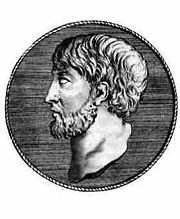
 Pāṇini, in India
, composed a grammar for Sanskrit
, in this century or slightly later. This is the oldest still known grammar of any language.
In the Near East
, the first half of this century was dominated by the Neo-Babylonian or Chaldean empire, which had risen to power late in the previous century after successfully rebelling against Assyria
n rule. The Kingdom of Judah
came to an end in 587 BC when Babylonian forces under Nebuchadnezzar II captured Jerusalem, and removed most of its population to their own lands. Babylonian rule was toppled however in the 540s, by Cyrus
, who founded the Persian Empire
in its place. The Persian Empire continued to expand and grew into the greatest empire the world had known at the time.
In Iron Age Europe, the Celtic expansion was in progress. China was in the Spring and Autumn Period.
India
India , officially the Republic of India , is a country in South Asia. It is the seventh-largest country by geographical area, the second-most populous country with over 1.2 billion people, and the most populous democracy in the world...
, composed a grammar for Sanskrit
Sanskrit
Sanskrit , is a historical Indo-Aryan language and the primary liturgical language of Hinduism, Jainism and Buddhism.Buddhism: besides Pali, see Buddhist Hybrid Sanskrit Today, it is listed as one of the 22 scheduled languages of India and is an official language of the state of Uttarakhand...
, in this century or slightly later. This is the oldest still known grammar of any language.
In the Near East
Near East
The Near East is a geographical term that covers different countries for geographers, archeologists, and historians, on the one hand, and for political scientists, economists, and journalists, on the other...
, the first half of this century was dominated by the Neo-Babylonian or Chaldean empire, which had risen to power late in the previous century after successfully rebelling against Assyria
Assyria
Assyria was a Semitic Akkadian kingdom, extant as a nation state from the mid–23rd century BC to 608 BC centred on the Upper Tigris river, in northern Mesopotamia , that came to rule regional empires a number of times through history. It was named for its original capital, the ancient city of Assur...
n rule. The Kingdom of Judah
Kingdom of Judah
The Kingdom of Judah was a Jewish state established in the Southern Levant during the Iron Age. It is often referred to as the "Southern Kingdom" to distinguish it from the northern Kingdom of Israel....
came to an end in 587 BC when Babylonian forces under Nebuchadnezzar II captured Jerusalem, and removed most of its population to their own lands. Babylonian rule was toppled however in the 540s, by Cyrus
Cyrus the Great
Cyrus II of Persia , commonly known as Cyrus the Great, also known as Cyrus the Elder, was the founder of the Achaemenid Empire. Under his rule, the empire embraced all the previous civilized states of the ancient Near East, expanded vastly and eventually conquered most of Southwest Asia and much...
, who founded the Persian Empire
Achaemenid Empire
The Achaemenid Empire , sometimes known as First Persian Empire and/or Persian Empire, was founded in the 6th century BCE by Cyrus the Great who overthrew the Median confederation...
in its place. The Persian Empire continued to expand and grew into the greatest empire the world had known at the time.
In Iron Age Europe, the Celtic expansion was in progress. China was in the Spring and Autumn Period.
- Mediterranean: Beginning of Greek philosophyGreek philosophyAncient Greek philosophy arose in the 6th century BCE and continued through the Hellenistic period, at which point Ancient Greece was incorporated in the Roman Empire...
, flourishes during the 5th century BC5th century BCThe 5th century BC started the first day of 500 BC and ended the last day of 401 BC.-Overview:This century saw the beginning of a period of philosophical brilliance among Western civilizations, particularly the Greeks which would continue all the way through the 4th century until the time of... - The late Hallstatt cultureHallstatt cultureThe Hallstatt culture was the predominant Central European culture from the 8th to 6th centuries BC , developing out of the Urnfield culture of the 12th century BC and followed in much of Central Europe by the La Tène culture.By the 6th century BC, the Hallstatt culture extended for some...
period in EasternEastern EuropeEastern Europe is the eastern part of Europe. The term has widely disparate geopolitical, geographical, cultural and socioeconomic readings, which makes it highly context-dependent and even volatile, and there are "almost as many definitions of Eastern Europe as there are scholars of the region"...
and Central EuropeCentral EuropeCentral Europe or alternatively Middle Europe is a region of the European continent lying between the variously defined areas of Eastern and Western Europe...
, the late Bronze AgeNordic Bronze AgeThe Nordic Bronze Age is the name given by Oscar Montelius to a period and a Bronze Age culture in Scandinavian pre-history, c. 1700-500 BC, with sites that reached as far east as Estonia. Succeeding the Late Neolithic culture, its ethnic and linguistic affinities are unknown in the absence of...
in Northern EuropeNorthern EuropeNorthern Europe is the northern part or region of Europe. Northern Europe typically refers to the seven countries in the northern part of the European subcontinent which includes Denmark, Estonia, Latvia, Lithuania, Norway, Finland and Sweden... - East AsiaEast AsiaEast Asia or Eastern Asia is a subregion of Asia that can be defined in either geographical or cultural terms...
: The Spring and Autumn Period. Chinese philosophyChinese philosophyChinese philosophy is philosophy written in the Chinese tradition of thought. The majority of traditional Chinese philosophy originates in the Spring and Autumn and Warring States era, during a period known as the "Hundred Schools of Thought", which was characterized by significant intellectual and...
become the orthodoxyOrthodoxyThe word orthodox, from Greek orthos + doxa , is generally used to mean the adherence to accepted norms, more specifically to creeds, especially in religion...
of ChinaChinaChinese civilization may refer to:* China for more general discussion of the country.* Chinese culture* Greater China, the transnational community of ethnic Chinese.* History of China* Sinosphere, the area historically affected by Chinese culture...
. ConfucianismConfucianismConfucianism is a Chinese ethical and philosophical system developed from the teachings of the Chinese philosopher Confucius . Confucianism originated as an "ethical-sociopolitical teaching" during the Spring and Autumn Period, but later developed metaphysical and cosmological elements in the Han...
, LegalismLegalism (Chinese philosophy)In Chinese history, Legalism was one of the main philosophic currents during the Warring States Period, although the term itself was invented in the Han Dynasty and thus does not refer to an organized 'school' of thought....
and Moism flourish. LaoziLaoziLaozi was a mystic philosopher of ancient China, best known as the author of the Tao Te Ching . His association with the Tao Te Ching has led him to be traditionally considered the founder of Taoism...
founds TaoismTaoismTaoism refers to a philosophical or religious tradition in which the basic concept is to establish harmony with the Tao , which is the mechanism of everything that exists... - Middle EastMiddle EastThe Middle East is a region that encompasses Western Asia and Northern Africa. It is often used as a synonym for Near East, in opposition to Far East...
: During the Persian empireAchaemenid EmpireThe Achaemenid Empire , sometimes known as First Persian Empire and/or Persian Empire, was founded in the 6th century BCE by Cyrus the Great who overthrew the Median confederation...
, ZoroasterZoroasterZoroaster , also known as Zarathustra , was a prophet and the founder of Zoroastrianism who was either born in North Western or Eastern Iran. He is credited with the authorship of the Yasna Haptanghaiti as well as the Gathas, hymns which are at the liturgical core of Zoroastrianism...
, aka Zarathustra, founded ZoroastrianismZoroastrianismZoroastrianism is a religion and philosophy based on the teachings of prophet Zoroaster and was formerly among the world's largest religions. It was probably founded some time before the 6th century BCE in Greater Iran.In Zoroastrianism, the Creator Ahura Mazda is all good, and no evil...
, a dualistic philosophyPhilosophyPhilosophy is the study of general and fundamental problems, such as those connected with existence, knowledge, values, reason, mind, and language. Philosophy is distinguished from other ways of addressing such problems by its critical, generally systematic approach and its reliance on rational...
. This was also the time of the Babylonian captivityBabylonian captivityThe Babylonian captivity was the period in Jewish history during which the Jews of the ancient Kingdom of Judah were captives in Babylon—conventionally 587–538 BCE....
of the ancient Jews - Ancient IndiaHistory of IndiaThe history of India begins with evidence of human activity of Homo sapiens as long as 75,000 years ago, or with earlier hominids including Homo erectus from about 500,000 years ago. The Indus Valley Civilization, which spread and flourished in the northwestern part of the Indian subcontinent from...
: The BuddhaGautama BuddhaSiddhārtha Gautama was a spiritual teacher from the Indian subcontinent, on whose teachings Buddhism was founded. In most Buddhist traditions, he is regarded as the Supreme Buddha Siddhārtha Gautama (Sanskrit: सिद्धार्थ गौतम; Pali: Siddhattha Gotama) was a spiritual teacher from the Indian...
and MahaviraMahaviraMahāvīra is the name most commonly used to refer to the Indian sage Vardhamāna who established what are today considered to be the central tenets of Jainism. According to Jain tradition, he was the 24th and the last Tirthankara. In Tamil, he is referred to as Arukaṉ or Arukadevan...
found BuddhismBuddhismBuddhism is a religion and philosophy encompassing a variety of traditions, beliefs and practices, largely based on teachings attributed to Siddhartha Gautama, commonly known as the Buddha . The Buddha lived and taught in the northeastern Indian subcontinent some time between the 6th and 4th...
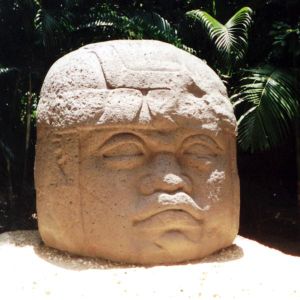
and JainismJainismJainism is an Indian religion that prescribes a path of non-violence towards all living beings. Its philosophy and practice emphasize the necessity of self-effort to move the soul towards divine consciousness and liberation. Any soul that has conquered its own inner enemies and achieved the state... - The decline of the OlmecOlmecThe Olmec were the first major Pre-Columbian civilization in Mexico. They lived in the tropical lowlands of south-central Mexico, in the modern-day states of Veracruz and Tabasco....
civilization in AmericaSouth AmericaSouth America is a continent situated in the Western Hemisphere, mostly in the Southern Hemisphere, with a relatively small portion in the Northern Hemisphere. The continent is also considered a subcontinent of the Americas. It is bordered on the west by the Pacific Ocean and on the north and east...
Events
- Mid-6th century BC: Foundation of Temple of Olympian Zeus (Athens) is made
- 598 BC: Jehoiachin succeeds JehoiakimJehoiakimJehoiakim .On Josiah's death, Jehoiakim's younger brother Jehoahaz was proclaimed king, but after three months pharaoh Necho II deposed him and replaced him with the eldest son, Eliakim, who adopted the name Jehoiakim and became king at the age of twenty-five...
as King of Judah - 16 March 597 BC: BabyloniaBabyloniaBabylonia was an ancient cultural region in central-southern Mesopotamia , with Babylon as its capital. Babylonia emerged as a major power when Hammurabi Babylonia was an ancient cultural region in central-southern Mesopotamia (present-day Iraq), with Babylon as its capital. Babylonia emerged as...
ns capture Jerusalem, replace Jehoiachin with ZedekiahZedekiahZedekiah or Tzidkiyahu was the last king of Judah before the destruction of the kingdom by Babylon. He was installed as king of Judah by Nebuchadnezzar II, king of Babylon, after a siege of Jerusalem to succeed his nephew, Jeconiah, who was overthrown as king after a reign of only three months and...
as King - 595 BC: Psammetichus IIPsammetichus IIPsamtik II was a king of the Saite based Twenty-sixth dynasty of Egypt...
succeeds Necho IINecho IINecho II was a king of the Twenty-sixth dynasty of Egypt .Necho II is most likely the pharaoh mentioned in several books of the Bible . The Book of Kings states that Necho met King Josiah of the Kingdom of Judah at Megiddo and killed him...
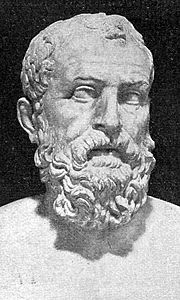
as King of EgyptHistory of Ancient EgyptThe History of Ancient Egypt spans the period from the early predynastic settlements of the northern Nile Valley to the Roman conquest in 30 BC... - 594 BC: SolonSolonSolon was an Athenian statesman, lawmaker, and poet. He is remembered particularly for his efforts to legislate against political, economic and moral decline in archaic Athens...
appointed archonArchonArchon is a Greek word that means "ruler" or "lord", frequently used as the title of a specific public office. It is the masculine present participle of the verb stem ἀρχ-, meaning "to rule", derived from the same root as monarch, hierarchy, and anarchy.- Ancient Greece :In ancient Greece the...
of AthensAthensAthens , is the capital and largest city of Greece. Athens dominates the Attica region and is one of the world's oldest cities, as its recorded history spans around 3,400 years. Classical Athens was a powerful city-state...
; institutes democratic reforms - 590 BC: EgyptEgyptEgypt , officially the Arab Republic of Egypt, Arabic: , is a country mainly in North Africa, with the Sinai Peninsula forming a land bridge in Southwest Asia. Egypt is thus a transcontinental country, and a major power in Africa, the Mediterranean Basin, the Middle East and the Muslim world...
ian army sacks NapataNapataNapata was a city-state of ancient Nubia on the west bank of the Nile River, at the site of modern Karima, Northern Sudan.During the 8th to 7th centuries BC, Napata was the capital of the Nubian kingdom of Kush, whence the 25th, or Nubian Dynasty conquered Egypt...
, compelling the CushKingdom of KushThe native name of the Kingdom was likely kaš, recorded in Egyptian as .The name Kash is probably connected to Cush in the Hebrew Bible , son of Ham ....
ite courtCourtA court is a form of tribunal, often a governmental institution, with the authority to adjudicate legal disputes between parties and carry out the administration of justice in civil, criminal, and administrative matters in accordance with the rule of law...
to move to a more secure location at MeroeMeroëMeroë Meroitic: Medewi or Bedewi; Arabic: and Meruwi) is an ancient city on the east bank of the Nile about 6 km north-east of the Kabushiya station near Shendi, Sudan, approximately 200 km north-east of Khartoum. Near the site are a group of villages called Bagrawiyah...
near the sixth Cataract - 589 BC: ApriesApriesApries is the name by which Herodotus and Diodorus designate Wahibre Haaibre, Ουαφρης , a pharaoh of Egypt , the fourth king of the Twenty-sixth dynasty of Egypt. He was equated with the Waphres of Manetho, who correctly records that he reigned for 19 years...
succeeds Psammetichus IIPsammetichus IIPsamtik II was a king of the Saite based Twenty-sixth dynasty of Egypt...
as King of EgyptHistory of Ancient EgyptThe History of Ancient Egypt spans the period from the early predynastic settlements of the northern Nile Valley to the Roman conquest in 30 BC... - 588 BC: Nebuchadrezzar II of Babylon begins siege of Jerusalem; some sources set the date at 587 BC
- 587/586 BC: Jerusalem falls to the BabyloniaBabyloniaBabylonia was an ancient cultural region in central-southern Mesopotamia , with Babylon as its capital. Babylonia emerged as a major power when Hammurabi Babylonia was an ancient cultural region in central-southern Mesopotamia (present-day Iraq), with Babylon as its capital. Babylonia emerged as...
ns, ending the Kingdom of JudahKingdom of JudahThe Kingdom of Judah was a Jewish state established in the Southern Levant during the Iron Age. It is often referred to as the "Southern Kingdom" to distinguish it from the northern Kingdom of Israel....
. The conquerors destroy the TempleSolomon's TempleSolomon's Temple, also known as the First Temple, was the main temple in ancient Jerusalem, on the Temple Mount , before its destruction by Nebuchadnezzar II after the Siege of Jerusalem of 587 BCE....
of Jerusalem and exile the land's remaining inhabitants. Babylonian CaptivityBabylonian captivityThe Babylonian captivity was the period in Jewish history during which the Jews of the ancient Kingdom of Judah were captives in Babylon—conventionally 587–538 BCE....
for the Jews began - 586 BC: death of King Ding of ZhouKing Ding of ZhouKing Ding of Zhou or King Ting of Chou was the twenty-first sovereign of the Chinese Zhou Dynasty and the ninth of Eastern Zhou Dynasty.-Personal information: Family name Ji in Chinese...
, King of the Zhou DynastyZhou DynastyThe Zhou Dynasty was a Chinese dynasty that followed the Shang Dynasty and preceded the Qin Dynasty. Although the Zhou Dynasty lasted longer than any other dynasty in Chinese history, the actual political and military control of China by the Ji family lasted only until 771 BC, a period known as...
of ChinaChinaChinese civilization may refer to:* China for more general discussion of the country.* Chinese culture* Greater China, the transnational community of ethnic Chinese.* History of China* Sinosphere, the area historically affected by Chinese culture... - 28 May 585 BC: A solar eclipseSolar eclipseAs seen from the Earth, a solar eclipse occurs when the Moon passes between the Sun and the Earth, and the Moon fully or partially blocks the Sun as viewed from a location on Earth. This can happen only during a new moon, when the Sun and the Moon are in conjunction as seen from Earth. At least...
occurs as predicted by ThalesThalesThales of Miletus was a pre-Socratic Greek philosopher from Miletus in Asia Minor, and one of the Seven Sages of Greece. Many, most notably Aristotle, regard him as the first philosopher in the Greek tradition...
, while Alyattes IIAlyattes IIAlyattes, king of Lydia , considered to be the founder of the Lydian empire, was the son of Sadyattes, of the house of the Mermnadae....
is battling CyaxaresCyaxaresCyaxares, Cyaxares the Great or Hvakhshathra , the son of King Phraortes, was the first king of Media. According to Herodotus, Cyaxares, grandson of Deioces, had a far greater military reputation than his father or grandfather, therefore he is often being described as the first official Median...
. This leads to a truce. This is one of the cardinal dates from which other dates can be calculated - 585/584 BC: AstyagesAstyagesAstyages Astyages Astyages (spelled by Herodotus as Ἀστυάγης - Astyages; by Ctesias as Astyigas; by Diodorus as Aspadas; Akkadian: Ištumegu, was the last king of the Median Empire, r...
succeeds CyaxaresCyaxaresCyaxares, Cyaxares the Great or Hvakhshathra , the son of King Phraortes, was the first king of Media. According to Herodotus, Cyaxares, grandson of Deioces, had a far greater military reputation than his father or grandfather, therefore he is often being described as the first official Median...
as King of the MedesMedesThe MedesThe Medes... - 585 BC: King Jian of ZhouKing Jian of ZhouKing Jian of Zhou or King Chien of Chou was the twenty-second sovereign of the Chinese Zhou Dynasty and the tenth of Eastern Zhou Dynasty.-Personal information: Family name Ji in Chinese...
becomes King of the Zhou DynastyZhou DynastyThe Zhou Dynasty was a Chinese dynasty that followed the Shang Dynasty and preceded the Qin Dynasty. Although the Zhou Dynasty lasted longer than any other dynasty in Chinese history, the actual political and military control of China by the Ji family lasted only until 771 BC, a period known as...
of ChinaChinaChinese civilization may refer to:* China for more general discussion of the country.* Chinese culture* Greater China, the transnational community of ethnic Chinese.* History of China* Sinosphere, the area historically affected by Chinese culture... - 582 BC: Pythian GamesPythian GamesThe Pythian Games were one of the four Panhellenic Games of Ancient Greece, a forerunner of the modern Olympic Games, held every four years at the sanctuary of Apollo at Delphi....
founded at DelphiDelphiDelphi is both an archaeological site and a modern town in Greece on the south-western spur of Mount Parnassus in the valley of Phocis.In Greek mythology, Delphi was the site of the Delphic oracle, the most important oracle in the classical Greek world, and a major site for the worship of the god...
(traditional date) - 580 BC: Cambyses ICambyses I of AnshanCambyses I or Cambyses the Elder was king of Anshan in Iran from c. 580 to 559 BC and the father of Cyrus the Great . He should not be confused with his better-known grandson Cambyses II.Cambyses was an early member of the Achaemenid dynasty...
succeeds Cyrus ICyrus I of AnshanCyrus I or Cyrus I of Anshan, was King of Anshan in Persia from c. 600 to 580 BC or, according to others, from c. 652 to 600 BC. He should not be confused with his famous grandson Cyrus the Great, also known as Cyrus II. His name in Modern Persian is کوروش, while in Greek he was called Κῦρος,...
as King of AnshanAnshan (Persia)Anshan - History :Before 1973, when it was identified as Tall-i Malyan, Anshan had been assumed by scholars to be somewhere in the central Zagros mountain range....
and head of the Achaemenid dynasty (approximate date) - 580 BC: Isthmian GamesIsthmian GamesThe Isthmian Games or Isthmia were one of the Panhellenic Games of Ancient Greece, and were named after the isthmus of Corinth, where they were held...
founded at Corinth (traditional date) - 579 BC: Servius TulliusServius TulliusServius Tullius was the legendary sixth king of ancient Rome, and the second of its Etruscan dynasty. He reigned 578-535 BC. Roman and Greek sources describe his servile origins and later marriage to a daughter of Lucius Tarquinius Priscus, Rome's first Etruscan king, who was assassinated in 579 BC...
succeeds the assassinated Lucius Tarquinius Priscus as King of RomeKing of RomeThe King of Rome was the chief magistrate of the Roman Kingdom. According to legend, the first king of Rome was Romulus, who founded the city in 753 BC upon the Palatine Hill. Seven legendary kings are said to have ruled Rome until 509 BC, when the last king was overthrown. These kings ruled for...
(traditional date) - 573 BC: Nemean GamesNemean GamesThe Nemean Games were one of the four Panhellenic Games of Ancient Greece, and were held at Nemea every two years ....
founded at NemeaNemeaNemea is an ancient site near the head of the valley of the River Elissos in the northeastern part of the Peloponnese, in Greece. Formerly part of the territory of Cleonae in Argolis, it is today part of the prefecture of Corinthia...
(traditional date) - 572 BC: Death of King Jian of ZhouKing Jian of ZhouKing Jian of Zhou or King Chien of Chou was the twenty-second sovereign of the Chinese Zhou Dynasty and the tenth of Eastern Zhou Dynasty.-Personal information: Family name Ji in Chinese...
, King of the Zhou DynastyZhou DynastyThe Zhou Dynasty was a Chinese dynasty that followed the Shang Dynasty and preceded the Qin Dynasty. Although the Zhou Dynasty lasted longer than any other dynasty in Chinese history, the actual political and military control of China by the Ji family lasted only until 771 BC, a period known as...
of ChinaChinaChinese civilization may refer to:* China for more general discussion of the country.* Chinese culture* Greater China, the transnational community of ethnic Chinese.* History of China* Sinosphere, the area historically affected by Chinese culture... - 571 BC: King Ling of ZhouKing Ling of ZhouKing Ling of Zhou or King Ling of Chou was the twenty-third sovereign of the Chinese Zhou Dynasty and the eleventh of Eastern Zhou Dynasty.-Personal information: Family name Ji in Chinese...
becomes King of the Zhou DynastyZhou DynastyThe Zhou Dynasty was a Chinese dynasty that followed the Shang Dynasty and preceded the Qin Dynasty. Although the Zhou Dynasty lasted longer than any other dynasty in Chinese history, the actual political and military control of China by the Ji family lasted only until 771 BC, a period known as...
of ChinaChinaChinese civilization may refer to:* China for more general discussion of the country.* Chinese culture* Greater China, the transnational community of ethnic Chinese.* History of China* Sinosphere, the area historically affected by Chinese culture... - 570 BC: Amasis IIAmasis IIAmasis II or Ahmose II was a pharaoh of the Twenty-sixth dynasty of Egypt, the successor of Apries at Sais. He was the last great ruler of Egypt before the Persian conquest.-Life:...
succeeds ApriesApriesApries is the name by which Herodotus and Diodorus designate Wahibre Haaibre, Ουαφρης , a pharaoh of Egypt , the fourth king of the Twenty-sixth dynasty of Egypt. He was equated with the Waphres of Manetho, who correctly records that he reigned for 19 years...
as King of EgyptHistory of Ancient EgyptThe History of Ancient Egypt spans the period from the early predynastic settlements of the northern Nile Valley to the Roman conquest in 30 BC... - 570 BC: PythagorasPythagorasPythagoras of Samos was an Ionian Greek philosopher, mathematician, and founder of the religious movement called Pythagoreanism. Most of the information about Pythagoras was written down centuries after he lived, so very little reliable information is known about him...
of SamosSamos IslandSamos is a Greek island in the eastern Aegean Sea, south of Chios, north of Patmos and the Dodecanese, and off the coast of Asia Minor, from which it is separated by the -wide Mycale Strait. It is also a separate regional unit of the North Aegean region, and the only municipality of the regional...
is born (approximate date) - 568 BC: Amtalqa succeeds his brother AspeltaAspeltaAspelta was a ruler of the kingdom of Kush .Aspelta used titles based on those of the Egyptian Pharaohs.Horus name: Neferkha Nebty Name: Neferkha...
as KingMonarchA monarch is the person who heads a monarchy. This is a form of government in which a state or polity is ruled or controlled by an individual who typically inherits the throne by birth and occasionally rules for life or until abdication...
of KushKingdom of KushThe native name of the Kingdom was likely kaš, recorded in Egyptian as .The name Kash is probably connected to Cush in the Hebrew Bible , son of Ham .... - 562 BC: Amel-MardukAmel-MardukAmel-Marduk Amel-Marduk Amel-Marduk (Akk.: Amēl-Marduk, 'man of Marduk' (died 560 BC) was the son and successor of Nebuchadrezzar, king of Babylon. He reigned only two years, 562 - 560 BC.- Biography :...
succeeds Nebuchadnezzar as King of Babylon - 560 BC: NeriglissarNeriglissarNergal-sharezer or Neriglissar was King of Babylon from 560 to 556 BC. He was the son-in-law of Nebuchadrezzar II, whose son and heir, Amel-Marduk, Nergal-sharezer murdered and succeeded. A Babylonian chronicle describes his western war in 557/556...
succeeds Amel-MardukAmel-MardukAmel-Marduk Amel-Marduk Amel-Marduk (Akk.: Amēl-Marduk, 'man of Marduk' (died 560 BC) was the son and successor of Nebuchadrezzar, king of Babylon. He reigned only two years, 562 - 560 BC.- Biography :...
as King of Babylon - 560/561 BC: CroesusCroesusCroesus was the king of Lydia from 560 to 547 BC until his defeat by the Persians. The fall of Croesus made a profound impact on the Hellenes, providing a fixed point in their calendar. "By the fifth century at least," J.A.S...
becomes King of Lydia - 560 BC: PisistratusPeisistratos (Athens)Peisistratos was a tyrant of Athens from 546 to 527/8 BC. His legacy lies primarily in his institution of the Panathenaic Festival and the consequent first attempt at producing a definitive version for Homeric epics. Peisistratos' championing of the lower class of Athens, the Hyperakrioi, can be...
seizes the AcropolisAcropolisAcropolis means "high city" in Greek, literally city on the extremity and is usually translated into English as Citadel . For purposes of defense, early people naturally chose elevated ground to build a new settlement, frequently a hill with precipitous sides...
of Athens and declares himself tyrantTyrantA tyrant was originally one who illegally seized and controlled a governmental power in a polis. Tyrants were a group of individuals who took over many Greek poleis during the uprising of the middle classes in the sixth and seventh centuries BC, ousting the aristocratic governments.Plato and...
. He is deposed in the same year - 550s BC550s BC-Events and trends:*Carthage conquers Sicily, Sardinia and Corsica.*559 BC—King Cambyses I of Anshan dies and is succeeded by his son Cyrus II the Great.*558 BC—Hegesias is removed as Archon of Athens....
: CarthageCarthageCarthage , implying it was a 'new Tyre') is a major urban centre that has existed for nearly 3,000 years on the Gulf of Tunis, developing from a Phoenician colony of the 1st millennium BC...
conquers SicilySicilySicily is a region of Italy, and is the largest island in the Mediterranean Sea. Along with the surrounding minor islands, it constitutes an autonomous region of Italy, the Regione Autonoma Siciliana Sicily has a rich and unique culture, especially with regard to the arts, music, literature,...
, SardiniaSardiniaSardinia is the second-largest island in the Mediterranean Sea . It is an autonomous region of Italy, and the nearest land masses are the French island of Corsica, the Italian Peninsula, Sicily, Tunisia and the Spanish Balearic Islands.The name Sardinia is from the pre-Roman noun *sard[],...
and CorsicaCorsicaCorsica is an island in the Mediterranean Sea. It is located west of Italy, southeast of the French mainland, and north of the island of Sardinia.... - 559 BC: King Cambyses I of AnshanCambyses I of AnshanCambyses I or Cambyses the Elder was king of Anshan in Iran from c. 580 to 559 BC and the father of Cyrus the Great . He should not be confused with his better-known grandson Cambyses II.Cambyses was an early member of the Achaemenid dynasty...
dies and is succeeded by his son Cyrus II the GreatCyrus the GreatCyrus II of Persia , commonly known as Cyrus the Great, also known as Cyrus the Elder, was the founder of the Achaemenid Empire. Under his rule, the empire embraced all the previous civilized states of the ancient Near East, expanded vastly and eventually conquered most of Southwest Asia and much... - 558 BC: HegesiasHegesiasHegesias may refer to:* Hegesias of Cyrene, Cyrenaic philosopher, c. 300 BC* Hegesias of Magnesia, Greek rhetorician and historian, c. 300 BC* Hegesias or Hegesinus of Salamis, sometimes said to be the author of the lost epic Cypria...
removed as Archon of AthensAthensAthens , is the capital and largest city of Greece. Athens dominates the Attica region and is one of the world's oldest cities, as its recorded history spans around 3,400 years. Classical Athens was a powerful city-state... - 558 BC: The ChineseChinaChinese civilization may refer to:* China for more general discussion of the country.* Chinese culture* Greater China, the transnational community of ethnic Chinese.* History of China* Sinosphere, the area historically affected by Chinese culture...
state of Jin defeats its rival Qin in battle - 556 BC: PisistratusPeisistratos (Athens)Peisistratos was a tyrant of Athens from 546 to 527/8 BC. His legacy lies primarily in his institution of the Panathenaic Festival and the consequent first attempt at producing a definitive version for Homeric epics. Peisistratos' championing of the lower class of Athens, the Hyperakrioi, can be...
is exiled from Athens to EuboeaEuboeaEuboea is the second largest Greek island in area and population, after Crete. The narrow Euripus Strait separates it from Boeotia in mainland Greece. In general outline it is a long and narrow, seahorse-shaped island; it is about long, and varies in breadth from to... - 556 BC: Labashi-MardukLabashi-MardukLabashi-Marduk, was king of Babylon , and son of Neriglissar. Labashi-Marduk succeeded his father when still only a boy, after the latter's four-year reign. Most likely due to his very young age, he was unfit to rule, and was murdered in a conspiracy only nine months after his inauguration...
succeeds NeriglissarNeriglissarNergal-sharezer or Neriglissar was King of Babylon from 560 to 556 BC. He was the son-in-law of Nebuchadrezzar II, whose son and heir, Amel-Marduk, Nergal-sharezer murdered and succeeded. A Babylonian chronicle describes his western war in 557/556...
as King of Babylon - 556/555 BC: NabonidusNabonidusNabonidus was the last king of the Neo-Babylonian Empire, reigning from 556-539 BCE.-Historiography on Nabonidus:...
succeeds Labashi-MardukLabashi-MardukLabashi-Marduk, was king of Babylon , and son of Neriglissar. Labashi-Marduk succeeded his father when still only a boy, after the latter's four-year reign. Most likely due to his very young age, he was unfit to rule, and was murdered in a conspiracy only nine months after his inauguration...
as King of Babylon - 550 BC: AbderaAbdera, ThraceAbdera was a city-state on the coast of Thrace 17 km east-northeast of the mouth of the Nestos, and almost opposite Thasos. The site now lies in the Xanthi peripheral unit of modern Greece. The municipality of Abdera, or Ávdira , has 18,573 inhabitants...
is destroyed by the ThraciansThraceThrace is a historical and geographic area in southeast Europe. As a geographical concept, Thrace designates a region bounded by the Balkan Mountains on the north, Rhodope Mountains and the Aegean Sea on the south, and by the Black Sea and the Sea of Marmara on the east... - 550 BC: Cyrus I of AnshanCyrus I of AnshanCyrus I or Cyrus I of Anshan, was King of Anshan in Persia from c. 600 to 580 BC or, according to others, from c. 652 to 600 BC. He should not be confused with his famous grandson Cyrus the Great, also known as Cyrus II. His name in Modern Persian is کوروش, while in Greek he was called Κῦρος,...
overthrows AstyagesAstyagesAstyages Astyages Astyages (spelled by Herodotus as Ἀστυάγης - Astyages; by Ctesias as Astyigas; by Diodorus as Aspadas; Akkadian: Ištumegu, was the last king of the Median Empire, r...
of the MedesMedesThe MedesThe Medes...
, establishing the Persian EmpireAchaemenid EmpireThe Achaemenid Empire , sometimes known as First Persian Empire and/or Persian Empire, was founded in the 6th century BCE by Cyrus the Great who overthrew the Median confederation... - 550 BC: The Late Mumun PeriodMumun pottery periodThe Mumun pottery period is an archaeological era in Korean prehistory that dates to approximately 1500-300 BC This period is named after the Korean name for undecorated or plain cooking and storage vessels that form a large part of the pottery assemblage over the entire length of the period, but...
begins in the Korean peninsulaKorean PeninsulaThe Korean Peninsula is a peninsula in East Asia. It extends southwards for about 684 miles from continental Asia into the Pacific Ocean and is surrounded by the Sea of Japan to the south, and the Yellow Sea to the west, the Korea Strait connecting the first two bodies of water.Until the end of... - 547 BC: CroesusCroesusCroesus was the king of Lydia from 560 to 547 BC until his defeat by the Persians. The fall of Croesus made a profound impact on the Hellenes, providing a fixed point in their calendar. "By the fifth century at least," J.A.S...
, LydiaLydiaLydia was an Iron Age kingdom of western Asia Minor located generally east of ancient Ionia in the modern Turkish provinces of Manisa and inland İzmir. Its population spoke an Anatolian language known as Lydian....
n KingMonarchA monarch is the person who heads a monarchy. This is a form of government in which a state or polity is ruled or controlled by an individual who typically inherits the throne by birth and occasionally rules for life or until abdication...
, is defeated by CyrusCyrus the GreatCyrus II of Persia , commonly known as Cyrus the Great, also known as Cyrus the Elder, was the founder of the Achaemenid Empire. Under his rule, the empire embraced all the previous civilized states of the ancient Near East, expanded vastly and eventually conquered most of Southwest Asia and much...
of PersiaAchaemenid EmpireThe Achaemenid Empire , sometimes known as First Persian Empire and/or Persian Empire, was founded in the 6th century BCE by Cyrus the Great who overthrew the Median confederation...
near the River HalysHalysHalys may refer to:* The Halys River in Anatolia , Turkish Kızılırmak .* In the Aeneid, Halys is a Trojan who defends Aeneas' camp from a Rutulian attack. He is killed by Turnus.... - 546 BC: CyrusCyrus the GreatCyrus II of Persia , commonly known as Cyrus the Great, also known as Cyrus the Elder, was the founder of the Achaemenid Empire. Under his rule, the empire embraced all the previous civilized states of the ancient Near East, expanded vastly and eventually conquered most of Southwest Asia and much...
of Persia completes his conquest of LydiaLydiaLydia was an Iron Age kingdom of western Asia Minor located generally east of ancient Ionia in the modern Turkish provinces of Manisa and inland İzmir. Its population spoke an Anatolian language known as Lydian....
, and makes PasargadaePasargadaePasargadae , the capital of Cyrus the Great and also his last resting place, was a city in ancient Persia, and is today an archaeological site and one of Iran's UNESCO World Heritage Sites.-History:...
his capital - 544 BC: People of TeosTeosTeos or Teo was a maritime city of Ionia, on a peninsula between Chytrium and Myonnesus, colonized by Orchomenian Minyans, Ionians, and Boeotians. The city is situated on a low hilly narrow strip of land connecting two larger areas of land . Teos ranked among twelve cities comprising the Ionian...
migrate to Abdera, ThraceAbdera, ThraceAbdera was a city-state on the coast of Thrace 17 km east-northeast of the mouth of the Nestos, and almost opposite Thasos. The site now lies in the Xanthi peripheral unit of modern Greece. The municipality of Abdera, or Ávdira , has 18,573 inhabitants...
to escape the yoke of PersiaIranIran , officially the Islamic Republic of Iran , is a country in Southern and Western Asia. The name "Iran" has been in use natively since the Sassanian era and came into use internationally in 1935, before which the country was known to the Western world as Persia... - 544 BC: King Jing of ZhouKing Jing of Zhou (Ji Gui)King Jing of Zhou, ch.: 周景王, pinyin: zhōu jĭng wáng, wg: King Ching of Chou, was the twenty-fourth sovereign of the Chinese Zhou Dynasty and the twelfth of Eastern Zhou Dynasty.-Personal information: Family name Ji in Chinese...
becomes King of the Zhou DynastyZhou DynastyThe Zhou Dynasty was a Chinese dynasty that followed the Shang Dynasty and preceded the Qin Dynasty. Although the Zhou Dynasty lasted longer than any other dynasty in Chinese history, the actual political and military control of China by the Ji family lasted only until 771 BC, a period known as...
of ChinaChinaChinese civilization may refer to:* China for more general discussion of the country.* Chinese culture* Greater China, the transnational community of ethnic Chinese.* History of China* Sinosphere, the area historically affected by Chinese culture... - 543 BC: North Indian PrincePrincePrince is a general term for a ruler, monarch or member of a monarch's or former monarch's family, and is a hereditary title in the nobility of some European states. The feminine equivalent is a princess...
Vijaya invades Ceylon and establishes a SinhaleseSinhalese peopleThe Sinhalese are an Indo-Aryan ethnic group,forming the majority of Sri Lanka,constituting 74% of the Sri Lankan population.They number approximately 15 million worldwide.The Sinhalese identity is based on language, heritage and religion. The Sinhalese speak Sinhala, an Indo-Aryan language and the...
dynasty - 543 BC: PisistratusPeisistratos (Athens)Peisistratos was a tyrant of Athens from 546 to 527/8 BC. His legacy lies primarily in his institution of the Panathenaic Festival and the consequent first attempt at producing a definitive version for Homeric epics. Peisistratos' championing of the lower class of Athens, the Hyperakrioi, can be...
, tyrant of AthensAthensAthens , is the capital and largest city of Greece. Athens dominates the Attica region and is one of the world's oldest cities, as its recorded history spans around 3,400 years. Classical Athens was a powerful city-state...
, purifies the island of DelosDelosThe island of Delos , isolated in the centre of the roughly circular ring of islands called the Cyclades, near Mykonos, is one of the most important mythological, historical and archaeological sites in Greece...
(approximate date) - 540 BC: GreekAncient GreeceAncient Greece is a civilization belonging to a period of Greek history that lasted from the Archaic period of the 8th to 6th centuries BC to the end of antiquity. Immediately following this period was the beginning of the Early Middle Ages and the Byzantine era. Included in Ancient Greece is the...
city of EleaEleaElea may refer to:* Elea, ancient name of an Italian Greek colony, now known as Velia**Eleatics, school of pre-Socratic philosophers at Elea* Elea, Kyrenia, a settlement of Cyprus in Kyrenia District...
of southern Italy founded (approximate date) - 540 BC: Persians conquer LycianLycianLycian may refer to:* Anything related to Lycia* Apollo Lyceus, a type of ancient Greek statuary* Lycian language, the language of Lycia* Lycian script, the writing system of Lycian language* Lycian Way, a footpath in Turkey...
city of XanthosXanthosXanthos was the name of a city in ancient Lycia, the site of present day Kınık, Antalya Province, Turkey, and of the river on which the city is situated...
, now in southern TurkeyTurkeyTurkey , known officially as the Republic of Turkey , is a Eurasian country located in Western Asia and in East Thrace in Southeastern Europe...
(approximate date). - 539 BC: BabylonBabylonBabylon was an Akkadian city-state of ancient Mesopotamia, the remains of which are found in present-day Al Hillah, Babil Province, Iraq, about 85 kilometers south of Baghdad...
is conquered by Cyrus the GreatCyrus the GreatCyrus II of Persia , commonly known as Cyrus the Great, also known as Cyrus the Elder, was the founder of the Achaemenid Empire. Under his rule, the empire embraced all the previous civilized states of the ancient Near East, expanded vastly and eventually conquered most of Southwest Asia and much...
, defeating NabonidusNabonidusNabonidus was the last king of the Neo-Babylonian Empire, reigning from 556-539 BCE.-Historiography on Nabonidus:... - c. 538 BC: Return of some JewsJewsThe Jews , also known as the Jewish people, are a nation and ethnoreligious group originating in the Israelites or Hebrews of the Ancient Near East. The Jewish ethnicity, nationality, and religion are strongly interrelated, as Judaism is the traditional faith of the Jewish nation...
from Babylonian exile who build the Second TempleSecond TempleThe Jewish Second Temple was an important shrine which stood on the Temple Mount in Jerusalem between 516 BCE and 70 CE. It replaced the First Temple which was destroyed in 586 BCE, when the Jewish nation was exiled to Babylon...
about seventy years after the destruction of the First Temple, from 520 BC–516 BC - 537 BC: Jews transported to BabylonBabylonBabylon was an Akkadian city-state of ancient Mesopotamia, the remains of which are found in present-day Al Hillah, Babil Province, Iraq, about 85 kilometers south of Baghdad...
are allowed to return to Jerusalem, bringing to a close the Babylonian captivityBabylonian captivityThe Babylonian captivity was the period in Jewish history during which the Jews of the ancient Kingdom of Judah were captives in Babylon—conventionally 587–538 BCE.... - 536 BC: According to tradition, the Biblical prophetProphetIn religion, a prophet, from the Greek word προφήτης profitis meaning "foreteller", is an individual who is claimed to have been contacted by the supernatural or the divine, and serves as an intermediary with humanity, delivering this newfound knowledge from the supernatural entity to other people...
DanielDanielDaniel is the protagonist in the Book of Daniel of the Hebrew Bible. In the narrative, when Daniel was a young man, he was taken into Babylonian captivity where he was educated in Chaldean thought. However, he never converted to Neo-Babylonian ways...
receives an angelic visitor - 534 BC: Lucius Tarquinius SuperbusLucius Tarquinius SuperbusLucius Tarquinius Superbus was the legendary seventh and final King of Rome, reigning from 535 BC until the popular uprising in 509 BC that led to the establishment of the Roman Republic. He is more commonly known by his cognomen Tarquinius Superbus and was a member of the so-called Etruscan...
becomes King of RomeKing of RomeThe King of Rome was the chief magistrate of the Roman Kingdom. According to legend, the first king of Rome was Romulus, who founded the city in 753 BC upon the Palatine Hill. Seven legendary kings are said to have ruled Rome until 509 BC, when the last king was overthrown. These kings ruled for... - 534 BC: Competitions for tragedyTragedyTragedy is a form of art based on human suffering that offers its audience pleasure. While most cultures have developed forms that provoke this paradoxical response, tragedy refers to a specific tradition of drama that has played a unique and important role historically in the self-definition of...
are instituted at the City Dionysia festivalFestivalA festival or gala is an event, usually and ordinarily staged by a local community, which centers on and celebrates some unique aspect of that community and the Festival....
in AthensAthensAthens , is the capital and largest city of Greece. Athens dominates the Attica region and is one of the world's oldest cities, as its recorded history spans around 3,400 years. Classical Athens was a powerful city-state... - 530 BC: Cambyses II succeeds CyrusCyrus the GreatCyrus II of Persia , commonly known as Cyrus the Great, also known as Cyrus the Elder, was the founder of the Achaemenid Empire. Under his rule, the empire embraced all the previous civilized states of the ancient Near East, expanded vastly and eventually conquered most of Southwest Asia and much...
as King of Persia - 528 BC: Gautama BuddhaGautama BuddhaSiddhārtha Gautama was a spiritual teacher from the Indian subcontinent, on whose teachings Buddhism was founded. In most Buddhist traditions, he is regarded as the Supreme Buddha Siddhārtha Gautama (Sanskrit: सिद्धार्थ गौतम; Pali: Siddhattha Gotama) was a spiritual teacher from the Indian...
attains Enlightenment, and begins his ministry. He founds BuddhismBuddhismBuddhism is a religion and philosophy encompassing a variety of traditions, beliefs and practices, largely based on teachings attributed to Siddhartha Gautama, commonly known as the Buddha . The Buddha lived and taught in the northeastern Indian subcontinent some time between the 6th and 4th...
in IndiaIndiaIndia , officially the Republic of India , is a country in South Asia. It is the seventh-largest country by geographical area, the second-most populous country with over 1.2 billion people, and the most populous democracy in the world...
. It becomes a major world religion - 526 BC: Psammetichus IIIPsammetichus IIIPsamtik III was the last Pharaoh of the Twenty-sixth Dynasty of Egypt from 526 BC to 525 BC. Most of what is known about his reign and life was documented by the Greek historian Herodotus in the 5th century...
succeeds Amasis IIAmasis IIAmasis II or Ahmose II was a pharaoh of the Twenty-sixth dynasty of Egypt, the successor of Apries at Sais. He was the last great ruler of Egypt before the Persian conquest.-Life:...
as KingKing- Centers of population :* King, Ontario, CanadaIn USA:* King, Indiana* King, North Carolina* King, Lincoln County, Wisconsin* King, Waupaca County, Wisconsin* King County, Washington- Moving-image works :Television:...
of EgyptHistory of Ancient EgyptThe History of Ancient Egypt spans the period from the early predynastic settlements of the northern Nile Valley to the Roman conquest in 30 BC... - 525 BC: Cambyses II, ruler of PersiaIranIran , officially the Islamic Republic of Iran , is a country in Southern and Western Asia. The name "Iran" has been in use natively since the Sassanian era and came into use internationally in 1935, before which the country was known to the Western world as Persia...
, conquers EgyptHistory of Ancient EgyptThe History of Ancient Egypt spans the period from the early predynastic settlements of the northern Nile Valley to the Roman conquest in 30 BC...
, defeating Psammetichus IIIPsammetichus IIIPsamtik III was the last Pharaoh of the Twenty-sixth Dynasty of Egypt from 526 BC to 525 BC. Most of what is known about his reign and life was documented by the Greek historian Herodotus in the 5th century...
. This is considered the end of the Twenty-sixth DynastyTwenty-sixth dynasty of EgyptThe Twenty-sixth Dynasty of Egypt was the last native dynasty to rule Egypt before the Persian conquest in 525 BC . The Dynasty's reign The Twenty-sixth Dynasty of Egypt (also written Dynasty XXVI or Dynasty 26) was the last native dynasty to rule Egypt before the Persian conquest in 525 BC...
, and the start of the Twenty-seventh DynastyTwenty-seventh Dynasty of EgyptThe Twenty-seventh Dynasty of Egypt also known as the First Egyptian Satrapy was effectively a province of the Achaemenid Perisan Empire between 525 BCE to 402 BCE. The last pharaoh of the Twenty-Sixth dynasty, Psamtik III, was defeated by Cambyses II of Persia in the battle of Pelusium in the... - 522 BC: SmerdisSmerdis of PersiaBardiya was a son of Cyrus the Great and the younger brother of Cambyses II, both Persian kings. There are sharply divided views on his life, he may have ruled the Achaemenid Empire for a few months in 522 BCE, or he may have been impersonated by a magus called Gaumata. -Name and sources:The...
succeeds Cambyses II as ruler of PersiaIranIran , officially the Islamic Republic of Iran , is a country in Southern and Western Asia. The name "Iran" has been in use natively since the Sassanian era and came into use internationally in 1935, before which the country was known to the Western world as Persia... - 522 BC: BabylonBabylonBabylon was an Akkadian city-state of ancient Mesopotamia, the remains of which are found in present-day Al Hillah, Babil Province, Iraq, about 85 kilometers south of Baghdad...
rebels against PersianAchaemenid EmpireThe Achaemenid Empire , sometimes known as First Persian Empire and/or Persian Empire, was founded in the 6th century BCE by Cyrus the Great who overthrew the Median confederation...
rule - 521 BC: Darius I succeeds Smerdis as ruler of PersiaIranIran , officially the Islamic Republic of Iran , is a country in Southern and Western Asia. The name "Iran" has been in use natively since the Sassanian era and came into use internationally in 1935, before which the country was known to the Western world as Persia...
- 521 BC: The Babylonian rebellion against PersianAchaemenid EmpireThe Achaemenid Empire , sometimes known as First Persian Empire and/or Persian Empire, was founded in the 6th century BCE by Cyrus the Great who overthrew the Median confederation...
rule is suppressed - 520 BC: King Dao of ZhouKing Dao of ZhouKing Dao of Zhou, ch.: 周悼王, pinyin: zhōu dào wáng, wg: King Tao of Chou, was the twenty-fifth sovereign of the Chinese Zhou Dynasty and the thirteenth of Eastern Zhou Dynasty.-Personal information: Family name...
becomes King of the Zhou DynastyZhou DynastyThe Zhou Dynasty was a Chinese dynasty that followed the Shang Dynasty and preceded the Qin Dynasty. Although the Zhou Dynasty lasted longer than any other dynasty in Chinese history, the actual political and military control of China by the Ji family lasted only until 771 BC, a period known as...
of ChinaChinaChinese civilization may refer to:* China for more general discussion of the country.* Chinese culture* Greater China, the transnational community of ethnic Chinese.* History of China* Sinosphere, the area historically affected by Chinese culture...
but dies before the end of the year - 520 BC: Cleomenes ICleomenes ICleomenes or Kleomenes was an Agiad King of Sparta in the late 6th and early 5th centuries BC. During his reign, which started around 520 BC, he pursued an adventurous and at times unscrupulous foreign policy aimed at crushing Argos and extending Sparta's influence both inside and outside the...
succeeds Anaxandridas IIAnaxandridas IIAnaxandridas II was a king of Sparta, son of Leon, between 560 to 525 BC. At the time when Croesus sent his embassy to form alliance with " the mightiest of the Greeks," i. e. about 554, the war with Tegea, which in the late reigns went against them, had now been decided in the Spartans' favour,...
as King of Sparta (approximate date) - 519 BC: King Jing of ZhouKing Jing of Zhou (Ji Gai)King Jing of Zhou, ch.: 周敬王, pinyin: zhōu jìng wáng, wg: King Ching of Chou, was the twenty-sixth sovereign of the Chinese Zhou Dynasty and the fourteenth of Eastern Zhou Dynasty.-Personal information: Family name Ji in Chinese...
becomes KingMonarchA monarch is the person who heads a monarchy. This is a form of government in which a state or polity is ruled or controlled by an individual who typically inherits the throne by birth and occasionally rules for life or until abdication...
of the Zhou DynastyZhou DynastyThe Zhou Dynasty was a Chinese dynasty that followed the Shang Dynasty and preceded the Qin Dynasty. Although the Zhou Dynasty lasted longer than any other dynasty in Chinese history, the actual political and military control of China by the Ji family lasted only until 771 BC, a period known as...
of ChinaChinaChinese civilization may refer to:* China for more general discussion of the country.* Chinese culture* Greater China, the transnational community of ethnic Chinese.* History of China* Sinosphere, the area historically affected by Chinese culture... - 516 BC: Indian subcontinentIndian subcontinentThe Indian subcontinent, also Indian Subcontinent, Indo-Pak Subcontinent or South Asian Subcontinent is a region of the Asian continent on the Indian tectonic plate from the Hindu Kush or Hindu Koh, Himalayas and including the Kuen Lun and Karakoram ranges, forming a land mass which extends...
—Occupation of PunjabPunjab regionThe Punjab , also spelled Panjab |water]]s"), is a geographical region straddling the border between Pakistan and India which includes Punjab province in Pakistan and the states of the Punjab, Haryana, Himachal Pradesh, Chandigarh and some northern parts of the National Capital Territory of Delhi...
is completed by the PersianAchaemenid EmpireThe Achaemenid Empire , sometimes known as First Persian Empire and/or Persian Empire, was founded in the 6th century BCE by Cyrus the Great who overthrew the Median confederation...
KingMonarchA monarch is the person who heads a monarchy. This is a form of government in which a state or polity is ruled or controlled by an individual who typically inherits the throne by birth and occasionally rules for life or until abdication...
Vistaspa - 12 March 515 BC: Construction is completed on the Temple in JerusalemTemple in JerusalemThe Temple in Jerusalem or Holy Temple , refers to one of a series of structures which were historically located on the Temple Mount in the Old City of Jerusalem, the current site of the Dome of the Rock. Historically, these successive temples stood at this location and functioned as the centre of...
- 514 BC: King Helü of WuKing Helü of WuKing Helü of the state of Wu , a state in ancient China, was initially known as Prince Guang . He reigned towards the end of the Spring and Autumn Period.-Biography:...
establishes the "Great City of Helü", the ancient name for SuzhouSuzhouSuzhou , previously transliterated as Su-chou, Suchow, and Soochow, is a major city located in the southeast of Jiangsu Province in Eastern China, located adjacent to Shanghai Municipality. The city is situated on the lower reaches of the Yangtze River and on the shores of Taihu Lake and is a part...
, as his capital in ChinaChinaChinese civilization may refer to:* China for more general discussion of the country.* Chinese culture* Greater China, the transnational community of ethnic Chinese.* History of China* Sinosphere, the area historically affected by Chinese culture... - 513 BC: Darius the GreatDarius I of PersiaDarius I , also known as Darius the Great, was the third king of kings of the Achaemenid Empire...
subdues the GetaeDaciaIn ancient geography, especially in Roman sources, Dacia was the land inhabited by the Dacians or Getae as they were known by the Greeks—the branch of the Thracians north of the Haemus range...
and east ThraceThraceThrace is a historical and geographic area in southeast Europe. As a geographical concept, Thrace designates a region bounded by the Balkan Mountains on the north, Rhodope Mountains and the Aegean Sea on the south, and by the Black Sea and the Sea of Marmara on the east...
in his war against the Scythians - 510 BC: HippiasHippias (son of Pisistratus)Hippias of Athens was one of the sons of Peisistratus, and was tyrant of Athens in the 6th century BC.Hippias succeeded Peisistratus in 527 BC, and in 525 BC he introduced a new system of coinage in Athens. His brother Hipparchus, who may have ruled jointly with him, was murdered by Harmodius and...
, son of PisistratusPeisistratos (Athens)Peisistratos was a tyrant of Athens from 546 to 527/8 BC. His legacy lies primarily in his institution of the Panathenaic Festival and the consequent first attempt at producing a definitive version for Homeric epics. Peisistratos' championing of the lower class of Athens, the Hyperakrioi, can be...
and tyrantTyrantA tyrant was originally one who illegally seized and controlled a governmental power in a polis. Tyrants were a group of individuals who took over many Greek poleis during the uprising of the middle classes in the sixth and seventh centuries BC, ousting the aristocratic governments.Plato and...
of AthensAthensAthens , is the capital and largest city of Greece. Athens dominates the Attica region and is one of the world's oldest cities, as its recorded history spans around 3,400 years. Classical Athens was a powerful city-state...
, is expelled by a popular revolt supported by Cleomenes ICleomenes ICleomenes or Kleomenes was an Agiad King of Sparta in the late 6th and early 5th centuries BC. During his reign, which started around 520 BC, he pursued an adventurous and at times unscrupulous foreign policy aimed at crushing Argos and extending Sparta's influence both inside and outside the...
, KingMonarchA monarch is the person who heads a monarchy. This is a form of government in which a state or polity is ruled or controlled by an individual who typically inherits the throne by birth and occasionally rules for life or until abdication...
of SpartaSpartaSparta or Lacedaemon, was a prominent city-state in ancient Greece, situated on the banks of the River Eurotas in Laconia, in south-eastern Peloponnese. It emerged as a political entity around the 10th century BC, when the invading Dorians subjugated the local, non-Dorian population. From c...
and his forces - 510 BC: End of reign of Lucius Tarquinius SuperbusLucius Tarquinius SuperbusLucius Tarquinius Superbus was the legendary seventh and final King of Rome, reigning from 535 BC until the popular uprising in 509 BC that led to the establishment of the Roman Republic. He is more commonly known by his cognomen Tarquinius Superbus and was a member of the so-called Etruscan...
, last King of the traditional seven Kings of Rome - 510 BC: Establishment of the Roman RepublicRoman RepublicThe Roman Republic was the period of the ancient Roman civilization where the government operated as a republic. It began with the overthrow of the Roman monarchy, traditionally dated around 508 BC, and its replacement by a government headed by two consuls, elected annually by the citizens and...
- 510 BC: DemaratusDemaratusDemaratus was a king of Sparta from 515 until 491 BC, of the Eurypontid line, successor to his father Ariston. As king, he is known chiefly for his opposition to the other, co-ruling Spartan king, Cleomenes I.-Biography:...
succeeds Ariston as King of SpartaKings of SpartaSparta was an important Greek city-state in the Peloponnesus. It was unusual among Greek city-states in that it maintained its kingship past the Archaic age. It was even more unusual in that it had two kings simultaneously, coming from two separate lines...
(approximate date) - 13 September 509 BC: The templeTempleA temple is a structure reserved for religious or spiritual activities, such as prayer and sacrifice, or analogous rites. A templum constituted a sacred precinct as defined by a priest, or augur. It has the same root as the word "template," a plan in preparation of the building that was marked out...
of JupiterJupiter (mythology)In ancient Roman religion and myth, Jupiter or Jove is the king of the gods, and the god of the sky and thunder. He is the equivalent of Zeus in the Greek pantheon....
on Rome's Capitoline HillCapitoline HillThe Capitoline Hill , between the Forum and the Campus Martius, is one of the seven hills of Rome. It was the citadel of the earliest Romans. By the 16th century, Capitolinus had become Capitolino in Italian, with the alternative Campidoglio stemming from Capitolium. The English word capitol...
is dedicated on the Ides of September - 508 BC: Office of pontifex maximusPontifex MaximusThe Pontifex Maximus was the high priest of the College of Pontiffs in ancient Rome. This was the most important position in the ancient Roman religion, open only to patricians until 254 BC, when a plebeian first occupied this post...
created in RomeRomeRome is the capital of Italy and the country's largest and most populated city and comune, with over 2.7 million residents in . The city is located in the central-western portion of the Italian Peninsula, on the Tiber River within the Lazio region of Italy.Rome's history spans two and a half... - 507 BC: CleisthenesCleisthenesCleisthenes was a noble Athenian of the Alcmaeonid family. He is credited with reforming the constitution of ancient Athens and setting it on a democratic footing in 508/7 BC...
, GreekAncient GreeceAncient Greece is a civilization belonging to a period of Greek history that lasted from the Archaic period of the 8th to 6th centuries BC to the end of antiquity. Immediately following this period was the beginning of the Early Middle Ages and the Byzantine era. Included in Ancient Greece is the...
reformReformReform means to put or change into an improved form or condition; to amend or improve by change of color or removal of faults or abuses, beneficial change, more specifically, reversion to a pure original state, to repair, restore or to correct....
er, takes power and increases democracyDemocracyDemocracy is generally defined as a form of government in which all adult citizens have an equal say in the decisions that affect their lives. Ideally, this includes equal participation in the proposal, development and passage of legislation into law... - 506 BC: Battle of Bai ju: Forces of the Kingdom of Wu under Sun TzuSun TzuSun Wu , style name Changqing , better known as Sun Tzu or Sunzi , was an ancient Chinese military general, strategist and philosopher who is traditionally believed, and who is most likely, to have authored The Art of War, an influential ancient Chinese book on military strategy...
defeat the forces of ChuChu (state)The State of Chu was a Zhou Dynasty vassal state in present-day central and southern China during the Spring and Autumn period and Warring States Period . Its ruling house had the surname Nai , and clan name Yan , later evolved to surname Mi , and clan name Xiong...
. - 505 BC: First pair of RomanRoman RepublicThe Roman Republic was the period of the ancient Roman civilization where the government operated as a republic. It began with the overthrow of the Roman monarchy, traditionally dated around 508 BC, and its replacement by a government headed by two consuls, elected annually by the citizens and...
consulConsulConsul was the highest elected office of the Roman Republic and an appointive office under the Empire. The title was also used in other city states and also revived in modern states, notably in the First French Republic...
s elected - 4 December 502 BC: Solar eclipseSolar eclipseAs seen from the Earth, a solar eclipse occurs when the Moon passes between the Sun and the Earth, and the Moon fully or partially blocks the Sun as viewed from a location on Earth. This can happen only during a new moon, when the Sun and the Moon are in conjunction as seen from Earth. At least...
darkens EgyptEgyptEgypt , officially the Arab Republic of Egypt, Arabic: , is a country mainly in North Africa, with the Sinai Peninsula forming a land bridge in Southwest Asia. Egypt is thus a transcontinental country, and a major power in Africa, the Mediterranean Basin, the Middle East and the Muslim world...
(computed, no clear historical record of observation) - 502 BC: The Latin LeagueLatin leagueThe Latin League was a confederation of about 30 villages and tribes in the region of Latium near ancient Rome, organized for mutual defense...
defeats the EtruscanEtruscan civilizationEtruscan civilization is the modern English name given to a civilization of ancient Italy in the area corresponding roughly to Tuscany. The ancient Romans called its creators the Tusci or Etrusci...
s under Lars PorsenaLars PorsenaLars Porsena, in Etruscan Pursenas, was an Etruscan king known for his war against the city of Rome. He ruled over the city of Clusium...
at AriciaAriciaAricia can refer to:*Aricia, a genus of gossamer-winged butterflies usually included in Aricia *Aricia , historical figure in ancient Britain*Aricia , minor figure in Greek mythology*Aricia, Italy... - 502 BC: Naxos rebels against PersiaIranIran , officially the Islamic Republic of Iran , is a country in Southern and Western Asia. The name "Iran" has been in use natively since the Sassanian era and came into use internationally in 1935, before which the country was known to the Western world as Persia...
n domination sparking the Ionian RevoltIonian RevoltThe Ionian Revolt, and associated revolts in Aeolis, Doris, Cyprus and Caria, were military rebellions by several regions of Asia Minor against Persian rule, lasting from 499 BC to 493 BC... - 501 BC: CleisthenesCleisthenesCleisthenes was a noble Athenian of the Alcmaeonid family. He is credited with reforming the constitution of ancient Athens and setting it on a democratic footing in 508/7 BC...
reforms democracyDemocracyDemocracy is generally defined as a form of government in which all adult citizens have an equal say in the decisions that affect their lives. Ideally, this includes equal participation in the proposal, development and passage of legislation into law...
in AthensAthensAthens , is the capital and largest city of Greece. Athens dominates the Attica region and is one of the world's oldest cities, as its recorded history spans around 3,400 years. Classical Athens was a powerful city-state... - 501 BC: Naxos is attacked by the Persian EmpireAchaemenid EmpireThe Achaemenid Empire , sometimes known as First Persian Empire and/or Persian Empire, was founded in the 6th century BCE by Cyrus the Great who overthrew the Median confederation...
- 501 BC: In response to threats by the Sabines, RomeAncient RomeAncient Rome was a thriving civilization that grew on the Italian Peninsula as early as the 8th century BC. Located along the Mediterranean Sea and centered on the city of Rome, it expanded to one of the largest empires in the ancient world....
creates the office of dictatorRoman dictatorIn the Roman Republic, the dictator , was an extraordinary magistrate with the absolute authority to perform tasks beyond the authority of the ordinary magistrate . The office of dictator was a legal innovation originally named Magister Populi , i.e... - 501 BC: ConfuciusConfuciusConfucius , literally "Master Kong", was a Chinese thinker and social philosopher of the Spring and Autumn Period....
is appointed governor of Chung-tu - 501 BC: Gadir (present-day CádizCádizCadiz is a city and port in southwestern Spain. It is the capital of the homonymous province, one of eight which make up the autonomous community of Andalusia....
) is captured by CarthageCarthageCarthage , implying it was a 'new Tyre') is a major urban centre that has existed for nearly 3,000 years on the Gulf of Tunis, developing from a Phoenician colony of the 1st millennium BC...
(approximate date) - 500 BC: BantuBantu languagesThe Bantu languages constitute a traditional sub-branch of the Niger–Congo languages. There are about 250 Bantu languages by the criterion of mutual intelligibility, though the distinction between language and dialect is often unclear, and Ethnologue counts 535 languages...
-speaking people migrate into south-west UgandaUgandaUganda , officially the Republic of Uganda, is a landlocked country in East Africa. Uganda is also known as the "Pearl of Africa". It is bordered on the east by Kenya, on the north by South Sudan, on the west by the Democratic Republic of the Congo, on the southwest by Rwanda, and on the south by...
from the west (approximate date) - 500 BC: RefugeeRefugeeA refugee is a person who outside her country of origin or habitual residence because she has suffered persecution on account of race, religion, nationality, political opinion, or because she is a member of a persecuted 'social group'. Such a person may be referred to as an 'asylum seeker' until...
s from TeosTeosTeos or Teo was a maritime city of Ionia, on a peninsula between Chytrium and Myonnesus, colonized by Orchomenian Minyans, Ionians, and Boeotians. The city is situated on a low hilly narrow strip of land connecting two larger areas of land . Teos ranked among twelve cities comprising the Ionian...
resettle AbderaAbdera, ThraceAbdera was a city-state on the coast of Thrace 17 km east-northeast of the mouth of the Nestos, and almost opposite Thasos. The site now lies in the Xanthi peripheral unit of modern Greece. The municipality of Abdera, or Ávdira , has 18,573 inhabitants... - 500 BC: Darius I of PersiaIranIran , officially the Islamic Republic of Iran , is a country in Southern and Western Asia. The name "Iran" has been in use natively since the Sassanian era and came into use internationally in 1935, before which the country was known to the Western world as Persia...
proclaims that AramaicAramaic languageAramaic is a group of languages belonging to the Afroasiatic language phylum. The name of the language is based on the name of Aram, an ancient region in central Syria. Within this family, Aramaic belongs to the Semitic family, and more specifically, is a part of the Northwest Semitic subfamily,...
be the official languageOfficial languageAn official language is a language that is given a special legal status in a particular country, state, or other jurisdiction. Typically a nation's official language will be the one used in that nation's courts, parliament and administration. However, official status can also be used to give a...
of the western half of his empire - 500 BC: Signifies the end of the Nordic Bronze AgeNordic Bronze AgeThe Nordic Bronze Age is the name given by Oscar Montelius to a period and a Bronze Age culture in Scandinavian pre-history, c. 1700-500 BC, with sites that reached as far east as Estonia. Succeeding the Late Neolithic culture, its ethnic and linguistic affinities are unknown in the absence of...
civilization in Oscar MonteliusOscar MonteliusOscar Montelius was a Swedish archaeologist who refined the concept of seriation, a relative chronological dating method...
periodization system and begins the Pre-Roman Iron AgePre-Roman Iron AgeThe Pre-Roman Iron Age of Northern Europe designates the earliest part of the Iron Age in Scandinavia, northern Germany, and the Netherlands north of the Rhine River. These regions feature many extensive archaeological excavation sites, which have yielded a wealth of artifacts... - 500 BC: Foundation of first republicRepublicA republic is a form of government in which the people, or some significant portion of them, have supreme control over the government and where offices of state are elected or chosen by elected people. In modern times, a common simplified definition of a republic is a government where the head of...
in VaishaliVaishali (ancient city)Vaiśālī was the capital city of the Licchavi, one of world's first republics, in the Vajjian Confederacy mahajanapada, around the 6th century BC. It was here in 599 BCE the 24th Jain Tirthankara, Bhagwan Mahavira was born and brought up in Kundalagrama in Vaiśālī republic, which make pious &...
BiharBiharBihar is a state in eastern India. It is the 12th largest state in terms of geographical size at and 3rd largest by population. Almost 58% of Biharis are below the age of 25, which is the highest proportion in India....
IndiaIndiaIndia , officially the Republic of India , is a country in South Asia. It is the seventh-largest country by geographical area, the second-most populous country with over 1.2 billion people, and the most populous democracy in the world... - Persians begin to seize power
- Persians dominate eastern MediterraneanEastern MediterraneanThe Eastern Mediterranean is a term that denotes the countries geographically to the east of the Mediterranean Sea. This region is also known as Greater Syria or the Levant....
- The PersiansIranIran , officially the Islamic Republic of Iran , is a country in Southern and Western Asia. The name "Iran" has been in use natively since the Sassanian era and came into use internationally in 1935, before which the country was known to the Western world as Persia...
under Darius I and later Cyrus invade TransoxianaTransoxianaTransoxiana is the ancient name used for the portion of Central Asia corresponding approximately with modern-day Uzbekistan, Tajikistan, southern Kyrgystan and southwest Kazakhstan. Geographically, it is the region between the Amu Darya and Syr Darya rivers... - CarthageCarthageCarthage , implying it was a 'new Tyre') is a major urban centre that has existed for nearly 3,000 years on the Gulf of Tunis, developing from a Phoenician colony of the 1st millennium BC...
's merchantMerchantA merchant is a businessperson who trades in commodities that were produced by others, in order to earn a profit.Merchants can be one of two types:# A wholesale merchant operates in the chain between producer and retail merchant...
empire slowly dominates the western Mediterranean - Tao Te ChingTao Te ChingThe Tao Te Ching, Dao De Jing, or Daodejing , also simply referred to as the Laozi, whose authorship has been attributed to Laozi, is a Chinese classic text...
written (traditional date) - ConfuciusConfuciusConfucius , literally "Master Kong", was a Chinese thinker and social philosopher of the Spring and Autumn Period....
formulates his ethical system of ConfucianismConfucianismConfucianism is a Chinese ethical and philosophical system developed from the teachings of the Chinese philosopher Confucius . Confucianism originated as an "ethical-sociopolitical teaching" during the Spring and Autumn Period, but later developed metaphysical and cosmological elements in the Han...
, which proves highly influential in ChinaChinaChinese civilization may refer to:* China for more general discussion of the country.* Chinese culture* Greater China, the transnational community of ethnic Chinese.* History of China* Sinosphere, the area historically affected by Chinese culture... - The SinhaleseSinhalese peopleThe Sinhalese are an Indo-Aryan ethnic group,forming the majority of Sri Lanka,constituting 74% of the Sri Lankan population.They number approximately 15 million worldwide.The Sinhalese identity is based on language, heritage and religion. The Sinhalese speak Sinhala, an Indo-Aryan language and the...
emigrate to Sri LankaSri LankaSri Lanka, officially the Democratic Socialist Republic of Sri Lanka is a country off the southern coast of the Indian subcontinent. Known until 1972 as Ceylon , Sri Lanka is an island surrounded by the Indian Ocean, the Gulf of Mannar and the Palk Strait, and lies in the vicinity of India and the... - Apparent writing of the Book of Psalms
- AbkhaziaAbkhaziaAbkhazia is a disputed political entity on the eastern coast of the Black Sea and the south-western flank of the Caucasus.Abkhazia considers itself an independent state, called the Republic of Abkhazia or Apsny...
is colonized by the GreeksAncient GreeceAncient Greece is a civilization belonging to a period of Greek history that lasted from the Archaic period of the 8th to 6th centuries BC to the end of antiquity. Immediately following this period was the beginning of the Early Middle Ages and the Byzantine era. Included in Ancient Greece is the... - Emergence of the Proto-Germanic Jastorf cultureJastorf cultureThe Jastorf culture is an Iron Age material culture in what is now north Germany, spanning the 6th to 1st centuries BC, forming the southern part of the Pre-Roman Iron Age. The culture evolved out of the Nordic Bronze Age, through influence from the Halstatt culture farther south...
- Temple B, Selinus, SicilySicilySicily is a region of Italy, and is the largest island in the Mediterranean Sea. Along with the surrounding minor islands, it constitutes an autonomous region of Italy, the Regione Autonoma Siciliana Sicily has a rich and unique culture, especially with regard to the arts, music, literature,...
, is built - The AutariataeAutariataeThe Autariatae or Autariates were an ancient people that eventually became the most powerful Illyrian tribe. Their territory was called...
communities united and expanded towards the TriballiTriballiThe Triballi were an ancient tribe whose dominion was around the plains of southern modern Serbia and west Bulgaria, at the Angrus and Brongus and the Iskur River, roughly centered where Serbia and Bulgaria are joined....
in the east and the Ardiaei in the south
Significant persons
- MahaviraMahaviraMahāvīra is the name most commonly used to refer to the Indian sage Vardhamāna who established what are today considered to be the central tenets of Jainism. According to Jain tradition, he was the 24th and the last Tirthankara. In Tamil, he is referred to as Arukaṉ or Arukadevan...
of VaishaliVaishali (ancient city)Vaiśālī was the capital city of the Licchavi, one of world's first republics, in the Vajjian Confederacy mahajanapada, around the 6th century BC. It was here in 599 BCE the 24th Jain Tirthankara, Bhagwan Mahavira was born and brought up in Kundalagrama in Vaiśālī republic, which make pious &...
, the 24th Tirthankara of JainismJainismJainism is an Indian religion that prescribes a path of non-violence towards all living beings. Its philosophy and practice emphasize the necessity of self-effort to move the soul towards divine consciousness and liberation. Any soul that has conquered its own inner enemies and achieved the state...
, (599 BC–527 BC) - 580s BC580s BC-Events and trends:* 589 BC—Apries succeeds Psamtik II as king of Egypt.* 588 BC—Nebuchadrezzar II of Babylon begins siege of Jerusalem; the opera Nabucco sets the date at 587 BC.* 587 BC—Jerusalem falls to the Babylonians, ending the Kingdom of Judah...
—Nebuchadnezzar II, King of Babylon - Anaximenes of MiletusAnaximenes of MiletusAnaximenes of Miletus was an Archaic Greek Pre-Socratic philosopher active in the latter half of the 6th century BC. One of the three Milesian philosophers, he is identified as a younger friend or student of Anaximander. Anaximenes, like others in his school of thought, practiced material monism...
, GreekAncient GreeceAncient Greece is a civilization belonging to a period of Greek history that lasted from the Archaic period of the 8th to 6th centuries BC to the end of antiquity. Immediately following this period was the beginning of the Early Middle Ages and the Byzantine era. Included in Ancient Greece is the...
philosopher (585 BC–525 BC) - PythagorasPythagorasPythagoras of Samos was an Ionian Greek philosopher, mathematician, and founder of the religious movement called Pythagoreanism. Most of the information about Pythagoras was written down centuries after he lived, so very little reliable information is known about him...
of SamosSamos IslandSamos is a Greek island in the eastern Aegean Sea, south of Chios, north of Patmos and the Dodecanese, and off the coast of Asia Minor, from which it is separated by the -wide Mycale Strait. It is also a separate regional unit of the North Aegean region, and the only municipality of the regional...
, Greek mathematician and discoverer of the Pythagorean theoremPythagorean theoremIn mathematics, the Pythagorean theorem or Pythagoras' theorem is a relation in Euclidean geometry among the three sides of a right triangle...
(c. 580 BC– c. 500 BC) - 580 BC—Death of Cyrus I of AnshanCyrus I of AnshanCyrus I or Cyrus I of Anshan, was King of Anshan in Persia from c. 600 to 580 BC or, according to others, from c. 652 to 600 BC. He should not be confused with his famous grandson Cyrus the Great, also known as Cyrus II. His name in Modern Persian is کوروش, while in Greek he was called Κῦρος,...
(approximate date) - Cyrus the GreatCyrus the GreatCyrus II of Persia , commonly known as Cyrus the Great, also known as Cyrus the Elder, was the founder of the Achaemenid Empire. Under his rule, the empire embraced all the previous civilized states of the ancient Near East, expanded vastly and eventually conquered most of Southwest Asia and much...
, King of Persia (576 BC–July 529 BC, reigned 559 BC–July 529 BC) - EzraEzraEzra , also called Ezra the Scribe and Ezra the Priest in the Book of Ezra. According to the Hebrew Bible he returned from the Babylonian exile and reintroduced the Torah in Jerusalem...
and NehemiahNehemiahNehemiah ]]," Standard Hebrew Nəḥemya, Tiberian Hebrew Nəḥemyāh) is the central figure of the Book of Nehemiah, which describes his work rebuilding Jerusalem and purifying the Jewish community. He was the son of Hachaliah, Nehemiah ]]," Standard Hebrew Nəḥemya, Tiberian Hebrew Nəḥemyāh) is the...
, leaders of the Jews returning from the Babylonian Exile - May 563 BC—Birth of Siddhartha Gautama, later known as Gautama BuddhaGautama BuddhaSiddhārtha Gautama was a spiritual teacher from the Indian subcontinent, on whose teachings Buddhism was founded. In most Buddhist traditions, he is regarded as the Supreme Buddha Siddhārtha Gautama (Sanskrit: सिद्धार्थ गौतम; Pali: Siddhattha Gotama) was a spiritual teacher from the Indian...
in LumbiniLumbiniLumbinī is a Buddhist pilgrimage site in the Rupandehi district of Nepal. It is the place where Queen Mayadevi gave birth to Siddhartha Gautama, who as the Buddha Gautama founded the Buddhist tradition. The Buddha lived between roughly 563 and 483 BCE...
, NepalNepalNepal , officially the Federal Democratic Republic of Nepal, is a landlocked sovereign state located in South Asia. It is located in the Himalayas and bordered to the north by the People's Republic of China, and to the south, east, and west by the Republic of India...
(died May 483 BC483 BCYear 483 BC was a year of the pre-Julian Roman calendar. At the time, it was known as the Year of the Consulship of Vibulanus and Potitus... - 563 BC—Queen MayaQueen MayaQueen Māyā of Sakya was the birth mother of the historical Gautama Buddha, Siddhārtha of the Gautama gotra, and sister of Mahāpajāpatī Gotamī the first Buddhist nun ordained by the Buddha. "Māyā" means "illusion" or "enchantment" in Sanskrit and Pāli. Māyā is also called Mahāmāyā and Māyādevī...
, mother of Siddhartha Gautama, dies seven days after giving birth - c. 562 BC—Death of Nebuchadnezzar, King of Babylon
- PisistratusPeisistratos (Athens)Peisistratos was a tyrant of Athens from 546 to 527/8 BC. His legacy lies primarily in his institution of the Panathenaic Festival and the consequent first attempt at producing a definitive version for Homeric epics. Peisistratos' championing of the lower class of Athens, the Hyperakrioi, can be...
, Tyrant of AthensAthensAthens , is the capital and largest city of Greece. Athens dominates the Attica region and is one of the world's oldest cities, as its recorded history spans around 3,400 years. Classical Athens was a powerful city-state...
in 561 BC, 559 BC–556 BC and 546 BC–528 BC (died 527 BC) - SolonSolonSolon was an Athenian statesman, lawmaker, and poet. He is remembered particularly for his efforts to legislate against political, economic and moral decline in archaic Athens...
of AthensAthensAthens , is the capital and largest city of Greece. Athens dominates the Attica region and is one of the world's oldest cities, as its recorded history spans around 3,400 years. Classical Athens was a powerful city-state...
, one of the Seven Sages of GreeceSeven Sages of GreeceThe Seven Sages or Seven Wise Men was the title given by ancient Greek tradition to seven early 6th century BC philosophers, statesmen and law-givers who were renowned in the following centuries for their wisdom.-The Seven Sages:Traditionally, each of the seven sages represents an aspect of worldly...
(638 BC630s BC-Events and trends:* 639 BC - Interregnum ends and Ancus Marcius becomes the king of Rome.* 636 BC — Duke Wen of Jin ascends to power in the State of Jin during the Zhou Dynasty of China....
–558 BC) - c. 556 BC—Birth of Simonides of CeosSimonides of CeosSimonides of Ceos was a Greek lyric poet, born at Ioulis on Kea. The scholars of Hellenistic Alexandria included him in the canonical list of nine lyric poets, along with Bacchylides and Pindar...
- 553 BC—EmperorEmperorAn emperor is a monarch, usually the sovereign ruler of an empire or another type of imperial realm. Empress, the female equivalent, may indicate an emperor's wife or a woman who rules in her own right...
Itoku in Japan appeared - StesichorusStesichorusStesichorus was the first great poet of the Greek West. He is best known for telling epic stories in lyric metres but he is also famous for some ancient traditions about his life, such as his opposition to the tyrant Phalaris, and the blindness he is said to have incurred and cured by composing...
of SicilySicilySicily is a region of Italy, and is the largest island in the Mediterranean Sea. Along with the surrounding minor islands, it constitutes an autonomous region of Italy, the Regione Autonoma Siciliana Sicily has a rich and unique culture, especially with regard to the arts, music, literature,...
, lyricLyric poetryLyric poetry is a genre of poetry that expresses personal and emotional feelings. In the ancient world, lyric poems were those which were sung to the lyre. Lyric poems do not have to rhyme, and today do not need to be set to music or a beat...
poetPoetA poet is a person who writes poetry. A poet's work can be literal, meaning that his work is derived from a specific event, or metaphorical, meaning that his work can take on many meanings and forms. Poets have existed since antiquity, in nearly all languages, and have produced works that vary...
(c. 640 BC640s BC-Events and trends:*Assyrian king Ashurbanipal founds library, which includes our earliest complete copy of the Epic of Gilgamesh.*649 BC — Indabigash succeeds Tammaritu as a king of the Elamite Empire....
–555 BC) - c. 551 BC—Death of ZoroasterZoroasterZoroaster , also known as Zarathustra , was a prophet and the founder of Zoroastrianism who was either born in North Western or Eastern Iran. He is credited with the authorship of the Yasna Haptanghaiti as well as the Gathas, hymns which are at the liturgical core of Zoroastrianism...
- ConfuciusConfuciusConfucius , literally "Master Kong", was a Chinese thinker and social philosopher of the Spring and Autumn Period....
, founding figure of ConfucianismConfucianismConfucianism is a Chinese ethical and philosophical system developed from the teachings of the Chinese philosopher Confucius . Confucianism originated as an "ethical-sociopolitical teaching" during the Spring and Autumn Period, but later developed metaphysical and cosmological elements in the Han...
(551 BC–479 BC479 BCYear 479 BC was a year of the pre-Julian Roman calendar. At the time, it was known as the Year of the Consulship of Vibulanus and Rutilus...
) - ThalesThalesThales of Miletus was a pre-Socratic Greek philosopher from Miletus in Asia Minor, and one of the Seven Sages of Greece. Many, most notably Aristotle, regard him as the first philosopher in the Greek tradition...
, Greek mathematician (635 BC630s BC-Events and trends:* 639 BC - Interregnum ends and Ancus Marcius becomes the king of Rome.* 636 BC — Duke Wen of Jin ascends to power in the State of Jin during the Zhou Dynasty of China....
–543 BC), predicts solar eclipse in 585 BC - Darius IDarius I of PersiaDarius I , also known as Darius the Great, was the third king of kings of the Achaemenid Empire...
, King of Persia (born 549 BC; reigned 521–485 BC485 BCYear 485 BC was a year of the pre-Julian Roman calendar. At the time, it was known as the Year of the Consulship of Cornelius and Vibulanus...
) - 547 BC—Death of CroesusCroesusCroesus was the king of Lydia from 560 to 547 BC until his defeat by the Persians. The fall of Croesus made a profound impact on the Hellenes, providing a fixed point in their calendar. "By the fifth century at least," J.A.S...
- 546 BC—Death of AnaximanderAnaximanderAnaximander was a pre-Socratic Greek philosopher who lived in Miletus, a city of Ionia; Milet in modern Turkey. He belonged to the Milesian school and learned the teachings of his master Thales...
, GreekAncient GreeceAncient Greece is a civilization belonging to a period of Greek history that lasted from the Archaic period of the 8th to 6th centuries BC to the end of antiquity. Immediately following this period was the beginning of the Early Middle Ages and the Byzantine era. Included in Ancient Greece is the...
philosopher (approximate date) - 545 BC—Death of King Ling of ZhouKing Ling of ZhouKing Ling of Zhou or King Ling of Chou was the twenty-third sovereign of the Chinese Zhou Dynasty and the eleventh of Eastern Zhou Dynasty.-Personal information: Family name Ji in Chinese...
, King of the Zhou DynastyZhou DynastyThe Zhou Dynasty was a Chinese dynasty that followed the Shang Dynasty and preceded the Qin Dynasty. Although the Zhou Dynasty lasted longer than any other dynasty in Chinese history, the actual political and military control of China by the Ji family lasted only until 771 BC, a period known as...
of ChinaChinaChinese civilization may refer to:* China for more general discussion of the country.* Chinese culture* Greater China, the transnational community of ethnic Chinese.* History of China* Sinosphere, the area historically affected by Chinese culture... - Sun TzuSun TzuSun Wu , style name Changqing , better known as Sun Tzu or Sunzi , was an ancient Chinese military general, strategist and philosopher who is traditionally believed, and who is most likely, to have authored The Art of War, an influential ancient Chinese book on military strategy...
, author of The Art of WarThe Art of WarThe Art of War is an ancient Chinese military treatise that is attributed to Sun Tzu , a high ranking military general and strategist during the late Spring and Autumn period...
(c. 544 BC–496 BC496 BCYear 496 BC was a year of the pre-Julian Roman calendar. At the time, it was known as the Year of the Consulship of Albus and Tricostus...
) - 543 BC((To be verified))—Death of Gautama BuddhaGautama BuddhaSiddhārtha Gautama was a spiritual teacher from the Indian subcontinent, on whose teachings Buddhism was founded. In most Buddhist traditions, he is regarded as the Supreme Buddha Siddhārtha Gautama (Sanskrit: सिद्धार्थ गौतम; Pali: Siddhattha Gotama) was a spiritual teacher from the Indian...
(traditionally in ThailandThailandThailand , officially the Kingdom of Thailand , formerly known as Siam , is a country located at the centre of the Indochina peninsula and Southeast Asia. It is bordered to the north by Burma and Laos, to the east by Laos and Cambodia, to the south by the Gulf of Thailand and Malaysia, and to the...
and elsewhere—basis of the Thai solar calendarThai solar calendarThe Thai solar calendar, Suriyakati was adopted by King Chulalongkorn in AD 1888 as the Siamese version of the Gregorian calendar. It is the legal calendar in Thailand, though Thai lunar calendar dates continue in use. Years are now counted in the Buddhist Era that is 543 years greater than...
) - c. 540 BC—Birth of Vardhaman Mahavir
- c. 540 BC—Amyntas IAmyntas I of MacedonAmyntas I was a king of Macedon. He was a son of Alcetas I of Macedon and his queen. He married a woman called Eurydice and had a son Alexander....
becomes King of MacedonMacedonMacedonia or Macedon was an ancient kingdom, centered in the northeastern part of the Greek peninsula, bordered by Epirus to the west, Paeonia to the north, the region of Thrace to the east and Thessaly to the south....
ia - 539 BC/538 BC—Death of NabonidusNabonidusNabonidus was the last king of the Neo-Babylonian Empire, reigning from 556-539 BCE.-Historiography on Nabonidus:...
, the last King of Babylon - c. 535 BC—Birth of HeraclitusHeraclitusHeraclitus of Ephesus was a pre-Socratic Greek philosopher, a native of the Greek city Ephesus, Ionia, on the coast of Asia Minor. He was of distinguished parentage. Little is known about his early life and education, but he regarded himself as self-taught and a pioneer of wisdom...
of EphesusEphesusEphesus was an ancient Greek city, and later a major Roman city, on the west coast of Asia Minor, near present-day Selçuk, Izmir Province, Turkey. It was one of the twelve cities of the Ionian League during the Classical Greek era...
, Greek philosopher - c. 531 BC—Death of LaoziLaoziLaozi was a mystic philosopher of ancient China, best known as the author of the Tao Te Ching . His association with the Tao Te Ching has led him to be traditionally considered the founder of Taoism...
, founder of TaoismTaoismTaoism refers to a philosophical or religious tradition in which the basic concept is to establish harmony with the Tao , which is the mechanism of everything that exists... - AeschylusAeschylusAeschylus was the first of the three ancient Greek tragedians whose work has survived, the others being Sophocles and Euripides, and is often described as the father of tragedy. His name derives from the Greek word aiskhos , meaning "shame"...
, authorAuthorAn author is broadly defined as "the person who originates or gives existence to anything" and that authorship determines responsibility for what is created. Narrowly defined, an author is the originator of any written work.-Legal significance:...
of Greek tragedies, (525 BC–456 BC456 BCYear 456 BC was a year of the pre-Julian Roman calendar. At the time, it was known as the Year of the Consulship of Lactuca and Caeliomontanus...
) - 525 BC—Death of Psammetichus IIIPsammetichus IIIPsamtik III was the last Pharaoh of the Twenty-sixth Dynasty of Egypt from 526 BC to 525 BC. Most of what is known about his reign and life was documented by the Greek historian Herodotus in the 5th century...
, the last PharaohPharaohPharaoh is a title used in many modern discussions of the ancient Egyptian rulers of all periods. The title originates in the term "pr-aa" which means "great house" and describes the royal palace...
of the Twenty-sixth DynastyTwenty-sixth dynasty of EgyptThe Twenty-sixth Dynasty of Egypt was the last native dynasty to rule Egypt before the Persian conquest in 525 BC . The Dynasty's reign The Twenty-sixth Dynasty of Egypt (also written Dynasty XXVI or Dynasty 26) was the last native dynasty to rule Egypt before the Persian conquest in 525 BC...
of EgyptHistory of Ancient EgyptThe History of Ancient Egypt spans the period from the early predynastic settlements of the northern Nile Valley to the Roman conquest in 30 BC... - 522 BC—Birth of PindarPindarPindar , was an Ancient Greek lyric poet. Of the canonical nine lyric poets of ancient Greece, his work is the best preserved. Quintilian described him as "by far the greatest of the nine lyric poets, in virtue of his inspired magnificence, the beauty of his thoughts and figures, the rich...
, GreekHellenic GreeceAncient Greece in the eighth through fourth centuries BC, between the Greek Dark Ages and the Hellenistic period, is referred to as Hellenic Greece. It is made up of two epochs:*Archaic Greece...
poetPoetA poet is a person who writes poetry. A poet's work can be literal, meaning that his work is derived from a specific event, or metaphorical, meaning that his work can take on many meanings and forms. Poets have existed since antiquity, in nearly all languages, and have produced works that vary... - March 521 BC—Death of Cambyses II, ruler of ancient PersiaAchaemenid EmpireThe Achaemenid Empire , sometimes known as First Persian Empire and/or Persian Empire, was founded in the 6th century BCE by Cyrus the Great who overthrew the Median confederation...
(suicide) - October 521 BC—Death of SmerdisSmerdis of PersiaBardiya was a son of Cyrus the Great and the younger brother of Cambyses II, both Persian kings. There are sharply divided views on his life, he may have ruled the Achaemenid Empire for a few months in 522 BCE, or he may have been impersonated by a magus called Gaumata. -Name and sources:The...
, ruler of ancient PersiaAchaemenid EmpireThe Achaemenid Empire , sometimes known as First Persian Empire and/or Persian Empire, was founded in the 6th century BCE by Cyrus the Great who overthrew the Median confederation... - c. 519 BC—Birth of Xerxes I of Persia
- EpimenidesEpimenidesEpimenides of Knossos was a semi-mythical 6th century BC Greek seer and philosopher-poet. While tending his father's sheep, he is said to have fallen asleep for fifty-seven years in a Cretan cave sacred to Zeus, after which he reportedly awoke with the gift of prophecy...
of KnossosKnossosKnossos , also known as Labyrinth, or Knossos Palace, is the largest Bronze Age archaeological site on Crete and probably the ceremonial and political centre of the Minoan civilization and culture. The palace appears as a maze of workrooms, living spaces, and store rooms close to a central square...
, a famous CretianCreteCrete is the largest and most populous of the Greek islands, the fifth largest island in the Mediterranean Sea, and one of the thirteen administrative regions of Greece. It forms a significant part of the economy and cultural heritage of Greece while retaining its own local cultural traits...
seerProphetIn religion, a prophet, from the Greek word προφήτης profitis meaning "foreteller", is an individual who is claimed to have been contacted by the supernatural or the divine, and serves as an intermediary with humanity, delivering this newfound knowledge from the supernatural entity to other people...
and philosopher-poetPoetryPoetry is a form of literary art in which language is used for its aesthetic and evocative qualities in addition to, or in lieu of, its apparent meaning...
, associated with the Epimenides paradoxEpimenides paradoxThe Epimenides paradox is a problem in logic. It is named after the Cretan philosopher Epimenides of Knossos , There is no single statement of the problem; a typical variation is given in the book Gödel, Escher, Bach, by Douglas Hofstadter:... - Lehi, first prophet recorded in the Book of MormonBook of MormonThe Book of Mormon is a sacred text of the Latter Day Saint movement that adherents believe contains writings of ancient prophets who lived on the American continent from approximately 2600 BC to AD 421. It was first published in March 1830 by Joseph Smith, Jr...
- ThespisThespisThespis of Icaria , according to certain Ancient Greek sources and especially Aristotle, was the first person ever to appear on stage as an actor playing a character in a play...
, founder of Greek theatre
Inventions, discoveries, introductions
- First archaeological surveys of the Arabian peninsulaArabian PeninsulaThe Arabian Peninsula is a land mass situated north-east of Africa. Also known as Arabia or the Arabian subcontinent, it is the world's largest peninsula and covers 3,237,500 km2...
by Babylonian King NabonidusNabonidusNabonidus was the last king of the Neo-Babylonian Empire, reigning from 556-539 BCE.-Historiography on Nabonidus:... - Sunshu AoSunshu AoSun Shu-Ao was an ancient Chinese court minister serving the administration of King Zhuang of Chu during the Eastern Zhou Dynasty. During his governmental career, SUN Shu-Ao was given notice by King Zhuang, who had him promoted to the rank of Prime Minister in the State of Chu...
(孫叔敖), China's first hydraulic engineer, creates an enormous artificial reservoirReservoirA reservoir , artificial lake or dam is used to store water.Reservoirs may be created in river valleys by the construction of a dam or may be built by excavation in the ground or by conventional construction techniques such as brickwork or cast concrete.The term reservoir may also be used to...
by damming a river for a massive irrigationIrrigationIrrigation may be defined as the science of artificial application of water to the land or soil. It is used to assist in the growing of agricultural crops, maintenance of landscapes, and revegetation of disturbed soils in dry areas and during periods of inadequate rainfall...
project while employed in the service of King Zhuang of ChuKing Zhuang of ChuKing Zhuāng of Chǔ was a monarch of the Zhou Dynasty vassal State of Chu during the Spring and Autumn Period of Chinese history...
(died 591 BC) - Lost-wax casting is spread to Ancient GreeceAncient GreeceAncient Greece is a civilization belonging to a period of Greek history that lasted from the Archaic period of the 8th to 6th centuries BC to the end of antiquity. Immediately following this period was the beginning of the Early Middle Ages and the Byzantine era. Included in Ancient Greece is the...