
All Topics  
3rd SS Division Totenkopf

 
3rd SS Division Totenkopf

   Email Print
   Bookmark   Link


3rd SS Division Totenkopf


The SS Division Totenkopf. ("Dead's Head" or "Skull") is also known as 3. SS-Panzergrenadier-Division Totenkopf and 3. SS-Panzer-Division Totenkopf. It was one of the 38 divisions
Division (military)

A division is a large military unit or Formation usually consisting of between ten to thirty thousand soldiers. In most armies, a division is composed of several regiments or brigades, and in turn several divisions make up a corps....
 fielded by the Waffen-SS
Waffen-SS

The Waffen-SS was the combat arm of the Schutzstaffel or SS. It was founded in Germany in 1939 after the SS was split into two units but the title of Waffen-SS only became official on 2 March, 1940....
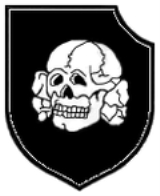
 during World War II. Prior to achieving division status, the formation was known as Kampfgruppe Eicke. The division is famous due to its insignia and the fact that most of the initial enlisted men were SS-Totenkopfverbände (SS concentration camp guards).

The
Totenkopf division was numbered with the "Germanic" divisions of the Waffen-SS.


Discussion
Ask a question about '3rd SS Division Totenkopf'
Start a new discussion about '3rd SS Division Totenkopf'
Answer questions from other users
Full Discussion Forum


Encyclopedia


The SS Division Totenkopf. ("Dead's Head" or "Skull") is also known as 3. SS-Panzergrenadier-Division Totenkopf and 3. SS-Panzer-Division Totenkopf. It was one of the 38 divisions
Division (military)

A division is a large military unit or Formation usually consisting of between ten to thirty thousand soldiers. In most armies, a division is composed of several regiments or brigades, and in turn several divisions make up a corps....
 fielded by the Waffen-SS
Waffen-SS

The Waffen-SS was the combat arm of the Schutzstaffel or SS. It was founded in Germany in 1939 after the SS was split into two units but the title of Waffen-SS only became official on 2 March, 1940....
 during World War II. Prior to achieving division status, the formation was known as Kampfgruppe Eicke. The division is famous due to its insignia and the fact that most of the initial enlisted men were SS-Totenkopfverbände (SS concentration camp guards).

The
Totenkopf division was numbered with the "Germanic" divisions of the Waffen-SS. These included also the SS-Panzergrenadier-Division Leibstandarte SS Adolf Hitler, SS-Panzergrenadier-Division Das Reich, and SS-Panzergrenadier-Division Wiking.

Formation and Fall Gelb


The SS Division
Totenkopf was formed in October 1939. The Totenkopf was initially formed from concentration camp guards and men from the SS-Heimwehr Danzig
SS Heimwehr Danzig

SS Heimwehr "Danzig" was an SS unit established in the Free City of Danzig before the Second World War. It fought with the German army against the Polish Army during the invasion of Poland....
. The division was officered by men from the SS-Verfügungstruppe (SS-VT), of whom many had seen action in Poland. The division was commanded by SS-Obergruppenführer Theodor Eicke
Theodor Eicke

Theodor Eicke was a Nazism official, SS-Obergruppenf?hrer, commander of the SS Division Totenkopf of the Waffen-SS and one of the key figures in the establishment of concentration camps in Nazi Germany....
. Through the Battle of France the division was generally equipped with ex-Czech weapons.

Having missed the Polish campaign
Fall Weiss

Fall Weiss translates as Case White following the German military's naming convention.Fall Weiss may refer to two military operations:...
,
Totenkopf was initially held in reserve during the assault into France and the Low Countries
Low Countries

The Low Countries, the historical region of de Nederlanden, are the country on low-lying land around the river delta of the Rhine, Scheldt, and Meuse River rivers....
 in May 1940. They were committed on 16 May to the Front in Belgium
Belgium

* A small German-speaking Community of Belgium exists in eastern Wallonia. Belgium's linguistic diversity and related political and cultural conflicts are reflected in the history of Belgium and a complex Communities and regions of Belgium....
. The Totenkopf men fought fanatically, suffering heavy losses.

Within a week of this initial commitment the division's first war crime
War crime

War crimes are "violations of the laws or customs of war"; including but not limited to "murder, the ill-treatment or deportation of civilian residents of an occupied territory to slave labor camps", "the murder or ill-treatment of prisoner of war", the killing of hostages, "the wanton destruction of cities, towns and villages, and any devast...
 had already been committed. At Le Paradis
Le Paradis massacre

The Le Paradis massacre was a war crime committed by members of the 14th Company, SS Division Totenkopf, under the command of Hauptsturmf?hrer Fritz Kn?chlein....
  4th Kompanie, I Abteilung, commanded by SS-Obersturmführer Fritz Knöchlein, machine-gunned 97 out of 99 British officers and men of the Royal Norfolk Regiment
Royal Norfolk Regiment

The Royal Norfolk Regiment, originally formed as the Norfolk Regiment, was an infantry regiment of the British Army. The Norfolk Regiment was created on 1 July 1881 as the county regiment of Norfolk....
 after they had surrendered to them; two survived. After the war, Knöchlein was tried by a British Court and convicted for war crimes in 1948. He was sentenced to death and hanged.

Totenkopf saw action a number of times during the French campaign. To the north-east of Cambrai
Cambrai

Cambrai is a Communes of France in the Nord Departments of France in northern France. It is a Subprefectures in France of the department.Cambrai is the seat of Archdiocese of Cambrai whose jurisdiction was immense during the Middle Ages....
 the division took 16,000 French prisoners. Whilst subsequently trying to drive through to the coast they encountered a major Anglo-French force which they had a great deal of difficulty stopping and came perilously close to panic. Totenkopf had to resort to firing artillery pieces in an anti-tank role, and were saved only by the intervention of Luftwaffe dive-bombers. It then suffered heavy losses during the taking of the La Bassée Canal. Further stiff resistance was then encountered at both Béthune
Béthune

B?thune is a city in northern France, Subprefectures in France of the Pas-de-Calais Departments of France....
 and Le Paradis. The French surrender found the division located near the Spanish border, where it was to stay, resting and refitting, until April 1941. Totenkopf had suffered heavy losses during the campaign, including over 300 officers. Replacement personnel were supplied, this time via regular Waffen-SS recruitment as opposed to coming from the camps. Flak and artillery battalions were added to its strength.

Barbarossa-Demjansk Pocket