

2002 Winter Olympics

Encyclopedia
The 2002 Winter Olympics, officially the XIX Olympic Winter Games, were a winter multi-sport event
that was celebrated in February 2002 in and around Salt Lake City, Utah
, United States
. Approximately 2,400 athletes from 77 nations participated in 78 events in fifteen disciplines, held throughout 165 sporting sessions. The 2002 Winter Olympics and the 2002 Paralympic Games were both organized by the Salt Lake Organizing Committee (SLOC). Utah
became the fifth state in the United States to host the Olympic Games, and the 2002 Winter Olympics are the most recent games to be held in the United States.
The opening ceremony was held on February 8, 2002 and sporting competitions were held up until the closing ceremony on February 24, 2002. Music for both ceremonies was directed by Mark Watters
. Salt Lake City became the most populous area ever to have hosted the Winter Olympics but was surpassed by Turin
in the 2006 Winter Olympics
four years later, which itself was surpassed by Vancouver
in the 2010 Winter Olympics
. Following a trend, the 2002 Olympic Winter Games were also larger than all prior Winter Games, with a considerable 10 more events than the 1998 Winter Olympics
in Nagano, Japan; more events yet were staged by Turin
and then Vancouver
and Sochi
Olympics.
The Salt Lake Games faced a bribery scandal
and some local opposition during the bid, as well as some sporting and refereeing controversies during the competitions. Nevertheless, from sporting and business standpoints, they were among the most successful Winter Olympiads in history; records were set in both the broadcasting and marketing programs. Over 2 billion viewers watch more than 13 billion viewer hours. The games were also financially successful raising more money with fewer sponsors than any prior Olympic Games, which left SLOC with a surplus of $40 million at the conclusion of the games. The surplus was used to create the Utah Athletic Foundation, which maintains and operates many of the remaining Olympic venues.
, Hungary.
1Because of the no-commercialization policy of the Olympics, the Delta Center, now the EnergySolutions Arena, was labeled as the "Salt Lake Ice Center," causing some confusion for visitors.
 78 National Olympic Committees sent athletes to the Salt Lake City games.
Cameroon, Hong Kong (China), Nepal, Tajikistan, and Thailand participated in their 1st Winter Olympic games.
(host)
):
, who was named CEO of the Salt Lake Games organizing committee in response to the scandal and a financial shortfall for the games, were forced to contend with public outcry.
LGBT activist groups
vocally opposed Utah's 2002 Winter Olympic bid because of the Utah State Legislature
's imposition of a ban on same-sex marriage in 1995. Led by the Gay and Lesbian Utah Democrats, the "Olympics Out of Utah Committee" modeled its campaign after the "Olympics Out of Cobb County" campaign, which successfully diverted the 1996 Summer Olympics
torch relay away from Cobb County, Georgia
, which had also passed antigay legislation. The Olympics Out of Utah Committee staged protests on Interstate 15
, which included the use of slow-driving cars to disrupt traffic.
In the first week of the Games, a controversy in the pairs' figure skating competition
culminated in the French judge's scores being thrown out and the Canadian team of Jamie Salé
and David Pelletier
being awarded a second gold medal. In short track speed skating
, Ohno initially finished second in the race to Kim Dong-Sung
of South Korea, but was awarded gold after Kim was disqualified for cross-skating across him on the final lap. This decision by the referee, Australian James Hewish
, angered many Koreans, who sent threatening emails to the Olympic website. Athletes in cross-country skiing
were disqualified for various reasons, including doping
by two Russians and one Spaniard, leading Russia to file protests and threaten to withdraw from competition. The 2002 games were the first Winter Olympics held after formation of the World Anti-Doping Agency
; as a result there were a large number of athletes disqualified following the new testing. Unproven allegations of bribery were leveled against many ice-skating judges, leading to the arrest (at the request of the United States) and release of known criminal Alimzhan Tokhtakhounov
by Italian officials.
, there were complaints that the Games were being conducted in an overtly patriotic
manner. President Bush received some criticism for departing from the Olympic charter by extending the declaration to open the Games, saying “On behalf of a proud, determined and grateful nation” before the traditional formula, “I declare open the Games of Salt Lake City”. In addition, the President opened the games standing among the US athletes, while previous heads of state opened the games from an official box. NBC
's Bob Costas
applauded the move during the network's coverage of the Opening Ceremony.
of Northern Utah, and the oranges and red representing the warmer, rugged, red-rock areas
of Southern Utah.
found in the western United States, and used the Fire and Ice theme colors of the Salt Lake 2002 Games. The line thickness and 30-degree angles found in the pictograms mirror those found in the snowflake emblem.
or Fremont
-style petroglyph
.
The torch relay
was a 65 day run, from December 4, 2001 to February 8, 2002, which carried the Olympic flame through 46 of the 50 states in the United States. The torch covered 13500 miles (21,726.1 km), passed through 300 communities, and was carried by 12,012 Torchbearers.
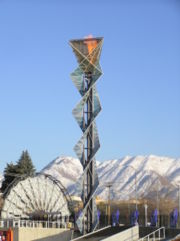
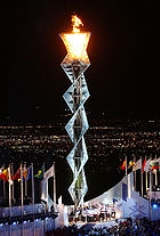
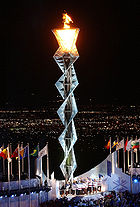
, and was made of glass which allowed the fire to be seen burning within. The actual glass cauldron stands atop a twisting glass and steel support, is 12 feet (3.7 m) high, and the flame within burns at 900 °F (482.2 °C). Together with its support the cauldron stands 117 feet (35.7 m) tall and was made of 738 individual pieces of glass. Small jets send water down the glass sides of the cauldron, both to keep the glass and metal cooled (so they would not crack or melt), and to give the effect of melting ice. The cauldron was designed by WET Design of Los Angeles, its frame built by Arrow Dynamics
of Clearfield, Utah
, and its glass pieces created by Western Glass of Ogden, Utah
. The cauldron's cost was 2 million dollars, and it was unveiled to the public during its original install at Rice-Eccles Stadium (2002 Olympic Stadium) on January 8, 2002. Following the completion of the 2002 Winter Olympics the cauldron was installed at the permanent Salt Lake 2002 Olympic Cauldron Park
, next the 2002 Olympic Stadium in Salt Lake City.
A second Olympic cauldron burned at the Awards Plaza in downtown Salt Lake City during the games. It was known as the Hero's Cauldron and was in the backdrop of every awards ceremony. This was the first time two cauldrons were used during the same Olympic Games.
(NSSE).
Aerial surveillance and radar control was provided by the Marines of Marine Air Control Squadron 2 det C, from Cherry Point NC.
When he spoke during the opening ceremonies, Jacques Rogge
, presiding over his first olympics as IOC president, told the athletes of the United States, the host country:
Multi-sport event
A multi-sport event is an organized sporting event, often held over multiple days, featuring competition in many different sports between organized teams of athletes from nation-states. The first major, modern, multi-sport event of international significance was the modern Olympic Games.Many...
that was celebrated in February 2002 in and around Salt Lake City, Utah
Utah
Utah is a state in the Western United States. It was the 45th state to join the Union, on January 4, 1896. Approximately 80% of Utah's 2,763,885 people live along the Wasatch Front, centering on Salt Lake City. This leaves vast expanses of the state nearly uninhabited, making the population the...
, United States
United States
The United States of America is a federal constitutional republic comprising fifty states and a federal district...
. Approximately 2,400 athletes from 77 nations participated in 78 events in fifteen disciplines, held throughout 165 sporting sessions. The 2002 Winter Olympics and the 2002 Paralympic Games were both organized by the Salt Lake Organizing Committee (SLOC). Utah
Utah
Utah is a state in the Western United States. It was the 45th state to join the Union, on January 4, 1896. Approximately 80% of Utah's 2,763,885 people live along the Wasatch Front, centering on Salt Lake City. This leaves vast expanses of the state nearly uninhabited, making the population the...
became the fifth state in the United States to host the Olympic Games, and the 2002 Winter Olympics are the most recent games to be held in the United States.
The opening ceremony was held on February 8, 2002 and sporting competitions were held up until the closing ceremony on February 24, 2002. Music for both ceremonies was directed by Mark Watters
Mark Watters
Mark Watters is a five-time Emmy Award winning American composer of music for film and television. He currently lives in Chatsworth with his wife Vanessa.- Biography :...
. Salt Lake City became the most populous area ever to have hosted the Winter Olympics but was surpassed by Turin
Turin
Turin is a city and major business and cultural centre in northern Italy, capital of the Piedmont region, located mainly on the left bank of the Po River and surrounded by the Alpine arch. The population of the city proper is 909,193 while the population of the urban area is estimated by Eurostat...
in the 2006 Winter Olympics
2006 Winter Olympics
The 2006 Winter Olympics, officially known as the XX Olympic Winter Games, was a winter multi-sport event which was celebrated in Turin, Italy from February 10, 2006, through February 26, 2006. This marked the second time Italy hosted the Olympic Winter Games, the first being the VII Olympic Winter...
four years later, which itself was surpassed by Vancouver
Vancouver
Vancouver is a coastal seaport city on the mainland of British Columbia, Canada. It is the hub of Greater Vancouver, which, with over 2.3 million residents, is the third most populous metropolitan area in the country,...
in the 2010 Winter Olympics
2010 Winter Olympics
The 2010 Winter Olympics, officially the XXI Olympic Winter Games or the 21st Winter Olympics, were a major international multi-sport event held from February 12–28, 2010, in Vancouver, British Columbia, Canada, with some events held in the suburbs of Richmond, West Vancouver and the University...
. Following a trend, the 2002 Olympic Winter Games were also larger than all prior Winter Games, with a considerable 10 more events than the 1998 Winter Olympics
1998 Winter Olympics
The 1998 Winter Olympics, officially the XVIII Olympic Winter Games, was a winter multi-sport event celebrated from 7 to 22 February 1998 in Nagano, Japan. Seventy-two nations and 2,176 participans contested in seven sports and 72 events at 15 venues. The games saw the introduction of Women's ice...
in Nagano, Japan; more events yet were staged by Turin
2006 Winter Olympics
The 2006 Winter Olympics, officially known as the XX Olympic Winter Games, was a winter multi-sport event which was celebrated in Turin, Italy from February 10, 2006, through February 26, 2006. This marked the second time Italy hosted the Olympic Winter Games, the first being the VII Olympic Winter...
and then Vancouver
2010 Winter Olympics
The 2010 Winter Olympics, officially the XXI Olympic Winter Games or the 21st Winter Olympics, were a major international multi-sport event held from February 12–28, 2010, in Vancouver, British Columbia, Canada, with some events held in the suburbs of Richmond, West Vancouver and the University...
and Sochi
2014 Winter Olympics
The 2014 Winter Olympics, officially the XXII Olympic Winter Games, or the 22nd Winter Olympics, is a major international multi-sport event scheduled to be celebrated from 7 to 23 February 2014, in Sochi, Russia with some events held in the resort town of Krasnaya Polyana. Both the Olympic and...
Olympics.
The Salt Lake Games faced a bribery scandal
2002 Winter Olympic bid scandal
The 2002 Olympic Winter Games bid scandal was a scandal involving allegations of bribery used to win the rights to host the 2002 Winter Olympics in Salt Lake City, Utah, United States. Prior to its successful bid in 1995, the city had attempted four times to secure the games; failing each time...
and some local opposition during the bid, as well as some sporting and refereeing controversies during the competitions. Nevertheless, from sporting and business standpoints, they were among the most successful Winter Olympiads in history; records were set in both the broadcasting and marketing programs. Over 2 billion viewers watch more than 13 billion viewer hours. The games were also financially successful raising more money with fewer sponsors than any prior Olympic Games, which left SLOC with a surplus of $40 million at the conclusion of the games. The surplus was used to create the Utah Athletic Foundation, which maintains and operates many of the remaining Olympic venues.
Host city selection
Salt Lake City was chosen over Quebec City, Canada, Sion, Switzerland, and, Östersund, Sweden on June 16, 1995, at the 104th IOC Session in BudapestBudapest
Budapest is the capital of Hungary. As the largest city of Hungary, it is the country's principal political, cultural, commercial, industrial, and transportation centre. In 2011, Budapest had 1,733,685 inhabitants, down from its 1989 peak of 2,113,645 due to suburbanization. The Budapest Commuter...
, Hungary.
| 2002 Winter Olympics bidding result | |||||
|---|---|---|---|---|---|
| City | Country | Round 1 | |||
| Salt Lake City | 54 | ||||
| Östersund Östersund Östersund is an urban area in Jämtland in the middle of Sweden. It is the seat of Östersund Municipality and the capital of Jämtland County. Östersund is located at the shores of Sweden's fifth largest lake, Storsjön, opposite the island Frösön, and is the only city in Jämtland. Östersund is the... |
14 | ||||
| Sion Sion, Switzerland Sion is the capital of the Swiss canton of Valais. it had a population of .Landmarks include the Basilique de Valère and Château de Tourbillon. Sion has an airfield for civilian and military use, which, because of its location in a valley, causes a reasonable amount of noise pollution. FC Sion... |
14 | ||||
| Quebec City Quebec City Quebec , also Québec, Quebec City or Québec City is the capital of the Canadian province of Quebec and is located within the Capitale-Nationale region. It is the second most populous city in Quebec after Montreal, which is about to the southwest... |
7 | ||||
Competitive Venues
| Venue | Event(s) | Gross Capacity | Ref. |
|---|---|---|---|
| Deer Valley Deer Valley Deer Valley is an alpine ski resort in the Wasatch Range, located east of Salt Lake City, in Park City, Utah, United States. The resort, known for its upscale amenities, is consistently ranked among the top ski resorts in North America... |
Alpine skiing Alpine skiing at the 2002 Winter Olympics Alpine skiing at the 2002 Winter Olympics consisted of ten events held near Salt Lake City, Utah, U.S.A. The downhill, Super G, and combined events were held at Snowbasin, the giant slalom at Park City, and the slalom at Deer Valley... (slalom), Freestyle skiing Freestyle skiing at the 2002 Winter Olympics Four freestyle skiing events were held at the 2002 Winter Olympics in Salt Lake City, at the venue in Deer Valley. There were both men's and women's competition in both aerials and moguls events... |
13,400 | |
| E Center | Ice hockey Ice hockey at the 2002 Winter Olympics Ice hockey at the 2002 Winter Olympics were held at the E Center in West Valley City and Peaks Ice Arena in Provo, Utah. Both the men's and women's tournaments were won by Canada, defeating the host USA in both games.-Men:... |
10,500 | |
| Park City Mountain Resort Park City Mountain Resort Park City Mountain Resort is a ski resort in Park City, Utah, located east of Salt Lake City. The resort has been a major tourist attraction for skiers from all over the United States, as well as a main employer for many of Park City's citizens. Park City, as the resort is often called by locals,... |
Alpine skiing (giant slalom), Snowboarding Snowboarding at the 2002 Winter Olympics The 2002 Winter Olympic Games Snowboarding competition consisted of men's and women's Halfpipe and Parallel Giant Slalom events. The snowboarding competition took place at Park City, over a five day period.-Medal table:-Men's events:... |
16,000 | |
| Peaks Ice Arena Peaks Ice Arena Peaks Ice Arena is an indoor ice hockey arena in Provo, Utah, United States, located south of Salt Lake City.It was built, along with the E Center in West Valley City, Utah, to serve as an ice hockey and practice venue for the 2002 Winter Olympics... |
Ice hockey | 8,400 | |
| Salt Lake Ice Center EnergySolutions Arena EnergySolutions Arena is an indoor arena, in Salt Lake City, Utah, United States, owned by Jazz Basketball Investors, Inc., the estate of Larry H. Miller... 1 |
Figure skating Figure skating at the 2002 Winter Olympics -Full Results:Referee:* Sally-Anne StaplefordAssistant Referee:* Junko HiramatsuJudges: Wendy Langton Merja Kosonen Janet Allen Nicolae Bellu Yuri Kliushnikov Volker Waldeck Alexander Penchev Mieko Fujimori Evgenia Bogdanova Jarmila Portová -Ladies:Hughes, fourth after the technical program, skated... , Short track speed skating Short track speed skating at the 2002 Winter Olympics 2002 Winter Olympic Games Short track speed skating. All events were held at the Salt Lake Ice Center.-Medal table:-Men's events:-Women's events:-References:*... |
17,500 | |
| Snowbasin Snowbasin Snowbasin Resort is located northeast of Salt Lake City, in Weber County, Utah. Opened in 1939, as part of an effort by the city of Ogden, Utah to restore the Wheeler Creek watershed, it is one of the oldest ski resorts in the United States. Over the next 50 years Snowbasin grew slowly... |
Alpine skiing (combined, downhill, super-G) | 22,500 | |
| Soldier Hollow Soldier Hollow Soldier Hollow is a cross-country ski resort located southeast of Salt Lake City in Wasatch Mountain State Park, Utah, United States. The resort was created for the 2002 Winter Olympics, and during the games it hosted the biathlon, cross-country skiing and the cross country skiing portion of the... |
Biathlon Biathlon at the 2002 Winter Olympics The 2002 Winter Olympic Games Biathlon were held at Soldier Hollow.-10 km Sprint:Without any misses with the shooting, Bjørndalen wins his second gold of the Games.-12.5 km Pursuit:... , Cross-country skiing Cross-country skiing at the 2002 Winter Olympics The cross-country skiing events at the 2002 Winter Olympics were marred by drug problems. The winners of three races were disqualified after blood tests showed that three skiers had overly high red blood cell counts indicating the use of darbepoetin, a drug used to treat anemia... , Nordic combined Nordic combined at the 2002 Winter Olympics Nordic combined at the 2002 Winter Olympics, consisted of three events held over ten days, from 9 February to 22 February. The ski jumping part took place in Park City, while the cross-country part took place in Soldier Hollow.-Medal table:-Events:... (cross-country skiing portion) |
15,200 | |
| The Ice Sheet at Ogden | Curling Curling at the 2002 Winter Olympics Curling at the 2002 Winter Olympics took place from February 11 to February 18 in Ogden, Utah:-Medal winners:-Teams:* Hammy McMillan was replaced by Warwick Smith as skip after Draw 4.-Final standings:-Draw 1:February 11, 9:00... |
2,000 | |
| Utah Olympic Oval Utah Olympic Oval The Utah Olympic Oval, an indoor speed skating oval built for the 2002 Winter Olympics, is located southwest of Salt Lake City, in Kearns, Utah. The Oval hosted the long track speed skating events for the 2002 games. Inside the facility the 400-meter skating track surrounds two international sized... |
Speed skating Speed skating at the 2002 Winter Olympics Speed skating at the 2002 Winter Olympics, was held over fourteen days, from 9 February to 23 February. Ten events were contested at the Utah Olympic Oval.-Medal table:-Men's events:-Women's events:-Records:... |
5,236 | |
| Utah Olympic Park Utah Olympic Park The Utah Olympic Park is a winter sports park built for the 2002 Winter Olympics, and is located east of Salt Lake City near Park City, Utah, United States. During the 2002 games the park hosted the bobsleigh, skeleton, luge, ski jumping, and nordic combined events. It still serves a training... (bobsleigh, luge, and skeleton track Utah Olympic Park bobsleigh/luge/skeleton track The Utah Olympic Park Track is a bobsleigh, luge, and skeleton track located in the Utah Olympic Park, near Park City, Utah, United States. During the 2002 Winter Olympics, held nearby in Salt Lake City, the track hosted the bobsleigh, luge, and skeleton events... ) |
Bobsleigh Bobsleigh at the 2002 Winter Olympics The bobsleigh results for the 2002 Winter Olympic Games at Salt Lake City.-Events:-Medal table:-References:***... , Luge Luge at the 2002 Winter Olympics The Luge competition at the 2002 Winter Olympic Games was held at Utah Olympic Park in Park City. Three events were staged, taking place from February 10 to February 14.-Medal table:-Events:-References:***... , Skeleton Skeleton at the 2002 Winter Olympics Skeleton returned to the program of the Winter Olympic Games for the first time in 54 years at the 2002 Games in Salt Lake City. Both men and women competed, with medals awarded after two runs down the course. Both events were contested on February 20.-Medal summary:-Medal table:-References:**... , Nordic combined (ski jumping portion), ski jumping Ski jumping at the 2002 Winter Olympics 2002 Winter Olympic Games Ski jumping-Medal table:- Events :-References:*... |
18,100 (ski jumping) 15,000 (sliding track) |
|
1Because of the no-commercialization policy of the Olympics, the Delta Center, now the EnergySolutions Arena, was labeled as the "Salt Lake Ice Center," causing some confusion for visitors.
Non-competitive Venues
| Venue | Event(s)/Purpose | Gross Capacity | Ref. |
|---|---|---|---|
| Main Media Center Salt Palace This article describes a large building in Utah. A one-story building made of locally mined salt blocks in Grand Saline, Texas is also called the "Salt Palace".... |
International Broadcast Center International Broadcast Centre The International Broadcast Centre is a temporary hub for broadcasters during major sport events.-FIFA World Cup:During the 2006 FIFA World Cup, in Germany, the IBC in Munich was host to journalists from around 190 countries. The centre was based at the Munich Fair, in what was formally Munich... & Main Press Center |
||
| 2002 Olympic Medals Plaza | Olympic medal presentations & Olympic Celebration Series concerts | 20,000 | |
| 2002 Olympic Village | Olympic Village Olympic Village An Olympic Village is an accommodation centre built for an Olympic Games, usually within an Olympic Park or elsewhere in a host city. Olympic Villages are built to house all participating athletes, as well as officials, athletic trainers, and other staff. Since the Munich Massacre at the 1972... & Olympic Family Hotel |
||
| Park City Park City, Utah Park City is a town in Summit and Wasatch counties in the U.S. state of Utah. It is considered to be part of the Wasatch Back. The city is southeast of downtown Salt Lake City and from Salt Lake City's east edge of Sugar House along Interstate 80. The population was 7,558 at the 2010 census... Main Street |
Main Street Celebration area, Park City Technical Center, NBC broadcast center, Sponsor Showcases | ||
| Rice-Eccles Olympic Stadium | Opening & Closing Ceremonies | ≈50,000 | |
| Salt Lake Olympic Square | Olympic Medals Plaza, Salt Lake Ice Center, Olympic Superstore, Sponsor Showcases | ||
Participating nations
Cameroon, Hong Kong (China), Nepal, Tajikistan, and Thailand participated in their 1st Winter Olympic games.
(host)
Medal table
| 1 | align=left | |13 | 5 | 7 | 25 |
| 2 | align=left | |12 | 16 | 8 | 36 |
| 3 | align=left | |10 | 13 | 11 | 34 |
| 4 | align=left | |7 | 3 | 7 | 17 |
| 5 | align=left | |5 | 4 | 4 | 13 |
| 6 | align=left | |4 | 5 | 2 | 11 |
| 7 | align=left | |4 | 4 | 5 | 13 |
| 8 | align=left | |4 | 2 | 1 | 7 |
| 9 | align=left | |3 | 5 | 0 | 8 |
| 10 | align=left | |3 | 4 | 10 | 17 |
Records
Several medals records were set and/or tied. They included (bold-face indicates broken during the Vancouver Olympics2010 Winter Olympics
The 2010 Winter Olympics, officially the XXI Olympic Winter Games or the 21st Winter Olympics, were a major international multi-sport event held from February 12–28, 2010, in Vancouver, British Columbia, Canada, with some events held in the suburbs of Richmond, West Vancouver and the University...
):
- Norway tied the Soviet Union at the 1976 Winter OlympicsSoviet Union at the 1976 Winter OlympicsThe Soviet Union competed at the 1976 Winter Olympics in Innsbruck, Austria.During the games, the Soviet Union won 13 gold medals, the most any country won at a single Winter Olympics. Norway tied it during the Salt Lake City games...
for most gold medals at a Winter Olympics, with 13. - Germany set a record for most total medals at a Winter Olympics, with 36.
- The following records the United States set and/or tied:
- Most gold medals at a home Winter Olympics, with 10, tying Norway at the 1994 Winter OlympicsNorway at the 1994 Winter OlympicsNorway was the host nation for the 1994 Winter Olympics in Lillehammer. It was the second time that Norway had hosted the Winter Olympic Games, after the 1952 Games in Oslo. In 1994, Norway finished second in the medal ranking to Russia, with strong results in the skiing events.During the games,...
. - Most total medals at a home Winter Olympics, with 34.
- Most gold medals at a home Winter Olympics, with 10, tying Norway at the 1994 Winter Olympics
Highlights
- The opening ceremonies included Grammy AwardGrammy AwardA Grammy Award — or Grammy — is an accolade by the National Academy of Recording Arts and Sciences of the United States to recognize outstanding achievement in the music industry...
-winning artist LeAnn RimesLeAnn RimesLeAnn Rimes is an American country/pop singer. She is known for her rich vocals and her rise to fame as an eight-year-old champion on the original Ed McMahon version of Star Search, followed by the release of the Patsy Cline-intended single "Blue" when Rimes was only age 13, resulting in her...
singing "Light the Fire Within," the official song of the 2002 Olympics. - The Grammy Award-winning Mormon Tabernacle ChoirMormon Tabernacle ChoirThe Mormon Tabernacle Choir, sometimes colloquially referred to as MoTab, is a Grammy and Emmy Award winning, 360-member, all-volunteer choir. The choir is part of The Church of Jesus Christ of Latter-day Saints . However, the choir is completely self-funded, traveling and producing albums to...
performed the "Star-Spangled Banner", National Anthem of the United States, for the opening ceremonies. - John WilliamsJohn WilliamsJohn Towner Williams is an American composer, conductor, and pianist. In a career spanning almost six decades, he has composed some of the most recognizable film scores in the history of motion pictures, including the Star Wars saga, Jaws, Superman, the Indiana Jones films, E.T...
composed a five-minute work for orchestra and chorus, Call of the ChampionsCall of the ChampionsCall of the Champions was composed by John Williams for the 2002 Winter Olympics in Salt Lake City, Utah. Premiering at the Opening Ceremony on February 8, 2002, it begins with the call by the Mormon Tabernacle Choir of "Citius! Altius! Fortius!" , which is the Olympic Motto chosen by the founder...
, that served as the official theme of the 2002 Winter Olympics, his first for a Winter Olympiad. It was performed by the Utah Symphony OrchestraUtah Symphony Orchestra-History:The first attempt to create a symphony group in the Utah area occurred in 1892, before Utah was a state. The Salt Lake Symphony was created and presented just one concert before disbanding. In 1902 the Salt Lake Symphony Orchestra was formed, and it remained in existence until 1911...
and featured the Mormon Tabernacle ChoirMormon Tabernacle ChoirThe Mormon Tabernacle Choir, sometimes colloquially referred to as MoTab, is a Grammy and Emmy Award winning, 360-member, all-volunteer choir. The choir is part of The Church of Jesus Christ of Latter-day Saints . However, the choir is completely self-funded, traveling and producing albums to...
and the Madeleine Choir School singing the official motto of the Olympic Games "Citius, Altius, Fortius" (Faster, Higher, Stronger). The premiere of the work at the opening ceremonies also corresponded with John Williams's 70th birthday. The work is featured on the CD American Journey, and also on the Choir's recording Spirit of America. - There were also signs of the aftermath of September 11, 2001, being the first Olympics since then. They included the flag that flew at Ground ZeroWorld Trade Center siteThe World Trade Center site , also known as "Ground Zero" after the September 11 attacks, sits on in Lower Manhattan in New York City...
, NYPDNew York City Police DepartmentThe New York City Police Department , established in 1845, is currently the largest municipal police force in the United States, with primary responsibilities in law enforcement and investigation within the five boroughs of New York City...
officer Daniel RodriguezDaniel RodriguezDaniel Rodríguez is an American operatic tenor from New York City. He became known as "The Singing Policeman" in his former work with the New York City Police Department, due to his role as one of the department's designated National Anthem singers...
singing "God Bless AmericaGod Bless America"God Bless America" is an American patriotic song written by Irving Berlin in 1918 and revised by him in 1938. The later version has notably been recorded by Kate Smith, becoming her signature song ....
", and honor guards of NYPD and FDNYNew York City Fire DepartmentThe New York City Fire Department or the Fire Department of the City of New York has the responsibility for protecting the citizens and property of New York City's five boroughs from fires and fire hazards, providing emergency medical services, technical rescue as well as providing first response...
members. - Along with the flag that flew at the World Trade Center site, the Challenger flagChallenger flagThe Challenger flag is an American flag that was in the flight kit of the final, disastrous Challenger mission. It was sponsored by Boy Scout Troop 514 of Monument, Colorado...
was also carried into the stadium. - The opening segment of the opening ceremony celebrated all previous hosts of the Olympic Winter Games.
- The Olympic Flame was lit by the members of the Gold Medal-winning US Hockey Team of the 1980 Winter Olympics1980 Winter OlympicsThe 1980 Winter Olympics, officially known as the XIII Olympic Winter Games, was a multi-sport event which was celebrated from 13 February through 24 February 1980 in Lake Placid, New York, United States of America. This was the second time the Upstate New York village hosted the Games, after 1932...
in Lake Placid, NY, which was the previous time the Winter Olympics were in the US. (See picture at right) - These Olympics marked the first time a United States presidentPresident of the United StatesThe President of the United States of America is the head of state and head of government of the United States. The president leads the executive branch of the federal government and is the commander-in-chief of the United States Armed Forces....
opened an Olympic Winter Games held in the United States, although previous Presidents Franklin Roosevelt and Richard NixonRichard NixonRichard Milhous Nixon was the 37th President of the United States, serving from 1969 to 1974. The only president to resign the office, Nixon had previously served as a US representative and senator from California and as the 36th Vice President of the United States from 1953 to 1961 under...
had opened the 1932 Winter Olympics1932 Winter OlympicsThe 1932 Winter Olympics, officially known as the III Olympic Winter Games, were a winter multi-sport event which was celebrated in 1932 in Lake Placid, New York, United States. The games opened on February 4 and closed on February 15. It would be the first winter olympics held in the United...
and the 1960 Winter Olympics1960 Winter OlympicsThe 1960 Winter Olympics, officially known as the VIII Olympic Winter Games, were a winter multi-sport event held between February 18 and 28, 1960 in Squaw Valley, California, United States. In 1955 at the 50th IOC meeting, the organizing committee made the surprise choice to award Squaw Valley as...
in their roles as Governor of New YorkGovernor of New YorkThe Governor of the State of New York is the chief executive of the State of New York. The governor is the head of the executive branch of New York's state government and the commander-in-chief of the state's military and naval forces. The officeholder is afforded the courtesy title of His/Her...
and Vice President of the United States, respectively. - These were the first Games to be held under IOC president Jacques RoggeJacques RoggeJacques Rogge, Count Rogge , is a Belgian sports bureaucrat. He is the eighth and current President of the International Olympic Committee .-Life and career:...
. - Competition highlights included biathlete Ole Einar BjørndalenOle Einar BjørndalenOle Einar Bjørndalen is a Norwegian professional biathlete. He is often regarded as one of the greatest athletes of all time. In 1992, he won his first career medal at the junior world championships. A year later In 1993, after winning a record three junior world championship titles, Bjørndalen...
of Norway, winning gold in all four men's events (10 k, 12.5 k, 20 k, 4 x 7.5 relay), Nordic combinedNordic combinedThe Nordic combined is a winter sport in which athletes compete in both cross-country skiing and ski jumping.- History :While Norwegian soldiers are known to have been competing in Nordic skiing since the 19th century, the first major competition in Nordic combined was held in 1892 in Oslo at the...
athlete Samppa LajunenSamppa LajunenSamppa Lajunen is a retired Finnish Nordic combined athlete who competed during the late 1990s and early 2000s....
of Finland winning three gold medals, Simon AmmannSimon AmmannSimon Ammann is a Swiss ski jumper, and double Olympic Champion at both 2002 and 2010 Winter Olympics.Ammann was born in Grabs, Switzerland, to Margit and Heinrich Ammann and raised in Unterwasser, Switzerland. He has two brothers and three sisters. He married Yana Yanovskaya on 25 June 2010...
of Switzerland taking the double in ski jumping. In alpine skiing, Janica KostelićJanica KostelicJanica Kostelić is a retired alpine ski racer from Croatia. She is the only woman to win four gold medals in alpine skiing at the Winter Olympics , and the only woman to win three alpine skiing gold medals in one Olympics ....
won three golds and a silver (the first Winter Olympic medals ever for an athlete from Croatia and the first three-gold performance by a female), while Kjetil André AamodtKjetil André AamodtKjetil André Aamodt is a Norwegian former alpine ski racer, and is the most decorated in history....
of Norway earned his second and third career golds, setting up both athletes to beat the sport's record with their fourth golds earned at the next Winter Olympics near TurinAlpine skiing at the 2006 Winter OlympicsAlpine skiing at the 2006 Winter Olympics consisted of ten events, held at Sestriere and Cesana-San Sicario, Italy. The races were held from February 12-25, 2006.-Medal table:- Men's events :- Women's events :-Course Information:...
(Aamodt also set the overall medal record in the sport with 8). - SkeletonSkeleton (sport)Skeleton is a fast winter sliding sport in which an individual person rides a small sled down a frozen track while lying face down, during which athletes experience forces up to 5g. It originated in St. Moritz, Switzerland as a spin-off from the popular British sport of Cresta Sledding...
returned as a medal sport in the 2002 Games for the first time since 1948. - Ireland reached its best ever position and came close to winning its first winter medal when Clifton WrottesleyClifton WrottesleyClifton Hugh Lancelot de Verdon Wrottesley, 6th Baron Wrottesley, 14th Baronet , is an Irish sportsman and British Peer.-Biography:...
(Clifton Hugh Lancelot de Verdon Wrottesley, 6th Baron Wrottesley) finished fourth in the men's skeleton event. - The Women's Bobsled Event had its debut at the 2002 Games after several years of World Cup competition.
- A feature of these Games was the emergence of the extreme sports, such as snowboarding, moguls and aerials, which appeared in previous Olympic Winter Games but have captured greater public attention in recent years.
- American Sarah HughesSarah HughesSarah Elizabeth Hughes is an American figure skater. She is the 2002 Olympic gold medalist and 2001 World bronze medalist in ladies singles.-Personal life:...
won the gold medal in figure skating. American and heavy favorite Michelle KwanMichelle KwanMichelle Wingshan Kwan is an American figure skater. She is a two-time Olympic medalist, a five-time World champion and a nine-time U.S...
fell during her long program and received the bronze medal. - China won its first and second Winter Olympic gold medals, both by women's short-track speed skater Yang Yang (A).
- One of the most memorable stories of the event occurred at the men's short track. Australian skater Steven BradburySteven BradburySteven John Bradbury OAM is a former Australian short track speed skater and four-time Olympian, who won the 1,000 m event at the 2002 Winter Olympics after all of his opponents were involved in a last corner pile-up...
, a competitor who had won a bronze in 19941994 Winter OlympicsThe 1994 Winter Olympics, officially known as the XVII Olympic Winter Games, was a winter multi-sport event celebrated from 12 to 27 February 1994 in and around Lillehammer, Norway. Lillehammer failed to win the bid for the 1992 event. Lillehammer was awarded the games in 1988, after having beat...
as part of a relay team but well off the pace of the medal favourites, cruised off the pace in his semifinal only to see three of his competitors crash into each other, allowing him to finish second and go through to the final. Bradbury was again well off the pace, but lightning struck again and all four other competitors crashed out in the final turn, leaving a jubilant Bradbury to take the most unlikely of gold medals, the first for Australia—or any other country of the Southern HemisphereSouthern HemisphereThe Southern Hemisphere is the part of Earth that lies south of the equator. The word hemisphere literally means 'half ball' or "half sphere"...
—in the Olympic Winter Games. - Australia winning their second gold medal, courtesy of Alisa CamplinAlisa CamplinAlisa Camplin OAM is an Australian aerial skier who won gold at the 2002 Winter Olympics, the second ever winter olympic gold medal for Australia. At the 2006 Winter Olympics, Camplin finished third, a bronze medal...
in Women's Aerials, the first ever Winter Games gold won by a woman from the Southern Hemisphere. - The Canadian men's ice hockeyIce hockeyIce hockey, often referred to as hockey, is a team sport played on ice, in which skaters use wooden or composite sticks to shoot a hard rubber puck into their opponent's net. The game is played between two teams of six players each. Five members of each team skate up and down the ice trying to take...
team defeated the American team 5–2 to claim the gold medal, ending 50 years without the hockey gold. The Canadian women's team also defeated the American team 3–2 after losing to them at the 1998 Winter Olympic GamesIce hockey at the 1998 Winter OlympicsIce hockey at the 1998 Winter Olympics was played at The Big Hat and Aqua Wing Arena in Nagano, Japan.-Men's tournament:The 1998 Olympic men's ice hockey tournament was the first in which professional players from the National Hockey League were allowed to participate, allowing national teams to...
in Nagano. - The closing ceremonies marked the final live performance of KISSKISS (band)Kiss is an American rock band formed in New York City in January 1973. Well-known for its members' face paint and flamboyant stage outfits, the group rose to prominence in the mid to late 1970s on the basis of their elaborate live performances, which featured fire breathing, blood spitting,...
with its lineup of StanleyPaul StanleyStanley Harvey Eisen , better known by his stage name Paul Stanley, is an American hard rock guitarist, singer, musician, painter and songwriter best known for being the rhythm guitarist and primary lead vocalist of the rock band Kiss. He is the writer or co-writer of many of the band's...
/SimmonsGene SimmonsGene Simmons is an Israeli-American entrepreneur, singer-songwriter, actor, and rock bassist. Known as "The Demon", he is the bassist/vocalist of Kiss, a hard rock band he co-founded in the early 1970s.-Early life:...
/FrehleyAce FrehleyPaul Daniel "Ace" Frehley is an American musician best known as the lead guitarist of the rock band Kiss. He took on the persona of the "Spaceman" or "Space Ace" when the band adopted costumes and theatrics...
/SingerEric SingerEric Doyle Mensinger , better known as Eric Singer, is a hard rock and heavy metal drummer for the rock band Kiss and formerly for singer Alice Cooper...
. They performed "Rock and Roll All NiteRock and Roll All Nite"Rock and Roll All Nite" is a song by Kiss, originally released on their 1975 album Dressed to Kill. It was released as the A-side of their fifth single, with the album track "Getaway." The studio version of the song peaked at No. 57 on the Billboard singles chart, besting the band's previous...
". Other artists performing at the 2002 ceremonies were CreedCreed (band)Creed is an American rock band formed in 1995 in Tallahassee, Florida. Becoming popular in the late 1990s and early 2000s, the band has released three consecutive multi-platinum albums, one of which has been certified diamond, and has sold over 28 million records in the United States, with an...
, Sting, Yo Yo Ma, R. KellyR. KellyRobert Sylvester Kelly , better known by his stage name R. Kelly, is an American singer-songwriter and record producer. A native of Chicago, Kelly began performing during the late 1980s and debuted in 1992 with the group Public Announcement. In 1993, Kelly went solo with the album 12 Play...
, Christina AguileraChristina AguileraChristina María Aguilera is an American recording artist and actress. Aguilera first appeared on national television in 1990 as a contestant on the Star Search program, and went on to star in Disney Channel's television series The Mickey Mouse Club from 1993–1994...
, Dianne ReevesDianne ReevesDianne Reeves is an American jazz singer. She currently lives in Denver, Colorado.-Early life:Reeves was born in Detroit, Michigan to a very musical family. Her father, who died when she was two years old, was also a singer. Her mother, Vada Swanson, played trumpet. A cousin, George Duke, is a...
, Harry Connick Jr., Dorothy HamillDorothy HamillDorothy Stuart Hamill is an American figure skater. She is the 1976 Olympic champion in Ladies' Singles and 1976 World Champion.-Early life:...
, Dave Matthews BandDave Matthews BandDave Matthews Band, sometimes shortened to DMB, is a U.S. rock band formed in Charlottesville, Virginia in 1991. The founding members were singer-songwriter and guitarist Dave Matthews, bassist Stefan Lessard, drummer/backing vocalist Carter Beauford and saxophonist LeRoi Moore. Boyd Tinsley was...
, 'N Sync'N SyncN Sync was an American boy band formed in Orlando, Florida, in 1995 and launched in Germany by BMG Ariola Munich, *NSYNC consisted of JC Chasez, Justin Timberlake, Lance Bass, Joey Fatone and Chris Kirkpatrick...
, Earth, Wind & FireEarth, Wind & FireEarth, Wind & Fire is an American soul and R&B band formed in Chicago, Illinois, in 1969 by Verdine and Maurice White. Also known as EWF, the band has won six Grammy Awards and four American Music Awards. They have been inducted into both the Rock and Roll Hall of Fame and the Vocal Group Hall of...
, The Dixie Chicks, Josh GrobanJosh GrobanJoshua Winslow "Josh" Groban is an American singer-songwriter, musician, actor, and record producer. His four solo albums have been certified at least multi-platinum, and in 2007, he was charted as the number-one best selling artist in the United States with over 21 million records in that country...
, Charlotte ChurchCharlotte ChurchCharlotte Maria Church is a Welsh singer-songwriter, actress and television presenter. She rose to fame in childhood as a classical singer before branching into pop music in 2005. By 2007, she had sold more than 10 million records worldwide including over 5 million in the United States...
, Mormon Tabernacle ChoirMormon Tabernacle ChoirThe Mormon Tabernacle Choir, sometimes colloquially referred to as MoTab, is a Grammy and Emmy Award winning, 360-member, all-volunteer choir. The choir is part of The Church of Jesus Christ of Latter-day Saints . However, the choir is completely self-funded, traveling and producing albums to...
and, during the presentation of Turin, Irene GrandiIrene Grandi-Biography:Irene Grandi was born in Florence.She debuted in the Sanremo Music Festival in the category New Proposed with "Fuori", in 1994, which was later won by Andrea Bocelli, who was also debuting the same year....
and ElisaElisaElisa Toffoli is an Italian singer-songwriter, performing under the mononym Elisa. She is one of few Italian musicians to write and record mainly in English. She draws inspiration from many genres such as pop, alternative rock, electronica and trip hop...
. - There was a Canadian dollar underneath the ice in support of the Canadian men's team, supposedly placed there at the request of Wayne GretzkyWayne GretzkyWayne Douglas Gretzky, CC is a Canadian former professional ice hockey player and former head coach. Nicknamed "The Great One", he is generally regarded as the best player in the history of the National Hockey League , and has been called "the greatest hockey player ever" by many sportswriters,...
, who knew the man responsible for ice upkeep. - Team Belarus's Vladimir Kopat scored a game winning goal from center ice against Team Sweden in the quarter finals, getting Belarus to their best place in international hockey so far.
- The games were formally closed by International Olympic Committee President Jacques RoggeJacques RoggeJacques Rogge, Count Rogge , is a Belgian sports bureaucrat. He is the eighth and current President of the International Olympic Committee .-Life and career:...
departing from former IOC President Juan Antonio SamaranchJuan Antonio SamaranchDon Juan Antonio Samaranch y Torelló, 1st Marquis of Samaranch, Grandee of Spain , known in Catalan as Joan Antoni Samaranch i Torelló , was a Catalan Spanish sports administrator who served as the seventh President of the International Olympic Committee from 1980 to 2001...
's tradition of declaring each games "best ever". Rogge's began a tradition of assigning each games their own identity in his comments calling the 2002 Salt Lake Games "flawless"
Concerns and controversies
In 1998, several IOC members were forced to resign after it was uncovered that they had accepted bribes from Salt Lake Bid Committee co-heads Tom Welch and Dave Johnson in return for voting for Salt Lake City to hold the Games. IOC President Dr. Jacques Rogge and Mitt RomneyMitt Romney
Willard Mitt Romney is an American businessman and politician. He was the 70th Governor of Massachusetts from 2003 to 2007 and is a candidate for the 2012 Republican Party presidential nomination.The son of George W...
, who was named CEO of the Salt Lake Games organizing committee in response to the scandal and a financial shortfall for the games, were forced to contend with public outcry.
LGBT activist groups
LGBT social movements
Lesbian, gay, bisexual, and transgender social movements share inter-related goals of social acceptance of sexual and gender minorities. Lesbian, gay, bisexual, and transgender people and their allies have a long history of campaigning for what is generally called LGBT rights, also called gay...
vocally opposed Utah's 2002 Winter Olympic bid because of the Utah State Legislature
Utah State Legislature
The Utah State Legislature is the state legislature of the U.S. state of Utah. It is a bicameral body, comprising the Utah House of Representatives, with 75 Representatives, and the Utah Senate, with 29 State Senators...
's imposition of a ban on same-sex marriage in 1995. Led by the Gay and Lesbian Utah Democrats, the "Olympics Out of Utah Committee" modeled its campaign after the "Olympics Out of Cobb County" campaign, which successfully diverted the 1996 Summer Olympics
1996 Summer Olympics
The 1996 Summer Olympics of Atlanta, officially known as the Games of the XXVI Olympiad and unofficially known as the Centennial Olympics, was an international multi-sport event which was celebrated in 1996 in Atlanta, Georgia, United States....
torch relay away from Cobb County, Georgia
Cobb County, Georgia
Cobb County is a county located in the U.S. state of Georgia. Its county seat and largest city is Marietta, which is located in the center of the county. The county was named for Thomas Willis Cobb, who in the early 19th century was a United States representative and senator from Georgia...
, which had also passed antigay legislation. The Olympics Out of Utah Committee staged protests on Interstate 15
Interstate 15
Interstate 15 is the fourth-longest north–south Interstate Highway in the United States, traveling through the states of California, Nevada, Arizona, Utah, Idaho, and Montana from San Diego to the Canadian border...
, which included the use of slow-driving cars to disrupt traffic.
In the first week of the Games, a controversy in the pairs' figure skating competition
2002 Olympic Winter Games figure skating scandal
At the 2002 Winter Olympics held in Salt Lake City, the figure skating competition was the source of much controversy and one of the immediate causes for the revamp of scoring in figure skating.-The competition:...
culminated in the French judge's scores being thrown out and the Canadian team of Jamie Salé
Jamie Salé
Jamie Rae Salé is a Canadian pair skater. With partner David Pelletier, she is a 2002 Olympic Champion and the 2001 World Champion. Salé & Pelletier's Olympic gold medal was shared with the Russian pair Elena Berezhnaya and Anton Sikharulidze after the 2002 Olympic Winter Games figure skating...
and David Pelletier
David Pelletier
David Jacques Pelletier is a Canadian pairs figure skater. With his partner Jamie Salé, he was the co-gold medal winner at the 2002 Olympic Winter Games...
being awarded a second gold medal. In short track speed skating
Short track speed skating
Short track speed skating is a form of competitive ice speed skating. In competitions, multiple skaters skate on an oval ice track with a circumference of 111.12 m...
, Ohno initially finished second in the race to Kim Dong-Sung
Kim Dong-Sung
Kim Dong-Sung is a former South Korean short track speed skater. He won a gold medal in 1000m race and silver medal in 5000m relay at the 1998 Winter Olympics...
of South Korea, but was awarded gold after Kim was disqualified for cross-skating across him on the final lap. This decision by the referee, Australian James Hewish
James Hewish
James Hewish is an Australian short track speed skating referee who works for ISU. He participated in the 2002 Salt Lake City and 2010 Vancouver Winter Olympics as the chief referee in the short track speed skating events.-Controversies:...
, angered many Koreans, who sent threatening emails to the Olympic website. Athletes in cross-country skiing
Cross-country skiing
Cross-country skiing is a winter sport in which participants propel themselves across snow-covered terrain using skis and poles...
were disqualified for various reasons, including doping
Doping (sport)
The use of performance-enhancing drugs in sport is commonly referred to by the term "doping", particularly by those organizations that regulate competitions. The use of performance enhancing drugs is mostly done to improve athletic performance. This is why many sports ban the use of performance...
by two Russians and one Spaniard, leading Russia to file protests and threaten to withdraw from competition. The 2002 games were the first Winter Olympics held after formation of the World Anti-Doping Agency
World Anti-Doping Agency
The World Anti-Doping Agency , , is an independent foundation created through a collective initiative led by the International Olympic Committee . It was set up on November 10, 1999 in Lausanne, Switzerland, as a result of what was called the "Declaration of Lausanne", to promote, coordinate and...
; as a result there were a large number of athletes disqualified following the new testing. Unproven allegations of bribery were leveled against many ice-skating judges, leading to the arrest (at the request of the United States) and release of known criminal Alimzhan Tokhtakhounov
Alimzhan Tokhtakhounov
Alimzhan Tursunovich Tokhtakhounov is a Russian businessman, suspected criminal, and former sportsman of Uyghur origin. He is accused in relations with organized crime and bribing of figure skating judges in the 2002 Winter Olympics...
by Italian officials.
Opening ceremony
While there was a lot of international sympathy for the US in the wake of the 9/11 attacksReactions to the September 11 attacks
Reactions to the September 11 attacks included condemnation from world leaders, other political and religious representatives and the international media, as well as numerous memorials and services all over the world. The attacks were denounced by the governments of countries traditionally...
, there were complaints that the Games were being conducted in an overtly patriotic
Patriotism
Patriotism is a devotion to one's country, excluding differences caused by the dependencies of the term's meaning upon context, geography and philosophy...
manner. President Bush received some criticism for departing from the Olympic charter by extending the declaration to open the Games, saying “On behalf of a proud, determined and grateful nation” before the traditional formula, “I declare open the Games of Salt Lake City”. In addition, the President opened the games standing among the US athletes, while previous heads of state opened the games from an official box. NBC
NBC
The National Broadcasting Company is an American commercial broadcasting television network and former radio network headquartered in the GE Building in New York City's Rockefeller Center with additional major offices near Los Angeles and in Chicago...
's Bob Costas
Bob Costas
Robert Quinlan "Bob" Costas is an American sportscaster, on the air for the NBC network since the early 1980s.-Early life:...
applauded the move during the network's coverage of the Opening Ceremony.
- The official box was occupied by the President's Olympic delegation
- Dorothy Koch, The President's Sister
- Five Sports Legends
- Lance ArmstrongLance ArmstrongLance Edward Armstrong is an American former professional road racing cyclist who won the Tour de France a record seven consecutive times, after having survived testicular cancer. He is also the founder and chairman of the Lance Armstrong Foundation for cancer research and support...
, Tour de France Champion - Hayden FryHayden FryJohn Hayden Fry is a former American football player and coach. He served as the head coach at Southern Methodist University , North Texas State University, now the University of North Texas , and the University of Iowa , compiling a career college football record of 232–178–10...
, Retired University of IowaIowa HawkeyesThe Iowa Hawkeyes are the athletics teams that represent the University of Iowa in Iowa City, Iowa, United States. The Hawkeyes have varsity teams in 24 sports, 11 for men and 13 for women. The teams participate in Division I of the National Collegiate Athletic Association and are members of the...
head gridiron coach - Sheryl Swoopes-JacksonSheryl SwoopesSheryl Denise Swoopes is an American professional basketball player who, subsequent to being waived into free agency, signed to re-join the WNBA to play with the Tulsa Shock in 2011. She was the first player to be signed in the WNBA when it was created. She has won three Olympic Gold Medals and...
, WNBA star - Cal Ripken, Jr.Cal Ripken, Jr.Calvin Edwin "Cal" Ripken, Jr. , nicknamed "Iron Man", is a former Major League Baseball shortstop and third baseman. He played his entire 21-year baseball career for the Baltimore Orioles ....
, Retired Baltimore OriolesBaltimore OriolesThe Baltimore Orioles are a professional baseball team based in Baltimore, Maryland in the United States. They are a member of the Eastern Division of Major League Baseball's American League. One of the American League's eight charter franchises in 1901, it spent its first year as a major league...
Third Baseman - Darrell WaltripDarrell WaltripDarrell Lee Waltrip is a 3-time NASCAR Cup Series champion , 3-time runner-up , winner of the 1989 Daytona 500 and 5-time winner of the prestigeous Coca-Cola 600 ,...
, Retired NASCAR Winston Cup Series Champion
- Lance Armstrong
- The Cabinet
- Colin PowellColin PowellColin Luther Powell is an American statesman and a retired four-star general in the United States Army. He was the 65th United States Secretary of State, serving under President George W. Bush from 2001 to 2005. He was the first African American to serve in that position. During his military...
, United States Department of StateUnited States Department of StateThe United States Department of State , is the United States federal executive department responsible for international relations of the United States, equivalent to the foreign ministries of other countries... - Mel MartinezMel MartinezMelquíades Rafael Martínez Ruiz, usually known as Mel Martinez , is a former United States Senator from Florida and served as Chairman of the Republican Party from November 2006 until October 19, 2007, the first Latino to serve as chairman of a major party...
, Department of Housing and Urban Development - Gale Ann Norton, Department of Interior
- Tommy ThompsonTommy ThompsonThomas George "Tommy" Thompson , a United States Republican politician, was the 42nd Governor of Wisconsin, after which he served as U.S. Secretary of Health and Human Services. Thompson was a candidate for the 2008 U.S. Presidential Election, but dropped out early after a poor performance in polls...
, Department of Health and Human Services - Ann VenemanAnn VenemanAnn Margaret Veneman is the former Executive Director of UNICEF, a position she held from 2005 to 2010. Her appointment was announced on January 18, 2005 by UN Secretary-General Kofi Annan. Previously, Veneman was the United States Secretary of Agriculture, the first and only woman to hold that...
, Department of Agriculture - Christine Todd WhitmanChristine Todd WhitmanChristine Todd "Christie" Whitman is an American Republican politician and author who served as the 50th Governor of New Jersey from 1994 to 2001, and was the Administrator of the Environmental Protection Agency in the administration of President George W. Bush from 2001 to 2003. She was New...
, Administrator of the Environmental Protection Agency
- Colin Powell
Olympic Emblem
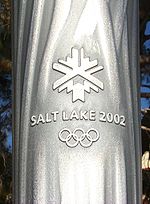
The 2002 Olympic emblem is a snowflake, which consisted of three separate sections. The yellow top section symbolizes the Olympic Flame, and represents the athletes' courage. The orange center section symbolizes the ancient weaving styles of Utah's Native Americans, and represents the region's culture. The blue/purple bottom section symbolizes a snow-capped mountain, and represents the contrast of Utah's mountain and desert areas. The orange/yellow colors above the blue/purple bottom section also gave the appearance of a sun rising from behind a mountain.Theme colors
An official palette of colors, which ranged from cool blues to warm reds and oranges, was created for the Salt Lake 2002 games. The palette became part of the official design theme named Land of Contrast – Fire and Ice, with the blues representing the cooler, snowy, mountainous regionsWasatch Front
The Wasatch Front is a metropolitan region in the north-central part of the U.S. state of Utah. It consists of a chain of cities and towns stretched along the Wasatch Range from approximately Santaquin in the south to Brigham City in the north...
of Northern Utah, and the oranges and red representing the warmer, rugged, red-rock areas
Colorado Plateau
The Colorado Plateau, also called the Colorado Plateau Province, is a physiographic region of the Intermontane Plateaus, roughly centered on the Four Corners region of the southwestern United States. The province covers an area of 337,000 km2 within western Colorado, northwestern New Mexico,...
of Southern Utah.
Pictograms
As with all Olympic games, pictograms, which easily identified the venues, sports, and services for spectators without using a written language, were specifically designed for the Salt Lake 2002 games. The pictograms for these games mimicked the designs of branding-ironsBranding iron
A branding iron is a tool which uses the process of pressing a heated metal shape against an object or livestock with the intention of leaving a mark....
found in the western United States, and used the Fire and Ice theme colors of the Salt Lake 2002 Games. The line thickness and 30-degree angles found in the pictograms mirror those found in the snowflake emblem.
The mascots
The mascots represent three of Utah's indigenous animals, and are named after natural resources which have long been important to Utah's economy, survival, and culture. All three animals are major characters in the legends of local Native Americans, and each mascot wears a charm around its neck with an original AnasaziAncient Pueblo Peoples
Ancient Pueblo People or Ancestral Pueblo peoples were an ancient Native American culture centered on the present-day Four Corners area of the United States, comprising southern Utah, northern Arizona, northwest New Mexico, and southern Colorado...
or Fremont
Fremont culture
The Fremont culture or Fremont people is a pre-Columbian archaeological culture which received its name from the Fremont River in the U.S. state of Utah where the first Fremont sites were discovered. The Fremont River itself is named for John Charles Frémont, an American explorer. It inhabited...
-style petroglyph
Petroglyph
Petroglyphs are pictogram and logogram images created by removing part of a rock surface by incising, picking, carving, and abrading. Outside North America, scholars often use terms such as "carving", "engraving", or other descriptions of the technique to refer to such images...
.
- Powder – A Snowshoe HareSnowshoe HareThe Snowshoe Hare , also called the Varying Hare, or Snowshoe Rabbit, is a species of hare found in North America. It has the name "snowshoe" because of the large size of its hind feet and the marks its tail leaves. The animal's feet prevent it from sinking into the snow when it hops and walks...
, represents the Native American legend when the sun was too close to the earth and was burning it. The hare ran to the top of a mountain, and shot her arrow into the sun. This caused it to drop lower in the sky, cooling the earth.
- Copper – A CoyoteCoyoteThe coyote , also known as the American jackal or the prairie wolf, is a species of canine found throughout North and Central America, ranging from Panama in the south, north through Mexico, the United States and Canada...
, represents the Native American legend when the earth froze and turned dark, the coyote climbed to the highest mountaintop and stole a flame from the fire people. He returned and brought warmth and light to the people.
- Coal – An American black bearAmerican black bearThe American black bear is a medium-sized bear native to North America. It is the continent's smallest and most common bear species. Black bears are omnivores, with their diets varying greatly depending on season and location. They typically live in largely forested areas, but do leave forests in...
, represents the Native American legend of hunters who were never able to kill the mighty bear. Today the sons of these hunters still chase the bear across the night sky, as constellationConstellationIn modern astronomy, a constellation is an internationally defined area of the celestial sphere. These areas are grouped around asterisms, patterns formed by prominent stars within apparent proximity to one another on Earth's night sky....
s.
The Olympic Torch and relay
The 2002 Olympic Torch is modeled after an icicle, with a slight curve to represent speed and fluidity. The Torch measures 33 inches (83.8 cm) long, 3 inches (7.6 cm) wide at the top, 0.5 inches (1.3 cm) at the bottom, and was designed by Axiom Design of Salt Lake City. It was created with three sections, each with its own meaning and representation.The torch relay
2002 Winter Olympics torch relay
The 2002 Winter Olympics torch relay was a 65 day run, from December 4, 2001 to February 8, 2002, prior to the 2002 Winter Olympics. The runners carried the Olympic Flame throughout the United States - following its lighting in Olympia, Greece to the opening ceremony of the 2002 games at...
was a 65 day run, from December 4, 2001 to February 8, 2002, which carried the Olympic flame through 46 of the 50 states in the United States. The torch covered 13500 miles (21,726.1 km), passed through 300 communities, and was carried by 12,012 Torchbearers.
The Olympic Cauldron
The Cauldron was designed with the official motto Light the Fire Within and the Fire and Ice theme in mind. It was designed to look like an icicleIcicle
An icicle is a spike of ice formed when water dripping or falling from an object freezes. Typically, icicles will form when ice or snow is melted by either sunlight or some other heat source , and the resulting melted water runs off into an area where the ambient temperature is below the freezing...
, and was made of glass which allowed the fire to be seen burning within. The actual glass cauldron stands atop a twisting glass and steel support, is 12 feet (3.7 m) high, and the flame within burns at 900 °F (482.2 °C). Together with its support the cauldron stands 117 feet (35.7 m) tall and was made of 738 individual pieces of glass. Small jets send water down the glass sides of the cauldron, both to keep the glass and metal cooled (so they would not crack or melt), and to give the effect of melting ice. The cauldron was designed by WET Design of Los Angeles, its frame built by Arrow Dynamics
Arrow Dynamics
Arrow Dynamics was a roller coaster and amusement ride design company based in Clearfield, Utah, United States. In 2002, the company went bankrupt but was quickly bought by fellow amusement ride manufacturer S&S Power to form S&S Arrow. During its peak, Arrow Dynamics was responsible for some of...
of Clearfield, Utah
Clearfield, Utah
Clearfield is a city in Davis County, Utah, United States. The population was 25,974 at the 2000 census. The city grew drastically during the 1940s, with the formation of Hill Air Force Base, and in the 1950s with the nation-wide increase in suburb and "bedroom" community populations and has been...
, and its glass pieces created by Western Glass of Ogden, Utah
Ogden, Utah
Ogden is a city in Weber County, Utah, United States. Ogden serves as the county seat of Weber County. The population was 82,825 according to the 2010 Census. The city served as a major railway hub through much of its history, and still handles a great deal of freight rail traffic which makes it a...
. The cauldron's cost was 2 million dollars, and it was unveiled to the public during its original install at Rice-Eccles Stadium (2002 Olympic Stadium) on January 8, 2002. Following the completion of the 2002 Winter Olympics the cauldron was installed at the permanent Salt Lake 2002 Olympic Cauldron Park
Salt Lake 2002 Olympic Cauldron Park
The Salt Lake 2002 Olympic Cauldron Park is a plaza located at the south end of Rice-Eccles Stadium on the campus of the University of Utah in Salt Lake City, Utah. During the 2002 Winter Olympics Rice-Eccles Stadium was known as Rice-Eccles Olympic Stadium and was the site of the Opening and...
, next the 2002 Olympic Stadium in Salt Lake City.
A second Olympic cauldron burned at the Awards Plaza in downtown Salt Lake City during the games. It was known as the Hero's Cauldron and was in the backdrop of every awards ceremony. This was the first time two cauldrons were used during the same Olympic Games.
Security measures
These Olympic games were the first since September 11, 2001, which meant a higher level of security than ever before provided for the Games. The Office of Homeland Security (OHS) designated the Olympics a National Special Security EventNational Special Security Event
A National Special Security Event is an event of national or international significance deemed by the United States Department of Homeland Security to be a potential target for terrorism or other criminal activity...
(NSSE).
Aerial surveillance and radar control was provided by the Marines of Marine Air Control Squadron 2 det C, from Cherry Point NC.
When he spoke during the opening ceremonies, Jacques Rogge
Jacques Rogge
Jacques Rogge, Count Rogge , is a Belgian sports bureaucrat. He is the eighth and current President of the International Olympic Committee .-Life and career:...
, presiding over his first olympics as IOC president, told the athletes of the United States, the host country:
See also
- 2002 Winter Olympic bid scandal2002 Winter Olympic bid scandalThe 2002 Olympic Winter Games bid scandal was a scandal involving allegations of bribery used to win the rights to host the 2002 Winter Olympics in Salt Lake City, Utah, United States. Prior to its successful bid in 1995, the city had attempted four times to secure the games; failing each time...
- :Category:Competitors at the 2002 Winter Olympics
- Call of the ChampionsCall of the ChampionsCall of the Champions was composed by John Williams for the 2002 Winter Olympics in Salt Lake City, Utah. Premiering at the Opening Ceremony on February 8, 2002, it begins with the call by the Mormon Tabernacle Choir of "Citius! Altius! Fortius!" , which is the Olympic Motto chosen by the founder...
, the Olympic theme song for 2002
External links
- Olympic Legacy image archives - Utah State Historical Society
- 2002 Olympic Winter Games Museum in Park City, UtahPark City, UtahPark City is a town in Summit and Wasatch counties in the U.S. state of Utah. It is considered to be part of the Wasatch Back. The city is southeast of downtown Salt Lake City and from Salt Lake City's east edge of Sugar House along Interstate 80. The population was 7,558 at the 2010 census...
- 2002 Olympic Cauldron Park in Salt Lake City.