

1 Ceres

Encyclopedia
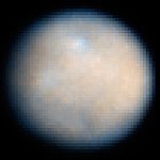
Ceres, formally 1 Ceres, is the smallest identified dwarf planet
in the Solar System
and the only one in the asteroid belt
. With a diameter of about 950 km, Ceres is by far the largest and most-massive asteroid
, comprising about a third of the mass
of the asteroid belt
. Discovered on 1 January 1801 by Giuseppe Piazzi
, it was the first asteroid to be identified. It is named after Cerēs
, the Roman goddess
of growing plants, the harvest, and motherly love.
The Cererian surface is probably a mixture of water ice and various hydrate
d mineral
s such as carbonates
and clay
s. Ceres appears to be differentiated
into a rocky
core and icy mantle
, and may harbour an ocean
of liquid water under its surface.
From Earth, the apparent magnitude
of Ceres ranges from 6.7 to 9.3, and hence even at its brightest it is still too dim to be seen with the naked eye except under extremely dark skies. On 27 September 2007, NASA
launched the Dawn space probe to explore Vesta
(2011–2012) and Ceres (2015).
and Jupiter
was first suggested by Johann Elert Bode
in 1772. His considerations were based on the Titius–Bode law, a now abandoned theory which had been first proposed by Johann Daniel Titius
in 1766, observing that there was a regular pattern in the semi-major axes of the known planets marred only by the large gap between Mars and Jupiter. The pattern predicted that the missing planet ought to have a semi-major axis near 2.8 AU
. William Herschel
's discovery of Uranus
in 1781 near the predicted distance for the next body beyond Saturn
increased faith in the law of Titius and Bode, and in 1800, they sent requests to twenty-four experienced astronomers, asking that they combine their efforts and begin a methodical search for the expected planet. The group was headed by Franz Xaver von Zach, editor of the Monatliche Correspondenz. While they did not discover Ceres, they later found several large asteroid
s.
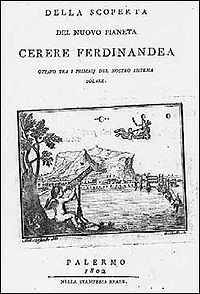 One of the astronomers selected for the search was Giuseppe Piazzi
at the Academy of Palermo
, Sicily
. Before receiving his invitation to join the group, Giuseppe Piazzi discovered Ceres on 1 January 1801. He was searching for "the 87th [star] of the Catalogue of the Zodiacal stars of Mr la Caille
", but found that "it was preceded by another". Instead of a star, Piazzi had found a moving star-like object, which he first thought was a comet
. Piazzi observed Ceres a total of 24 times, the final time on 11 February 1801, when illness interrupted his observations. He announced his discovery on 24 January 1801 in letters to only two fellow astronomers, his compatriot Barnaba Oriani
of Milan
and Bode of Berlin
. He reported it as a comet but "since its movement is so slow and rather uniform, it has occurred to me several times that it might be something better than a comet". In April, Piazzi sent his complete observations to Oriani, Bode, and Jérôme Lalande
in Paris
. The information was published in the September 1801 issue of the Monatliche Correspondenz.
By this time, the apparent position of Ceres had changed (mostly due to the Earth's orbital motion), and was too close to the Sun's glare for other astronomers to confirm Piazzi's observations. Toward the end of the year, Ceres should have been visible again, but after such a long time it was difficult to predict its exact position. To recover Ceres, Carl Friedrich Gauss
, then 24 years old, developed an efficient method of orbit determination. He set himself the task of determining a Keplerian motion
from three complete observations (time, right ascension
, declination
). In only a few weeks, he predicted the path of Ceres and sent his results to von Zach. On 31 December 1801, von Zach and Heinrich W. M. Olbers
found Ceres near the predicted position and thus recovered it.
The early observers were only able to calculate the size of Ceres to within about an order of magnitude
. Herschel underestimated its size as 260 km in 1802, while in 1811 Johann Hieronymus Schröter overestimated it as 2,613 km.
of agriculture, Italian
Cerere) and King Ferdinand III
of Sicily
. "Ferdinandea" was not acceptable to other nations of the world and was thus dropped. Ceres was also called Hera
for a short time in Germany
. In Greece, it is called Δήμητρα (Demeter
), after the Greek equivalent of the goddess Ceres; in English, that name is used for the asteroid 1108 Demeter
. The adjectival form of the name is Cererian, derived from the Latin
genitive Cereris. The old astronomical symbol
of Ceres is a sickle
, ( ), similar to Venus
' symbol , but with a gap in the upper circle; this was later replaced with the numbered disk ①. The element cerium
, discovered in 1803, was named after Ceres. In the same year, another element was also initially named after Ceres, but its discoverer changed its name to palladium
(after the second asteroid, 2 Pallas
) when cerium was named.
 The classification of Ceres has changed more than once and has been the subject of some disagreement. Johann Elert Bode
believed Ceres to be the "missing planet" he had proposed to exist between Mars
and Jupiter
, at a distance of 419 million km (2.8 AU
) from the Sun. Ceres was assigned a planetary symbol, and remained listed as a planet in astronomy books and tables (along with 2 Pallas
, 3 Juno
and 4 Vesta
) for about half a century.
As other objects were discovered in the area it was realised that Ceres represented the first of a class of many similar bodies. In 1802 Sir William Herschel
coined the term asteroid ("star-like") for such bodies, writing "they resemble small stars so much as hardly to be distinguished from them, even by very good telescopes". As the first such body to be discovered, it was given the designation 1 Ceres under the modern system of asteroid numbering.
The 2006 debate surrounding Pluto
and what constitutes a 'planet' led to Ceres being considered for reclassification as a planet. A proposal before the International Astronomical Union
for the definition of a planet
would have defined a planet as "a celestial body that (a) has sufficient mass for its self-gravity to overcome rigid-body forces so that it assumes a hydrostatic equilibrium (nearly round) shape, and (b) is in orbit around a star, and is neither a star nor a satellite of a planet". Had this resolution been adopted, it would have made Ceres the fifth planet in order from the Sun. It was not accepted, and in its place an alternate definition came into effect as of 24 August 2006, carrying the additional requirement that a "planet" must have "cleared the neighborhood
around its orbit". By this definition, Ceres is not a planet because it does not dominate its orbit, sharing it as it does with the thousands of other asteroids in the asteroid belt
and constituting only about a third of the total mass. It is instead now classified as a dwarf planet
.
It is sometimes assumed that Ceres has been reclassified as a dwarf planet, and that it is therefore no longer considered an asteroid. For example, a news update at Space.com spoke of "Pallas, the largest asteroid, and Ceres, the dwarf planet formerly classified as an asteroid", while an IAU question-and-answer posting states, "Ceres is (or now we can say it was) the largest asteroid", though it then speaks of "other asteroids" crossing Ceres' path and otherwise implies that Ceres is still one of the asteroids. The Minor Planet Center
notes that such bodies may have dual designations. The 2006 IAU decision that classified Ceres as a dwarf planet never addressed whether it is or is not an asteroid, as indeed the IAU has never defined the word 'asteroid' at all, preferring the term 'minor planet
' until 2006, and 'small Solar System body
' and 'dwarf planet' after 2006. Lang (2011) comments, "The [IAU has] added a new designation to Ceres, classifying it as a dwarf planet. [...] By [its] definition, Eris, Haumea, Makemake and Pluto, as well as the largest asteroid, 1 Ceres, are all dwarf planets", and describes it elsewhere as "the dwarf planet–asteroid 1 Ceres". NASA continues to refer to Ceres as an asteroid, saying in a 2011 press announcement that "Dawn will orbit two of the largest asteroids in the Main Belt", as do various academic textbooks.
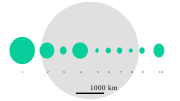
 Ceres is the largest object in the asteroid belt, which lies between Mars and Jupiter. The mass of Ceres has been determined by analysis of the influence it exerts on smaller asteroids. Results differ slightly between researchers. The average of the three most precise values as of 2008 is 9.4 kg. With this mass Ceres comprises about a third of the estimated total 3.0 ± 0.2 kg mass of the asteroid belt, which is in turn about 4% of the mass of the Moon
. The mass of Ceres is sufficient to give it a nearly spherical shape in hydrostatic equilibrium
. In contrast, other large asteroids such as 2 Pallas
, 3 Juno
, and in particular 10 Hygiea
are known to be somewhat irregular in shape.
. This 100 km-thick mantle (23%–28% of Ceres by mass; 50% by volume) contains 200 million cubic kilometres of water, which is more than the amount of fresh water
on the Earth. This result is supported by the observations made by the Keck telescope in 2002 and by evolutionary modelling. Also, some characteristics of its surface and history (such as its distance from the Sun, which weakened solar radiation enough to allow some fairly low-freezing-point components to be incorporated during its formation), point to the presence of volatile materials
in the interior of Ceres.
Alternatively, the shape and dimensions of Ceres may be explained by an interior that is porous and either partially differentiated or completely undifferentiated. The presence of a layer of rock on top of ice would be gravitationally unstable. If any of the rock deposits sank into a layer of differentiated ice, salt deposits would be formed. Such deposits have not been detected. Thus it is possible that Ceres does not contain a large ice shell, but was instead formed from low-density asteroids with an aqueous component. The decay of radioactive isotopes may not have been sufficient to cause differentiation.
s. Some differences do exist. The ubiquitous features of the Cererian IR
spectra
are those of hydrated materials, which indicate the presence of significant amounts of water in the interior. Other possible surface constituents include iron
-rich clay
s (cronstedtite
) and carbonate minerals
(dolomite
and siderite
), which are common minerals in carbonaceous chondrite
meteorites. The spectral features of carbonates and clay are usually absent in the spectra of other C-type asteroids. Sometimes Ceres is classified as a G-type asteroid
.
The Cererian surface is relatively warm. The maximum temperature with the Sun
overhead was estimated from measurements to be 235 K
(about −38 °C, −36 °F) on 5 May 1991.
 Only a few Cererian surface features have been unambiguously detected. High-resolution ultraviolet
Hubble Space Telescope
images taken in 1995 showed a dark spot on its surface which was nicknamed "Piazzi" in honour of the discoverer of Ceres. This was thought to be a crater. Later near-infrared images with a higher resolution taken over a whole rotation with the Keck telescope using adaptive optics
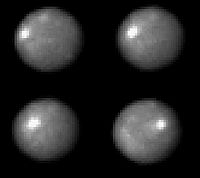
showed several bright and dark features moving with the dwarf planet's rotation. Two dark features had circular shapes and are presumably craters; one of them was observed to have a bright central region, while another was identified as the "Piazzi" feature. More recent visible-light Hubble Space Telescope
images of a full rotation taken in 2003 and 2004 showed 11 recognizable surface features, the natures of which are currently unknown. One of these features corresponds to the "Piazzi" feature observed earlier.
These last observations also determined that the north pole of Ceres points in the direction of right ascension
19 h 24 min (291°), declination
+59°, in the constellation
Draco
. This means that Ceres' axial tilt
is very small—about 3°.
on the surface. Surface water ice is unstable at distances less than 5 AU from the Sun, so it is expected to sublime if it is exposed directly to solar radiation. Water ice can migrate from the deep layers of Ceres to the surface, but will escape in a very short time. As a result, it is difficult to detect water vaporization. Water escaping from polar regions of Ceres was possibly observed in the early 1990s but this has not been unambiguously demonstrated. It may be possible to detect escaping water from the surroundings of a fresh impact crater or from cracks in the sub-surface layers of Ceres. Ultraviolet
observations by the IUE spacecraft detected statistically significant amounts of hydroxide
ion near the Cererean north pole, which is a product of water-vapor dissociation by ultraviolet solar radiation.
or Europa, the potential presence of water ice has led some scientists to hypothesize that life may exist there, and that evidence for this could be found in hypothesized ejecta
that could have come from Ceres to Earth.
 Ceres follows an orbit between Mars and Jupiter, within the asteroid belt
, with a period of 4.6 Earth years. The orbit is moderately inclined (i = 10.6° compared to 7° for Mercury
and 17° for Pluto
) and moderately eccentric
(e = 0.08 compared to 0.09 for Mars).
The diagram illustrates the orbits of Ceres (blue) and several planets (white and grey). The segments of orbits below the ecliptic are plotted in darker colours, and the orange plus sign is the Sun's location. The top left diagram is a polar view that shows the location of Ceres in the gap between Mars and Jupiter. The top right is a close-up demonstrating the locations of the perihelia (q) and aphelia (Q) of Ceres and Mars. The perihelion of Mars is on the opposite side of the Sun from those of Ceres and several of the large main-belt asteroids, including 2 Pallas
and 10 Hygiea
. The bottom diagram is a side view showing the inclination of the orbit of Ceres compared to the orbits of Mars and Jupiter.
In the past, Ceres had been considered to be a member of an asteroid family
. These groupings of asteroids share similar proper orbital elements
, which may indicate a common origin through an asteroid collision some time in the past. Ceres was found to have spectral properties different from other members of the family, and so this grouping is now called the Gefion family
, named after the next-lowest-numbered family member, 1272 Gefion
. Ceres appears to be merely an interloper in its own family, coincidentally having similar orbital elements but not a common origin.
The rotational period of Ceres (the Cererian day) is 9 hours and 4 minutes.
it, from a vantage on Ceres. The most common transits are those of Mercury, which usually happen every few years, most recently in 2006 and 2010. The corresponding dates are 1953 and 2051 for Venus, 1814 and 2081 for Earth, and 767 and 2684 for Mars.
(planetary embryo), which formed 4.57 billion years ago in the asteroid belt
. While the majority of inner Solar System protoplanets (including all lunar- to Mars-sized bodies) either merged with other protoplanets to form terrestrial planet
s or were ejected from the Solar System
by Jupiter
, Ceres is believed to have survived relatively intact. An alternative theory proposes that Ceres formed in the Kuiper Belt
and later migrated to the asteroid belt. Another possible protoplanet, Vesta
, is less than half the size of Ceres; it suffered a major impact after solidifying, losing ~1% of its mass.
The geological evolution of Ceres was dependent on the heat sources available during and after its formation: friction from planetesimal
accretion
, and decay of various radionuclide
s (possibly including short-lived elements like 26Al
). These are thought to have been sufficient to allow Ceres to differentiate into a rocky core and icy mantle
soon after its formation. This process may have caused resurfacing by water volcanism
and tectonics
, erasing older geological features. Due to its small size, Ceres would have cooled early in its existence, causing all geological resurfacing processes to cease. Any ice on the surface would have gradually sublimated, leaving behind various hydrated minerals like clay
s and carbonates
.
Today, Ceres appears to be a geologically inactive body, with a surface sculpted only by impacts
. The presence of significant amounts of water ice in its composition raises the possibility that Ceres has or had a layer of liquid water in its interior. This hypothetical layer is often called an ocean
. If such a layer of liquid water exists, it is believed to be located between the rocky core and ice mantle like that of the theorized ocean on Europa
. The existence of an ocean is more likely if dissolved solutes (i.e. salts), ammonia
, sulfuric acid
or other antifreeze
compounds are dissolved in the water.
, but under exceptional viewing conditions a very sharp-sighted person may be able to see this dwarf planet
. Ceres will be at its brightest (6.73) on December 18, 2012. The only other asteroids that can reach a similarly bright magnitude are 4 Vesta, and, during rare oppositions near perihelion, 2 Pallas and 7 Iris
. At a conjunction Ceres has a magnitude of around +9.3, which corresponds to the faintest objects visible with 10×50 binoculars
. It can thus be seen with binoculars whenever it is above the horizon of a fully dark sky.
Some notable observational milestones for Ceres include:
 To date, no space probe has visited Ceres. Radio signals from spacecraft in orbit around and on the surface of Mars
have been used to estimate the mass of Ceres from its perturbations
on the motion of Mars.
The unmanned Dawn spacecraft, launched by NASA
in 2007, is en route to Ceres. The probe has been orbiting asteroid 4 Vesta
since July 15, 2011. After completing one year of explorations there it will continue on to Ceres, arriving in 2015, five months prior to the arrival of New Horizons
at Pluto
. Dawn will thus be the first mission to study a dwarf planet at close range.
Dawns mission profile calls for it to enter orbit around Ceres at an altitude of 5,900 km. The spacecraft will reduce its orbital distance to 1,300 km after five months of study, and then down to 700 km after another five months. The spacecraft instrumentation includes a framing camera, a visual and infrared spectrometer
, and a gamma-ray and neutron
detector. These instruments will be used to examine the dwarf planet's shape and elemental composition.
Dwarf planet
A dwarf planet, as defined by the International Astronomical Union , is a celestial body orbiting the Sun that is massive enough to be spherical as a result of its own gravity but has not cleared its neighboring region of planetesimals and is not a satellite...
in the Solar System
Solar System
The Solar System consists of the Sun and the astronomical objects gravitationally bound in orbit around it, all of which formed from the collapse of a giant molecular cloud approximately 4.6 billion years ago. The vast majority of the system's mass is in the Sun...
and the only one in the asteroid belt
Asteroid belt
The asteroid belt is the region of the Solar System located roughly between the orbits of the planets Mars and Jupiter. It is occupied by numerous irregularly shaped bodies called asteroids or minor planets...
. With a diameter of about 950 km, Ceres is by far the largest and most-massive asteroid
Asteroid
Asteroids are a class of small Solar System bodies in orbit around the Sun. They have also been called planetoids, especially the larger ones...
, comprising about a third of the mass
Mass
Mass can be defined as a quantitive measure of the resistance an object has to change in its velocity.In physics, mass commonly refers to any of the following three properties of matter, which have been shown experimentally to be equivalent:...
of the asteroid belt
Asteroid belt
The asteroid belt is the region of the Solar System located roughly between the orbits of the planets Mars and Jupiter. It is occupied by numerous irregularly shaped bodies called asteroids or minor planets...
. Discovered on 1 January 1801 by Giuseppe Piazzi
Giuseppe Piazzi
Giuseppe Piazzi was an Italian Catholic priest of the Theatine order, mathematician, and astronomer. He was born in Ponte in Valtellina, and died in Naples. He established an observatory at Palermo, now the Osservatorio Astronomico di Palermo – Giuseppe S...
, it was the first asteroid to be identified. It is named after Cerēs
Ceres (mythology)
In ancient Roman religion, Ceres was a goddess of agriculture, grain crops, fertility and motherly relationships. She was originally the central deity in Rome's so-called plebeian or Aventine Triad, then was paired with her daughter Proserpina in what Romans described as "the Greek rites of Ceres"...
, the Roman goddess
Roman mythology
Roman mythology is the body of traditional stories pertaining to ancient Rome's legendary origins and religious system, as represented in the literature and visual arts of the Romans...
of growing plants, the harvest, and motherly love.
The Cererian surface is probably a mixture of water ice and various hydrate
Hydrate
Hydrate is a term used in inorganic chemistry and organic chemistry to indicate that a substance contains water. The chemical state of the water varies widely between hydrates, some of which were so labeled before their chemical structure was understood....
d mineral
Mineral
A mineral is a naturally occurring solid chemical substance formed through biogeochemical processes, having characteristic chemical composition, highly ordered atomic structure, and specific physical properties. By comparison, a rock is an aggregate of minerals and/or mineraloids and does not...
s such as carbonates
Carbonate minerals
Carbonate minerals are those minerals containing the carbonate ion: CO32-.-Anhydrous carbonates:*Calcite group: Trigonal**Calcite CaCO3**Gaspeite CO3**Magnesite MgCO3**Otavite CdCO3**Rhodochrosite MnCO3**Siderite FeCO3**Smithsonite ZnCO3...
and clay
Clay
Clay is a general term including many combinations of one or more clay minerals with traces of metal oxides and organic matter. Geologic clay deposits are mostly composed of phyllosilicate minerals containing variable amounts of water trapped in the mineral structure.- Formation :Clay minerals...
s. Ceres appears to be differentiated
Planetary differentiation
In planetary science, planetary differentiation is the process of separating out different constituents of a planetary body as a consequence of their physical or chemical behaviour, where the body develops into compositionally distinct layers; the denser materials of a planet sink to the center,...
into a rocky
Rock (geology)
In geology, rock or stone is a naturally occurring solid aggregate of minerals and/or mineraloids.The Earth's outer solid layer, the lithosphere, is made of rock. In general rocks are of three types, namely, igneous, sedimentary, and metamorphic...
core and icy mantle
Mantle (geology)
The mantle is a part of a terrestrial planet or other rocky body large enough to have differentiation by density. The interior of the Earth, similar to the other terrestrial planets, is chemically divided into layers. The mantle is a highly viscous layer between the crust and the outer core....
, and may harbour an ocean
Ocean
An ocean is a major body of saline water, and a principal component of the hydrosphere. Approximately 71% of the Earth's surface is covered by ocean, a continuous body of water that is customarily divided into several principal oceans and smaller seas.More than half of this area is over 3,000...
of liquid water under its surface.
From Earth, the apparent magnitude
Apparent magnitude
The apparent magnitude of a celestial body is a measure of its brightness as seen by an observer on Earth, adjusted to the value it would have in the absence of the atmosphere...
of Ceres ranges from 6.7 to 9.3, and hence even at its brightest it is still too dim to be seen with the naked eye except under extremely dark skies. On 27 September 2007, NASA
NASA
The National Aeronautics and Space Administration is the agency of the United States government that is responsible for the nation's civilian space program and for aeronautics and aerospace research...
launched the Dawn space probe to explore Vesta
4 Vesta
Vesta, formally designated 4 Vesta, is one of the largest asteroids, with a mean diameter of about . It was discovered by Heinrich Wilhelm Olbers on March 29, 1807, and is named after the Roman virgin goddess of home and hearth, Vesta....
(2011–2012) and Ceres (2015).
Discovery
The idea that an undiscovered planet could exist between the orbits of MarsMars
Mars is the fourth planet from the Sun in the Solar System. The planet is named after the Roman god of war, Mars. It is often described as the "Red Planet", as the iron oxide prevalent on its surface gives it a reddish appearance...
and Jupiter
Jupiter
Jupiter is the fifth planet from the Sun and the largest planet within the Solar System. It is a gas giant with mass one-thousandth that of the Sun but is two and a half times the mass of all the other planets in our Solar System combined. Jupiter is classified as a gas giant along with Saturn,...
was first suggested by Johann Elert Bode
Johann Elert Bode
Johann Elert Bode was a German astronomer known for his reformulation and popularization of the Titius-Bode law. Bode determined the orbit of Uranus and suggested the planet's name.-Biography:...
in 1772. His considerations were based on the Titius–Bode law, a now abandoned theory which had been first proposed by Johann Daniel Titius
Johann Daniel Titius
Johann Daniel Titius was a German astronomer and a professor at Wittenberg.Titius was born in Konitz , Royal Prussia, and died in Wittenberg...
in 1766, observing that there was a regular pattern in the semi-major axes of the known planets marred only by the large gap between Mars and Jupiter. The pattern predicted that the missing planet ought to have a semi-major axis near 2.8 AU
Astronomical unit
An astronomical unit is a unit of length equal to about or approximately the mean Earth–Sun distance....
. William Herschel
William Herschel
Sir Frederick William Herschel, KH, FRS, German: Friedrich Wilhelm Herschel was a German-born British astronomer, technical expert, and composer. Born in Hanover, Wilhelm first followed his father into the Military Band of Hanover, but emigrated to Britain at age 19...
's discovery of Uranus
Uranus
Uranus is the seventh planet from the Sun. It has the third-largest planetary radius and fourth-largest planetary mass in the Solar System. It is named after the ancient Greek deity of the sky Uranus , the father of Cronus and grandfather of Zeus...
in 1781 near the predicted distance for the next body beyond Saturn
Saturn
Saturn is the sixth planet from the Sun and the second largest planet in the Solar System, after Jupiter. Saturn is named after the Roman god Saturn, equated to the Greek Cronus , the Babylonian Ninurta and the Hindu Shani. Saturn's astronomical symbol represents the Roman god's sickle.Saturn,...
increased faith in the law of Titius and Bode, and in 1800, they sent requests to twenty-four experienced astronomers, asking that they combine their efforts and begin a methodical search for the expected planet. The group was headed by Franz Xaver von Zach, editor of the Monatliche Correspondenz. While they did not discover Ceres, they later found several large asteroid
Asteroid
Asteroids are a class of small Solar System bodies in orbit around the Sun. They have also been called planetoids, especially the larger ones...
s.
Giuseppe Piazzi
Giuseppe Piazzi was an Italian Catholic priest of the Theatine order, mathematician, and astronomer. He was born in Ponte in Valtellina, and died in Naples. He established an observatory at Palermo, now the Osservatorio Astronomico di Palermo – Giuseppe S...
at the Academy of Palermo
Palermo
Palermo is a city in Southern Italy, the capital of both the autonomous region of Sicily and the Province of Palermo. The city is noted for its history, culture, architecture and gastronomy, playing an important role throughout much of its existence; it is over 2,700 years old...
, Sicily
Sicily
Sicily is a region of Italy, and is the largest island in the Mediterranean Sea. Along with the surrounding minor islands, it constitutes an autonomous region of Italy, the Regione Autonoma Siciliana Sicily has a rich and unique culture, especially with regard to the arts, music, literature,...
. Before receiving his invitation to join the group, Giuseppe Piazzi discovered Ceres on 1 January 1801. He was searching for "the 87th [star] of the Catalogue of the Zodiacal stars of Mr la Caille
Nicolas Louis de Lacaille
Abbé Nicolas Louis de Lacaille was a French astronomer.He is noted for his catalogue of nearly 10,000 southern stars, including 42 nebulous objects. This catalogue, called Coelum Australe Stelliferum, was published posthumously in 1763. It introduced 14 new constellations which have since become...
", but found that "it was preceded by another". Instead of a star, Piazzi had found a moving star-like object, which he first thought was a comet
Comet
A comet is an icy small Solar System body that, when close enough to the Sun, displays a visible coma and sometimes also a tail. These phenomena are both due to the effects of solar radiation and the solar wind upon the nucleus of the comet...
. Piazzi observed Ceres a total of 24 times, the final time on 11 February 1801, when illness interrupted his observations. He announced his discovery on 24 January 1801 in letters to only two fellow astronomers, his compatriot Barnaba Oriani
Barnaba Oriani
__FORCETOC__Barnaba Oriani was an Italian priest, geodesist, astronomer and scientist.-Life:Oriani was born in Garegnano , the son of a mason, and died in Milan....
of Milan
Milan
Milan is the second-largest city in Italy and the capital city of the region of Lombardy and of the province of Milan. The city proper has a population of about 1.3 million, while its urban area, roughly coinciding with its administrative province and the bordering Province of Monza and Brianza ,...
and Bode of Berlin
Berlin
Berlin is the capital city of Germany and is one of the 16 states of Germany. With a population of 3.45 million people, Berlin is Germany's largest city. It is the second most populous city proper and the seventh most populous urban area in the European Union...
. He reported it as a comet but "since its movement is so slow and rather uniform, it has occurred to me several times that it might be something better than a comet". In April, Piazzi sent his complete observations to Oriani, Bode, and Jérôme Lalande
Jérôme Lalande
Joseph Jérôme Lefrançois de Lalande was a French astronomer and writer.-Biography:Lalande was born at Bourg-en-Bresse...
in Paris
Paris
Paris is the capital and largest city in France, situated on the river Seine, in northern France, at the heart of the Île-de-France region...
. The information was published in the September 1801 issue of the Monatliche Correspondenz.
By this time, the apparent position of Ceres had changed (mostly due to the Earth's orbital motion), and was too close to the Sun's glare for other astronomers to confirm Piazzi's observations. Toward the end of the year, Ceres should have been visible again, but after such a long time it was difficult to predict its exact position. To recover Ceres, Carl Friedrich Gauss
Carl Friedrich Gauss
Johann Carl Friedrich Gauss was a German mathematician and scientist who contributed significantly to many fields, including number theory, statistics, analysis, differential geometry, geodesy, geophysics, electrostatics, astronomy and optics.Sometimes referred to as the Princeps mathematicorum...
, then 24 years old, developed an efficient method of orbit determination. He set himself the task of determining a Keplerian motion
Kepler's laws of planetary motion
In astronomy, Kepler's laws give a description of the motion of planets around the Sun.Kepler's laws are:#The orbit of every planet is an ellipse with the Sun at one of the two foci....
from three complete observations (time, right ascension
Right ascension
Right ascension is the astronomical term for one of the two coordinates of a point on the celestial sphere when using the equatorial coordinate system. The other coordinate is the declination.-Explanation:...
, declination
Declination
In astronomy, declination is one of the two coordinates of the equatorial coordinate system, the other being either right ascension or hour angle. Declination in astronomy is comparable to geographic latitude, but projected onto the celestial sphere. Declination is measured in degrees north and...
). In only a few weeks, he predicted the path of Ceres and sent his results to von Zach. On 31 December 1801, von Zach and Heinrich W. M. Olbers
Heinrich Wilhelm Matthäus Olbers
Heinrich Wilhelm Matthäus Olbers was a German physician and astronomer.-Life and career:Olbers was born in Arbergen, near Bremen, and studied to be a physician at Göttingen. After his graduation in 1780, he began practicing medicine in Bremen, Germany...
found Ceres near the predicted position and thus recovered it.
The early observers were only able to calculate the size of Ceres to within about an order of magnitude
Order of magnitude
An order of magnitude is the class of scale or magnitude of any amount, where each class contains values of a fixed ratio to the class preceding it. In its most common usage, the amount being scaled is 10 and the scale is the exponent being applied to this amount...
. Herschel underestimated its size as 260 km in 1802, while in 1811 Johann Hieronymus Schröter overestimated it as 2,613 km.
Name
Piazzi originally suggested the name Cerere Ferdinandea for his discovery, after both the mythological figure Ceres (Roman goddessRoman mythology
Roman mythology is the body of traditional stories pertaining to ancient Rome's legendary origins and religious system, as represented in the literature and visual arts of the Romans...
of agriculture, Italian
Italian language
Italian is a Romance language spoken mainly in Europe: Italy, Switzerland, San Marino, Vatican City, by minorities in Malta, Monaco, Croatia, Slovenia, France, Libya, Eritrea, and Somalia, and by immigrant communities in the Americas and Australia...
Cerere) and King Ferdinand III
Ferdinand I of the Two Sicilies
Ferdinand I reigned variously over Naples, Sicily, and the Two Sicilies from 1759 until his death. He was the third son of King Charles III of Spain by his wife Maria Amalia of Saxony. On 10 August 1759, Charles succeeded his elder brother, Ferdinand VI, as King Charles III of Spain...
of Sicily
Kingdom of Sicily
The Kingdom of Sicily was a state that existed in the south of Italy from its founding by Roger II in 1130 until 1816. It was a successor state of the County of Sicily, which had been founded in 1071 during the Norman conquest of southern Italy...
. "Ferdinandea" was not acceptable to other nations of the world and was thus dropped. Ceres was also called Hera
Hera
Hera was the wife and one of three sisters of Zeus in the Olympian pantheon of Greek mythology and religion. Her chief function was as the goddess of women and marriage. Her counterpart in the religion of ancient Rome was Juno. The cow and the peacock were sacred to her...
for a short time in Germany
Germany
Germany , officially the Federal Republic of Germany , is a federal parliamentary republic in Europe. The country consists of 16 states while the capital and largest city is Berlin. Germany covers an area of 357,021 km2 and has a largely temperate seasonal climate...
. In Greece, it is called Δήμητρα (Demeter
Demeter
In Greek mythology, Demeter is the goddess of the harvest, who presided over grains, the fertility of the earth, and the seasons . Her common surnames are Sito as the giver of food or corn/grain and Thesmophoros as a mark of the civilized existence of agricultural society...
), after the Greek equivalent of the goddess Ceres; in English, that name is used for the asteroid 1108 Demeter
1108 Demeter
1108 Demeter is a main-belt asteroid orbiting the Sun. It was discovered by Karl Reinmuth in Heidelberg, Germany on May 31, 1929. Its provisional designation was 1929 KA. It was named after the Greek goddess of fruitful soil and agriculture....
. The adjectival form of the name is Cererian, derived from the Latin
Latin
Latin is an Italic language originally spoken in Latium and Ancient Rome. It, along with most European languages, is a descendant of the ancient Proto-Indo-European language. Although it is considered a dead language, a number of scholars and members of the Christian clergy speak it fluently, and...
genitive Cereris. The old astronomical symbol
Astronomical symbols
Astronomical symbols are symbols used to represent various celestial objects, theoretical constructs and observational events in astronomy. The earliest forms of these symbols appear in Greek papyri of late antiquity. The Byzantine codices in which the Greek papyri were preserved continued and...
of Ceres is a sickle
Sickle
A sickle is a hand-held agricultural tool with a variously curved blade typically used for harvesting grain crops or cutting succulent forage chiefly for feeding livestock . Sickles have also been used as weapons, either in their original form or in various derivations.The diversity of sickles that...
, (
Venus
Venus is the second planet from the Sun, orbiting it every 224.7 Earth days. The planet is named after Venus, the Roman goddess of love and beauty. After the Moon, it is the brightest natural object in the night sky, reaching an apparent magnitude of −4.6, bright enough to cast shadows...
' symbol , but with a gap in the upper circle; this was later replaced with the numbered disk ①. The element cerium
Cerium
Cerium is a chemical element with the symbol Ce and atomic number 58. It is a soft, silvery, ductile metal which easily oxidizes in air. Cerium was named after the dwarf planet . Cerium is the most abundant of the rare earth elements, making up about 0.0046% of the Earth's crust by weight...
, discovered in 1803, was named after Ceres. In the same year, another element was also initially named after Ceres, but its discoverer changed its name to palladium
Palladium
Palladium is a chemical element with the chemical symbol Pd and an atomic number of 46. It is a rare and lustrous silvery-white metal discovered in 1803 by William Hyde Wollaston. He named it after the asteroid Pallas, which was itself named after the epithet of the Greek goddess Athena, acquired...
(after the second asteroid, 2 Pallas
2 Pallas
Pallas, formally designated 2 Pallas, is the second asteroid to have been discovered , and one of the largest. It is estimated to constitute 7% of the mass of the asteroid belt, and its diameter of 530–565 km is comparable to, or slightly larger than, that of 4 Vesta. It is however 20%...
) when cerium was named.
Status
Johann Elert Bode
Johann Elert Bode was a German astronomer known for his reformulation and popularization of the Titius-Bode law. Bode determined the orbit of Uranus and suggested the planet's name.-Biography:...
believed Ceres to be the "missing planet" he had proposed to exist between Mars
Mars
Mars is the fourth planet from the Sun in the Solar System. The planet is named after the Roman god of war, Mars. It is often described as the "Red Planet", as the iron oxide prevalent on its surface gives it a reddish appearance...
and Jupiter
Jupiter
Jupiter is the fifth planet from the Sun and the largest planet within the Solar System. It is a gas giant with mass one-thousandth that of the Sun but is two and a half times the mass of all the other planets in our Solar System combined. Jupiter is classified as a gas giant along with Saturn,...
, at a distance of 419 million km (2.8 AU
Astronomical unit
An astronomical unit is a unit of length equal to about or approximately the mean Earth–Sun distance....
) from the Sun. Ceres was assigned a planetary symbol, and remained listed as a planet in astronomy books and tables (along with 2 Pallas
2 Pallas
Pallas, formally designated 2 Pallas, is the second asteroid to have been discovered , and one of the largest. It is estimated to constitute 7% of the mass of the asteroid belt, and its diameter of 530–565 km is comparable to, or slightly larger than, that of 4 Vesta. It is however 20%...
, 3 Juno
3 Juno
Juno , formal designation 3 Juno in the Minor Planet Center catalogue system, was the third asteroid to be discovered and is one of the larger main-belt asteroids, being one of the two largest stony asteroids, along with 15 Eunomia. Juno is estimated to contain 1% of the total mass of the asteroid...
and 4 Vesta
4 Vesta
Vesta, formally designated 4 Vesta, is one of the largest asteroids, with a mean diameter of about . It was discovered by Heinrich Wilhelm Olbers on March 29, 1807, and is named after the Roman virgin goddess of home and hearth, Vesta....
) for about half a century.
As other objects were discovered in the area it was realised that Ceres represented the first of a class of many similar bodies. In 1802 Sir William Herschel
William Herschel
Sir Frederick William Herschel, KH, FRS, German: Friedrich Wilhelm Herschel was a German-born British astronomer, technical expert, and composer. Born in Hanover, Wilhelm first followed his father into the Military Band of Hanover, but emigrated to Britain at age 19...
coined the term asteroid ("star-like") for such bodies, writing "they resemble small stars so much as hardly to be distinguished from them, even by very good telescopes". As the first such body to be discovered, it was given the designation 1 Ceres under the modern system of asteroid numbering.
The 2006 debate surrounding Pluto
Pluto
Pluto, formal designation 134340 Pluto, is the second-most-massive known dwarf planet in the Solar System and the tenth-most-massive body observed directly orbiting the Sun...
and what constitutes a 'planet' led to Ceres being considered for reclassification as a planet. A proposal before the International Astronomical Union
International Astronomical Union
The International Astronomical Union IAU is a collection of professional astronomers, at the Ph.D. level and beyond, active in professional research and education in astronomy...
for the definition of a planet
Definition of planet
The definition of planet, since the word was coined by the ancient Greeks, has included within its scope a wide range of celestial bodies. Greek astronomers employed the term asteres planetai , "wandering stars", for objects which apparently move over the sky...
would have defined a planet as "a celestial body that (a) has sufficient mass for its self-gravity to overcome rigid-body forces so that it assumes a hydrostatic equilibrium (nearly round) shape, and (b) is in orbit around a star, and is neither a star nor a satellite of a planet". Had this resolution been adopted, it would have made Ceres the fifth planet in order from the Sun. It was not accepted, and in its place an alternate definition came into effect as of 24 August 2006, carrying the additional requirement that a "planet" must have "cleared the neighborhood
Clearing the neighbourhood
"Clearing the neighbourhood of its orbit" is a criterion for a celestial body to be considered a planet in the Solar System. This was one of the three criteria adopted by the International Astronomical Union in its 2006 definition of planet....
around its orbit". By this definition, Ceres is not a planet because it does not dominate its orbit, sharing it as it does with the thousands of other asteroids in the asteroid belt
Asteroid belt
The asteroid belt is the region of the Solar System located roughly between the orbits of the planets Mars and Jupiter. It is occupied by numerous irregularly shaped bodies called asteroids or minor planets...
and constituting only about a third of the total mass. It is instead now classified as a dwarf planet
Dwarf planet
A dwarf planet, as defined by the International Astronomical Union , is a celestial body orbiting the Sun that is massive enough to be spherical as a result of its own gravity but has not cleared its neighboring region of planetesimals and is not a satellite...
.
It is sometimes assumed that Ceres has been reclassified as a dwarf planet, and that it is therefore no longer considered an asteroid. For example, a news update at Space.com spoke of "Pallas, the largest asteroid, and Ceres, the dwarf planet formerly classified as an asteroid", while an IAU question-and-answer posting states, "Ceres is (or now we can say it was) the largest asteroid", though it then speaks of "other asteroids" crossing Ceres' path and otherwise implies that Ceres is still one of the asteroids. The Minor Planet Center
Minor Planet Center
The Minor Planet Center operates at the Smithsonian Astrophysical Observatory , which is part of the Center for Astrophysics along with the Harvard College Observatory ....
notes that such bodies may have dual designations. The 2006 IAU decision that classified Ceres as a dwarf planet never addressed whether it is or is not an asteroid, as indeed the IAU has never defined the word 'asteroid' at all, preferring the term 'minor planet
Minor planet
An asteroid group or minor-planet group is a population of minor planets that have a share broadly similar orbits. Members are generally unrelated to each other, unlike in an asteroid family, which often results from the break-up of a single asteroid...
' until 2006, and 'small Solar System body
Small Solar System body
A small Solar System body is an object in the Solar System that is neither a planet nor a dwarf planet, nor a satellite of a planet or dwarf planet:...
' and 'dwarf planet' after 2006. Lang (2011) comments, "The [IAU has] added a new designation to Ceres, classifying it as a dwarf planet. [...] By [its] definition, Eris, Haumea, Makemake and Pluto, as well as the largest asteroid, 1 Ceres, are all dwarf planets", and describes it elsewhere as "the dwarf planet–asteroid 1 Ceres". NASA continues to refer to Ceres as an asteroid, saying in a 2011 press announcement that "Dawn will orbit two of the largest asteroids in the Main Belt", as do various academic textbooks.
Physical characteristics
Moon
The Moon is Earth's only known natural satellite,There are a number of near-Earth asteroids including 3753 Cruithne that are co-orbital with Earth: their orbits bring them close to Earth for periods of time but then alter in the long term . These are quasi-satellites and not true moons. For more...
. The mass of Ceres is sufficient to give it a nearly spherical shape in hydrostatic equilibrium
Hydrostatic equilibrium
Hydrostatic equilibrium or hydrostatic balance is the condition in fluid mechanics where a volume of a fluid is at rest or at constant velocity. This occurs when compression due to gravity is balanced by a pressure gradient force...
. In contrast, other large asteroids such as 2 Pallas
2 Pallas
Pallas, formally designated 2 Pallas, is the second asteroid to have been discovered , and one of the largest. It is estimated to constitute 7% of the mass of the asteroid belt, and its diameter of 530–565 km is comparable to, or slightly larger than, that of 4 Vesta. It is however 20%...
, 3 Juno
3 Juno
Juno , formal designation 3 Juno in the Minor Planet Center catalogue system, was the third asteroid to be discovered and is one of the larger main-belt asteroids, being one of the two largest stony asteroids, along with 15 Eunomia. Juno is estimated to contain 1% of the total mass of the asteroid...
, and in particular 10 Hygiea
10 Hygiea
10 Hygiea is an asteroid located in the asteroid belt. With somewhat oblong diameters of 350–500 km, and a mass estimated to be 2.9% of the total mass of the belt, it is the fourth largest asteroid by volume and mass...
are known to be somewhat irregular in shape.
Internal structure
Ceres' oblateness is inconsistent with an undifferentiated body, which indicates that it consists of a rocky core overlain with an icy mantleMantle (geology)
The mantle is a part of a terrestrial planet or other rocky body large enough to have differentiation by density. The interior of the Earth, similar to the other terrestrial planets, is chemically divided into layers. The mantle is a highly viscous layer between the crust and the outer core....
. This 100 km-thick mantle (23%–28% of Ceres by mass; 50% by volume) contains 200 million cubic kilometres of water, which is more than the amount of fresh water
Fresh Water
Fresh Water is the debut album by Australian rock and blues singer Alison McCallum, released in 1972. Rare for an Australian artist at the time, it came in a gatefold sleeve...
on the Earth. This result is supported by the observations made by the Keck telescope in 2002 and by evolutionary modelling. Also, some characteristics of its surface and history (such as its distance from the Sun, which weakened solar radiation enough to allow some fairly low-freezing-point components to be incorporated during its formation), point to the presence of volatile materials
Volatiles
In planetary science, volatiles are that group of chemical elements and chemical compounds with low boiling points that are associated with a planet's or moon's crust and/or atmosphere. Examples include nitrogen, water, carbon dioxide, ammonia, hydrogen, and methane, all compounds of C, H, O...
in the interior of Ceres.
Alternatively, the shape and dimensions of Ceres may be explained by an interior that is porous and either partially differentiated or completely undifferentiated. The presence of a layer of rock on top of ice would be gravitationally unstable. If any of the rock deposits sank into a layer of differentiated ice, salt deposits would be formed. Such deposits have not been detected. Thus it is possible that Ceres does not contain a large ice shell, but was instead formed from low-density asteroids with an aqueous component. The decay of radioactive isotopes may not have been sufficient to cause differentiation.
Surface
The surface composition of Ceres is broadly similar to that of C-type asteroidC-type asteroid
C-type asteroids are carbonaceous asteroids. They are the most common variety, forming around 75% of known asteroids, and an even higher percentage in the outer part of the asteroid belt beyond 2.7 AU, which is dominated by this asteroid type...
s. Some differences do exist. The ubiquitous features of the Cererian IR
Infrared
Infrared light is electromagnetic radiation with a wavelength longer than that of visible light, measured from the nominal edge of visible red light at 0.74 micrometres , and extending conventionally to 300 µm...
spectra
Spectrum
A spectrum is a condition that is not limited to a specific set of values but can vary infinitely within a continuum. The word saw its first scientific use within the field of optics to describe the rainbow of colors in visible light when separated using a prism; it has since been applied by...
are those of hydrated materials, which indicate the presence of significant amounts of water in the interior. Other possible surface constituents include iron
Iron
Iron is a chemical element with the symbol Fe and atomic number 26. It is a metal in the first transition series. It is the most common element forming the planet Earth as a whole, forming much of Earth's outer and inner core. It is the fourth most common element in the Earth's crust...
-rich clay
Clay
Clay is a general term including many combinations of one or more clay minerals with traces of metal oxides and organic matter. Geologic clay deposits are mostly composed of phyllosilicate minerals containing variable amounts of water trapped in the mineral structure.- Formation :Clay minerals...
s (cronstedtite
Cronstedtite
Cronstedtite is a complex iron silicate mineral belonging to the serpentine group of minerals. It has a formula of Fe2+2Fe3+4.It was discovered in 1821 and named in honor of Swedish mineralogist Axel Fredrik Cronstedt...
) and carbonate minerals
Carbonate minerals
Carbonate minerals are those minerals containing the carbonate ion: CO32-.-Anhydrous carbonates:*Calcite group: Trigonal**Calcite CaCO3**Gaspeite CO3**Magnesite MgCO3**Otavite CdCO3**Rhodochrosite MnCO3**Siderite FeCO3**Smithsonite ZnCO3...
(dolomite
Dolomite
Dolomite is a carbonate mineral composed of calcium magnesium carbonate CaMg2. The term is also used to describe the sedimentary carbonate rock dolostone....
and siderite
Siderite
Siderite is a mineral composed of iron carbonate FeCO3. It takes its name from the Greek word σίδηρος sideros, “iron”. It is a valuable iron mineral, since it is 48% iron and contains no sulfur or phosphorus...
), which are common minerals in carbonaceous chondrite
Carbonaceous chondrite
Carbonaceous chondrites or C chondrites are a class of chondritic meteorites comprising at least 7 known groups and many ungrouped meteorites. They include some of the most primitive known meteorites...
meteorites. The spectral features of carbonates and clay are usually absent in the spectra of other C-type asteroids. Sometimes Ceres is classified as a G-type asteroid
G-type asteroid
G-type asteroids are a relatively uncommon type of carbonaceous asteroid. The most notable asteroid in this class is 1 Ceres.- Characteristics :Generally similar to the C-type objects, but containing a strong ultraviolet absorption feature below 0.5 μm...
.
The Cererian surface is relatively warm. The maximum temperature with the Sun
Sun
The Sun is the star at the center of the Solar System. It is almost perfectly spherical and consists of hot plasma interwoven with magnetic fields...
overhead was estimated from measurements to be 235 K
Kelvin
The kelvin is a unit of measurement for temperature. It is one of the seven base units in the International System of Units and is assigned the unit symbol K. The Kelvin scale is an absolute, thermodynamic temperature scale using as its null point absolute zero, the temperature at which all...
(about −38 °C, −36 °F) on 5 May 1991.
Ultraviolet
Ultraviolet light is electromagnetic radiation with a wavelength shorter than that of visible light, but longer than X-rays, in the range 10 nm to 400 nm, and energies from 3 eV to 124 eV...
Hubble Space Telescope
Hubble Space Telescope
The Hubble Space Telescope is a space telescope that was carried into orbit by a Space Shuttle in 1990 and remains in operation. A 2.4 meter aperture telescope in low Earth orbit, Hubble's four main instruments observe in the near ultraviolet, visible, and near infrared...
images taken in 1995 showed a dark spot on its surface which was nicknamed "Piazzi" in honour of the discoverer of Ceres. This was thought to be a crater. Later near-infrared images with a higher resolution taken over a whole rotation with the Keck telescope using adaptive optics
Adaptive optics
Adaptive optics is a technology used to improve the performance of optical systems by reducing the effect of wavefront distortions. It is used in astronomical telescopes and laser communication systems to remove the effects of atmospheric distortion, and in retinal imaging systems to reduce the...
showed several bright and dark features moving with the dwarf planet's rotation. Two dark features had circular shapes and are presumably craters; one of them was observed to have a bright central region, while another was identified as the "Piazzi" feature. More recent visible-light Hubble Space Telescope
Hubble Space Telescope
The Hubble Space Telescope is a space telescope that was carried into orbit by a Space Shuttle in 1990 and remains in operation. A 2.4 meter aperture telescope in low Earth orbit, Hubble's four main instruments observe in the near ultraviolet, visible, and near infrared...
images of a full rotation taken in 2003 and 2004 showed 11 recognizable surface features, the natures of which are currently unknown. One of these features corresponds to the "Piazzi" feature observed earlier.
These last observations also determined that the north pole of Ceres points in the direction of right ascension
Right ascension
Right ascension is the astronomical term for one of the two coordinates of a point on the celestial sphere when using the equatorial coordinate system. The other coordinate is the declination.-Explanation:...
19 h 24 min (291°), declination
Declination
In astronomy, declination is one of the two coordinates of the equatorial coordinate system, the other being either right ascension or hour angle. Declination in astronomy is comparable to geographic latitude, but projected onto the celestial sphere. Declination is measured in degrees north and...
+59°, in the constellation
Constellation
In modern astronomy, a constellation is an internationally defined area of the celestial sphere. These areas are grouped around asterisms, patterns formed by prominent stars within apparent proximity to one another on Earth's night sky....
Draco
Draco (constellation)
Draco is a constellation in the far northern sky. Its name is Latin for dragon. Draco is circumpolar for many observers in the northern hemisphere...
. This means that Ceres' axial tilt
Axial tilt
In astronomy, axial tilt is the angle between an object's rotational axis, and a line perpendicular to its orbital plane...
is very small—about 3°.
Atmosphere
There are indications that Ceres may have a weak atmosphere and water frostFrost
Frost is the solid deposition of water vapor from saturated air. It is formed when solid surfaces are cooled to below the dew point of the adjacent air as well as below the freezing point of water. Frost crystals' size differ depending on time and water vapour available. Frost is also usually...
on the surface. Surface water ice is unstable at distances less than 5 AU from the Sun, so it is expected to sublime if it is exposed directly to solar radiation. Water ice can migrate from the deep layers of Ceres to the surface, but will escape in a very short time. As a result, it is difficult to detect water vaporization. Water escaping from polar regions of Ceres was possibly observed in the early 1990s but this has not been unambiguously demonstrated. It may be possible to detect escaping water from the surroundings of a fresh impact crater or from cracks in the sub-surface layers of Ceres. Ultraviolet
Ultraviolet
Ultraviolet light is electromagnetic radiation with a wavelength shorter than that of visible light, but longer than X-rays, in the range 10 nm to 400 nm, and energies from 3 eV to 124 eV...
observations by the IUE spacecraft detected statistically significant amounts of hydroxide
Hydroxide
Hydroxide is a diatomic anion with chemical formula OH−. It consists of an oxygen and a hydrogen atom held together by a covalent bond, and carrying a negative electric charge. It is an important but usually minor constituent of water. It functions as a base, as a ligand, a nucleophile, and a...
ion near the Cererean north pole, which is a product of water-vapor dissociation by ultraviolet solar radiation.
Potential for extraterrestrial life
While not as actively discussed as a potential home for extraterrestrial life as MarsLife on Mars
Scientists have long speculated about the possibility of life on Mars owing to the planet's proximity and similarity to Earth. Fictional Martians have been a recurring feature of popular entertainment of the 20th and 21st centuries, but it remains an open question whether life currently exists on...
or Europa, the potential presence of water ice has led some scientists to hypothesize that life may exist there, and that evidence for this could be found in hypothesized ejecta
Ejecta
Ejecta can mean:*In volcanology, particles that came out of a volcanic vent, traveled through the air or under water, and fell back on the ground surface or on the ocean floor...
that could have come from Ceres to Earth.
Orbit
Asteroid belt
The asteroid belt is the region of the Solar System located roughly between the orbits of the planets Mars and Jupiter. It is occupied by numerous irregularly shaped bodies called asteroids or minor planets...
, with a period of 4.6 Earth years. The orbit is moderately inclined (i = 10.6° compared to 7° for Mercury
Mercury (planet)
Mercury is the innermost and smallest planet in the Solar System, orbiting the Sun once every 87.969 Earth days. The orbit of Mercury has the highest eccentricity of all the Solar System planets, and it has the smallest axial tilt. It completes three rotations about its axis for every two orbits...
and 17° for Pluto
Pluto
Pluto, formal designation 134340 Pluto, is the second-most-massive known dwarf planet in the Solar System and the tenth-most-massive body observed directly orbiting the Sun...
) and moderately eccentric
Orbital eccentricity
The orbital eccentricity of an astronomical body is the amount by which its orbit deviates from a perfect circle, where 0 is perfectly circular, and 1.0 is a parabola, and no longer a closed orbit...
(e = 0.08 compared to 0.09 for Mars).
The diagram illustrates the orbits of Ceres (blue) and several planets (white and grey). The segments of orbits below the ecliptic are plotted in darker colours, and the orange plus sign is the Sun's location. The top left diagram is a polar view that shows the location of Ceres in the gap between Mars and Jupiter. The top right is a close-up demonstrating the locations of the perihelia (q) and aphelia (Q) of Ceres and Mars. The perihelion of Mars is on the opposite side of the Sun from those of Ceres and several of the large main-belt asteroids, including 2 Pallas
2 Pallas
Pallas, formally designated 2 Pallas, is the second asteroid to have been discovered , and one of the largest. It is estimated to constitute 7% of the mass of the asteroid belt, and its diameter of 530–565 km is comparable to, or slightly larger than, that of 4 Vesta. It is however 20%...
and 10 Hygiea
10 Hygiea
10 Hygiea is an asteroid located in the asteroid belt. With somewhat oblong diameters of 350–500 km, and a mass estimated to be 2.9% of the total mass of the belt, it is the fourth largest asteroid by volume and mass...
. The bottom diagram is a side view showing the inclination of the orbit of Ceres compared to the orbits of Mars and Jupiter.
In the past, Ceres had been considered to be a member of an asteroid family
Asteroid family
An asteroid family is a population of asteroids that share similar proper orbital elements, such as semimajor axis, eccentricity, and orbital inclination. The members of the families are thought to be fragments of past asteroid collisions...
. These groupings of asteroids share similar proper orbital elements
Proper orbital elements
The proper orbital elements of an orbit are constants of motion of an object in space that remain practically unchanged over an astronomically long timescale...
, which may indicate a common origin through an asteroid collision some time in the past. Ceres was found to have spectral properties different from other members of the family, and so this grouping is now called the Gefion family
Gefion family
The Gefion family of asteroids is a grouping of S-type asteroids in the intermediate main belt.-Properties:The members have proper orbital elements in the approximate ranges...
, named after the next-lowest-numbered family member, 1272 Gefion
1272 Gefion
1272 Gefion is an asteroid from the asteroid belt discovered on October 10, 1931 by Reinmuth, K. at Heidelberg.-References:...
. Ceres appears to be merely an interloper in its own family, coincidentally having similar orbital elements but not a common origin.
The rotational period of Ceres (the Cererian day) is 9 hours and 4 minutes.
Transits of planets from Ceres
Mercury, Venus, Earth, and Mars can all appear to cross the Sun, or transitAstronomical transit
The term transit or astronomical transit has three meanings in astronomy:* A transit is the astronomical event that occurs when one celestial body appears to move across the face of another celestial body, hiding a small part of it, as seen by an observer at some particular vantage point...
it, from a vantage on Ceres. The most common transits are those of Mercury, which usually happen every few years, most recently in 2006 and 2010. The corresponding dates are 1953 and 2051 for Venus, 1814 and 2081 for Earth, and 767 and 2684 for Mars.
Origin and evolution
Ceres is probably a surviving protoplanetProtoplanet
Protoplanets are large planetary embryos that originate within protoplanetary discs and have undergone internal melting to produce differentiated interiors. They are believed to form out of kilometer-sized planetesimals that attract each other gravitationally and collide...
(planetary embryo), which formed 4.57 billion years ago in the asteroid belt
Asteroid belt
The asteroid belt is the region of the Solar System located roughly between the orbits of the planets Mars and Jupiter. It is occupied by numerous irregularly shaped bodies called asteroids or minor planets...
. While the majority of inner Solar System protoplanets (including all lunar- to Mars-sized bodies) either merged with other protoplanets to form terrestrial planet
Terrestrial planet
A terrestrial planet, telluric planet or rocky planet is a planet that is composed primarily of silicate rocks or metals. Within the Solar System, the terrestrial planets are the inner planets closest to the Sun...
s or were ejected from the Solar System
Solar System
The Solar System consists of the Sun and the astronomical objects gravitationally bound in orbit around it, all of which formed from the collapse of a giant molecular cloud approximately 4.6 billion years ago. The vast majority of the system's mass is in the Sun...
by Jupiter
Jupiter
Jupiter is the fifth planet from the Sun and the largest planet within the Solar System. It is a gas giant with mass one-thousandth that of the Sun but is two and a half times the mass of all the other planets in our Solar System combined. Jupiter is classified as a gas giant along with Saturn,...
, Ceres is believed to have survived relatively intact. An alternative theory proposes that Ceres formed in the Kuiper Belt
Kuiper belt
The Kuiper belt , sometimes called the Edgeworth–Kuiper belt, is a region of the Solar System beyond the planets extending from the orbit of Neptune to approximately 50 AU from the Sun. It is similar to the asteroid belt, although it is far larger—20 times as wide and 20 to 200 times as massive...
and later migrated to the asteroid belt. Another possible protoplanet, Vesta
4 Vesta
Vesta, formally designated 4 Vesta, is one of the largest asteroids, with a mean diameter of about . It was discovered by Heinrich Wilhelm Olbers on March 29, 1807, and is named after the Roman virgin goddess of home and hearth, Vesta....
, is less than half the size of Ceres; it suffered a major impact after solidifying, losing ~1% of its mass.
The geological evolution of Ceres was dependent on the heat sources available during and after its formation: friction from planetesimal
Planetesimal
Planetesimals are solid objects thought to exist in protoplanetary disks and in debris disks.A widely accepted theory of planet formation, the so-called planetesimal hypothesis of Viktor Safronov, states that planets form out of cosmic dust grains that collide and stick to form larger and larger...
accretion
Accretion (astrophysics)
In astrophysics, the term accretion is used for at least two distinct processes.The first and most common is the growth of a massive object by gravitationally attracting more matter, typically gaseous matter in an accretion disc. Accretion discs are common around smaller stars or stellar remnants...
, and decay of various radionuclide
Radionuclide
A radionuclide is an atom with an unstable nucleus, which is a nucleus characterized by excess energy available to be imparted either to a newly created radiation particle within the nucleus or to an atomic electron. The radionuclide, in this process, undergoes radioactive decay, and emits gamma...
s (possibly including short-lived elements like 26Al
Isotopes of aluminium
Aluminium has 22 known isotopes from 21Al to 42Al and 4 known isomers. Only 27Al and 26Al occur naturally, however 27Al has a natural abundance of 99.9+ %. Other than 26Al, all radioisotopes have half-lives under 7 minutes, most under a second. Standard atomic mass is 26.9815386 u...
). These are thought to have been sufficient to allow Ceres to differentiate into a rocky core and icy mantle
Mantle (geology)
The mantle is a part of a terrestrial planet or other rocky body large enough to have differentiation by density. The interior of the Earth, similar to the other terrestrial planets, is chemically divided into layers. The mantle is a highly viscous layer between the crust and the outer core....
soon after its formation. This process may have caused resurfacing by water volcanism
Volcanism
Volcanism is the phenomenon connected with volcanoes and volcanic activity. It includes all phenomena resulting from and causing magma within the crust or mantle of a planet to rise through the crust and form volcanic rocks on the surface....
and tectonics
Tectonics
Tectonics is a field of study within geology concerned generally with the structures within the lithosphere of the Earth and particularly with the forces and movements that have operated in a region to create these structures.Tectonics is concerned with the orogenies and tectonic development of...
, erasing older geological features. Due to its small size, Ceres would have cooled early in its existence, causing all geological resurfacing processes to cease. Any ice on the surface would have gradually sublimated, leaving behind various hydrated minerals like clay
Clay
Clay is a general term including many combinations of one or more clay minerals with traces of metal oxides and organic matter. Geologic clay deposits are mostly composed of phyllosilicate minerals containing variable amounts of water trapped in the mineral structure.- Formation :Clay minerals...
s and carbonates
Carbonate minerals
Carbonate minerals are those minerals containing the carbonate ion: CO32-.-Anhydrous carbonates:*Calcite group: Trigonal**Calcite CaCO3**Gaspeite CO3**Magnesite MgCO3**Otavite CdCO3**Rhodochrosite MnCO3**Siderite FeCO3**Smithsonite ZnCO3...
.
Today, Ceres appears to be a geologically inactive body, with a surface sculpted only by impacts
Impact crater
In the broadest sense, the term impact crater can be applied to any depression, natural or manmade, resulting from the high velocity impact of a projectile with a larger body...
. The presence of significant amounts of water ice in its composition raises the possibility that Ceres has or had a layer of liquid water in its interior. This hypothetical layer is often called an ocean
Ocean
An ocean is a major body of saline water, and a principal component of the hydrosphere. Approximately 71% of the Earth's surface is covered by ocean, a continuous body of water that is customarily divided into several principal oceans and smaller seas.More than half of this area is over 3,000...
. If such a layer of liquid water exists, it is believed to be located between the rocky core and ice mantle like that of the theorized ocean on Europa
Europa (moon)
Europa Slightly smaller than Earth's Moon, Europa is primarily made of silicate rock and probably has an iron core. It has a tenuous atmosphere composed primarily of oxygen. Its surface is composed of ice and is one of the smoothest in the Solar System. This surface is striated by cracks and...
. The existence of an ocean is more likely if dissolved solutes (i.e. salts), ammonia
Ammonia
Ammonia is a compound of nitrogen and hydrogen with the formula . It is a colourless gas with a characteristic pungent odour. Ammonia contributes significantly to the nutritional needs of terrestrial organisms by serving as a precursor to food and fertilizers. Ammonia, either directly or...
, sulfuric acid
Sulfuric acid
Sulfuric acid is a strong mineral acid with the molecular formula . Its historical name is oil of vitriol. Pure sulfuric acid is a highly corrosive, colorless, viscous liquid. The salts of sulfuric acid are called sulfates...
or other antifreeze
Antifreeze
Antifreeze is a freeze preventive used in internal combustion engines and other heat transfer applications, such as HVAC chillers and solar water heaters....
compounds are dissolved in the water.
Observations
When Ceres has an opposition near the perihelion, it can reach a visual magnitude of +6.7. This is generally regarded as too dim to be seen with the naked eyeNaked eye
The naked eye is a figure of speech referring to human visual perception unaided by a magnifying or light-collecting optical device, such as a telescope or microscope. Vision corrected to normal acuity using corrective lenses is considered "naked"...
, but under exceptional viewing conditions a very sharp-sighted person may be able to see this dwarf planet
Dwarf planet
A dwarf planet, as defined by the International Astronomical Union , is a celestial body orbiting the Sun that is massive enough to be spherical as a result of its own gravity but has not cleared its neighboring region of planetesimals and is not a satellite...
. Ceres will be at its brightest (6.73) on December 18, 2012. The only other asteroids that can reach a similarly bright magnitude are 4 Vesta, and, during rare oppositions near perihelion, 2 Pallas and 7 Iris
7 Iris
7 Iris is a large main-belt asteroid. Among the S-type asteroids, it ranks fifth in geometric mean diameter after Eunomia, Juno, Amphitrite and Herculina....
. At a conjunction Ceres has a magnitude of around +9.3, which corresponds to the faintest objects visible with 10×50 binoculars
Binoculars
Binoculars, field glasses or binocular telescopes are a pair of identical or mirror-symmetrical telescopes mounted side-by-side and aligned to point accurately in the same direction, allowing the viewer to use both eyes when viewing distant objects...
. It can thus be seen with binoculars whenever it is above the horizon of a fully dark sky.
Some notable observational milestones for Ceres include:
- An occultationOccultationAn occultation is an event that occurs when one object is hidden by another object that passes between it and the observer. The word is used in astronomy . It can also refer to any situation wherein an object in the foreground blocks from view an object in the background...
of a starStarA star is a massive, luminous sphere of plasma held together by gravity. At the end of its lifetime, a star can also contain a proportion of degenerate matter. The nearest star to Earth is the Sun, which is the source of most of the energy on Earth...
by Ceres observed in MexicoMexicoThe United Mexican States , commonly known as Mexico , is a federal constitutional republic in North America. It is bordered on the north by the United States; on the south and west by the Pacific Ocean; on the southeast by Guatemala, Belize, and the Caribbean Sea; and on the east by the Gulf of...
, FloridaFloridaFlorida is a state in the southeastern United States, located on the nation's Atlantic and Gulf coasts. It is bordered to the west by the Gulf of Mexico, to the north by Alabama and Georgia and to the east by the Atlantic Ocean. With a population of 18,801,310 as measured by the 2010 census, it...
and across the CaribbeanCaribbeanThe Caribbean is a crescent-shaped group of islands more than 2,000 miles long separating the Gulf of Mexico and the Caribbean Sea, to the west and south, from the Atlantic Ocean, to the east and north...
on 13 November 1984. - UltravioletUltravioletUltraviolet light is electromagnetic radiation with a wavelength shorter than that of visible light, but longer than X-rays, in the range 10 nm to 400 nm, and energies from 3 eV to 124 eV...
Hubble Space TelescopeHubble Space TelescopeThe Hubble Space Telescope is a space telescope that was carried into orbit by a Space Shuttle in 1990 and remains in operation. A 2.4 meter aperture telescope in low Earth orbit, Hubble's four main instruments observe in the near ultraviolet, visible, and near infrared...
images with 50 km resolution taken on 25 June 1995. - InfraredInfraredInfrared light is electromagnetic radiation with a wavelength longer than that of visible light, measured from the nominal edge of visible red light at 0.74 micrometres , and extending conventionally to 300 µm...
images with 30 km resolution taken with the Keck telescope in 2002 using adaptive opticsAdaptive opticsAdaptive optics is a technology used to improve the performance of optical systems by reducing the effect of wavefront distortions. It is used in astronomical telescopes and laser communication systems to remove the effects of atmospheric distortion, and in retinal imaging systems to reduce the...
. - Visible light images with 30 km resolution (the best to date) taken using HubbleHubble Space TelescopeThe Hubble Space Telescope is a space telescope that was carried into orbit by a Space Shuttle in 1990 and remains in operation. A 2.4 meter aperture telescope in low Earth orbit, Hubble's four main instruments observe in the near ultraviolet, visible, and near infrared...
in 2003 and 2004.
Exploration
Mars
Mars is the fourth planet from the Sun in the Solar System. The planet is named after the Roman god of war, Mars. It is often described as the "Red Planet", as the iron oxide prevalent on its surface gives it a reddish appearance...
have been used to estimate the mass of Ceres from its perturbations
Perturbation (astronomy)
Perturbation is a term used in astronomy in connection with descriptions of the complex motion of a massive body which is subject to appreciable gravitational effects from more than one other massive body....
on the motion of Mars.
The unmanned Dawn spacecraft, launched by NASA
NASA
The National Aeronautics and Space Administration is the agency of the United States government that is responsible for the nation's civilian space program and for aeronautics and aerospace research...
in 2007, is en route to Ceres. The probe has been orbiting asteroid 4 Vesta
4 Vesta
Vesta, formally designated 4 Vesta, is one of the largest asteroids, with a mean diameter of about . It was discovered by Heinrich Wilhelm Olbers on March 29, 1807, and is named after the Roman virgin goddess of home and hearth, Vesta....
since July 15, 2011. After completing one year of explorations there it will continue on to Ceres, arriving in 2015, five months prior to the arrival of New Horizons
New Horizons
New Horizons is a NASA robotic spacecraft mission currently en route to the dwarf planet Pluto. It is expected to be the first spacecraft to fly by and study Pluto and its moons, Charon, Nix, Hydra and S/2011 P 1. Its estimated arrival date at the Pluto-Charon system is July 14th, 2015...
at Pluto
Pluto
Pluto, formal designation 134340 Pluto, is the second-most-massive known dwarf planet in the Solar System and the tenth-most-massive body observed directly orbiting the Sun...
. Dawn will thus be the first mission to study a dwarf planet at close range.
Dawns mission profile calls for it to enter orbit around Ceres at an altitude of 5,900 km. The spacecraft will reduce its orbital distance to 1,300 km after five months of study, and then down to 700 km after another five months. The spacecraft instrumentation includes a framing camera, a visual and infrared spectrometer
Spectrometer
A spectrometer is an instrument used to measure properties of light over a specific portion of the electromagnetic spectrum, typically used in spectroscopic analysis to identify materials. The variable measured is most often the light's intensity but could also, for instance, be the polarization...
, and a gamma-ray and neutron
Neutron
The neutron is a subatomic hadron particle which has the symbol or , no net electric charge and a mass slightly larger than that of a proton. With the exception of hydrogen, nuclei of atoms consist of protons and neutrons, which are therefore collectively referred to as nucleons. The number of...
detector. These instruments will be used to examine the dwarf planet's shape and elemental composition.
See also
- Ceres in fictionCeres in fictionAs the largest body in the asteroid belt, the dwarf planet Ceres frequently appears in science fiction:-Literature:*In Garrett P...
- Colonization of CeresColonization of CeresCeres has been proposed as one possible target for human colonization in the inner Solar System.- Physical conditions :Ceres is a dwarf planet in the asteroid belt, comprising about one third of the mass of the whole belt and being the sixth largest body in the inner Solar System by mass and volume...
- Former classification of planets
- Ceres in astrology