

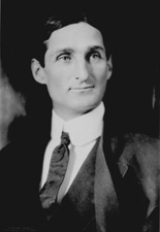
1924 Democratic National Convention

Encyclopedia
The 1924 Democratic National Convention
, also called the Klanbake, held at the Madison Square Garden
in New York City
from June 24 to July 9, took a record 103 ballots to nominate a presidential candidate. It was the longest continuously running convention in United States
political history. It was the first major party national convention that saw the name of a woman, Lena Springs
, placed in nomination for the office of Vice President. It was also known for the strong influence of the Ku Klux Klan
. John W. Davis
, initially an outsider, eventually won the presidential nomination as a compromise candidate following a virtual war of attrition between front-runners William Gibbs McAdoo
and Al Smith
.
Davis went on to be defeated by incumbent President Calvin Coolidge
in the United States presidential election of 1924
.
, a relic of post-Civil War Reconstruction, was resurrected after the 1915 release of D.W. Griffith's very popular motion picture The Birth of a Nation
. After World War I
, the popularity of the Klan surged, and it became a political power in many regions of the United States, particularly in the South
. It was also popular in the border states
, the Mountain States
, and the West
. Its local political strength gave it a major role in the 1924 Democratic Party National Convention (DNC). However, its participation was unwelcome by many DNC delegates, such as Catholics from the major cities of the Northeast and Midwest. The tension between pro- and anti-Klan delegates produced an intense and sometimes violent showdown between convention attendees from the states of Colorado and Missouri. Klan delegates opposed the nomination of New York Governor Al Smith
because Smith was a Roman Catholic. Smith campaigned against William Gibbs McAdoo
, who had the support of most Klan delegates.
, to condemn the organization for its violence in the Democratic Party's platform. Klan delegates defeated the platform plank in a series of floor debates. To celebrate, tens of thousands of hooded Klansmen rallied in a field in New Jersey opposite of the convention building. This event, known subsequently as the "Klanbake", was also attended by hundreds of Klan delegates to the convention, who burned crosses, urged violence and intimidation against African Americans and Catholics, and attacked effigies of Smith.
.
 The first day of balloting (June 30) brought the predicted deadlock between the leading aspirants for the nomination, William G. McAdoo of California and Gov. Alfred E. Smith of New York, with the remainder divided mainly between local "favorite sons". McAdoo was the leader from the outset, and both he and Smith made small gains in the day's fifteen ballots, but the prevailing belief among the delegates was that the impasse could only be broken by the elimination of both McAdoo and Smith and the selection of one of the other contenders; much interest centred about the candidacy of John W. Davis, who also increased his vote during the day from 31 to 61 (with a peak of 64.5 votes on the 13th and 14th ballots). Most of the favorite son delegations refused to be stampeded to either of the leading candidates and were in no hurry to retire from the contest.
In the early balloting many delegations appeared to be jockeying for position, and some of the original votes were purely complimentary and seemed to conceal the real sentiments of the delegates. Louisiana, for example, which was bound by the "unit rule", first complimented its neighbour Arkansas by casting its 20 votes for Sen. Joseph T. Robinson, then it switched to Sen. Carter Glass
, and on another ballot Gov. Albert C. Ritchie
got the twenty, before the delegation finally settled on John W. Davis.
There was some excitement on the tenth ballot, when Kansas abandoned Gov. Jonathan M. Davis
and threw its votes to McAdoo. There was an instant uproar among McAdoo delegates and supporters, and a parade was started around the hall, the Kansas standard leading, with those of all the other McAdoo states coming along behind, and pictures of "McAdoo, Democracy's Hope", being lifted up. After six minutes the chairman's gavel brought order and the roll call resumed, and soon the other side had something to cheer, when New Jersey made its favorite son, Gov. George S. Silzer
, walk the plank and threw its votes into the Smith column. This started another parade, the New York and New Jersey standards leading those of the other Smith delegations around the hall while the band played "Tramp, Tramp, Tramp, the Boys are Marching".
431.5 votes (39.4%)
2. Alfred E. Smith 241 votes (22.0%)
3. James M. Cox
59 votes (5.4%)
4. Pat Harrison
43.5 votes (4.0%)
5. Oscar W. Underwood 42.5 votes (3.9%)
6. George S. Silzer
38 votes (3.5%)
7. John W. Davis
31 votes (2.8%)
8. Samuel M. Ralston
30 votes (2.7%)
9. Woodbridge N. Ferris 30 votes (2.7%)
10. Carter Glass
25 votes (2.3%)
11. Albert C. Ritchie
22.5 votes (2.1%)
12. Joseph T. Robinson 21 votes (1.9%)
13. Jonathan M. Davis
20 votes (1.8%)
14. Charles W. Bryan
18 votes (1.6%)
15. Fred H. Brown
17 votes (1.6%)
16. William Sweet
12 votes (1.1%)
17. Willard Saulsbury
7 votes (0.6%)
18. John Kendrick
6 votes (0.5%)
19. Houston Thompson 1 vote (0.1%)
479 votes (43.6%)
2. Alfred E. Smith 305.5 votes (27.8%)
3. John W. Davis
61 votes (5.6%)
4. James M. Cox
60 votes (5.5%)
5. Oscar W. Underwood 39.5 votes (3.6%)
6. Samuel M. Ralston
31 votes (2.8%)
7. Carter Glass
25 votes (2.3%)
8. Pat Harrison
20.5 votes (1.9%)
9. Joseph T. Robinson 20.5 votes (1.9%)
10. Albert C. Ritchie
17.5 votes (1.6%)
11. Jonathan M. Davis
11 votes (1.0%)
12. Charles W. Bryan
11 votes (1.0%)
13. Fred H. Brown
9 votes (0.8%)
14. Willard Saulsbury
6 votes (0.5%)
15. Thomas J. Walsh
1 vote (0.1%)
Newton D. Baker
1 vote (0.1%)
432 votes (39.5%)
2. Alfred E. Smith 307.5 votes (28.0%)
3. John W. Davis
122 votes (11.3%)
4. Oscar W. Underwood 45.5 votes (4.1%)
5. Samuel M. Ralston
30 votes (2.7%)
6. Carter Glass
25 votes (2.3%)
7. Joseph T. Robinson 21 votes (1.9%)
8. Albert C. Ritchie
17.5 votes (1.6%)
9. Others 97.5 votes (8.6%)
415.5 votes (37.7%)
2. Alfred E. Smith 323.5 votes (29.4%)
3. John W. Davis
126.5 votes (11.5%)
4. Oscar W. Underwood 39.5 votes (3.6%)
5. Samuel M. Ralston
33 votes (3.0%)
6. Carter Glass
24 votes (2.2%)
7. Joseph T. Robinson 23 votes (2.1%)
8. Albert C. Ritchie
17.5 votes (1.6%)
9. Others 95.5 votes (9.9%)
503.4 votes (45.7%)
2. Alfred E. Smith 318.6 votes (28.9%)
3. John W. Davis
67 votes (6.0%)
4. Others 209.0 votes (19.4%)
469.5 votes (42.6%)
2. Alfred E. Smith 335.5 votes (30.5%)
3. John W. Davis
60 votes (5.4%)
4. Others 233 votes (21.5%)
528.5 votes (48.0%)
2. Alfred E. Smith 334.5 votes (30.4%)
3. John W. Davis
67 votes (6.0%)
4. Others 170 votes (15.6%)
513 votes (47.7%)
2. Alfred E. Smith 367 votes (33.3%)
3. John W. Davis
76.5 votes (6.9%)
4. Others 134 votes (12.1%)
2. William G. McAdoo
333.5 votes (30.3%)
3. John W. Davis
66.5 votes (6.0%)
4. Others 336.5 votes (30.9%)
2. John W. Davis
203.5 votes (18.7%)
3. William G. McAdoo
190 votes (17.5%)
4. Edwin T. Meredith 75.5 votes (7.0%)
5. Thomas J. Walsh
52.5 votes (4.8%)
6. Joseph T. Robinson 46 votes (4.2%)
7. Oscar W. Underwood 41.5 votes (3.8%)
8. Carter Glass
35 votes (3.2%)
9. Josephus Daniels
24 votes (2.2%)
10. Robert L. Owen
20 votes (1.8%)
11. Albert C. Ritchie
17.5 votes (1.6%)
12. James W. Gerard
10 votes (0.9%)
13. David F. Houston
9 votes (0.8%)
14. Willard Saulsbury
6 votes (0.6%)
15. Charles W. Bryan
2 votes (0.2%)
16. George L. Berry
1 vote (0.1%)
17. Newton D. Baker
1 vote (0.1%)
Democratic National Convention
The Democratic National Convention is a series of presidential nominating conventions held every four years since 1832 by the United States Democratic Party. They have been administered by the Democratic National Committee since the 1852 national convention...
, also called the Klanbake, held at the Madison Square Garden
Madison Square Garden (1890)
Madison Square Garden was an indoor arena in New York City, the second by that name, and the second to be located at 26th Street and Madison Avenue in Manhattan...
in New York City
New York City
New York is the most populous city in the United States and the center of the New York Metropolitan Area, one of the most populous metropolitan areas in the world. New York exerts a significant impact upon global commerce, finance, media, art, fashion, research, technology, education, and...
from June 24 to July 9, took a record 103 ballots to nominate a presidential candidate. It was the longest continuously running convention in United States
United States
The United States of America is a federal constitutional republic comprising fifty states and a federal district...
political history. It was the first major party national convention that saw the name of a woman, Lena Springs
Lena Springs
Lena Jones Wade Springs was the first woman placed in nomination for the office of Vice President of the United States, at the 1924 Democratic National Convention....
, placed in nomination for the office of Vice President. It was also known for the strong influence of the Ku Klux Klan
Ku Klux Klan
Ku Klux Klan, often abbreviated KKK and informally known as the Klan, is the name of three distinct past and present far-right organizations in the United States, which have advocated extremist reactionary currents such as white supremacy, white nationalism, and anti-immigration, historically...
. John W. Davis
John W. Davis
John William Davis was an American politician, diplomat and lawyer. He served as a United States Representative from West Virginia , then as Solicitor General of the United States and US Ambassador to the UK under President Woodrow Wilson...
, initially an outsider, eventually won the presidential nomination as a compromise candidate following a virtual war of attrition between front-runners William Gibbs McAdoo
William Gibbs McAdoo
William Gibbs McAdoo, Jr. was an American lawyer and political leader who served as a U.S. Senator, United States Secretary of the Treasury and director of the United States Railroad Administration...
and Al Smith
Al Smith
Alfred Emanuel Smith. , known in private and public life as Al Smith, was an American statesman who was elected the 42nd Governor of New York three times, and was the Democratic U.S. presidential candidate in 1928...
.
Davis went on to be defeated by incumbent President Calvin Coolidge
Calvin Coolidge
John Calvin Coolidge, Jr. was the 30th President of the United States . A Republican lawyer from Vermont, Coolidge worked his way up the ladder of Massachusetts state politics, eventually becoming governor of that state...
in the United States presidential election of 1924
United States presidential election, 1924
The United States presidential election of 1924 was won by incumbent President Calvin Coolidge, the Republican candidate.Coolidge was vice-president under Warren G. Harding and became president in 1923 when Harding died in office. Coolidge was given credit for a booming economy at home and no...
.
Ku Klux Klan
The Ku Klux KlanKu Klux Klan
Ku Klux Klan, often abbreviated KKK and informally known as the Klan, is the name of three distinct past and present far-right organizations in the United States, which have advocated extremist reactionary currents such as white supremacy, white nationalism, and anti-immigration, historically...
, a relic of post-Civil War Reconstruction, was resurrected after the 1915 release of D.W. Griffith's very popular motion picture The Birth of a Nation
The Birth of a Nation
The Birth of a Nation is a 1915 American silent film directed by D. W. Griffith and based on the novel and play The Clansman, both by Thomas Dixon, Jr. Griffith also co-wrote the screenplay , and co-produced the film . It was released on February 8, 1915...
. After World War I
World War I
World War I , which was predominantly called the World War or the Great War from its occurrence until 1939, and the First World War or World War I thereafter, was a major war centred in Europe that began on 28 July 1914 and lasted until 11 November 1918...
, the popularity of the Klan surged, and it became a political power in many regions of the United States, particularly in the South
Southern United States
The Southern United States—commonly referred to as the American South, Dixie, or simply the South—constitutes a large distinctive area in the southeastern and south-central United States...
. It was also popular in the border states
Border states (Civil War)
In the context of the American Civil War, the border states were slave states that did not declare their secession from the United States before April 1861...
, the Mountain States
Mountain States
thumb|300px|Regional definitions vary from source to source. The states shown in dark red are always included, while the striped states are usually considered part of the same region called the Mountain States....
, and the West
Western United States
.The Western United States, commonly referred to as the American West or simply "the West," traditionally refers to the region comprising the westernmost states of the United States. Because the U.S. expanded westward after its founding, the meaning of the West has evolved over time...
. Its local political strength gave it a major role in the 1924 Democratic Party National Convention (DNC). However, its participation was unwelcome by many DNC delegates, such as Catholics from the major cities of the Northeast and Midwest. The tension between pro- and anti-Klan delegates produced an intense and sometimes violent showdown between convention attendees from the states of Colorado and Missouri. Klan delegates opposed the nomination of New York Governor Al Smith
Al Smith
Alfred Emanuel Smith. , known in private and public life as Al Smith, was an American statesman who was elected the 42nd Governor of New York three times, and was the Democratic U.S. presidential candidate in 1928...
because Smith was a Roman Catholic. Smith campaigned against William Gibbs McAdoo
William Gibbs McAdoo
William Gibbs McAdoo, Jr. was an American lawyer and political leader who served as a U.S. Senator, United States Secretary of the Treasury and director of the United States Railroad Administration...
, who had the support of most Klan delegates.
KKK platform plank
The second dispute of the convention revolved around an attempt by non-Klan delegates, led by Forney Johnston of AlabamaAlabama
Alabama is a state located in the southeastern region of the United States. It is bordered by Tennessee to the north, Georgia to the east, Florida and the Gulf of Mexico to the south, and Mississippi to the west. Alabama ranks 30th in total land area and ranks second in the size of its inland...
, to condemn the organization for its violence in the Democratic Party's platform. Klan delegates defeated the platform plank in a series of floor debates. To celebrate, tens of thousands of hooded Klansmen rallied in a field in New Jersey opposite of the convention building. This event, known subsequently as the "Klanbake", was also attended by hundreds of Klan delegates to the convention, who burned crosses, urged violence and intimidation against African Americans and Catholics, and attacked effigies of Smith.
Impact
The notoriety of the Klanbake convention and the violence it produced cast a lasting shadow over the Democratic Party's prospects in the 1924 Election and contributed to their defeat by incumbent Republican President Calvin CoolidgeCalvin Coolidge
John Calvin Coolidge, Jr. was the 30th President of the United States . A Republican lawyer from Vermont, Coolidge worked his way up the ladder of Massachusetts state politics, eventually becoming governor of that state...
.
President
In the early balloting many delegations appeared to be jockeying for position, and some of the original votes were purely complimentary and seemed to conceal the real sentiments of the delegates. Louisiana, for example, which was bound by the "unit rule", first complimented its neighbour Arkansas by casting its 20 votes for Sen. Joseph T. Robinson, then it switched to Sen. Carter Glass
Carter Glass
Carter Glass was a newspaper publisher and politician from Lynchburg, Virginia. He served many years in Congress as a member of the Democratic Party. As House co-sponsor, he played a central role in the development of the 1913 Glass-Owen Act that created the Federal Reserve System. Glass...
, and on another ballot Gov. Albert C. Ritchie
Albert Ritchie
Albert Cabell Ritchie , a member of the United States Democratic Party, was the 49th Governor of Maryland in the United States from 1920 to 1935...
got the twenty, before the delegation finally settled on John W. Davis.
There was some excitement on the tenth ballot, when Kansas abandoned Gov. Jonathan M. Davis
Jonathan M. Davis
Jonathan McMillan Davis was the 22nd Governor of Kansas.Davis was born in Bourbon County, Kansas to Jonathan McMillan and Eve Davis....
and threw its votes to McAdoo. There was an instant uproar among McAdoo delegates and supporters, and a parade was started around the hall, the Kansas standard leading, with those of all the other McAdoo states coming along behind, and pictures of "McAdoo, Democracy's Hope", being lifted up. After six minutes the chairman's gavel brought order and the roll call resumed, and soon the other side had something to cheer, when New Jersey made its favorite son, Gov. George S. Silzer
George Sebastian Silzer
George Sebastian Silzer served as the 38th Governor of New Jersey.-Biography:He was born on April 14, 1870 in New Brunswick, New Jersey. Silzer was a member of the New Brunswick board of aldermen from 1892 to 1896. He was a member of the New Jersey Senate from Middlesex County from 1907 to 1912....
, walk the plank and threw its votes into the Smith column. This started another parade, the New York and New Jersey standards leading those of the other Smith delegations around the hall while the band played "Tramp, Tramp, Tramp, the Boys are Marching".
First ballot
1. William G. McAdooWilliam Gibbs McAdoo
William Gibbs McAdoo, Jr. was an American lawyer and political leader who served as a U.S. Senator, United States Secretary of the Treasury and director of the United States Railroad Administration...
431.5 votes (39.4%)
2. Alfred E. Smith 241 votes (22.0%)
3. James M. Cox
James M. Cox
James Middleton Cox was the 46th and 48th Governor of Ohio, U.S. Representative from Ohio and Democratic candidate for President of the United States in the election of 1920....
59 votes (5.4%)
4. Pat Harrison
Pat Harrison
Byron Patton "Pat" Harrison was a Mississippi politician who served as a Democrat in the United States House of Representatives from 1911 to 1919 and in the United States Senate from 1919 until his death....
43.5 votes (4.0%)
5. Oscar W. Underwood 42.5 votes (3.9%)
6. George S. Silzer
George Sebastian Silzer
George Sebastian Silzer served as the 38th Governor of New Jersey.-Biography:He was born on April 14, 1870 in New Brunswick, New Jersey. Silzer was a member of the New Brunswick board of aldermen from 1892 to 1896. He was a member of the New Jersey Senate from Middlesex County from 1907 to 1912....
38 votes (3.5%)
7. John W. Davis
John W. Davis
John William Davis was an American politician, diplomat and lawyer. He served as a United States Representative from West Virginia , then as Solicitor General of the United States and US Ambassador to the UK under President Woodrow Wilson...
31 votes (2.8%)
8. Samuel M. Ralston
Samuel M. Ralston
Samuel Moffett Ralston was Democratic politician, the 28th Governor of and a United States Senator from the U.S. state of Indiana. Born into a large impoverished family, he took many jobs as a child including working in a coal mine...
30 votes (2.7%)
9. Woodbridge N. Ferris 30 votes (2.7%)
10. Carter Glass
Carter Glass
Carter Glass was a newspaper publisher and politician from Lynchburg, Virginia. He served many years in Congress as a member of the Democratic Party. As House co-sponsor, he played a central role in the development of the 1913 Glass-Owen Act that created the Federal Reserve System. Glass...
25 votes (2.3%)
11. Albert C. Ritchie
Albert Ritchie
Albert Cabell Ritchie , a member of the United States Democratic Party, was the 49th Governor of Maryland in the United States from 1920 to 1935...
22.5 votes (2.1%)
12. Joseph T. Robinson 21 votes (1.9%)
13. Jonathan M. Davis
Jonathan M. Davis
Jonathan McMillan Davis was the 22nd Governor of Kansas.Davis was born in Bourbon County, Kansas to Jonathan McMillan and Eve Davis....
20 votes (1.8%)
14. Charles W. Bryan
Charles W. Bryan
Charles Wayland Bryan was the younger brother of perennial U.S. Democratic presidential candidate William Jennings Bryan, with whom he shares the distinction of being the only set of brothers to be nominated for national office by a major party.-Biography:Born in 1867 in Salem, Illinois, Bryan...
18 votes (1.6%)
15. Fred H. Brown
Fred H. Brown
Fred Herbert Brown was an American lawyer and Democratic politician from Somersworth, New Hampshire. He served as mayor of Somersworth and as United States Attorney for New Hampshire before his term as Governor of New Hampshire from 1923 to 1925, and later served in the United States Senate.Brown...
17 votes (1.6%)
16. William Sweet
William Sweet
William Sweet is a Canadian philosopher, and a Past-President of the Canadian Philosophical Association. He is currently Professor of Philosophy and Director of the Centre for Philosophy, Theology, and Cultural Traditions at St Francis Xavier University...
12 votes (1.1%)
17. Willard Saulsbury
Willard Saulsbury, Jr.
Willard Saulsbury, Jr. was an American lawyer and politician from Wilmington, in New Castle County, Delaware. He was a member of the Democratic Party who served as U.S. Senator from Delaware and President pro tempore of the U.S...
7 votes (0.6%)
18. John Kendrick
John B. Kendrick
John Benjamin Kendrick was an American politician who served as a United States Senator from Wyoming.Kendrick was born near Rusk, Texas, where he attended the public schools, and then moved to Wyoming in 1879 and settled on a ranch near Sheridan, where he raised cattle.He was a member of the State...
6 votes (0.5%)
19. Houston Thompson 1 vote (0.1%)
Fifteenth ballot
1. William G. McAdooWilliam Gibbs McAdoo
William Gibbs McAdoo, Jr. was an American lawyer and political leader who served as a U.S. Senator, United States Secretary of the Treasury and director of the United States Railroad Administration...
479 votes (43.6%)
2. Alfred E. Smith 305.5 votes (27.8%)
3. John W. Davis
John W. Davis
John William Davis was an American politician, diplomat and lawyer. He served as a United States Representative from West Virginia , then as Solicitor General of the United States and US Ambassador to the UK under President Woodrow Wilson...
61 votes (5.6%)
4. James M. Cox
James M. Cox
James Middleton Cox was the 46th and 48th Governor of Ohio, U.S. Representative from Ohio and Democratic candidate for President of the United States in the election of 1920....
60 votes (5.5%)
5. Oscar W. Underwood 39.5 votes (3.6%)
6. Samuel M. Ralston
Samuel M. Ralston
Samuel Moffett Ralston was Democratic politician, the 28th Governor of and a United States Senator from the U.S. state of Indiana. Born into a large impoverished family, he took many jobs as a child including working in a coal mine...
31 votes (2.8%)
7. Carter Glass
Carter Glass
Carter Glass was a newspaper publisher and politician from Lynchburg, Virginia. He served many years in Congress as a member of the Democratic Party. As House co-sponsor, he played a central role in the development of the 1913 Glass-Owen Act that created the Federal Reserve System. Glass...
25 votes (2.3%)
8. Pat Harrison
Pat Harrison
Byron Patton "Pat" Harrison was a Mississippi politician who served as a Democrat in the United States House of Representatives from 1911 to 1919 and in the United States Senate from 1919 until his death....
20.5 votes (1.9%)
9. Joseph T. Robinson 20.5 votes (1.9%)
10. Albert C. Ritchie
Albert Ritchie
Albert Cabell Ritchie , a member of the United States Democratic Party, was the 49th Governor of Maryland in the United States from 1920 to 1935...
17.5 votes (1.6%)
11. Jonathan M. Davis
Jonathan M. Davis
Jonathan McMillan Davis was the 22nd Governor of Kansas.Davis was born in Bourbon County, Kansas to Jonathan McMillan and Eve Davis....
11 votes (1.0%)
12. Charles W. Bryan
Charles W. Bryan
Charles Wayland Bryan was the younger brother of perennial U.S. Democratic presidential candidate William Jennings Bryan, with whom he shares the distinction of being the only set of brothers to be nominated for national office by a major party.-Biography:Born in 1867 in Salem, Illinois, Bryan...
11 votes (1.0%)
13. Fred H. Brown
Fred H. Brown
Fred Herbert Brown was an American lawyer and Democratic politician from Somersworth, New Hampshire. He served as mayor of Somersworth and as United States Attorney for New Hampshire before his term as Governor of New Hampshire from 1923 to 1925, and later served in the United States Senate.Brown...
9 votes (0.8%)
14. Willard Saulsbury
Willard Saulsbury, Jr.
Willard Saulsbury, Jr. was an American lawyer and politician from Wilmington, in New Castle County, Delaware. He was a member of the Democratic Party who served as U.S. Senator from Delaware and President pro tempore of the U.S...
6 votes (0.5%)
15. Thomas J. Walsh
Thomas J. Walsh
Thomas James Walsh was a lawyer and Democratic Party politician from Helena, Montana, in the United States.-Background:...
1 vote (0.1%)
Newton D. Baker
Newton D. Baker
Newton Diehl Baker, Jr. was an American politician who belonged to the Democratic Party. He served as the 37th mayor of Cleveland, Ohio from 1912 to 1915 and as U.S. Secretary of War from 1916 to 1921.-Early years:...
1 vote (0.1%)
Twentieth ballot
1. William G. McAdooWilliam Gibbs McAdoo
William Gibbs McAdoo, Jr. was an American lawyer and political leader who served as a U.S. Senator, United States Secretary of the Treasury and director of the United States Railroad Administration...
432 votes (39.5%)
2. Alfred E. Smith 307.5 votes (28.0%)
3. John W. Davis
John W. Davis
John William Davis was an American politician, diplomat and lawyer. He served as a United States Representative from West Virginia , then as Solicitor General of the United States and US Ambassador to the UK under President Woodrow Wilson...
122 votes (11.3%)
4. Oscar W. Underwood 45.5 votes (4.1%)
5. Samuel M. Ralston
Samuel M. Ralston
Samuel Moffett Ralston was Democratic politician, the 28th Governor of and a United States Senator from the U.S. state of Indiana. Born into a large impoverished family, he took many jobs as a child including working in a coal mine...
30 votes (2.7%)
6. Carter Glass
Carter Glass
Carter Glass was a newspaper publisher and politician from Lynchburg, Virginia. He served many years in Congress as a member of the Democratic Party. As House co-sponsor, he played a central role in the development of the 1913 Glass-Owen Act that created the Federal Reserve System. Glass...
25 votes (2.3%)
7. Joseph T. Robinson 21 votes (1.9%)
8. Albert C. Ritchie
Albert Ritchie
Albert Cabell Ritchie , a member of the United States Democratic Party, was the 49th Governor of Maryland in the United States from 1920 to 1935...
17.5 votes (1.6%)
9. Others 97.5 votes (8.6%)
Thirtieth ballot
1. William G. McAdooWilliam Gibbs McAdoo
William Gibbs McAdoo, Jr. was an American lawyer and political leader who served as a U.S. Senator, United States Secretary of the Treasury and director of the United States Railroad Administration...
415.5 votes (37.7%)
2. Alfred E. Smith 323.5 votes (29.4%)
3. John W. Davis
John W. Davis
John William Davis was an American politician, diplomat and lawyer. He served as a United States Representative from West Virginia , then as Solicitor General of the United States and US Ambassador to the UK under President Woodrow Wilson...
126.5 votes (11.5%)
4. Oscar W. Underwood 39.5 votes (3.6%)
5. Samuel M. Ralston
Samuel M. Ralston
Samuel Moffett Ralston was Democratic politician, the 28th Governor of and a United States Senator from the U.S. state of Indiana. Born into a large impoverished family, he took many jobs as a child including working in a coal mine...
33 votes (3.0%)
6. Carter Glass
Carter Glass
Carter Glass was a newspaper publisher and politician from Lynchburg, Virginia. He served many years in Congress as a member of the Democratic Party. As House co-sponsor, he played a central role in the development of the 1913 Glass-Owen Act that created the Federal Reserve System. Glass...
24 votes (2.2%)
7. Joseph T. Robinson 23 votes (2.1%)
8. Albert C. Ritchie
Albert Ritchie
Albert Cabell Ritchie , a member of the United States Democratic Party, was the 49th Governor of Maryland in the United States from 1920 to 1935...
17.5 votes (1.6%)
9. Others 95.5 votes (9.9%)
Forty-second ballot
1. William G. McAdooWilliam Gibbs McAdoo
William Gibbs McAdoo, Jr. was an American lawyer and political leader who served as a U.S. Senator, United States Secretary of the Treasury and director of the United States Railroad Administration...
503.4 votes (45.7%)
2. Alfred E. Smith 318.6 votes (28.9%)
3. John W. Davis
John W. Davis
John William Davis was an American politician, diplomat and lawyer. He served as a United States Representative from West Virginia , then as Solicitor General of the United States and US Ambassador to the UK under President Woodrow Wilson...
67 votes (6.0%)
4. Others 209.0 votes (19.4%)
Sixty-first ballot
1. William G. McAdooWilliam Gibbs McAdoo
William Gibbs McAdoo, Jr. was an American lawyer and political leader who served as a U.S. Senator, United States Secretary of the Treasury and director of the United States Railroad Administration...
469.5 votes (42.6%)
2. Alfred E. Smith 335.5 votes (30.5%)
3. John W. Davis
John W. Davis
John William Davis was an American politician, diplomat and lawyer. He served as a United States Representative from West Virginia , then as Solicitor General of the United States and US Ambassador to the UK under President Woodrow Wilson...
60 votes (5.4%)
4. Others 233 votes (21.5%)
Seventieth ballot
1. William G. McAdooWilliam Gibbs McAdoo
William Gibbs McAdoo, Jr. was an American lawyer and political leader who served as a U.S. Senator, United States Secretary of the Treasury and director of the United States Railroad Administration...
528.5 votes (48.0%)
2. Alfred E. Smith 334.5 votes (30.4%)
3. John W. Davis
John W. Davis
John William Davis was an American politician, diplomat and lawyer. He served as a United States Representative from West Virginia , then as Solicitor General of the United States and US Ambassador to the UK under President Woodrow Wilson...
67 votes (6.0%)
4. Others 170 votes (15.6%)
Seventy-seventh
1. William G. McAdooWilliam Gibbs McAdoo
William Gibbs McAdoo, Jr. was an American lawyer and political leader who served as a U.S. Senator, United States Secretary of the Treasury and director of the United States Railroad Administration...
513 votes (47.7%)
2. Alfred E. Smith 367 votes (33.3%)
3. John W. Davis
John W. Davis
John William Davis was an American politician, diplomat and lawyer. He served as a United States Representative from West Virginia , then as Solicitor General of the United States and US Ambassador to the UK under President Woodrow Wilson...
76.5 votes (6.9%)
4. Others 134 votes (12.1%)
Eighty-seventh
1. Alfred E. Smith 361.5 votes (32.8%)2. William G. McAdoo
William Gibbs McAdoo
William Gibbs McAdoo, Jr. was an American lawyer and political leader who served as a U.S. Senator, United States Secretary of the Treasury and director of the United States Railroad Administration...
333.5 votes (30.3%)
3. John W. Davis
John W. Davis
John William Davis was an American politician, diplomat and lawyer. He served as a United States Representative from West Virginia , then as Solicitor General of the United States and US Ambassador to the UK under President Woodrow Wilson...
66.5 votes (6.0%)
4. Others 336.5 votes (30.9%)
One hundredth ballot
1. Alfred E. Smith 351.5 votes (32.4%)2. John W. Davis
John W. Davis
John William Davis was an American politician, diplomat and lawyer. He served as a United States Representative from West Virginia , then as Solicitor General of the United States and US Ambassador to the UK under President Woodrow Wilson...
203.5 votes (18.7%)
3. William G. McAdoo
William Gibbs McAdoo
William Gibbs McAdoo, Jr. was an American lawyer and political leader who served as a U.S. Senator, United States Secretary of the Treasury and director of the United States Railroad Administration...
190 votes (17.5%)
4. Edwin T. Meredith 75.5 votes (7.0%)
5. Thomas J. Walsh
Thomas J. Walsh
Thomas James Walsh was a lawyer and Democratic Party politician from Helena, Montana, in the United States.-Background:...
52.5 votes (4.8%)
6. Joseph T. Robinson 46 votes (4.2%)
7. Oscar W. Underwood 41.5 votes (3.8%)
8. Carter Glass
Carter Glass
Carter Glass was a newspaper publisher and politician from Lynchburg, Virginia. He served many years in Congress as a member of the Democratic Party. As House co-sponsor, he played a central role in the development of the 1913 Glass-Owen Act that created the Federal Reserve System. Glass...
35 votes (3.2%)
9. Josephus Daniels
Josephus Daniels
Josephus Daniels was a newspaper editor and publisher from North Carolina who was appointed by United States President Woodrow Wilson to serve as Secretary of the Navy during World War I...
24 votes (2.2%)
10. Robert L. Owen
Robert L. Owen
Robert Latham Owen, Jr. was one of the first two U.S. senators from Oklahoma. He served in the Senate between 1907 and 1925...
20 votes (1.8%)
11. Albert C. Ritchie
Albert Ritchie
Albert Cabell Ritchie , a member of the United States Democratic Party, was the 49th Governor of Maryland in the United States from 1920 to 1935...
17.5 votes (1.6%)
12. James W. Gerard
James W. Gerard
James Watson Gerard was a U.S. lawyer and diplomat.-Biography:Gerard was born in Geneseo, N. Y. He graduated from Columbia in 1890 and from New York Law School. He was chairman of the Democratic campaign committee of New York County for four years, and served as major of the National Guard of the...
10 votes (0.9%)
13. David F. Houston
David F. Houston
David Franklin Houston was an American academic, businessman and politician.-Biography:Born in Monroe, North Carolina, he graduated from the University of South Carolina in 1887 and went on to do graduate work at Harvard University, where he received a M.A...
9 votes (0.8%)
14. Willard Saulsbury
Willard Saulsbury, Jr.
Willard Saulsbury, Jr. was an American lawyer and politician from Wilmington, in New Castle County, Delaware. He was a member of the Democratic Party who served as U.S. Senator from Delaware and President pro tempore of the U.S...
6 votes (0.6%)
15. Charles W. Bryan
Charles W. Bryan
Charles Wayland Bryan was the younger brother of perennial U.S. Democratic presidential candidate William Jennings Bryan, with whom he shares the distinction of being the only set of brothers to be nominated for national office by a major party.-Biography:Born in 1867 in Salem, Illinois, Bryan...
2 votes (0.2%)
16. George L. Berry
George L. Berry
George Leonard Berry was president of the International Pressmen and Assistants' Union of North America from 1907 to 1948 and a Democratic United States Senator from Tennessee from 1937 to 1938.-Early life:...
1 vote (0.1%)
17. Newton D. Baker
Newton D. Baker
Newton Diehl Baker, Jr. was an American politician who belonged to the Democratic Party. He served as the 37th mayor of Cleveland, Ohio from 1912 to 1915 and as U.S. Secretary of War from 1916 to 1921.-Early years:...
1 vote (0.1%)
Legacy
- During his 1960 campaign, John F. KennedyJohn F. KennedyJohn Fitzgerald "Jack" Kennedy , often referred to by his initials JFK, was the 35th President of the United States, serving from 1961 until his assassination in 1963....
cited the dilemma of the Massachusetts delegation at the 1924 Democratic National Convention when making light of his own campaign problems : "Either we must switch to a more liberal candidate or move to a cheaper hotel." - Both Franklin D. Roosevelt and Al Smith were filmed during the convention by Lee De ForestLee De ForestLee De Forest was an American inventor with over 180 patents to his credit. De Forest invented the Audion, a vacuum tube that takes relatively weak electrical signals and amplifies them. De Forest is one of the fathers of the "electronic age", as the Audion helped to usher in the widespread use...
in DeForest's PhonofilmPhonofilmIn 1919, Lee De Forest, inventor of the audion tube, filed his first patent on a sound-on-film process, DeForest Phonofilm, which recorded sound directly onto film as parallel lines. These parallel lines photographically recorded electrical waveforms from a microphone, which were translated back...
sound-on-filmSound-on-filmSound-on-film refers to a class of sound film processes where the sound accompanying picture is physically recorded onto photographic film, usually, but not always, the same strip of film carrying the picture. Sound-on-film processes can either record an analog sound track or digital sound track,...
process. These films are in the Maurice Zouary collection at the Library of CongressLibrary of CongressThe Library of Congress is the research library of the United States Congress, de facto national library of the United States, and the oldest federal cultural institution in the United States. Located in three buildings in Washington, D.C., it is the largest library in the world by shelf space and...
.
Sources
- Robert K. Murray, The 103rd Ballot: Democrats and the Disaster in Madison Square Garden (NY: Harper & Row, 1976)