

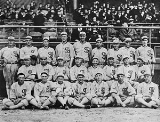
1919 World Series

Encyclopedia
The 1919 World Series matched the American League
champion Chicago White Sox
against the National League
champion Cincinnati Reds
. Although most World Series have been of the best-of-seven format, the 1919 World Series was a best-of-nine series (along with , , and ). Baseball decided to try the best-of-nine format partly to increase popularity of the sport and partly to generate more revenue.
The events of the series are often associated with the Black Sox Scandal
, when several members of the Chicago franchise conspired
with gamblers
to throw
(i.e., intentionally lose) World Series games. The 1919 World Series was the last World Series to take place without a Commissioner of Baseball
in place. In , the various franchise owners installed Kenesaw Mountain Landis
as the first "Commissioner of Baseball."
In 1921, eight players from the White Sox—including superstar Shoeless Joe Jackson
—were banned from organized baseball for fixing the series (or having knowledge about the fix).
, along with a few others, to World War I
service. Team owner Charlie Comiskey fired manager Pants Rowland
after the season, replacing him with 20-year Major League veteran Kid Gleason
, who was getting his first managerial assignment. The White Sox were back on top of the American League in 1919, finishing with a record of 88-52, 3.5 games in front of the Cleveland Indians
.
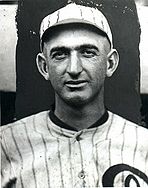 Jackson was the unchallenged star of the team. The left fielder hit .351 that season, fourth in the American League and also finished in the AL's top five in slugging percentage, runs batted in, total bases and base hits. He was not alone on the team, however, as Eddie Collins
, one of the greatest second basemen of all time, was still going strong in his early 30's, hitting .319 with a .400 on base percentage at the top of the line-up. Right fielder Nemo Leibold
was another .300 hitter, hitting .302 while scoring 81 runs, in a line-up that hardly had a weak spot. First baseman Chick Gandil
hit .290, third baseman Buck Weaver
was at .296, and center fielder Oscar "Happy" Felsch
hit .275 while tying with Jackson for the team lead in home runs with 7. Even catcher Ray Schalk
, a typical dead-ball era
"good field, no hit" catcher, hit .282 that year, and shortstop Swede Risberg
was not an automatic out with his .256 average and 38 runs batted in. Manager Gleason even had two good hitters on the bench, outfielder Shano Collins
and infielder Fred McMullin
, who were both veterans of the 1917 campaign.
On the mound, the White Sox depended on a pair of aces, backed by a very promising rookie. Knuckleballer Eddie Cicotte
had become one of the American League's best pitchers after turning 30 and discovering the "shine ball"; he had won 28 games for the 1917 champions, and after an off-year in 1918, had come back with an outstanding 29–7 record, leading the league in wins and finishing second in earned run average
to Walter Johnson
. He was backed by Claude "Lefty" Williams
, who had posted a 23–11 record with a 2.64 ERA. 26-year old rookie Dickie Kerr
only started 17 games but maintained a solid 13–7 record with a 2.88 ERA. The back end of the staff included Urban "Red" Faber
, who had beaten the Giants three times in the 1917 World Series but had had an off-year in 1919, finishing 11–9, 3.83 in 20 starts. Unfortunately, Faber was injured and not able to pitch in the Series. This limited Gleason to only three starters in a possible nine games.
All was not well in the White Sox camp, besides. Tensions between many of the players and owner Comiskey were very high, with the players complaining of his penny-pinching ways, which are reflected in two urban legends: the first is that Comiskey instructed Gleason to sit down Cicotte at the end of the year in order that he would not win 30 games, a milestone which would have earned him a sizeable bonus; the second was that the team was known derisively as the Black Sox because Comiskey would not pay to have their uniforms washed regularly.
, best known as the leader of another bunch of unlikely visitors to the World Series, the Philadelphia Phillies of 1915, Cincinnati finished 9 games in front of the New York Giants, with a 96–44 record, leaving every other team in the league at least 20 games back.
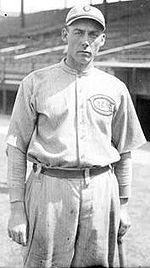 The Reds' greatest star was center fielder Edd Roush
, who led the league with a .321 batting average and, like the White Sox's Jackson, placed in the top five in most important hitting categories. Third baseman Heinie Groh
was the other great hitter on the team, contributing a .310 average with a .392 on-base percentage and 79 runs scored. First baseman Jake Daubert
, a two-time National League batting champion with Brooklyn earlier in the decade, also scored 79 runs, with a .276 average and great defense, while catcher Ivey Wingo
hit .273. The rest of the team was unheralded, including second baseman Morrie Rath
, a .264 hitter with no power but good on-base skills, and shortstop Larry Kopf
, a .270 singles hitter. The rest of the outfield was a definite weak spot, as former Phillies star Sherry Magee
hit only .215 in 56 games in left field, while in right field Earle "Greasy" Neale only hit .242 with little power. This would prompt Moran to start a rookie, Pat Duncan
, in left field during the World Series.
The Reds' pitching was universally solid, however. The team's big three included Hod Eller
(20–9, 2.39), Dutch Ruether
(19–6, 1.82) and Slim Sallee
(21–7, 2.06), all prominent among the league leaders in various categories. They were backed by three other pitchers who were almost as successful: Jimmy Ring
was only 10–9, but with a 2.26 ERA; Ray Fisher
was 14–5, 2.17 and pitched five shutouts, while Cuban Dolf Luque
was 10–3, 2.63. It was a deep and talented staff, a definite advantage in a Series whose format had just been changed from best of seven to best of nine.
 The conspiracy was the brainchild of White Sox first baseman Arnold "Chick" Gandil
and Joseph "Sport" Sullivan, who was a professional gambler of Gandil's acquaintance. New York gangster Arnold Rothstein
supplied the major connections needed. The money was supplied by Abe Attell
, former featherweight boxing champion, who accepted the offer even though he didn't have the $80,000 that the White Sox wanted.
Gandil enlisted seven of his teammates, motivated by a mixture of greed and a dislike of penurious club owner Charles Comiskey
, to implement the fix. Starting pitchers Eddie Cicotte
and Claude "Lefty" Williams
, outfielder Oscar "Happy" Felsch
, and infielder Charles "Swede" Risberg
were all involved. There remains some controversy as to whether outfielder "Shoeless" Joe Jackson
participated; while he was certainly aware of the fix, several of the players said years later that he wasn't involved. Buck Weaver
was also asked to participate, but refused; he was later banned with the others for knowing of the fix but not reporting it. Utility infielder Fred McMullin
was not initially approached but got word of the fix and threatened to report the others unless he was in on the payoff. Sullivan and his two associates Sleepy Bill Burns
and Billy Maharg
, somewhat out of their depth, approached Rothstein to provide the money for the players, who were promised a total of $100,000.
The conspirators got an unexpected assist when Faber was left off the roster due to a case of the flu. Indeed, years later Schalk said that had Faber been healthy, there never would have been a fix (since he almost certainly would have gotten starts that went to Cicotte and/or Williams).
Stories of the "Black Sox" scandal have usually included Comiskey in its gallery of subsidiary villains, focusing in particular on his intentions regarding a clause in Cicotte's contract that would have paid Cicotte an additional $10,000 bonus for winning 30 games. According to Eliot Asinof's account of the events, Eight Men Out, Cicotte was "rested" for the season's final two weeks after reaching his 29th win, presumably to deny him the bonus. However, the record is perhaps more complex. Cicotte won his 29th game on September 19, had an ineffective start on September 24, and was pulled after a few innings in a tuneup on the season's final day, September 28 (the World Series beginning three days later). Reportedly, Cicotte agreed to the fix on the same day he won his 29th game, before he could have known of any efforts to deny him a chance to win his 30th. The story was probably true, though, for the 1917 season—when Cicotte won 28 games and helped the White Sox to the world championship.
 Wednesday, October 1, 1919 at Redland Field
in Cincinnati, Ohio
The first game began at 3 PM that day at Cincinnati's Redland Field with Cicotte on the mound for Chicago, who failed to score in the top of the first inning, and 30,511 fans in the stands (with people outside the park paying at least $50 per ticket). In the bottom of that inning, Cicotte (who was paid his $10,000 the night before the series began) hit the lead-off hitter, Morrie Rath
, in the back with just his second pitch, a prearranged signal to Arnold Rothstein
that the game was going to be thrown. Despite this, the game remained close for a while, due in part to some excellent defense from the conspirators, who did not wish to bring suspicion on themselves. In the fourth, however, Cicotte gave up a sequence of hits, including a two-out triple to the opposing pitcher, as the Reds scored five times to break a 1–1 tie. Cicotte was replaced by a relief pitcher, but the damage was done, and the Reds triumphed 9–1.
By the evening of that day, there were already signs that things were going wrong. Only Cicotte, who had shrewdly demanded his $10,000 in advance, had been paid. Burns and Maharg met with Abe Attell
, a former world boxing
champion who acted as intermediary for Rothstein, but he did not provide the next installment ($20,000), wanting to place it out on bets for the next game. The next morning Gandil met Attell and again demanded their money. Again, the players went unpaid.
in Cincinnati, Ohio
Although they had not received their money, the players were still willing to go through with the fix. "Lefty" Williams, the starting pitcher in Game 2, was not going to be as obvious as Cicotte. After a shaky start, he pitched well until the fourth inning, when he walked three and gave up as many runs. After that, Williams went back to looking unhittable, giving up only one more run; but a lack of clutch hitting, with Gandil a particular guilty party, meant that the White Sox lost 4–2. Afterwards, Attell was still in no mood to pay up. Burns managed to get $10,000 and gave it to Gandil, who distributed it among the conspirators. The teams headed to Comiskey Park
in Chicago for the third game.
in Chicago, Illinois
Rookie pitcher Dickie Kerr
, who was to start Game 3 for the Sox, was not in on the fix. The original plan was for the conspirators, who disliked Kerr, to lose this game; but by now dissent among the players meant that the plan was in disarray. Burns still had faith, however, and gathered the last of his resources to bet on Cincinnati. It was a decision that would leave him broke, as Chicago scored early—Gandil himself driving in two runs—and Kerr was masterful, holding the Reds to three hits in throwing a complete game shutout and a 3–0 victory.
in Chicago, Illinois
Cicotte was again Chicago's starter for the fourth game, and he was determined not to look as bad as he had in the first. For the first four innings he and Reds pitcher Jimmy Ring
matched zeroes. With one out in the fifth, Cicotte fielded a slow roller by Pat Duncan
, but threw wildly to first for a two-base error. The next man up, Larry Kopf
, singled to left; Cicotte cut off the throw from Jackson and then fumbled the ball, allowing Duncan to score. The home crowd was stunned by the veteran pitcher's obvious mistake. When Cicotte then gave up a double to Greasy Neale that scored Kopf, the score was 2–0 — enough of a lead for Ring, who threw a three-hit shutout of his own. The Reds led the Series 3–1.
After the game, "Sport" Sullivan came through with $20,000 for the players, which Gandil split equally between Risberg, Felsch, Jackson, and Williams — who was due to start Game 5 the next day.
in Chicago, Illinois
The next game was delayed by rain for a day, and when it got under way, both Williams and Reds pitcher Hod Eller
were excellent. By the sixth inning, neither had allowed a runner past first base, before Eller hit a blooper that fell between Felsch and Jackson. Felsch's throw was off line, and the opposing pitcher was safe at third. Leadoff hitter Morrie Rath
hit a single over the drawn-in infield, and Eller scored. Heinie Groh
walked before Edd Roush
hit a double—the beneficiary of some more doubtful defense from Felsch—to score two more runs, and Roush himself scored shortly thereafter. Eller pitched well enough for the four runs to stand up, and the Reds were only one game from becoming world champions.
in Cincinnati, Ohio
Game 6 was held back in Cincinnati. Dickie Kerr, starting for the White Sox, was not as dominant as in Game 3. Aided by three errors, the Reds jumped out to a 4–0 lead before Chicago fought back, tying the game at 4–4 in the sixth, which remained the score into extra innings. In the top of the tenth, Gandil drove in Weaver to make it 5–4, and Kerr closed it out to record his—and Chicago's—second win.
in Cincinnati, Ohio
Despite the rumors that were already circulating over Cicotte's prior performances, Chicago manager Kid Gleason
showed faith in his ace for Game 7. This time, the knuckleballer did not let him down. Chicago scored early and, for once, it was Cincinnati that made errors in the field. The Reds threatened only briefly in the sixth before losing 4–1, and suddenly the Series was close again.
This did not go unnoticed by Sullivan and Rothstein, who were suddenly worried. Prior to the start of the Series, the Sox had been strong favorites and few doubted that they could win two games in a row—presuming they were trying to win. Rothstein had been too smart to bet on individual games but had a considerable sum riding on Cincinnati to win the Series. The night before the eighth game, Williams—who was due to pitch—was supposedly visited by an associate of Sullivan's who left him in no doubt that if he failed to blow the game in the first inning, he and his wife would be in serious danger.
in Chicago, Illinois
Whatever Williams had been told had made its impression. In the first, throwing nothing but mediocre fastballs, he gave up four straight one-out hits to yield three runs before Gleason replaced him with relief pitcher Big Bill James
, who allowed one of Williams' baserunners to score. James continued to be ineffective and, although the Sox rallied in the eighth, the Reds ran out 10–5 victors—clinching the Series by five games to three. Jackson hit the only homer of the Series, a solo shot in the third inning after the Reds had built a 5–0 lead. Immediately after the end of the Series, rumors were rife throughout the country that the games had been thrown. Journalist Hugh Fullerton
of the Chicago Herald and Examiner, disgusted by the display of ineptitude with which the White Sox had "thrown" the series, immediately wrote that the Series should never be played again.
(N.L.) over Chicago White Sox
(A.L.)
Shoeless Joe had 12 hits overall, which at the time was a World Series record.
American League
The American League of Professional Baseball Clubs, or simply the American League , is one of two leagues that make up Major League Baseball in the United States and Canada. It developed from the Western League, a minor league based in the Great Lakes states, which eventually aspired to major...
champion Chicago White Sox
Chicago White Sox
The Chicago White Sox are a Major League Baseball team located in Chicago, Illinois.The White Sox play in the American League's Central Division. Since , the White Sox have played in U.S. Cellular Field, which was originally called New Comiskey Park and nicknamed The Cell by local fans...
against the National League
National League
The National League of Professional Baseball Clubs, known simply as the National League , is the older of two leagues constituting Major League Baseball, and the world's oldest extant professional team sports league. Founded on February 2, 1876, to replace the National Association of Professional...
champion Cincinnati Reds
Cincinnati Reds
The Cincinnati Reds are a Major League Baseball team based in Cincinnati, Ohio. They are members of the National League Central Division. The club was established in 1882 as a charter member of the American Association and joined the National League in 1890....
. Although most World Series have been of the best-of-seven format, the 1919 World Series was a best-of-nine series (along with , , and ). Baseball decided to try the best-of-nine format partly to increase popularity of the sport and partly to generate more revenue.
The events of the series are often associated with the Black Sox Scandal
Black Sox Scandal
The Black Sox Scandal took place around and during the play of the American baseball 1919 World Series. Eight members of the Chicago White Sox were banned for life from baseball for intentionally losing games, which allowed the Cincinnati Reds to win the World Series...
, when several members of the Chicago franchise conspired
Conspiracy (crime)
In the criminal law, a conspiracy is an agreement between two or more persons to break the law at some time in the future, and, in some cases, with at least one overt act in furtherance of that agreement...
with gamblers
Gambling
Gambling is the wagering of money or something of material value on an event with an uncertain outcome with the primary intent of winning additional money and/or material goods...
to throw
Match fixing
In organised sports, match fixing, game fixing, race fixing, or sports fixing occurs as a match is played to a completely or partially pre-determined result, violating the rules of the game and often the law. Where the sporting competition in question is a race then the incident is referred to as...
(i.e., intentionally lose) World Series games. The 1919 World Series was the last World Series to take place without a Commissioner of Baseball
Commissioner of Baseball
The Commissioner of Baseball is the chief executive of Major League Baseball and its associated minor leagues. Under the direction of the Commissioner, the Office of the Commissioner of Baseball hires and maintains the sport's umpiring crews, and negotiates marketing, labor, and television contracts...
in place. In , the various franchise owners installed Kenesaw Mountain Landis
Kenesaw Mountain Landis
Kenesaw Mountain Landis was an American jurist who served as a federal judge from 1905 to 1922 and as the first Commissioner of Baseball from 1920 until his death...
as the first "Commissioner of Baseball."
In 1921, eight players from the White Sox—including superstar Shoeless Joe Jackson
Shoeless Joe Jackson
Joseph Jefferson Jackson , nicknamed "Shoeless Joe", was an American baseball player who played Major League Baseball in the early part of the 20th century...
—were banned from organized baseball for fixing the series (or having knowledge about the fix).
The Chicago White Sox
The Chicago White Sox of 1919 were one of baseball's glamour teams. Using most of the same players, they had won the 1917 World Series over the New York Giants in a convincing manner, by four games to two. They had fallen to sixth place in the American League in 1918, largely as a result to losing their best player Shoeless Joe JacksonShoeless Joe Jackson
Joseph Jefferson Jackson , nicknamed "Shoeless Joe", was an American baseball player who played Major League Baseball in the early part of the 20th century...
, along with a few others, to World War I
World War I
World War I , which was predominantly called the World War or the Great War from its occurrence until 1939, and the First World War or World War I thereafter, was a major war centred in Europe that began on 28 July 1914 and lasted until 11 November 1918...
service. Team owner Charlie Comiskey fired manager Pants Rowland
Pants Rowland
Clarence Henry "Pants" Rowland was a Major League Baseball manager for the Chicago White Sox from 1915 through 1918 who went on to become a major figure in minor league baseball. He was born in Platteville, Wisconsin...
after the season, replacing him with 20-year Major League veteran Kid Gleason
Kid Gleason
William J. "Kid" Gleason was an American professional athlete and Major League Baseball player and manager. Gleason is best known as the manager of the 1919 Chicago White Sox, the team made infamous by the Black Sox scandal, in which Gleason's players conspired to intentionally lose the World...
, who was getting his first managerial assignment. The White Sox were back on top of the American League in 1919, finishing with a record of 88-52, 3.5 games in front of the Cleveland Indians
Cleveland Indians
The Cleveland Indians are a professional baseball team based in Cleveland, Ohio. They are in the Central Division of Major League Baseball's American League. Since , they have played in Progressive Field. The team's spring training facility is in Goodyear, Arizona...
.
Eddie Collins
Edward Trowbridge Collins, Sr. , nicknamed "Cocky", was an American Major League Baseball second baseman, manager and executive...
, one of the greatest second basemen of all time, was still going strong in his early 30's, hitting .319 with a .400 on base percentage at the top of the line-up. Right fielder Nemo Leibold
Nemo Leibold
Harry Loran "Nemo" Leibold was an outfielder in Major League Baseball from 1913-1925. He played for the Cleveland Naps, Chicago White Sox, Boston Red Sox, and Washington Senators...
was another .300 hitter, hitting .302 while scoring 81 runs, in a line-up that hardly had a weak spot. First baseman Chick Gandil
Chick Gandil
Charles Arnold "Chick" Gandil was a professional baseball player. He played for the Washington Senators, Cleveland Indians, and Chicago White Sox of the American League. He is best known as the ringleader of the players involved in the 1919 Black Sox scandal...
hit .290, third baseman Buck Weaver
Buck Weaver
George Daniel "Buck" Weaver was an American shortstop and third baseman in Major League Baseball who played his entire career for the Chicago White Sox...
was at .296, and center fielder Oscar "Happy" Felsch
Happy Felsch
Oscar Emil "Happy" Felsch was an American center fielder in Major League Baseball who played for the Chicago White Sox from 1915 to 1920. He is probably best known for his involvement in the 1919 Black Sox scandal....
hit .275 while tying with Jackson for the team lead in home runs with 7. Even catcher Ray Schalk
Ray Schalk
Raymond William Schalk was a professional baseball player, coach, manager and scout. He played as a catcher in Major League Baseball for the Chicago White Sox for the majority of his career. Known for his fine handling of pitchers and outstanding defensive ability, Schalk was considered the...
, a typical dead-ball era
Dead-ball era
The dead-ball era is a baseball term used to describe the period between 1900 and the emergence of Babe Ruth as a power hitter in 1919. In 1919, Ruth hit a then league record 29 home runs, a spectacular feat at that time.This era was characterized by low-scoring games and a lack of home runs...
"good field, no hit" catcher, hit .282 that year, and shortstop Swede Risberg
Swede Risberg
Charles August "Swede" Risberg was an Major League Baseball shortstop. He played for the Chicago White Sox from 1917 to 1920. He is best known for his involvement in the 1919 Black Sox scandal.-Background:...
was not an automatic out with his .256 average and 38 runs batted in. Manager Gleason even had two good hitters on the bench, outfielder Shano Collins
Shano Collins
John Francis "Shano" Collins was an American right fielder and first baseman in Major League Baseball for the Chicago White Sox and Boston Red Sox....
and infielder Fred McMullin
Fred McMullin
Frederick Drury McMullin was an American Major League Baseball third baseman. He is best known for his involvement in the 1919 Black Sox scandal.-Career:...
, who were both veterans of the 1917 campaign.
On the mound, the White Sox depended on a pair of aces, backed by a very promising rookie. Knuckleballer Eddie Cicotte
Eddie Cicotte
Edward Victor Cicotte , nicknamed "Knuckles", was an American right-handed pitcher in Major League Baseball best known for his time with the Chicago White Sox...
had become one of the American League's best pitchers after turning 30 and discovering the "shine ball"; he had won 28 games for the 1917 champions, and after an off-year in 1918, had come back with an outstanding 29–7 record, leading the league in wins and finishing second in earned run average
Earned run average
In baseball statistics, earned run average is the mean of earned runs given up by a pitcher per nine innings pitched. It is determined by dividing the number of earned runs allowed by the number of innings pitched and multiplying by nine...
to Walter Johnson
Walter Johnson
Walter Perry Johnson , nicknamed "Barney" and "The Big Train", was a Major League Baseball right-handed pitcher. He played his entire 21-year baseball career for the Washington Senators...
. He was backed by Claude "Lefty" Williams
Lefty Williams
Claude Preston "Lefty" Williams was an American pitcher in Major League Baseball. He is probably best known for his involvement in the 1919 World Series fix, known as the Black Sox scandal.-Career:...
, who had posted a 23–11 record with a 2.64 ERA. 26-year old rookie Dickie Kerr
Dickie Kerr
Richard Henry "Dickey" Kerr was a starting pitcher for the Chicago White Sox from -. As a rookie, he won 13 games and both his starts in the 1919 World Series, which would lead to the permanent suspensions of eight of his teammates in the Black Sox Scandal...
only started 17 games but maintained a solid 13–7 record with a 2.88 ERA. The back end of the staff included Urban "Red" Faber
Red Faber
Urban Clarence "Red" Faber was an American right-handed pitcher in Major League Baseball from through , playing his entire career for the Chicago White Sox. He was inducted into the Baseball Hall of Fame in 1964....
, who had beaten the Giants three times in the 1917 World Series but had had an off-year in 1919, finishing 11–9, 3.83 in 20 starts. Unfortunately, Faber was injured and not able to pitch in the Series. This limited Gleason to only three starters in a possible nine games.
All was not well in the White Sox camp, besides. Tensions between many of the players and owner Comiskey were very high, with the players complaining of his penny-pinching ways, which are reflected in two urban legends: the first is that Comiskey instructed Gleason to sit down Cicotte at the end of the year in order that he would not win 30 games, a milestone which would have earned him a sizeable bonus; the second was that the team was known derisively as the Black Sox because Comiskey would not pay to have their uniforms washed regularly.
The Cincinnati Reds
In contrast to the White Sox, the 1919 Cincinnati Reds were upstarts. They had finished no higher than third since 1900, achieving that much success only twice. Yet, in 1919, they won the league pennant handily. Under new manager Pat MoranPat Moran
Patrick Joseph Moran was an American catcher and manager in Major League Baseball. As a manager, he led two teams to their first-ever modern-era National League championships: the 1915 Philadelphia Phillies and the 1919 Cincinnati Reds...
, best known as the leader of another bunch of unlikely visitors to the World Series, the Philadelphia Phillies of 1915, Cincinnati finished 9 games in front of the New York Giants, with a 96–44 record, leaving every other team in the league at least 20 games back.
Edd Roush
Edd J. Roush was a Major League Baseball player who was elected to the Baseball Hall of Fame in 1962. He played the majority of his career in center field....
, who led the league with a .321 batting average and, like the White Sox's Jackson, placed in the top five in most important hitting categories. Third baseman Heinie Groh
Heinie Groh
Henry Knight "Heinie" Groh was an American third baseman in Major League Baseball who spent nearly his entire career with the Cincinnati Reds and New York Giants. He was the National League's top third baseman in the late 1910s and early 1920s, and captained championship teams with the Reds and ...
was the other great hitter on the team, contributing a .310 average with a .392 on-base percentage and 79 runs scored. First baseman Jake Daubert
Jake Daubert
Jacob Ellsworth Daubert was an American first baseman in Major League Baseball who played for the Brooklyn Superbas and Cincinnati Reds. His career lasted from 1910 until his death in 1924....
, a two-time National League batting champion with Brooklyn earlier in the decade, also scored 79 runs, with a .276 average and great defense, while catcher Ivey Wingo
Ivey Wingo
Ivey Brown Wingo was a Major League Baseball catcher for the St. Louis Cardinals and Cincinnati Reds. Wingo spent the first four years of his career with the Cardinals and last thirteen years with the Reds....
hit .273. The rest of the team was unheralded, including second baseman Morrie Rath
Morrie Rath
Morris Charles "Morrie" Rath was an American baseball player who played second base for the Chicago White Sox and Cincinnati Reds in the 1910s. His name was often reported as Maurice Rath....
, a .264 hitter with no power but good on-base skills, and shortstop Larry Kopf
Larry Kopf
William Lorenz "Larry" Kopf , is a former professional baseball player who played infielder in the Major Leagues from to . He would play for the Cleveland Indians, Philadelphia Athletics, Boston Braves and Cincinnati Reds.He was the brother of football coach Herbert M...
, a .270 singles hitter. The rest of the outfield was a definite weak spot, as former Phillies star Sherry Magee
Sherry Magee
Sherwood Robert "Sherry" Magee was an American left fielder in Major League Baseball. From 1904 through 1919, Magee played for the Philadelphia Phillies , Boston Braves and Cincinnati Reds...
hit only .215 in 56 games in left field, while in right field Earle "Greasy" Neale only hit .242 with little power. This would prompt Moran to start a rookie, Pat Duncan
Pat Duncan
Pat Duncan is a former politician in the Yukon, Canada. Duncan served as leader of the Yukon Liberal Party from 1998 to 2005 and as the sixth Premier of Yukon from 2000 until 2002...
, in left field during the World Series.
The Reds' pitching was universally solid, however. The team's big three included Hod Eller
Hod Eller
Horace Owen Eller was a pitcher in Major League Baseball.Eller started his minor league career in 1913 and was drafted by the Cincinnati Reds after the 1916 season. He pitched five years for the Reds, going 60-40 with a 2.62 earned run average .Eller peaked in the Reds' pennant-winning 1919 season...
(20–9, 2.39), Dutch Ruether
Dutch Ruether
Walter Henry Ruether was an American baseball player who pitched for five different Major League teams...
(19–6, 1.82) and Slim Sallee
Slim Sallee
Harry Franklin "Slim" Sallee was a former professional baseball player. He was a left-handed pitcher over parts of fourteen seasons with the St. Louis Cardinals, New York Giants and Cincinnati Reds. For his career, he compiled a 174-143 record in 476 appearances, with an 2.56 earned run average...
(21–7, 2.06), all prominent among the league leaders in various categories. They were backed by three other pitchers who were almost as successful: Jimmy Ring
Jimmy Ring
James Joseph "Jimmy" Ring was a starting pitcher in Major League Baseball who played for the Cincinnati Reds , Philadelphia Phillies , New York Giants and St. Louis Cardinals . Ring batted and threw right-handed.Ring was used sparingly by the Cincinnati Reds from 1917-18...
was only 10–9, but with a 2.26 ERA; Ray Fisher
Ray Fisher
Ray Lyle Fisher was an American professional baseball pitcher. He pitched all or part of ten seasons in Major League Baseball. His debut game took place on July 2, 1910. His final game took place on October 2, 1920...
was 14–5, 2.17 and pitched five shutouts, while Cuban Dolf Luque
Dolf Luque
Adolfo Domingo De Guzmán "Dolf" Luque , was an early 20th century Cuban starting pitcher in Major League Baseball.Luque was inducted into the Cincinnati Reds Hall of Fame in 1967....
was 10–3, 2.63. It was a deep and talented staff, a definite advantage in a Series whose format had just been changed from best of seven to best of nine.
The Fix
Chick Gandil
Charles Arnold "Chick" Gandil was a professional baseball player. He played for the Washington Senators, Cleveland Indians, and Chicago White Sox of the American League. He is best known as the ringleader of the players involved in the 1919 Black Sox scandal...
and Joseph "Sport" Sullivan, who was a professional gambler of Gandil's acquaintance. New York gangster Arnold Rothstein
Arnold Rothstein
Arnold Rothstein , nicknamed "The Brain", was a New York businessman and gambler who became a famous kingpin of the Jewish mafia. Rothstein was also widely reputed to have been behind baseball's Black Sox Scandal, in which the 1919 World Series was fixed...
supplied the major connections needed. The money was supplied by Abe Attell
Abe Attell
Abraham Washington "Abe" Attell , known in the boxing world as Abe "The Little Hebrew" Attell, was a boxer who became known for his record-setting six-year reign as World Featherweight Champion...
, former featherweight boxing champion, who accepted the offer even though he didn't have the $80,000 that the White Sox wanted.
Gandil enlisted seven of his teammates, motivated by a mixture of greed and a dislike of penurious club owner Charles Comiskey
Charles Comiskey
Charles Albert "The Old Roman" Comiskey was a Major League Baseball player, manager and team owner. He was a key person in the formation of the American League and later owned the Chicago White Sox...
, to implement the fix. Starting pitchers Eddie Cicotte
Eddie Cicotte
Edward Victor Cicotte , nicknamed "Knuckles", was an American right-handed pitcher in Major League Baseball best known for his time with the Chicago White Sox...
and Claude "Lefty" Williams
Lefty Williams
Claude Preston "Lefty" Williams was an American pitcher in Major League Baseball. He is probably best known for his involvement in the 1919 World Series fix, known as the Black Sox scandal.-Career:...
, outfielder Oscar "Happy" Felsch
Happy Felsch
Oscar Emil "Happy" Felsch was an American center fielder in Major League Baseball who played for the Chicago White Sox from 1915 to 1920. He is probably best known for his involvement in the 1919 Black Sox scandal....
, and infielder Charles "Swede" Risberg
Swede Risberg
Charles August "Swede" Risberg was an Major League Baseball shortstop. He played for the Chicago White Sox from 1917 to 1920. He is best known for his involvement in the 1919 Black Sox scandal.-Background:...
were all involved. There remains some controversy as to whether outfielder "Shoeless" Joe Jackson
Shoeless Joe Jackson
Joseph Jefferson Jackson , nicknamed "Shoeless Joe", was an American baseball player who played Major League Baseball in the early part of the 20th century...
participated; while he was certainly aware of the fix, several of the players said years later that he wasn't involved. Buck Weaver
Buck Weaver
George Daniel "Buck" Weaver was an American shortstop and third baseman in Major League Baseball who played his entire career for the Chicago White Sox...
was also asked to participate, but refused; he was later banned with the others for knowing of the fix but not reporting it. Utility infielder Fred McMullin
Fred McMullin
Frederick Drury McMullin was an American Major League Baseball third baseman. He is best known for his involvement in the 1919 Black Sox scandal.-Career:...
was not initially approached but got word of the fix and threatened to report the others unless he was in on the payoff. Sullivan and his two associates Sleepy Bill Burns
Sleepy Bill Burns
William Thomas "Bill" Burns , nicknamed "Sleepy Bill," was an American baseball player who played as a pitcher in Major League Baseball for five different teams from 1908 to 1912...
and Billy Maharg
Billy Maharg
William Joseph Maharg, also known as William Joseph Graham has three distinct historical connections with Major League Baseball -- first, as a replacement player in the 1912 Detroit Tigers' players strike, second, for a one-game stint with the Philadelphia Phillies in 1916, and third, for his role...
, somewhat out of their depth, approached Rothstein to provide the money for the players, who were promised a total of $100,000.
The conspirators got an unexpected assist when Faber was left off the roster due to a case of the flu. Indeed, years later Schalk said that had Faber been healthy, there never would have been a fix (since he almost certainly would have gotten starts that went to Cicotte and/or Williams).
Stories of the "Black Sox" scandal have usually included Comiskey in its gallery of subsidiary villains, focusing in particular on his intentions regarding a clause in Cicotte's contract that would have paid Cicotte an additional $10,000 bonus for winning 30 games. According to Eliot Asinof's account of the events, Eight Men Out, Cicotte was "rested" for the season's final two weeks after reaching his 29th win, presumably to deny him the bonus. However, the record is perhaps more complex. Cicotte won his 29th game on September 19, had an ineffective start on September 24, and was pulled after a few innings in a tuneup on the season's final day, September 28 (the World Series beginning three days later). Reportedly, Cicotte agreed to the fix on the same day he won his 29th game, before he could have known of any efforts to deny him a chance to win his 30th. The story was probably true, though, for the 1917 season—when Cicotte won 28 games and helped the White Sox to the world championship.
Summary
Game 1
Crosley Field
Crosley Field was a Major League Baseball park located in Cincinnati, Ohio. It was the home field of the National League's Cincinnati Reds from 1912 through June 24, 1970, and the original Cincinnati Bengals football team, members of the second and third American Football League...
in Cincinnati, Ohio
Cincinnati, Ohio
Cincinnati is a city in the U.S. state of Ohio. Cincinnati is the county seat of Hamilton County. Settled in 1788, the city is located to north of the Ohio River at the Ohio-Kentucky border, near Indiana. The population within city limits is 296,943 according to the 2010 census, making it Ohio's...
The first game began at 3 PM that day at Cincinnati's Redland Field with Cicotte on the mound for Chicago, who failed to score in the top of the first inning, and 30,511 fans in the stands (with people outside the park paying at least $50 per ticket). In the bottom of that inning, Cicotte (who was paid his $10,000 the night before the series began) hit the lead-off hitter, Morrie Rath
Morrie Rath
Morris Charles "Morrie" Rath was an American baseball player who played second base for the Chicago White Sox and Cincinnati Reds in the 1910s. His name was often reported as Maurice Rath....
, in the back with just his second pitch, a prearranged signal to Arnold Rothstein
Arnold Rothstein
Arnold Rothstein , nicknamed "The Brain", was a New York businessman and gambler who became a famous kingpin of the Jewish mafia. Rothstein was also widely reputed to have been behind baseball's Black Sox Scandal, in which the 1919 World Series was fixed...
that the game was going to be thrown. Despite this, the game remained close for a while, due in part to some excellent defense from the conspirators, who did not wish to bring suspicion on themselves. In the fourth, however, Cicotte gave up a sequence of hits, including a two-out triple to the opposing pitcher, as the Reds scored five times to break a 1–1 tie. Cicotte was replaced by a relief pitcher, but the damage was done, and the Reds triumphed 9–1.
By the evening of that day, there were already signs that things were going wrong. Only Cicotte, who had shrewdly demanded his $10,000 in advance, had been paid. Burns and Maharg met with Abe Attell
Abe Attell
Abraham Washington "Abe" Attell , known in the boxing world as Abe "The Little Hebrew" Attell, was a boxer who became known for his record-setting six-year reign as World Featherweight Champion...
, a former world boxing
Boxing
Boxing, also called pugilism, is a combat sport in which two people fight each other using their fists. Boxing is supervised by a referee over a series of between one to three minute intervals called rounds...
champion who acted as intermediary for Rothstein, but he did not provide the next installment ($20,000), wanting to place it out on bets for the next game. The next morning Gandil met Attell and again demanded their money. Again, the players went unpaid.
Game 2
Thursday, October 2, 1919 at Redland FieldCrosley Field
Crosley Field was a Major League Baseball park located in Cincinnati, Ohio. It was the home field of the National League's Cincinnati Reds from 1912 through June 24, 1970, and the original Cincinnati Bengals football team, members of the second and third American Football League...
in Cincinnati, Ohio
Cincinnati, Ohio
Cincinnati is a city in the U.S. state of Ohio. Cincinnati is the county seat of Hamilton County. Settled in 1788, the city is located to north of the Ohio River at the Ohio-Kentucky border, near Indiana. The population within city limits is 296,943 according to the 2010 census, making it Ohio's...
Although they had not received their money, the players were still willing to go through with the fix. "Lefty" Williams, the starting pitcher in Game 2, was not going to be as obvious as Cicotte. After a shaky start, he pitched well until the fourth inning, when he walked three and gave up as many runs. After that, Williams went back to looking unhittable, giving up only one more run; but a lack of clutch hitting, with Gandil a particular guilty party, meant that the White Sox lost 4–2. Afterwards, Attell was still in no mood to pay up. Burns managed to get $10,000 and gave it to Gandil, who distributed it among the conspirators. The teams headed to Comiskey Park
Comiskey Park
Comiskey Park was the ballpark in which the Chicago White Sox played from 1910 to 1990. It was built by Charles Comiskey after a design by Zachary Taylor Davis, and was the site of four World Series and more than 6,000 major league games...
in Chicago for the third game.
Game 3
Friday, October 3, 1919 at Comiskey Park (I)Comiskey Park
Comiskey Park was the ballpark in which the Chicago White Sox played from 1910 to 1990. It was built by Charles Comiskey after a design by Zachary Taylor Davis, and was the site of four World Series and more than 6,000 major league games...
in Chicago, Illinois
Rookie pitcher Dickie Kerr
Dickie Kerr
Richard Henry "Dickey" Kerr was a starting pitcher for the Chicago White Sox from -. As a rookie, he won 13 games and both his starts in the 1919 World Series, which would lead to the permanent suspensions of eight of his teammates in the Black Sox Scandal...
, who was to start Game 3 for the Sox, was not in on the fix. The original plan was for the conspirators, who disliked Kerr, to lose this game; but by now dissent among the players meant that the plan was in disarray. Burns still had faith, however, and gathered the last of his resources to bet on Cincinnati. It was a decision that would leave him broke, as Chicago scored early—Gandil himself driving in two runs—and Kerr was masterful, holding the Reds to three hits in throwing a complete game shutout and a 3–0 victory.
Game 4
Saturday, October 4, 1919 at Comiskey Park (I)Comiskey Park
Comiskey Park was the ballpark in which the Chicago White Sox played from 1910 to 1990. It was built by Charles Comiskey after a design by Zachary Taylor Davis, and was the site of four World Series and more than 6,000 major league games...
in Chicago, Illinois
Cicotte was again Chicago's starter for the fourth game, and he was determined not to look as bad as he had in the first. For the first four innings he and Reds pitcher Jimmy Ring
Jimmy Ring
James Joseph "Jimmy" Ring was a starting pitcher in Major League Baseball who played for the Cincinnati Reds , Philadelphia Phillies , New York Giants and St. Louis Cardinals . Ring batted and threw right-handed.Ring was used sparingly by the Cincinnati Reds from 1917-18...
matched zeroes. With one out in the fifth, Cicotte fielded a slow roller by Pat Duncan
Pat Duncan (baseball)
Louis Baird "Pat" Duncan , was a professional baseball player who played outfielder in the Major Leagues from -. He would play for the Cincinnati Reds and Pittsburgh Pirates.-External links:...
, but threw wildly to first for a two-base error. The next man up, Larry Kopf
Larry Kopf
William Lorenz "Larry" Kopf , is a former professional baseball player who played infielder in the Major Leagues from to . He would play for the Cleveland Indians, Philadelphia Athletics, Boston Braves and Cincinnati Reds.He was the brother of football coach Herbert M...
, singled to left; Cicotte cut off the throw from Jackson and then fumbled the ball, allowing Duncan to score. The home crowd was stunned by the veteran pitcher's obvious mistake. When Cicotte then gave up a double to Greasy Neale that scored Kopf, the score was 2–0 — enough of a lead for Ring, who threw a three-hit shutout of his own. The Reds led the Series 3–1.
After the game, "Sport" Sullivan came through with $20,000 for the players, which Gandil split equally between Risberg, Felsch, Jackson, and Williams — who was due to start Game 5 the next day.
Game 5
Monday, October 6, 1919 at Comiskey Park (I)Comiskey Park
Comiskey Park was the ballpark in which the Chicago White Sox played from 1910 to 1990. It was built by Charles Comiskey after a design by Zachary Taylor Davis, and was the site of four World Series and more than 6,000 major league games...
in Chicago, Illinois
The next game was delayed by rain for a day, and when it got under way, both Williams and Reds pitcher Hod Eller
Hod Eller
Horace Owen Eller was a pitcher in Major League Baseball.Eller started his minor league career in 1913 and was drafted by the Cincinnati Reds after the 1916 season. He pitched five years for the Reds, going 60-40 with a 2.62 earned run average .Eller peaked in the Reds' pennant-winning 1919 season...
were excellent. By the sixth inning, neither had allowed a runner past first base, before Eller hit a blooper that fell between Felsch and Jackson. Felsch's throw was off line, and the opposing pitcher was safe at third. Leadoff hitter Morrie Rath
Morrie Rath
Morris Charles "Morrie" Rath was an American baseball player who played second base for the Chicago White Sox and Cincinnati Reds in the 1910s. His name was often reported as Maurice Rath....
hit a single over the drawn-in infield, and Eller scored. Heinie Groh
Heinie Groh
Henry Knight "Heinie" Groh was an American third baseman in Major League Baseball who spent nearly his entire career with the Cincinnati Reds and New York Giants. He was the National League's top third baseman in the late 1910s and early 1920s, and captained championship teams with the Reds and ...
walked before Edd Roush
Edd Roush
Edd J. Roush was a Major League Baseball player who was elected to the Baseball Hall of Fame in 1962. He played the majority of his career in center field....
hit a double—the beneficiary of some more doubtful defense from Felsch—to score two more runs, and Roush himself scored shortly thereafter. Eller pitched well enough for the four runs to stand up, and the Reds were only one game from becoming world champions.
Game 6
Tuesday, October 7, 1919 at Redland FieldCrosley Field
Crosley Field was a Major League Baseball park located in Cincinnati, Ohio. It was the home field of the National League's Cincinnati Reds from 1912 through June 24, 1970, and the original Cincinnati Bengals football team, members of the second and third American Football League...
in Cincinnati, Ohio
Cincinnati, Ohio
Cincinnati is a city in the U.S. state of Ohio. Cincinnati is the county seat of Hamilton County. Settled in 1788, the city is located to north of the Ohio River at the Ohio-Kentucky border, near Indiana. The population within city limits is 296,943 according to the 2010 census, making it Ohio's...
Game 6 was held back in Cincinnati. Dickie Kerr, starting for the White Sox, was not as dominant as in Game 3. Aided by three errors, the Reds jumped out to a 4–0 lead before Chicago fought back, tying the game at 4–4 in the sixth, which remained the score into extra innings. In the top of the tenth, Gandil drove in Weaver to make it 5–4, and Kerr closed it out to record his—and Chicago's—second win.
Game 7
Wednesday, October 8, 1919 at Redland FieldCrosley Field
Crosley Field was a Major League Baseball park located in Cincinnati, Ohio. It was the home field of the National League's Cincinnati Reds from 1912 through June 24, 1970, and the original Cincinnati Bengals football team, members of the second and third American Football League...
in Cincinnati, Ohio
Cincinnati, Ohio
Cincinnati is a city in the U.S. state of Ohio. Cincinnati is the county seat of Hamilton County. Settled in 1788, the city is located to north of the Ohio River at the Ohio-Kentucky border, near Indiana. The population within city limits is 296,943 according to the 2010 census, making it Ohio's...
Despite the rumors that were already circulating over Cicotte's prior performances, Chicago manager Kid Gleason
Kid Gleason
William J. "Kid" Gleason was an American professional athlete and Major League Baseball player and manager. Gleason is best known as the manager of the 1919 Chicago White Sox, the team made infamous by the Black Sox scandal, in which Gleason's players conspired to intentionally lose the World...
showed faith in his ace for Game 7. This time, the knuckleballer did not let him down. Chicago scored early and, for once, it was Cincinnati that made errors in the field. The Reds threatened only briefly in the sixth before losing 4–1, and suddenly the Series was close again.
This did not go unnoticed by Sullivan and Rothstein, who were suddenly worried. Prior to the start of the Series, the Sox had been strong favorites and few doubted that they could win two games in a row—presuming they were trying to win. Rothstein had been too smart to bet on individual games but had a considerable sum riding on Cincinnati to win the Series. The night before the eighth game, Williams—who was due to pitch—was supposedly visited by an associate of Sullivan's who left him in no doubt that if he failed to blow the game in the first inning, he and his wife would be in serious danger.
Game 8
Thursday, October 9, 1919 at Comiskey Park (I)Comiskey Park
Comiskey Park was the ballpark in which the Chicago White Sox played from 1910 to 1990. It was built by Charles Comiskey after a design by Zachary Taylor Davis, and was the site of four World Series and more than 6,000 major league games...
in Chicago, Illinois
Whatever Williams had been told had made its impression. In the first, throwing nothing but mediocre fastballs, he gave up four straight one-out hits to yield three runs before Gleason replaced him with relief pitcher Big Bill James
Big Bill James
William Henry "Big Bill" James was a professional baseball pitcher. He played all or part of eight seasons in Major League Baseball between 1911 and 1919. Primarily used as a starting pitcher, he played for the Cleveland Naps , St. Louis Browns , Detroit Tigers , Boston Red Sox and Chicago White...
, who allowed one of Williams' baserunners to score. James continued to be ineffective and, although the Sox rallied in the eighth, the Reds ran out 10–5 victors—clinching the Series by five games to three. Jackson hit the only homer of the Series, a solo shot in the third inning after the Reds had built a 5–0 lead. Immediately after the end of the Series, rumors were rife throughout the country that the games had been thrown. Journalist Hugh Fullerton
Hugh Fullerton
thumb|Hugh Fullerton III was an influential American sportswriter of the first half of the 20th century. He was one of the founders of the Baseball Writers Association of America. He is best remembered for his role in uncovering the 1919 "Black Sox" Scandal...
of the Chicago Herald and Examiner, disgusted by the display of ineptitude with which the White Sox had "thrown" the series, immediately wrote that the Series should never be played again.
Composite box
1919 World Series (5–3): Cincinnati RedsCincinnati Reds
The Cincinnati Reds are a Major League Baseball team based in Cincinnati, Ohio. They are members of the National League Central Division. The club was established in 1882 as a charter member of the American Association and joined the National League in 1890....
(N.L.) over Chicago White Sox
Chicago White Sox
The Chicago White Sox are a Major League Baseball team located in Chicago, Illinois.The White Sox play in the American League's Central Division. Since , the White Sox have played in U.S. Cellular Field, which was originally called New Comiskey Park and nicknamed The Cell by local fans...
(A.L.)
Notable performances
Jackson led all players with his .375 average. Some believed that most of his offensive potency came in games that were not fixed and/or when the game appeared out of reach. He hit the Series' lone home run, in the final (eighth) game, a solo shot in the third inning, by which time the Reds were already ahead 5–0. His five hits with runners in scoring position were: Game 6, sixth inning (1), game not fixed, Kerr pitching; Game 7, first inning (1), third inning (1), the game in which the dishonest players rebelled and Cicotte won; Game 8, eighth inning (2), by which time the Reds were ahead 10–1.Shoeless Joe had 12 hits overall, which at the time was a World Series record.
Cincinnati Reds
- Greasy Neale (OF): 10-for-28; .357 batting average; 3 runs; 2 doubles; 1 triple; 4 RBI
- Hod EllerHod EllerHorace Owen Eller was a pitcher in Major League Baseball.Eller started his minor league career in 1913 and was drafted by the Cincinnati Reds after the 1916 season. He pitched five years for the Reds, going 60-40 with a 2.62 earned run average .Eller peaked in the Reds' pennant-winning 1919 season...
(P): 2 games (started); 2 complete games (1 shutout); 2 wins; 18 innings pitched; 13 hits allowed, 4 earned runs; 2 bases-on-balls; 15 strikeouts; 2.00 ERA
Chicago White Sox
- Joe JacksonShoeless Joe JacksonJoseph Jefferson Jackson , nicknamed "Shoeless Joe", was an American baseball player who played Major League Baseball in the early part of the 20th century...
(OF): 12-for-32; .375 batting average; 5-for-12 w/ men in scoring position; 5 runs; 3 doubles; 1 home run; 6 RBI - Ray SchalkRay SchalkRaymond William Schalk was a professional baseball player, coach, manager and scout. He played as a catcher in Major League Baseball for the Chicago White Sox for the majority of his career. Known for his fine handling of pitchers and outstanding defensive ability, Schalk was considered the...
(C): 7-for-23; .304 batting average; 2-for-3 w/ men in scoring position; 1 run; 2 RBI - Buck WeaverBuck WeaverGeorge Daniel "Buck" Weaver was an American shortstop and third baseman in Major League Baseball who played his entire career for the Chicago White Sox...
(3B): 11-for-34; .324 batting average; 1-for-5 w/ men in scoring position; 4 runs; 4 doubles; 1 triple - Dickie KerrDickie KerrRichard Henry "Dickey" Kerr was a starting pitcher for the Chicago White Sox from -. As a rookie, he won 13 games and both his starts in the 1919 World Series, which would lead to the permanent suspensions of eight of his teammates in the Black Sox Scandal...
(P): 2 games (started); 2 complete games (1 shutout); 2 wins; 19 innings pitched; 14 hits allowed; 3 earned runs; 3 bases-on-balls; 6 strikeouts; 1.42 ERA
In popular culture
- In the book The Great GatsbyThe Great GatsbyThe Great Gatsby is a novel by the American author F. Scott Fitzgerald. First published in1925, it is set on Long Island's North Shore and in New York City from spring to autumn of 1922....
the character Meyer Wolfsheim is supposedly the one who fixed the World Series of 1919. - In the film The Godfather Part IIThe Godfather Part IIThe Godfather Part II is a 1974 American gangster film directed by Francis Ford Coppola from a script co-written with Mario Puzo. The film is both a sequel and a prequel to The Godfather, chronicling the story of the Corleone family following the events of the first film while also depicting the...
, Hyman RothHyman RothHyman Roth is a fictional character, and the primary antagonist in The Godfather Part II, played by the actor and acting teacher Lee Strasberg, who was nominated for the Academy Award for Best Supporting Actor for the role...
states that he has liked baseball since Arnold RothsteinArnold RothsteinArnold Rothstein , nicknamed "The Brain", was a New York businessman and gambler who became a famous kingpin of the Jewish mafia. Rothstein was also widely reputed to have been behind baseball's Black Sox Scandal, in which the 1919 World Series was fixed...
fixed the 1919 World Series. - Eight members of the 1919 White Sox, most prominently Joe Jackson, make an appearance in the fictional movie Field of DreamsField of DreamsField of Dreams is a 1989 American fantasy-drama film directed by Phil Alden Robinson and is from the novel Shoeless Joe by W. P. Kinsella...
. - The film Eight Men OutEight Men OutEight Men Out is an American dramatic sports film, released in 1988 and based on Eliot Asinof 1963 book 8 Men Out. It was written and directed by John Sayles....
is about the fix itself. - The television show Boardwalk Empire discusses the event in great detail.
External links
- Eight Men Out — IMDb page on the 1988 movie, written and directed by John SaylesJohn SaylesJohn Thomas Sayles is an American independent film director, screenwriter and author.-Early life:Sayles was born in Schenectady, New York, the son of Mary , a teacher, and Donald John Sayles, a school administrator. He was raised Catholic and took to labeling himself "a Catholic atheist"...
and based on Asinof's book