


1911 Indianapolis 500

Encyclopedia
The 1911 Indianapolis 500-Mile Race, or International 500-Mile Sweepstakes Race was held at the Indianapolis Motor Speedway
on Tuesday, May 30, 1911. A departure from previous Speedway policy of holding numerous smaller racing meets during 1909 and 1910 racing seasons, the singular, large-scale event attracted widespread attention from both American and European racing teams and manufacturers, and, despite controversy surrounding its conclusion, proved far and away a successful event, immediately establishing itself both as the premier motorsports competition in the nation, and one of the most prestigious in the world.
, won by Ray Harroun
The crowds grew progressively smaller for the rest of the season, however. After seeing a second decline in attendance in as many days for Labor Day
, September 5, the final day of the concluding meet, Speedway co-founders Carl Fisher
, James Allison
, Arthur Newby and Frank Wheeler conferred to decide on a new course for the following year.
While the appearance on Monday of some 18,000 was reasonable enough in some respects, given both the rain showers occurring early that morning and the large parade held downtown in the afternoon, neither the two days of the Labor Day meet nor the July 4 weekend races had come near to equalling the Memorial Day turnout. While potential explanations for the decline included the summer's extreme heat and the women of the city making holiday plans for their families that did not include auto racing, one of the most likely, they reasoned, was an overabundance of the very events they exhibited: too many races had diluted turnout to including only those most interested in the sport.
, or a 1000 mi (1,609.3 km) endurance event, with a spectacular $US25,000 (Fr
1.25 million, about ₤
5250) purse
, more than high enough to attract global as well as local and regional competition contest for 1911. The endurance event was favored by several manufacturers, but debate soon proceeded as to what would be most beneficial to spectators as well as participants; while 24-hour event would be possible on a technical level despite its extreme nature, all agreed potential ticket-buyers would inevitably depart the grounds well before its conclusion. Deciding on a "race window" extending from 10:00 A.M. to late afternoon, local time, early estimates placed the planned race distance at 300 to 300 to 500 mi (482.8 to 804.7 km); the winner of the event, with purse estimates ranging toward $30,000, could expect to see as much as $12,000.
In choices for a specific date for the race, Memorial Day, already the occasion of the largest attendance, was always foremost. As suggested to the Speedway owners by Lem Trotter, the date coincided with the completion of a late-spring agricultural practice known as "haying," after which the farmers acquired an effective two-week break. While the intention, Trotter argued, would certainly be to draw from far more than just the local farming community, simple business sense called for as little interference as possible with the regional economy. That such an opportunity to avoid a potential conflict of interest fell on a major national holiday sealed the decision: within two days, formal announcement was made of a 500 miles (804.7 km), marathon-distance motor race, to be held at the Indianapolis Motor Speedway, May 30, 1911.
Due to the publicity thus created, Speedway management, which had for the previous two seasons of meets charged the effectively nominal entry fee of one dollar per mile of scheduled race distances, took measure to ensure that the conceivably large entry list did not include any but the most serious participants: at an accordingly heightened fee of $500 per car, participation became a nominally risky proposition to teams and manufacturers, since, although the high finishers were due to receive record purse money and accessory prizes, no money at all was offered to finishers below tenth place. Interest, however, was far from dampened, with entry blanks distributed over the course of the following month quickly returning filled, the first of which being an automobile built by the J. I. Case Threshing Machine Company
of Racine, Wisconsin
, to be driven by Lewis Strang
. By May 1, the final potential day for entry, an extensive total of some 46 cars had been nominated to compete.
May 1 also marked the beginning of an eventually decades-long tradition of the opening of the Speedway, on the first day of the month, to practice by any and all participants. A policy originally established so as to allow teams unfamiliar with the 2.5 miles (4 km), recently brick-paved high-speed course as much time to acclimate as necessary, it ultimately proved most advantageous to the locally-based teams, given many of the entries from abroad not even setting out for the city until well into the month. One example of such, the double-entry Pope-Hartford team based in Springfield
, Massachusetts
, came by way of the team's actual racing cars themselves simply being driven, while loaded up with toolboxes and as many spare parts
as they could hold, cross-country, making overnight stops in New York City
, Buffalo
, Cleveland
and Columbus, Ohio
, before finally arriving, where they were duly met at the city's East Washington Street
by Frank Fox
, who was not only the slated driver of one of the two cars but also the company's local agent.
 The largest racing purse offered to date, $
27,550, drew 46 entries from the United States
and Europe
, from which 40 qualified by sustaining 75 mph (120.7 km/h) along the quarter mile-long main straight. Grid positions were determined by date of filing of official entry forms, rather than speed, a difference from the contemporary European practice of lottery. Entries were prescribed by rules to have a minimum weight of 2,300 lb (1,043 kg) and a maximum engine size of 600 cubic inches (9.83 litres) displacement
.
The cars lined up five to a row, excepting the first and last. Row One, from what is now called the pole position
, was led by co-founder and president of the Speedway Carl G. Fisher in a Stoddard-Dayton
pace car. Row Nine had just single car to make up for the shifted positioning that resulted. Fisher's use of the Stoddard-Dayton is believed to constitute the first use of such a vehicle, for the first known mass rolling start of an automobile race.
Amid roiling smoke, the roar of the 40 machines' engines, and the waving of a red flag which signalled 'clear course ahead', American Johnny Aitken
, in a National, took the lead from the fourth starting spot on the extreme outside of the first row, and held it until lap 5 when Spencer Wishart
took over in a Mercedes
, himself soon overtaken by David L. Bruce-Brown
's Fiat
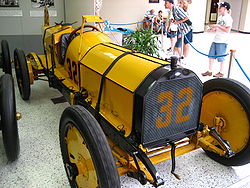
which would go on to dominate the first half of the race. Nearing the halfway point, Ray Harroun
, an engineer for the Marmon-Nordyke company and defending AAA
national champion, and the only driver competing without a riding mechanic
due to his first-ever-recorded use of a cowl-mounted rear-view mirror
, passed Bruce-Brown for the lead in his self-designed, six-cylinder
"Marmon Wasp" (so named for its distinctively sharp-pointed, wasp-like tail).
Others falter during the marathon event; of the 14 cars to fall out, riding mechanic Sam Dickson
is the lone fatality, killed when driver Arthur Greiner
hits the wall in the second turn on lap 12.
Harroun, relieved by Cyrus Patschke for 35 laps (87.5 miles / 140.82 km), led 88 of the 200 laps, the most among the race's seven leaders, for a race-average a speed of 74.602 mph (120.060 km/h) in a total time of 6:42:08 for the 500-mile (804.67 km) distance to win.
During the midpoint of the second half the race, Harroun and Lozier
driver Ralph Mulford
had fought an intense duel, with Harroun holding a small advantage near the 340 mile (550 kilometer) mark, whereupon one of the Wasp's tires 'let go'. Harroun's forced stop allowed Mulford to move to the front, before Mulford also pitted for new rubber. After Mulford came back onto the track, Harroun was scored in the lead with a 1 minute 48 second advantage. It is on this statistic controversy hinges.
Upon Harroun's declared victory, second-place finisher Mulford protested, contending he had lapped Harroun when the Marmon limped in on the torn tire, an argument appearing plausible to some, due to an accident disrupting the official timing and scoring stand at nearly the same time. However, race officials were quick to note Mulford's subsequent pit stop forced the Lozier crew to spend several minutes themselves changing a tire which stuck to the wheel hub; Mulford's protest was thus denied.
After the race, and collection of $10,000 for first place, Harroun returned to the position he had taken at the end of the 1910 racing season: retirement. He would never race again.
2006 Indianapolis 500 Official Program
Summary of race at www.champcarstars.com
Indianapolis Motor Speedway
The Indianapolis Motor Speedway, located in Speedway, Indiana in the United States, is the home of the Indianapolis 500-Mile Race and the Brickyard 400....
on Tuesday, May 30, 1911. A departure from previous Speedway policy of holding numerous smaller racing meets during 1909 and 1910 racing seasons, the singular, large-scale event attracted widespread attention from both American and European racing teams and manufacturers, and, despite controversy surrounding its conclusion, proved far and away a successful event, immediately establishing itself both as the premier motorsports competition in the nation, and one of the most prestigious in the world.
"Too much racing"
The 1910 racing season at Indianapolis Motor Speedway began well, with 60,000 spectators for the 200 mi (321.9 km) Wheeler-Schebler Trophy on Memorial DayMemorial Day
Memorial Day is a United States federal holiday observed on the last Monday of May. Formerly known as Decoration Day, it originated after the American Civil War to commemorate the fallen Union soldiers of the Civil War...
, won by Ray Harroun
Ray Harroun
Ray Harroun was an American racecar driver, born in Spartansburg, Pennsylvania.-Early driving:As noted in the Columbia Car webpages, Harroun participated in the original setting of the record from Chicago to New York in 1903, and the re-taking of that record in 1904...
The crowds grew progressively smaller for the rest of the season, however. After seeing a second decline in attendance in as many days for Labor Day
Labor Day
Labor Day is a United States federal holiday observed on the first Monday in September that celebrates the economic and social contributions of workers.-History:...
, September 5, the final day of the concluding meet, Speedway co-founders Carl Fisher
Carl G. Fisher
Carl Graham Fisher was an American entrepreneur. Despite having severe astigmatism, he became a seemingly tireless pioneer and promoter of the automotive, auto racing, and real estate development industries...
, James Allison
James A. Allison
James Ashbury Allison , born in Marcellus, Michigan, was an American entrepreneur and businessman. He was the inventor of the Allison Perfection Fountain Pen and with Carl G. Fisher a founder of Prest-O-Lite, a manufacturer of automobile headlights. With Carl G. Fisher, Frank H. Wheeler, and Arthur C...
, Arthur Newby and Frank Wheeler conferred to decide on a new course for the following year.
While the appearance on Monday of some 18,000 was reasonable enough in some respects, given both the rain showers occurring early that morning and the large parade held downtown in the afternoon, neither the two days of the Labor Day meet nor the July 4 weekend races had come near to equalling the Memorial Day turnout. While potential explanations for the decline included the summer's extreme heat and the women of the city making holiday plans for their families that did not include auto racing, one of the most likely, they reasoned, was an overabundance of the very events they exhibited: too many races had diluted turnout to including only those most interested in the sport.
Timing and farming
By the next day, Tuesday September 6, local newspapers had already heard rumors of the decision, and reported the four partners chose to concentrate on a single race. They considered a 24-hour contest, in the fashion of Le Mans24 Hours of Le Mans
The 24 Hours of Le Mans is the world's oldest sports car race in endurance racing, held annually since near the town of Le Mans, France. Commonly known as the Grand Prix of Endurance and Efficiency, race teams have to balance speed against the cars' ability to run for 24 hours without sustaining...
, or a 1000 mi (1,609.3 km) endurance event, with a spectacular $US25,000 (Fr
French franc
The franc was a currency of France. Along with the Spanish peseta, it was also a de facto currency used in Andorra . Between 1360 and 1641, it was the name of coins worth 1 livre tournois and it remained in common parlance as a term for this amount of money...
1.25 million, about ₤
Pound sterling
The pound sterling , commonly called the pound, is the official currency of the United Kingdom, its Crown Dependencies and the British Overseas Territories of South Georgia and the South Sandwich Islands, British Antarctic Territory and Tristan da Cunha. It is subdivided into 100 pence...
5250) purse
Prize money
Prize money has a distinct meaning in warfare, especially naval warfare, where it was a monetary reward paid out to the crew of a ship for capturing an enemy vessel...
, more than high enough to attract global as well as local and regional competition contest for 1911. The endurance event was favored by several manufacturers, but debate soon proceeded as to what would be most beneficial to spectators as well as participants; while 24-hour event would be possible on a technical level despite its extreme nature, all agreed potential ticket-buyers would inevitably depart the grounds well before its conclusion. Deciding on a "race window" extending from 10:00 A.M. to late afternoon, local time, early estimates placed the planned race distance at 300 to 300 to 500 mi (482.8 to 804.7 km); the winner of the event, with purse estimates ranging toward $30,000, could expect to see as much as $12,000.
In choices for a specific date for the race, Memorial Day, already the occasion of the largest attendance, was always foremost. As suggested to the Speedway owners by Lem Trotter, the date coincided with the completion of a late-spring agricultural practice known as "haying," after which the farmers acquired an effective two-week break. While the intention, Trotter argued, would certainly be to draw from far more than just the local farming community, simple business sense called for as little interference as possible with the regional economy. That such an opportunity to avoid a potential conflict of interest fell on a major national holiday sealed the decision: within two days, formal announcement was made of a 500 miles (804.7 km), marathon-distance motor race, to be held at the Indianapolis Motor Speedway, May 30, 1911.
Superlatives, preparation
As desired and expected, news of the inauguration of a contest of such distance evoked strong enthusiasm both within and without the motorsport community. Newspaper and trade magazine articles used ever-new superlatives for the challenges expected to soon face both drivers and engineers, and continuing discussion throughout the spring and winter kept the race as the primary conversation piece of the average citizen. Everyone, it seemed, had something to say about it.Due to the publicity thus created, Speedway management, which had for the previous two seasons of meets charged the effectively nominal entry fee of one dollar per mile of scheduled race distances, took measure to ensure that the conceivably large entry list did not include any but the most serious participants: at an accordingly heightened fee of $500 per car, participation became a nominally risky proposition to teams and manufacturers, since, although the high finishers were due to receive record purse money and accessory prizes, no money at all was offered to finishers below tenth place. Interest, however, was far from dampened, with entry blanks distributed over the course of the following month quickly returning filled, the first of which being an automobile built by the J. I. Case Threshing Machine Company
Case Corporation
Case Corporation was a manufacturer of construction and agricultural equipment. In 1999 it merged with New Holland to form CNH Global, a Fiat Group division...
of Racine, Wisconsin
Racine, Wisconsin
Racine is a city in and the county seat of Racine County, Wisconsin, United States. According to 2008 U.S. Census Bureau estimates, the city had a population of 82,196...
, to be driven by Lewis Strang
Lewis Strang
Lewis Strang was an American racecar driver. Strang was pole sitter for the inaugural Indianapolis 500. He was killed in a testing accident, becoming the first Indy 500 veteran to die....
. By May 1, the final potential day for entry, an extensive total of some 46 cars had been nominated to compete.
May 1 also marked the beginning of an eventually decades-long tradition of the opening of the Speedway, on the first day of the month, to practice by any and all participants. A policy originally established so as to allow teams unfamiliar with the 2.5 miles (4 km), recently brick-paved high-speed course as much time to acclimate as necessary, it ultimately proved most advantageous to the locally-based teams, given many of the entries from abroad not even setting out for the city until well into the month. One example of such, the double-entry Pope-Hartford team based in Springfield
Springfield, Massachusetts
Springfield is the most populous city in Western New England, and the seat of Hampden County, Massachusetts, United States. Springfield sits on the eastern bank of the Connecticut River near its confluence with three rivers; the western Westfield River, the eastern Chicopee River, and the eastern...
, Massachusetts
Massachusetts
The Commonwealth of Massachusetts is a state in the New England region of the northeastern United States of America. It is bordered by Rhode Island and Connecticut to the south, New York to the west, and Vermont and New Hampshire to the north; at its east lies the Atlantic Ocean. As of the 2010...
, came by way of the team's actual racing cars themselves simply being driven, while loaded up with toolboxes and as many spare parts
Interchangeable parts
Interchangeable parts are parts that are, for practical purposes, identical. They are made to specifications that ensure that they are so nearly identical that they will fit into any device of the same type. One such part can freely replace another, without any custom fitting...
as they could hold, cross-country, making overnight stops in New York City
New York City
New York is the most populous city in the United States and the center of the New York Metropolitan Area, one of the most populous metropolitan areas in the world. New York exerts a significant impact upon global commerce, finance, media, art, fashion, research, technology, education, and...
, Buffalo
Buffalo, New York
Buffalo is the second most populous city in the state of New York, after New York City. Located in Western New York on the eastern shores of Lake Erie and at the head of the Niagara River across from Fort Erie, Ontario, Buffalo is the seat of Erie County and the principal city of the...
, Cleveland
Cleveland, Ohio
Cleveland is a city in the U.S. state of Ohio and is the county seat of Cuyahoga County, the most populous county in the state. The city is located in northeastern Ohio on the southern shore of Lake Erie, approximately west of the Pennsylvania border...
and Columbus, Ohio
Columbus, Ohio
Columbus is the capital of and the largest city in the U.S. state of Ohio. The broader metropolitan area encompasses several counties and is the third largest in Ohio behind those of Cleveland and Cincinnati. Columbus is the third largest city in the American Midwest, and the fifteenth largest city...
, before finally arriving, where they were duly met at the city's East Washington Street
Washington Street (Indianapolis)
Washington Street is the primary east-west street in Indianapolis, Indiana, United States. The street follows the route of the National Road for almost all of its length in the city of Indianapolis. For a time, its entire length was designated as U.S...
by Frank Fox
Frank Fox
Frank Fox was an American racecar driver. After his driving career ended he turned to horse racing. The harness race is named after him. He is buried at Crown Hill Cemetery in Indianapolis.-Indy 500 results:-External links:...
, who was not only the slated driver of one of the two cars but also the company's local agent.
The 500-mile race
United States dollar
The United States dollar , also referred to as the American dollar, is the official currency of the United States of America. It is divided into 100 smaller units called cents or pennies....
27,550, drew 46 entries from the United States
United States
The United States of America is a federal constitutional republic comprising fifty states and a federal district...
and Europe
Europe
Europe is, by convention, one of the world's seven continents. Comprising the westernmost peninsula of Eurasia, Europe is generally 'divided' from Asia to its east by the watershed divides of the Ural and Caucasus Mountains, the Ural River, the Caspian and Black Seas, and the waterways connecting...
, from which 40 qualified by sustaining 75 mph (120.7 km/h) along the quarter mile-long main straight. Grid positions were determined by date of filing of official entry forms, rather than speed, a difference from the contemporary European practice of lottery. Entries were prescribed by rules to have a minimum weight of 2,300 lb (1,043 kg) and a maximum engine size of 600 cubic inches (9.83 litres) displacement
Engine displacement
Engine displacement is the volume swept by all the pistons inside the cylinders of an internal combustion engine in a single movement from top dead centre to bottom dead centre . It is commonly specified in cubic centimeters , litres , or cubic inches...
.
The cars lined up five to a row, excepting the first and last. Row One, from what is now called the pole position
Pole position
The term "pole position", as used in motorsports, comes from the horse racing term where the number one starter starts on the inside next to the inside pole. The term made its way, along with several other customs, to auto racing. In circuit motorsports, a driver has pole position when he or she...
, was led by co-founder and president of the Speedway Carl G. Fisher in a Stoddard-Dayton
Stoddard-Dayton
Stoddard-Dayton was a high quality car manufactured by Dayton Motor Car Company in Dayton, Ohio, USA, between 1905 and 1913. John W. Stoddard and his son Charles G...
pace car. Row Nine had just single car to make up for the shifted positioning that resulted. Fisher's use of the Stoddard-Dayton is believed to constitute the first use of such a vehicle, for the first known mass rolling start of an automobile race.
Amid roiling smoke, the roar of the 40 machines' engines, and the waving of a red flag which signalled 'clear course ahead', American Johnny Aitken
Johnny Aitken
Johnny Aitken was a racecar driver from Indianapolis, who was active in the years prior to World War I.Aitken competed in the Indianapolis 500 three times. He started the race twice, in 1911 and 1916. He led the first lap of the first race . Aitken captured the pole position in 1916, but ended...
, in a National, took the lead from the fourth starting spot on the extreme outside of the first row, and held it until lap 5 when Spencer Wishart
Spencer Wishart
Spencer Wishart was an American racecar driver. He was active during the early years of the Indianapolis 500. Wishart was killed when he clipped another car during an AAA national championship race and crashed into a tree.-Indy 500 results:...
took over in a Mercedes
Mercedes (car)
Mercedes was a brand of the Daimler-Motoren-Gesellschaft . DMG which began to develop in 1900, after the death of its co-founder, Gottlieb Daimler...
, himself soon overtaken by David L. Bruce-Brown
David L. Bruce-Brown
David Loney Bruce-Brown was an American racecar driver. Having bluffed his way into auto racing at the age of 18, he turned out to be a natural talent behind the wheel and won the 1908 Daytona Speed Trials. He then went on to win the American Grand Prize in both 1910 and 1911 as well as numerous...
's Fiat
Fiat
FIAT, an acronym for Fabbrica Italiana Automobili Torino , is an Italian automobile manufacturer, engine manufacturer, financial, and industrial group based in Turin in the Italian region of Piedmont. Fiat was founded in 1899 by a group of investors including Giovanni Agnelli...
which would go on to dominate the first half of the race. Nearing the halfway point, Ray Harroun
Ray Harroun
Ray Harroun was an American racecar driver, born in Spartansburg, Pennsylvania.-Early driving:As noted in the Columbia Car webpages, Harroun participated in the original setting of the record from Chicago to New York in 1903, and the re-taking of that record in 1904...
, an engineer for the Marmon-Nordyke company and defending AAA
American Automobile Association
AAA , formerly known as the American Automobile Association, is a federation of 51 independently operated motor clubs throughout North America. AAA is a not-for-profit member service organization with more than 51 million members. AAA provides services to its members such as travel, automotive,...
national champion, and the only driver competing without a riding mechanic
Riding mechanic
A riding mechanic was a mechanic that rode along with a race car during the race who was tasked with maintaining, monitoring, and repairing the car during the race. They communicated with the pits and spotted from inside the car. Riding mechanics were used by most cars in the Indianapolis 500 from...
due to his first-ever-recorded use of a cowl-mounted rear-view mirror
Rear-view mirror
A rear-view mirror is a mirror in automobiles and other vehicles, designed to allow the driver to see rearward through the vehicle's backlight ....
, passed Bruce-Brown for the lead in his self-designed, six-cylinder
Cylinder (engine)
A cylinder is the central working part of a reciprocating engine or pump, the space in which a piston travels. Multiple cylinders are commonly arranged side by side in a bank, or engine block, which is typically cast from aluminum or cast iron before receiving precision machine work...
"Marmon Wasp" (so named for its distinctively sharp-pointed, wasp-like tail).
Others falter during the marathon event; of the 14 cars to fall out, riding mechanic Sam Dickson
Sam Dickson
Sam Dickson was a race car riding mechanic, and the first person to be killed in the Indianapolis 500. In the inaugural race, Dickson was the riding mechanic for Arthur Greiner who was making his only 500 appearance...
is the lone fatality, killed when driver Arthur Greiner
Arthur Greiner
Arthur Greiner was an American racecar driver, and historically the first to finish last in the Indianapolis 500. Greiner crashed on the backstretch after completing twelve laps in the inaugural race...
hits the wall in the second turn on lap 12.
Harroun, relieved by Cyrus Patschke for 35 laps (87.5 miles / 140.82 km), led 88 of the 200 laps, the most among the race's seven leaders, for a race-average a speed of 74.602 mph (120.060 km/h) in a total time of 6:42:08 for the 500-mile (804.67 km) distance to win.
During the midpoint of the second half the race, Harroun and Lozier
Lozier
The Lozier Motor Company was a brass era producer of automobiles in the United States of America. The company produced luxury automobiles from 1900 to 1915, with a factory at 3703 Mack Avenue, Detroit, Michigan....
driver Ralph Mulford
Ralph Mulford
Ralph Mulford was an American racecar driver active during the formative years of the auto racing....
had fought an intense duel, with Harroun holding a small advantage near the 340 mile (550 kilometer) mark, whereupon one of the Wasp's tires 'let go'. Harroun's forced stop allowed Mulford to move to the front, before Mulford also pitted for new rubber. After Mulford came back onto the track, Harroun was scored in the lead with a 1 minute 48 second advantage. It is on this statistic controversy hinges.
Upon Harroun's declared victory, second-place finisher Mulford protested, contending he had lapped Harroun when the Marmon limped in on the torn tire, an argument appearing plausible to some, due to an accident disrupting the official timing and scoring stand at nearly the same time. However, race officials were quick to note Mulford's subsequent pit stop forced the Lozier crew to spend several minutes themselves changing a tire which stuck to the wheel hub; Mulford's protest was thus denied.
After the race, and collection of $10,000 for first place, Harroun returned to the position he had taken at the end of the 1910 racing season: retirement. He would never race again.
Qualifications
| 1911 Indianapolis 500-Mile Race Qualification Results | |||||
| Starting grid determined by order of entry date. | |||||
| Entries required to maintain an excess of 75 mph (120.7 km/h) over a quarter-mile distance to qualify. | |||||
| No qualification times or speeds recorded, only success or failure to qualify. | |||||
| Row | Far Inside | Inside Center | Center | Outside Center | Far Outside |
| 1 | Pace Car Position |  Lewis Strang Lewis StrangLewis Strang Lewis Strang was an American racecar driver. Strang was pole sitter for the inaugural Indianapolis 500. He was killed in a testing accident, becoming the first Indy 500 veteran to die.... |
 †1 Ralph DePalma †1 Ralph DePalmaRalph DePalma Ralph De Palma was an Italian-American racecar driving champion, most notably winner of the 1915 Indianapolis 500. His entry at the International Motorsports Hall of Fame estimates that he won about 2000 races... |
Harry Endicott Harry Endicott Harry Endicott was an American racecar driver. He was the brother of fellow "500" participant Bill Endicott. Endicott was killed in a dirt oval practice crash.-Indy 500 results:... |
Johnny Aitken Johnny Aitken Johnny Aitken was a racecar driver from Indianapolis, who was active in the years prior to World War I.Aitken competed in the Indianapolis 500 three times. He started the race twice, in 1911 and 1916. He led the first lap of the first race . Aitken captured the pole position in 1916, but ended... |
| 2 | Louis Disbrow Louis Disbrow Louis Disbrow was an American racecar driver.-Life:Louis Disbrow was born on March 24, 1888 in Indianapolis, Indiana.He died on July 9, 1939 in his home in Philadelphia, Pennsylvania.-Indy 500 results:-References:... |
Frank Fox Frank Fox Frank Fox was an American racecar driver. After his driving career ended he turned to horse racing. The harness race is named after him. He is buried at Crown Hill Cemetery in Indianapolis.-Indy 500 results:-External links:... |
Harry Knight Harry Knight Harry Knight was an American racecar driver. He drove in the first two Indianapolis 500 races as well as two "pre-500 era" races at the Indianapolis Motor Speedway in 1910, finishing second in a 100 mile race... |
†2 Joe Jagersberger Joe Jagersberger Joe Jagersberger was an Austrian-American racecar driver.-Background:... |
Will Jones Will Jones (racing driver) Will Jones was an American racecar driver who drove in the Indianapolis 500.-Indy 500 results:... |
| 3 |  Gil Andersen Gil AndersenGil Andersen Gil Andersen was an Norwegian-American racecar driver active during the formative years of auto racing.... |
Spencer Wishart Spencer Wishart Spencer Wishart was an American racecar driver. He was active during the early years of the Indianapolis 500. Wishart was killed when he clipped another car during an AAA national championship race and crashed into a tree.-Indy 500 results:... |
W. H. Turner W. H. Turner W. H. "Wild Bill" Turner was an American racecar driver.-Indy 500 results:... |
Fred Belcher Fred Belcher Fred Belcher was an American racecar driver who competed in the Indianapolis 500.-Indy 500 results:... |
 †3 Arthur Chevrolet †3 Arthur ChevroletArthur Chevrolet Arthur Chevrolet, was a Swiss American racecar driver and automobile manufacturer.Born in La Chaux-de-Fonds, Neuchatel, Switzerland, Arthur was the middle brother of Louis and Gaston Chevrolet... |
| 4 |  †4 Charles Basle †4 Charles BasleCharles Basle Charles Lucien Basle was a French racecar driver.-Indy 500 results:... |
Eddie Hearne Eddie Hearne Eddie Hearne Eddie Hearne Eddie Hearne (March 1, 1887 - February 9, 1955 was an American racecar driver from Kansas City, Kansas who was active in the formative years of auto racing. He participated in the inaugural Indianapolis 500. He later was a long-time Duesenberg factory-backed driver... |
Harry Grant |
Charlie Merz Charlie Merz Charlie Merz was an American racecar driver. Active in the early years of the Indianapolis 500, he later became Chief Steward of the Memorial Day Classic.-Early years:... |
Howdy Wilcox Howdy Wilcox Howard Samuel Wilcox was an American racecar driver active in formative years of auto racing.Born in Crawfordsville, Indiana, Howdy Wilcox led the last 98 laps of the 1919 Indianapolis 500 after starting in the 2nd position. He died in a wreck in 1923 at the Altoona Speedway board track in Tyrone,... |
| 5 | Mel Marquette Mel Marquette Melvon Marquette was an American racecar driver. He was also an early aviator.-Indy 500 results:... |
Fred Ellis Fred Ellis (racing driver) Fred Ellis was an American racecar driver.-Indy 500 results:... |
Harry Cobe Harry Cobe Harry Cobe was an American racecar driver.-Indy 500 results:... |
Jack Tower Jack Tower Jack Tower was an American racecar driver. He lived in Flint, Michigan.-Indy 500 results:-External links:* at ChampCarStats.com... |
Ernest Delaney Ernest Delaney Ernest Delaney was an American racecar driver.-Indy 500 results:... |
| 6 | David L. Bruce-Brown David L. Bruce-Brown David Loney Bruce-Brown was an American racecar driver. Having bluffed his way into auto racing at the age of 18, he turned out to be a natural talent behind the wheel and won the 1908 Daytona Speed Trials. He then went on to win the American Grand Prize in both 1910 and 1911 as well as numerous... |
Lee Frayer Lee Frayer Lee Frayer was an American racecar driver who competed in the Indianapolis 500. Driving a Firestone-Columbus automobile, Frayer won a 100-mile race in Columbus, Ohio, defeating, among others, the great Barney Oldfield.-Indy 500 results:... |
Joe Dawson Joe Dawson (racecar driver) Joe Dawson was an American race car driver.-Biography:Born in Odon, Indiana, Dawson competed in the Indianapolis 500 race three times, beginning in 1911 when he drove a Marmon to a fifth place finish. The following year, Dawson won after Ralph DePalma, who had led for 196 laps of the 200 lap race,... |
Ray Harroun Ray Harroun Ray Harroun was an American racecar driver, born in Spartansburg, Pennsylvania.-Early driving:As noted in the Columbia Car webpages, Harroun participated in the original setting of the record from Chicago to New York in 1903, and the re-taking of that record in 1904... |
Ralph Mulford Ralph Mulford Ralph Mulford was an American racecar driver active during the formative years of the auto racing.... |
| 7 | Teddy Tetzlaff Teddy Tetzlaff Teddy Tetzlaff was an American racecar driver active in the formative years of auto racing. He competed in the first four Indianapolis 500s, with a highest finish of second in 1912. He earned the nickname "Terrible" Teddy Tetzlaff due to his rough treatment of his vehicles... |
Herbert Lytle Herbert Lytle Herbert Lytle was an American racecar driver. He was injured in a crash when he struck a tree on the road approaching West Mattituck.-Indy 500 results:-References:... |
Hughie Hughes Hughie Hughes Hughie Hughes was an American racecar driver. He was killed in a board track crash.-Indy 500 results:... |
Charles Bigelow Charles Bigelow (racing driver) Charles Bigelow was an American racecar driver. He is no relation to fellow Indy 500 driver Tom Bigelow.-Indy 500 results:-External links:... |
Ralph Beardsley Ralph Beardsley Ralph Edward Beardsley was an American racecar driver.-Indy 500 results:-External links:*... |
| 8 | Caleb Bragg Caleb Bragg Caleb Smith Bragg was an American racecar driver, speedboat racer, aviation pioneer, and automotive inventor. He participated in the 1911, 1913 and 1914 Indianapolis 500. In speedboat racing, Caleb won three consecutive APBA Challenge Cup races in Detroit from 1923-1925... |
Howard Hall Howard Hall (racing driver) Howard Hall was an American early-era racecar driver. Hall competed in the inaugural 1911 Indianapolis 500 in a Velie. Earlier, in 1909, Hall competed in the Portola Festival Race in San Francisco. Hall also served as a riding mechanic, serving with Bob Burman in the 1910 American Grand Prize... |
Bill Endicott Bill Endicott Bill Endicott was an American racecar driver. He was the brother of fellow racer Harry Endicott.-Indy 500 results:... |
Arthur Greiner Arthur Greiner Arthur Greiner was an American racecar driver, and historically the first to finish last in the Indianapolis 500. Greiner crashed on the backstretch after completing twelve laps in the inaugural race... |
Bob Burman Bob Burman Bob Burman was an American racecar driver active in the formative years of auto racing.-Biography:He was born on April 23, 1884 in Imlay City, Michigan. He was the winner of the Prest-O-Lite Trophy Race in 1909. He competed at the inaugural Indianapolis 500 in 1911... |
| 9 | Billy Knipper Billy Knipper William P. Knipper was an American racecar driver.A hillclimb was held at Dugdale Hill, Rochester, New York, on October 13, 1906. The free-for-all class was won by Billy Knipper in a time of 51.8 sec. -Indy 500 results:- References :... |
||||
| DNQ | Louis Edmunds |
Rupert Jeffkins |
|||
The Race
| 1911 Indianapolis 500-Mile Race | |||||||||||||||||||
| Race finishing times recorded down to second intervals. | |||||||||||||||||||
| All entries still running at conclusion scored ahead of non-finishing entries, regardless of race completion percentage. | |||||||||||||||||||
| Position colors reflect the wikistandard for American American Championship Car Racing Since 1916 there has been a recognized United States national automobile racing National Championship for drivers of professional-level, single-seat open wheel race cars. The championship has been under the auspices of several different sanctioning bodies since 1909. Since 1911, the Indianapolis... formula motorsports Formula racing Formula racing is a term that refers to various forms of open wheeled single seater motorsport. Its origin lies in the nomenclature that was adopted by the FIA for all of its post-World War II single seater regulations, or formulae. The best known of these formulæ are Formula One, Formula Two, and... finishing positions. |
|||||||||||||||||||
| Pos | No | Driver | (Relief Driver) | Car | Entrant | Chassis | Engine | Cyl Cylinder (engine) A cylinder is the central working part of a reciprocating engine or pump, the space in which a piston travels. Multiple cylinders are commonly arranged side by side in a bank, or engine block, which is typically cast from aluminum or cast iron before receiving precision machine work... |
Displ Engine displacement Engine displacement is the volume swept by all the pistons inside the cylinders of an internal combustion engine in a single movement from top dead centre to bottom dead centre . It is commonly specified in cubic centimeters , litres , or cubic inches... (in³) (L) |
Color | Qual Speed | Rank | Start Pos |
Laps Led* |
Laps Run |
Time | Speed (mph) (km/h) |
Status | Prize Money ($ United States dollar The United States dollar , also referred to as the American dollar, is the official currency of the United States of America. It is divided into 100 smaller units called cents or pennies.... ) |
|---|---|---|---|---|---|---|---|---|---|---|---|---|---|---|---|---|---|---|---|
| 1 | 32 | Ray Harroun Ray Harroun Ray Harroun was an American racecar driver, born in Spartansburg, Pennsylvania.-Early driving:As noted in the Columbia Car webpages, Harroun participated in the original setting of the record from Chicago to New York in 1903, and the re-taking of that record in 1904... ** |
Cyrus Patschke |
Marmon Marmon Marmon Motor Car Company was an automobile manufacturer founded by Howard Marmon and owned by Nordyke Marmon & Company of Indianapolis, Indiana, USA. It was established in 1902 and was merged and renamed in 1933. They produced cars under the Marmon brand. It was succeeded by Marmon-Herrington and... "Wasp" |
Nordyke & Marmon Company Marmon Marmon Motor Car Company was an automobile manufacturer founded by Howard Marmon and owned by Nordyke Marmon & Company of Indianapolis, Indiana, USA. It was established in 1902 and was merged and renamed in 1933. They produced cars under the Marmon brand. It was succeeded by Marmon-Herrington and... |
Marmon | Marmon | 6 | 477 7.82 |
yellow / black | no full lap | 28 | 88 | 200 | 6:42:08 | 74.602 120.060 |
finished | 14,250 | |
| 2 | 33 | Ralph Mulford Ralph Mulford Ralph Mulford was an American racecar driver active during the formative years of the auto racing.... |
Lozier Lozier The Lozier Motor Company was a brass era producer of automobiles in the United States of America. The company produced luxury automobiles from 1900 to 1915, with a factory at 3703 Mack Avenue, Detroit, Michigan.... |
Lozier Motor Company Lozier The Lozier Motor Company was a brass era producer of automobiles in the United States of America. The company produced luxury automobiles from 1900 to 1915, with a factory at 3703 Mack Avenue, Detroit, Michigan.... |
Lozier | Lozier | 4 | 544 8.91 |
White | no full lap | 29 | 10 | 200 | 6:43:51 +0:01:43 |
74.285 119.550 |
finished | 5,200 | ||
| 3 | 28 | David L. Bruce-Brown David L. Bruce-Brown David Loney Bruce-Brown was an American racecar driver. Having bluffed his way into auto racing at the age of 18, he turned out to be a natural talent behind the wheel and won the 1908 Daytona Speed Trials. He then went on to win the American Grand Prize in both 1910 and 1911 as well as numerous... |
Fiat Fiat FIAT, an acronym for Fabbrica Italiana Automobili Torino , is an Italian automobile manufacturer, engine manufacturer, financial, and industrial group based in Turin in the Italian region of Piedmont. Fiat was founded in 1899 by a group of investors including Giovanni Agnelli... |
E. E. Hewlett | Fiat | Fiat | 4 | 589 9.65 |
maroon / white | no full lap | 25 | 81 | 200 | 6:52:29 +0:10:21 |
72.730 117.048 |
finished | 3,250 | ||
| 4 | 11 | Spencer Wishart Spencer Wishart Spencer Wishart was an American racecar driver. He was active during the early years of the Indianapolis 500. Wishart was killed when he clipped another car during an AAA national championship race and crashed into a tree.-Indy 500 results:... |
Dave Murphy |
Mercedes Mercedes (car) Mercedes was a brand of the Daimler-Motoren-Gesellschaft . DMG which began to develop in 1900, after the death of its co-founder, Gottlieb Daimler... |
Spencer Wishart | Mercedes | Mercedes | 4 | 583 9.55 |
gray | no full lap | 11 | 5 | 200 | 6:52:57 +0:10:49 |
72.648 116.916 |
finished | 2,350 | |
| 5 | 31 | Joe Dawson Joe Dawson (racecar driver) Joe Dawson was an American race car driver.-Biography:Born in Odon, Indiana, Dawson competed in the Indianapolis 500 race three times, beginning in 1911 when he drove a Marmon to a fifth place finish. The following year, Dawson won after Ralph DePalma, who had led for 196 laps of the 200 lap race,... |
Cyrus Patschke |
Marmon | Nordyke & Marmon Company | Marmon | Marmon | 4 | 495 8.11 |
yellow / black | no full lap | 27 | 0 | 200 | 6:54:34 +0:12:26 |
72.365 116.460 |
finished | 1,500 | |
| 6 | 2 | †1 Ralph DePalma Ralph DePalma Ralph De Palma was an Italian-American racecar driving champion, most notably winner of the 1915 Indianapolis 500. His entry at the International Motorsports Hall of Fame estimates that he won about 2000 races... |
Simplex | Simplex Automobile Company | Simplex | Simplex | 4 | 597 9.78 |
red / white | no full lap | 2 | 4 | 200 | 7:02:02 +0:19:54 |
71.084 114.399 |
finished | 1,000 | ||
| 7 | 20 | Charlie Merz Charlie Merz Charlie Merz was an American racecar driver. Active in the early years of the Indianapolis 500, he later became Chief Steward of the Memorial Day Classic.-Early years:... |
Len Zengel Len Zengel Len Zengel was an American racecar driver.-Indy 500 results:... |
National | National Motor Vehicle Company | National | National | 4 | 447 7.33 |
blue / white | no full lap | 18 | 0 | 200 | 7:06:20 +0:24:12 |
70.367 113.245 |
finished | 800 | |
| 8 | 12 | W. H. Turner W. H. Turner W. H. "Wild Bill" Turner was an American racecar driver.-Indy 500 results:... |
Walter Jones |
Amplex | Simplex Automobile Company | Amplex | Amplex | 4 | 443 7.26 |
red | no full lap | 12 | 0 | 200 | 7:15:56 +0:33:48 |
68.818 110.752 |
finished | 700 | |
| 9 | 15 | Fred Belcher Fred Belcher Fred Belcher was an American racecar driver who competed in the Indianapolis 500.-Indy 500 results:... |
John Coffey |
Knox | Knox Automobile Company | Knox | Knox | 6 | 432 7.08 |
brown | no full lap | 13 | 4 | 200 | 7:17:09 +0:35:01 |
68.626 110.443 |
finished | 600 | |
| 10 | 25 | Harry Cobe Harry Cobe Harry Cobe was an American racecar driver.-Indy 500 results:... |
Louis Schwitzer |
Jackson | Jackson Automobile Company Jackson Automobile Company Jackson Automobile Company was a brass era auto manufacturer that produced the Jackson from 1903 to 1923, as well as the Jaxon steam car during 1903, and the Orlo only in 1904. All these cars were produced in Jackson, Michigan.-Company Background:... |
Jackson | Jackson | 4 | 559 9.16 |
maroon / white | no full lap | 22 | 0 | 200 | 7:21:50 +0:39:42 |
67.899 109.273 |
finished | 500 | |
| 11 | 10 | Gil Andersen Gil Andersen Gil Andersen was an Norwegian-American racecar driver active during the formative years of auto racing.... |
Stutz | Ideal Motor Car Company | Stutz | Wisconsin | 4 | 390 6.39 |
gray / white | no full lap | 10 | 0 | 200 | 7:22:55 +0:40:47 |
67.73 109.001 |
finished | 0 | ||
| 12 | 36 | Hughie Hughes Hughie Hughes Hughie Hughes was an American racecar driver. He was killed in a board track crash.-Indy 500 results:... |
Mercer | Mercer Motors Company | Mercer | Mercer | 4 | 300 4.92 |
yellow / blue | no full lap | 32 | 0 | 200 | 7:23:32 +0:41:24 |
67.63 108.840 |
finished | 0 | ||
| 13 | 30 | Lee Frayer Lee Frayer Lee Frayer was an American racecar driver who competed in the Indianapolis 500. Driving a Firestone-Columbus automobile, Frayer won a 100-mile race in Columbus, Ohio, defeating, among others, the great Barney Oldfield.-Indy 500 results:... |
Eddie Rickenbacker Eddie Rickenbacker Edward Vernon Rickenbacker was an American fighter ace in World War I and Medal of Honor recipient. He was also a race car driver and automotive designer, a government consultant in military matters and a pioneer in air transportation, particularly as the longtime head of Eastern Air Lines.-Early... |
Firestone-Columbus | Columbus Buggy Company | Firestone-Columbus | Firestone-Columbus | 4 | 432 7.08 |
scarlet / gray | no full lap | 26 | 0 | 197 | flagged | flagged, still running |
0 | ||
| 14 | 21 | Howdy Wilcox Howdy Wilcox Howard Samuel Wilcox was an American racecar driver active in formative years of auto racing.Born in Crawfordsville, Indiana, Howdy Wilcox led the last 98 laps of the 1919 Indianapolis 500 after starting in the 2nd position. He died in a wreck in 1923 at the Altoona Speedway board track in Tyrone,... |
National | National Motor Vehicle Company | National | National | 4 | 589 9.65 |
blue / white | no full lap | 19 | 0 | 194 | flagged | flagged, still running |
0 | |||
| 15 | 37 | Charles Bigelow Charles Bigelow (racing driver) Charles Bigelow was an American racecar driver. He is no relation to fellow Indy 500 driver Tom Bigelow.-Indy 500 results:-External links:... |
W. H. Frey E. H. Sherwood |
Mercer | Mercer Motors Company | Mercer | Mercer | 4 | 300 4.92 |
yellow / blue | no full lap | 33 | 0 | 194 | flagged | flagged, still running |
0 | ||
| 16 | 3 | Harry Endicott Harry Endicott Harry Endicott was an American racecar driver. He was the brother of fellow "500" participant Bill Endicott. Endicott was killed in a dirt oval practice crash.-Indy 500 results:... |
Inter-State | Inter-State Automobile Company | Inter-State | Inter-State | 4 | 390 6.39 |
gray / black | no full lap | 3 | 0 | 192 | flagged | flagged, still running |
0 | |||
| 17 | 41 | Howard Hall Howard Hall (racing driver) Howard Hall was an American early-era racecar driver. Hall competed in the inaugural 1911 Indianapolis 500 in a Velie. Earlier, in 1909, Hall competed in the Portola Festival Race in San Francisco. Hall also served as a riding mechanic, serving with Bob Burman in the 1910 American Grand Prize... |
Rupert Jeffkins |
Velie | Velie Motors Corporation | Velie | Velie | 4 | 334 5.47 |
gray | no full lap | 36 | 0 | 190 | flagged | flagged, still running |
0 | ||
| 18 | 46 | Billy Knipper Billy Knipper William P. Knipper was an American racecar driver.A hillclimb was held at Dugdale Hill, Rochester, New York, on October 13, 1906. The free-for-all class was won by Billy Knipper in a time of 51.8 sec. -Indy 500 results:- References :... |
Benz | E. A. Moross | Benz | Benz | 4 | 444 7.28 |
white | no full lap | 40 | 0 | 188 | flagged | flagged, still running |
0 | |||
| 19 | 45 | Bob Burman Bob Burman Bob Burman was an American racecar driver active in the formative years of auto racing.-Biography:He was born on April 23, 1884 in Imlay City, Michigan. He was the winner of the Prest-O-Lite Trophy Race in 1909. He competed at the inaugural Indianapolis 500 in 1911... |
Benz | E. A. Moross | Benz | Benz | 4 | 520 8.52 |
white | no full lap | 39 | 0 | 183 | flagged | flagged, still running |
0 | |||
| 20 | 38 | Ralph Beardsley Ralph Beardsley Ralph Edward Beardsley was an American racecar driver.-Indy 500 results:-External links:*... |
Frank Goode |
Simplex | Simplex Automobile Company | Simplex | Simplex | 4 | 597 9.78 |
red | no full lap | 34 | 0 | 178 | flagged | flagged, still running |
0 | ||
| 21 | 18 | Eddie Hearne Eddie Hearne Eddie Hearne Eddie Hearne Eddie Hearne (March 1, 1887 - February 9, 1955 was an American racecar driver from Kansas City, Kansas who was active in the formative years of auto racing. He participated in the inaugural Indianapolis 500. He later was a long-time Duesenberg factory-backed driver... |
Edward Parker |
Fiat | Edward A. Hearne | Fiat | Fiat | 4 | 487 7.98 |
red / white | no full lap | 16 | 0 | 175 | flagged | flagged, still running |
0 | ||
| 22 | 6 | Frank Fox Frank Fox Frank Fox was an American racecar driver. After his driving career ended he turned to horse racing. The harness race is named after him. He is buried at Crown Hill Cemetery in Indianapolis.-Indy 500 results:-External links:... |
Fred Clemons |
Pope-Hartford | Pope Manufacturing Company Pope Manufacturing Company Pope Manufacturing Company was founded by Albert Augustus Pope in Hartford, Connecticut. The company began with the introduction of the "Columbia High Wheeler" bicycle in 1878.-History:... |
Pope-Hartford | Pope-Hartford | 4 | 390 6.39 |
red / white | no full lap | 6 | 0 | 162 | flagged | flagged, still running |
0 | ||
| 23 | 27 | Ernest Delaney Ernest Delaney Ernest Delaney was an American racecar driver.-Indy 500 results:... |
Cutting Cutting (automobile) The Cutting was an automobile manufactured in Jackson, Michigan by the Clark-Carter Automobile Company from 1909-11, and the Cutting Motor Car Company from 1911-12. The Cutting was a powerful automobile using engines from Milwaukee, Model, and Wisconsin ranging from 30-60 hp. Cuttings have... |
Clark-Carter Automobile Company | Cutting | Cutting | 4 | 390 6.39 |
gray / black / white | no full lap | 24 | 0 | 160 | flagged | flagged, still running |
0 | |||
| 24 | 26 | Jack Tower Jack Tower Jack Tower was an American racecar driver. He lived in Flint, Michigan.-Indy 500 results:-External links:* at ChampCarStats.com... |
Robert Evans |
Jackson | Jackson Automobile Company Jackson Automobile Company Jackson Automobile Company was a brass era auto manufacturer that produced the Jackson from 1903 to 1923, as well as the Jaxon steam car during 1903, and the Orlo only in 1904. All these cars were produced in Jackson, Michigan.-Company Background:... |
Jackson | Jackson | 4 | 432 7.08 |
maroon / white | no full lap | 23 | 0 | 145 | flagged | flagged, still running |
0 | ||
| 25 | 23 | Bert Adams (started) Mel Marquette Mel Marquette Melvon Marquette was an American racecar driver. He was also an early aviator.-Indy 500 results:... (finished) |
McFarlan McFarlan Automobile McFarlan is an American automobile manufactured in Connersville, Indiana from 1909 to 1928 as an outgrowth of the McFarlan Carriage Company founded in 1856 by English-born John B. McFarlan .... |
Speed Motors Company | McFarlan | McFarlan | 6 | 377 6.18 |
lead / white | no full lap | 20 | 0 | 142 | flagged | flagged, still running |
0 | |||
| 26 | 42 | Bill Endicott Bill Endicott Bill Endicott was an American racecar driver. He was the brother of fellow racer Harry Endicott.-Indy 500 results:... |
Johnny Jenkins Johnny Jenkins (racing driver) Johnny Jenkins was an American racecar driver.-Indy 500 results:... |
Cole | Cole Motor Car Company Cole Motor Car Company The Cole Motor Car Company was an early automobile maker based in Indianapolis, Indiana. Cole automobiles were built from 1908 until 1925. They were quality-built luxury cars. The make is a pioneer of the V-8 engine.- Early years :... |
Cole | Cole | 4 | 471 7.72 |
green | no full lap | 37 | 0 | 104 | flagged | flagged, still running |
0 | ||
| 27 | 4 | Johnny Aitken Johnny Aitken Johnny Aitken was a racecar driver from Indianapolis, who was active in the years prior to World War I.Aitken competed in the Indianapolis 500 three times. He started the race twice, in 1911 and 1916. He led the first lap of the first race . Aitken captured the pole position in 1916, but ended... |
National | National Motor Vehicle Company | National | National | 4 | 589 9.65 |
blue / white | no full lap | 4 | 8 | 125 | did not finish | connecting rod | 0 | |||
| 28 | 9 | Will Jones Will Jones (racing driver) Will Jones was an American racecar driver who drove in the Indianapolis 500.-Indy 500 results:... |
Case | Case Corporation Case Corporation Case Corporation was a manufacturer of construction and agricultural equipment. In 1999 it merged with New Holland to form CNH Global, a Fiat Group division... |
Case | Wisconsin | 4 | 284 4.65 |
red / gray | no full lap | 9 | 0 | 122 | did not finish | steering | 0 | |||
| 29 | 1 | Lewis Strang Lewis Strang Lewis Strang was an American racecar driver. Strang was pole sitter for the inaugural Indianapolis 500. He was killed in a testing accident, becoming the first Indy 500 veteran to die.... |
Elmer Ray Elmer Ray Elmer "Kid Violent" Ray was an American heavyweight boxer who fought from 1926 to 1949. Ray was known as a hard puncher and had a career record of 86 -13-1.... |
Case | Case Corporation | Case | Wisconsin | 4 | 284 4.65 |
red / gray | no full lap | 1 | 0 | 109 | did not finish | steering | 0 | ||
| 30 | 7 | Harry Knight Harry Knight Harry Knight was an American racecar driver. He drove in the first two Indianapolis 500 races as well as two "pre-500 era" races at the Indianapolis Motor Speedway in 1910, finishing second in a 100 mile race... |
Westcott | Westcott Motor Car Company Westcott automobile The Westcott was an automobile produced in Richmond, Indiana and Springfield, Ohio in the United States between 1912 and 1925. The car company was named for its founder, Burton J. Westcott.... |
Westcott | Westcott | 6 | 421 6.90 |
gray | no full lap | 7 | 0 | 90 | did not finish | accident, front-straight |
0 | |||
| 31 | 8 | †2 Joe Jagersberger Joe Jagersberger Joe Jagersberger was an Austrian-American racecar driver.-Background:... |
Case | Case Corporation | Case | Wisconsin | 4 | 284 4.65 |
red / gray | no full lap | 8 | 0 | 87 | did not finish | accident, front-straight |
0 | |||
| 32 | 35 | Herbert Lytle Herbert Lytle Herbert Lytle was an American racecar driver. He was injured in a crash when he struck a tree on the road approaching West Mattituck.-Indy 500 results:-References:... |
Apperson Apperson The Apperson was a brand of American automobile manufactured from 1901 to 1926 in Kokomo, Indiana.-Company history:The company was founded by the brothers Edgar and Elmer Apperson shortly after they left Haynes-Apperson; for a time they continued to use a FR layoutont-mounted flat-twin engine,... |
Apperson Apperson The Apperson was a brand of American automobile manufactured from 1901 to 1926 in Kokomo, Indiana.-Company history:The company was founded by the brothers Edgar and Elmer Apperson shortly after they left Haynes-Apperson; for a time they continued to use a FR layoutont-mounted flat-twin engine,... Brothers Automotive Company |
Apperson | Apperson | 4 | 546 8.95 |
vermillion / white | no full lap | 31 | 0 | 82 | did not finish | accident, pits |
0 | |||
| 33 | 19 | Harry Grant Harry Grant Harry Grant was an American auto racing driver. Born in Cambridge, Massachusetts, driving an ALCO, Grant won the 1909 and 1910 Vanderbilt Cup on Long Island. He then competed in the Indianapolis 500 four times between 1911 and 1915. He had his best showing in 1915, finishing in 5th place... |
Alco | American Locomotive Company American Locomotive Company The American Locomotive Company, often shortened to ALCO or Alco , was a builder of railroad locomotives in the United States.-Early history:... |
Alco | Alco | 6 | 580 9.50 |
black | no full lap | 17 | 0 | 51 | did not finish | bearings | 0 | |||
| 34 | 17 | †4 Charles Basle Charles Basle Charles Lucien Basle was a French racecar driver.-Indy 500 results:... |
Buick | Buick Motor Company | Buick | Buick | 4 | 594 9.73 |
white / red | no full lap | 15 | 0 | 46 | did not finish | mechanical | 0 | |||
| 35 | 5 | Louis Disbrow Louis Disbrow Louis Disbrow was an American racecar driver.-Life:Louis Disbrow was born on March 24, 1888 in Indianapolis, Indiana.He died on July 9, 1939 in his home in Philadelphia, Pennsylvania.-Indy 500 results:-References:... |
Pope-Hartford | Pope Manufacturing Company | Pope-Hartford | Pope-Hartford | 4 | 390 6.39 |
red / black | no full lap | 5 | 0 | 45 | did not finish | accident, front-straight |
0 | |||
| 36 | 16 | †3 Arthur Chevrolet Arthur Chevrolet Arthur Chevrolet, was a Swiss American racecar driver and automobile manufacturer.Born in La Chaux-de-Fonds, Neuchatel, Switzerland, Arthur was the middle brother of Louis and Gaston Chevrolet... |
Buick | Buick Motor Company | Buick | Buick | 4 | 594 9.73 |
white / red | no full lap | 14 | 0 | 30 | did not finish | mechanical | 0 | |||
| 37 | 39 | Caleb Bragg Caleb Bragg Caleb Smith Bragg was an American racecar driver, speedboat racer, aviation pioneer, and automotive inventor. He participated in the 1911, 1913 and 1914 Indianapolis 500. In speedboat racing, Caleb won three consecutive APBA Challenge Cup races in Detroit from 1923-1925... |
Fiat | Caleb S. Bragg | Fiat | Fiat | 4 | 487 7.98 |
maroon | no full lap | 35 | 0 | 24 | did not finish | wrecked, pits |
0 | |||
| 38 | 24 | Fred Ellis Fred Ellis Fred C. Ellis was an American editorial cartoonist. He is best remembered as one of the leading radical artists of the 1920s and 1930s as an artist for various publications of the Communist Party, USA , including stints on the staff of the CPUSA's daily newspaper.-Early years:Fred Ellis was born... |
Jackson | Jackson Automobile Company | Jackson | Jackson | 4 | 355 5.82 |
maroon / white | no full lap | 21 | 0 | 22 | did not finish | fire damage, withdrawn |
0 | |||
| 39 | 34 | Teddy Tetzlaff Teddy Tetzlaff Teddy Tetzlaff was an American racecar driver active in the formative years of auto racing. He competed in the first four Indianapolis 500s, with a highest finish of second in 1912. He earned the nickname "Terrible" Teddy Tetzlaff due to his rough treatment of his vehicles... |
Lozier | Lozier Motor Company | Lozier | Lozier | 4 | 544 8.91 |
white / red | no full lap | 30 | 0 | 20 | did not finish | accident, front-straight |
0 | |||
| 40 | 44 | Arthur Greiner Arthur Greiner Arthur Greiner was an American racecar driver, and historically the first to finish last in the Indianapolis 500. Greiner crashed on the backstretch after completing twelve laps in the inaugural race... |
Amplex | Simplex Motor Car Company | Amplex | Amplex | 4 | 443 7.26 |
red / white | no full lap | 8 | 0 | 12 | did not finish | accident, second turn |
0 | |||
Footnotes
2006 Indianapolis 500 Official Program
Summary of race at www.champcarstars.com