

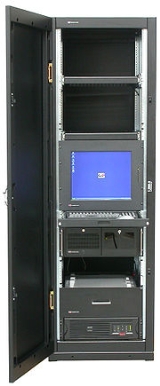
19-inch rack

Encyclopedia
Overview and history
Equipment designed to be placed in a rack is typically described as rack-mount, rack-mount instrument, a rack mounted system, a rack mount chassis, subrack, rack mountable, or occasionally simply shelf. The height of the electronic modules is also standardized as multiples of 1.75 inches (44.5 mm) or one rack unitRack unit
A rack unit or U is a unit of measure used to describe the height of equipment intended for mounting in a 19-inch rack or a 23-inch rack...
or U (less commonly RU). The industry standard rack cabinet is 42U tall.
Because of their origin as mounting systems for railroad signaling relay
Relay
A relay is an electrically operated switch. Many relays use an electromagnet to operate a switching mechanism mechanically, but other operating principles are also used. Relays are used where it is necessary to control a circuit by a low-power signal , or where several circuits must be controlled...
s, they are still sometimes called relay racks, but the 19-inch rack format has remained a constant while the technology that is mounted within it has changed to completely different fields. The 19 inches (482.6 mm) standard rack arrangement is widely used throughout the telecommunication
Telecommunication
Telecommunication is the transmission of information over significant distances to communicate. In earlier times, telecommunications involved the use of visual signals, such as beacons, smoke signals, semaphore telegraphs, signal flags, and optical heliographs, or audio messages via coded...
, computing
Computer
A computer is a programmable machine designed to sequentially and automatically carry out a sequence of arithmetic or logical operations. The particular sequence of operations can be changed readily, allowing the computer to solve more than one kind of problem...
, audio
Sound recording and reproduction
Sound recording and reproduction is an electrical or mechanical inscription and re-creation of sound waves, such as spoken voice, singing, instrumental music, or sound effects. The two main classes of sound recording technology are analog recording and digital recording...
, entertainment
Entertainment
Entertainment consists of any activity which provides a diversion or permits people to amuse themselves in their leisure time. Entertainment is generally passive, such as watching opera or a movie. Active forms of amusement, such as sports, are more often considered to be recreation...
and other industries, though the Western Electric
Western Electric
Western Electric Company was an American electrical engineering company, the manufacturing arm of AT&T from 1881 to 1995. It was the scene of a number of technological innovations and also some seminal developments in industrial management...
23-inch standard
23-inch rack
A 23-inch rack is used for housing telephone , computer, audio and other equipment though is less common than the 19-inch rack. The size notes the width of the faceplate for the installed equipment...
, with holes on 1 inches (25.4 mm) centers, prevails in telecommunications.
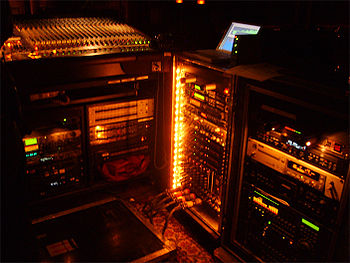
19-inch racks are often used to house professional audio and video equipment, including amplifier
Amplifier
Generally, an amplifier or simply amp, is a device for increasing the power of a signal.In popular use, the term usually describes an electronic amplifier, in which the input "signal" is usually a voltage or a current. In audio applications, amplifiers drive the loudspeakers used in PA systems to...
s, effects unit
Effects unit
Effects units are electronic devices that alter how a musical instrument or other audio source sounds. Some effects subtly "color" a sound, while others transform it dramatically. Effects are used during live performances or in the studio, typically with electric guitar, keyboard and bass...
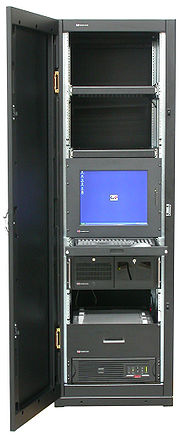
s, interfaces, headphone amplifiers, and even small scale audio mixers. They are also widely used for computer server equipment, allowing for dense hardware configurations without occupying excessive floorspace or requiring shelving. A third common use for rack-mounted equipment is industrial power, control, and automation hardware.
Typically, a piece of equipment being installed has a front panel height inch (0.031 inch (0.7874 mm)) less than the allotted number of Us. Thus, a 1U rackmount computer is not 1.75 inches (44.5 mm) tall but is 1.719 inches (43.7 mm) tall. 2U would be 3.469 inches (88.1 mm) instead of 3.5 inches (88.9 mm). This gap allows a bit of room above and below an installed piece of equipment so it may be removed without binding on the adjacent equipment.
In 1965, a durable fiber reinforced plastic 19-inch rackmount case was patented by ECS Composites and became widely used in military and commercial applications for electronic deployment and operation. State-of-the-art rackmount cases are now also constructed of thermo stamped composite, carbon fiber
Carbon fiber
Carbon fiber, alternatively graphite fiber, carbon graphite or CF, is a material consisting of fibers about 5–10 μm in diameter and composed mostly of carbon atoms. The carbon atoms are bonded together in crystals that are more or less aligned parallel to the long axis of the fiber...
and DuPont
DuPont
E. I. du Pont de Nemours and Company , commonly referred to as DuPont, is an American chemical company that was founded in July 1802 as a gunpowder mill by Eleuthère Irénée du Pont. DuPont was the world's third largest chemical company based on market capitalization and ninth based on revenue in 2009...
’s Kevlar
Kevlar
Kevlar is the registered trademark for a para-aramid synthetic fiber, related to other aramids such as Nomex and Technora. Developed at DuPont in 1965, this high strength material was first commercially used in the early 1970s as a replacement for steel in racing tires...
for demanding military and commercial uses.
Equipment mounting
Fastening
Originally, the mounting holes were tappedTaps and dies
Taps and dies are cutting tools used to create screw threads, which is called threading. A tap is used to cut the female portion of the mating pair . A die is used to cut the male portion of the mating pair . The process of cutting threads using a tap is called tapping, whereas the process using a...
to receive a particular type of threaded bolt
Screw
A screw, or bolt, is a type of fastener characterized by a helical ridge, known as an external thread or just thread, wrapped around a cylinder. Some screw threads are designed to mate with a complementary thread, known as an internal thread, often in the form of a nut or an object that has the...
. This is still frequently used in some government and military applications, often in conjunction with slide rails for ease of maintenance. However, it is no longer typical for frequently changed server racks, due to the possibility for the threads to become damaged or for a bolt to bind and break off, rendering the mounting hole unusable. Tapped-hole racks are still used for hardware that rarely changes, such as phone, network cabling panels, TV broadcasting facilities, studios and relay racks.
The tapped-hole rack was first replaced by clearance-hole racks. The holes are large enough to permit a bolt to be freely inserted through without binding, and bolts are fastened in place using cage nuts. A cage nut
Cage nut
A cage nut or caged nut consists of a square nut in a spring steel cage which wraps around the nut. The cage has two wings that when compressed allow the cage to be inserted into the square holes in equipment racks, and when released hold the nut in position behind the hole...
consists of a spring steel
Spring steel
Spring steel is a low alloy, medium carbon steel or high carbon steel with a very high yield strength. This allows objects made of spring steel to return to their original shape despite significant bending or twisting.-Grades:...
cage, designed to clip onto the open mounting hole, within which is a captive nut. In the event of a nut being stripped out or a bolt breaking, the nut can be easily removed and replaced with a new one. Production of clearance-hole racks is less expensive because tapping the holes is eliminated and replaced with fewer, less expensive, cage nuts.
The next innovation in rack design has been the square-hole rack. Square-hole racks allow boltless mounting, such that the rack-mount equipment only needs to insert through and hook down into the lip of the square hole. Installation and removal of hardware in a square hole rack is very easy and boltless, where the weight of the equipment and small retention clips are all that is necessary to hold the equipment in place. Older equipment meant for round-hole or tapped-hole racks can still be used, with the use of cage nuts made for square-hole racks.
Structural support
Rack-mountable equipment is traditionally mounted by bolting or clipping its front panel to the rack. Within the IT industry, it's common for network/communications equipment to have multiple mounting positions, including table-top and wall mounting, so rack mountable equipment will often feature L-brackets that must be screwed or bolted to the equipment prior to mounting in a 19-inch rack. With the prevalence of 23-inch23-inch rack
A 23-inch rack is used for housing telephone , computer, audio and other equipment though is less common than the 19-inch rack. The size notes the width of the faceplate for the installed equipment...
racks in the Telecoms industry, the same practice is also common, but with equipment having 19-inch and 23-inch brackets available, enabling them to be mounted in existing racks.
A key structural weakness of front-mounted support is the shear stress
Shear stress
A shear stress, denoted \tau\, , is defined as the component of stress coplanar with a material cross section. Shear stress arises from the force vector component parallel to the cross section...
placed on the mounting rails and the leading edge of the equipment. As a result, 4-post racks have become common, with such racks featuring a mirrored pair of rear mounting posts. Since the spacing between the front and rear mounting posts may differ between rack vendors and/or the configuration of the rack (some racks may incorporate front and rear rails that may be moved forwards and backwards, i.e. APC SX-range racks), it's common for equipment that features 4-post mounting brackets, to have an adjustable rear bracket.
Servers and deep pieces of equipment are often mounted using rails that are bolted to the front and rear posts (as above, it's common for such rails to have an adjustable depth), allowing the equipment to be supported by 4-posts, whilst also enabling it to be easily installed and removed.
While there is no standard for the depth of equipment, nor specifying the outer width and depth of the rack enclosure itself (incorporating the structure, doors and panels that contain the mounting rails), there is a tendency for 4-post racks to be 600 mm or 800 mm wide, and for them to be 600 mm, 800 mm or 1010 mm deep. This of course varies by manufacturer, the design of the rack and it's purpose, but through common constraining factors (such as raised floor tile dimensions), these dimensions have become quite common. The extra width and depth enables cabling to be routed with ease (also helping to maintain bend-radius for fibre and copper cables) and deeper equipment to be utilised. A common feature in IT racks, are mounting positions for "Zero-U" accessories, such as PDU (power distribution units) and vertical cable managers/ducts, that utilise the space between the rear rails, and the side of the rack enclosure.
The strength required of the mounting posts means they are invariably not merely flat strips but actually a wider folded strip arranged around the corner of the rack. The posts are usually made of steel
Steel
Steel is an alloy that consists mostly of iron and has a carbon content between 0.2% and 2.1% by weight, depending on the grade. Carbon is the most common alloying material for iron, but various other alloying elements are used, such as manganese, chromium, vanadium, and tungsten...
of around 2 mm thickness (the official standard recommends a minimum of 1.9 mm), or of slightly thicker aluminum.
Racks, especially two-post racks, are often secured to the floor or adjacent building structure so as not to fall over. This is usually required by local building codes in seismic zones
Earthquake
An earthquake is the result of a sudden release of energy in the Earth's crust that creates seismic waves. The seismicity, seismism or seismic activity of an area refers to the frequency, type and size of earthquakes experienced over a period of time...
. According to Telcordia Technologies
Telcordia Technologies
Telcordia Technologies, formerly Bell Communications Research, Inc. or Bellcore, is a telecommunications research and development company based in the United States created as part of the 1982 Modification of Final Judgment that broke up American Telephone & Telegraph...
Generic Requirements document GR-63-CORE, during an earthquake, telecommunications equipment is subjected to motions that can over-stress equipment framework, circuit boards, and connectors. The amount of motion and resulting stress depends on the structural characteristics of the building and framework in which the equipment is contained, and the severity of the earthquake. Seismic racks rated according to Telcordia GR-63-CORE are available, with Zone 4 representing the most demanding environment.
Telcordia GR-3108-CORE specifies the usable opening of seismic-compliant 19-inch racks.
Rails (slides)

Slides or rails for computers and other data processing equipment such as disk array
Disk array
A disk array is a disk storage system which contains multiple disk drives. It is differentiated from a disk enclosure, in that an array has cache memory and advanced functionality, like RAID and virtualization.Components of a typical disk array include:...
s or routers often need to be purchased directly from the equipment manufacturer, as there is no standardization on such equipment's thickness (measurement from the side of the rack to the equipment) or means for mounting to the rail.
Computer mounting
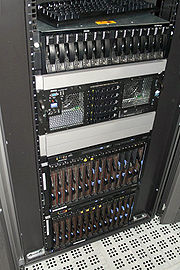
- The sliding rails can lock in various extended positions to prevent the equipment from moving when extended out from the rack for service.
- The server itself might have locking pins on the sides that just drop into slots on the extended rail assembly, in a manner similar to a removable kitchen drawer. This permits a very easy server installation and removal since there is no need for the server to be held in midair while someone fastens each rail to the sides of the server with screws.
- Some manufacturers of rack-mount hardware include a folding cable tray behind the server, so that the cables are held into a neat and tidy folded channel when inside the rack, but can unfold out into a long strip when pulled out of the rack, allowing the server to continue to be plugged in and operating normally even while fully extended and hanging in midair in front of the rack. This piece of equipment thus simplifies maintenance, but at the cost of providing a restriction to airflow.
- Rack-optimized servers might duplicate indicator lights on the front and rear of the rack to help identify a machine needing attention, or provide a separate "identify" LEDLight-emitting diodeA light-emitting diode is a semiconductor light source. LEDs are used as indicator lamps in many devices and are increasingly used for other lighting...
indicators on both sides of the server (which can be turned on in software or by pushing an associated button). Since some configurations permit over fifty 1U servers in a single rack, this provides a simple method to determine exactly which machine is having a problem when at the rear of the rack. - A handle may be provided at the rear of the server rails, to help pull or push the server without having to pull on the cables.
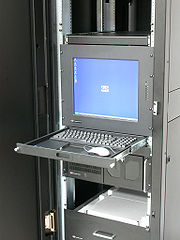
When there are a large number of computers in a single rack, it is impractical for each one to have its own separate keyboard, mouse, and monitor. Instead, a KVM switch
KVM switch
A KVM switch is a hardware device that allows a user to control multiple computers from a single keyboard, video monitor and mouse. Although multiple computers are connected to the KVM, typically a smaller number of computers can be controlled at any given time...
or LOM
Out-of-band management
In computing, out-of-band management involves the use of a dedicated management channel for device maintenance...
software is used to share a single keyboard/video/mouse set amongst many different computers.
Since the mounting hole arrangement is vertically symmetric, it is possible to mount rack-mountable equipment upside-down. However, not all equipment is suitable for this type of mounting. For instance, most optical disc
Optical disc
In computing and optical disc recording technologies, an optical disc is a flat, usually circular disc which encodes binary data in the form of pits and lands on a special material on one of its flat surfaces...
players will not work upside-down because the driving motor
Electric motor
An electric motor converts electrical energy into mechanical energy.Most electric motors operate through the interaction of magnetic fields and current-carrying conductors to generate force...
mechanism does not grip the disc.
Four- and two-post racks
Racks are available with either four or two vertical posts. Four-post racks allow for mounting rails to support the equipment at the front and rear. These racks may be open in construction (similar to the traditional open-style two-post racks), or may be enclosed by front and/or rear doors, side panels, or tops. Two-post racks provide just two vertical posts; a piece of equipment can be mounted either via its front panel holes, or close to its center of gravity (to minimize load on its front panel), depending on the design of the rack. Two-post racks are most often used for telecommunication installations.Specifications
- Electronic Industries AllianceElectronic Industries AllianceThe Electronic Industries Alliance was a standards and trade organization composed as an alliance of trade associations for electronics manufacturers in the United States. They developed standards to ensure the equipment of different manufacturers was compatible and interchangeable...
EIA-310-D, Cabinets, Racks, Panels, and Associated Equipment, dated September 1992. (Latest Standard Now REV E 1996) - Consumer Electronics AssociationConsumer Electronics AssociationThe Consumer Electronics Association is a standards and trade organization for the consumer electronics industry in the United States. The Consumer Electronics Association is the preeminent trade association promoting growth in the $173 billion U.S...
CEA-310-E design requirements for Cabinets, Panels, Racks and Subracks., dated December 14, 2005 - International Electrotechnical CommissionInternational Electrotechnical CommissionThe International Electrotechnical Commission is a non-profit, non-governmental international standards organization that prepares and publishes International Standards for all electrical, electronic and related technologies – collectively known as "electrotechnology"...
- Multiple documents are available in French and English versions.- IEC 60297 Mechanical structures for electronic equipment - Dimensions of mechanical structures of the 482,6 mm (19 in) series
- IEC 60297-1 Replaced by IEC 60297-3-100
- IEC 60297-2 Replaced by IEC 60297-3-100
- IEC 60297-3-100 Part 3-100: Basic dimensions of front panels, subracks, chassis, racks and cabinets
- IEC 60297-3-101 Part 3-101: Subracks and associated plug-in units
- IEC 60297-3-102 Part 3-102: Injector/extractor handle
- IEC 60297-3-102 Part 3-103: Keying and alignment pin
- IEC 60297-3-104 Part 3-104: Connector dependent interface dimensions of subracks and plug-in units
- IEC 60297-3-105 Part 3-105: Dimensions and design aspects for 1U chassis
- IEC 60297-4 Replaced by IEC 60297-3-102
- IEC 60297-5 Multiple documents, -100, 101, 102, ... 107, replaced by IEC 60297-3-101
- IEC 60297 Mechanical structures for electronic equipment - Dimensions of mechanical structures of the 482,6 mm (19 in) series
- Deutsches Institut für NormungDeutsches Institut für Normungis the German national organization for standardization and is that country's ISO member body. DIN is a Registered German Association headquartered in Berlin...
DIN 41494 - Multiple documents in German but some documents are available in English.- DIN 41494 Equipment practices for electronic equipment; mechanical structures of the 482,6 mm (19 inch) series
- DIN 41494-7 Dimensions of cabinets and suites of racks.
- DIN 41494-8 Components on front panels; mounting conditions, dimensions
- DIN IEC 60297-3-100 (see above in IEC section)
- DIN 41494 Equipment practices for electronic equipment; mechanical structures of the 482,6 mm (19 inch) series
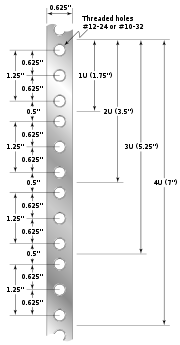
A rack's mounting fixture consists of two parallel metal strips (also referred to as "posts" or "panel mounts") standing vertically. The posts are each 0.625 inches (15.88 mm) wide, and are separated by a gap of 17.75 inches (450.85 mm), giving an overall rack width of 19 inches (482.6 mm). The posts have holes in them at regular intervals, with both posts matching, so that each hole is part of a horizontal pair with a center-to-center distance of 18.312 inches (465.12 mm).
The holes in the posts are arranged vertically in repeating sets of three, with center-to-center separations of 0.5 inches (12.7 mm), 0.625 inches (15.88 mm), 0.625 inches (15.88 mm). The hole pattern thus repeats every 1.75 inches (44.45 mm).
Holes so arranged can either be tapped (usually -inch UNC thread, more seldom metric 5 or 6 mm) or square. The square holes are meant for cage nut
Cage nut
A cage nut or caged nut consists of a square nut in a spring steel cage which wraps around the nut. The cage has two wings that when compressed allow the cage to be inserted into the square holes in equipment racks, and when released hold the nut in position behind the hole...
s. Tapped holes are more common in USA whereas square holes for cage nuts are common in Europe, especially in German cabinetry.
Racks are divided into regions, 1.75 inches (44.45 mm) in height, within which there are three complete hole pairs in a vertically symmetric pattern, the holes being centered 0.25 inches (6.35 mm), 0.875 inches (22.23 mm), and 1.5 inches (38.1 mm) from the top or bottom of the region. Such a region is commonly known as a "U", for "unit", or in German "HE" (for Höheneinheit) and heights within racks are measured by this unit. Rack-mountable equipment is usually designed to occupy some integer number of U. For example, an oscilloscope
Oscilloscope
An oscilloscope is a type of electronic test instrument that allows observation of constantly varying signal voltages, usually as a two-dimensional graph of one or more electrical potential differences using the vertical or 'Y' axis, plotted as a function of time,...
might be 4U high, and rack-mountable computers are most often 1U or 2U high. A blade server
Blade server
A blade server is a stripped down server computer with a modular design optimized to minimize the use of physical space and energy. Whereas a standard rack-mount server can function with a power cord and network cable, blade servers have many components removed to save space, minimize power...
enclosure might require 10U. Occasionally, one may see fractional U devices such as a 1.5U server, but these are much less common.
The height of a rack can vary from a few inches, such as in a broadcast console, to a floor mounted rack whose interior is 78.75 inches (200 cm) (45 rack units) high. Many wall-mounted industrial equipment enclosures have 19-inch rack rails to support mounting of equipment.
See also
- 23-inch rack23-inch rackA 23-inch rack is used for housing telephone , computer, audio and other equipment though is less common than the 19-inch rack. The size notes the width of the faceplate for the installed equipment...
- Data centerData centerA data center is a facility used to house computer systems and associated components, such as telecommunications and storage systems...
- Horizontal pitchHorizontal pitchHorizontal pitch is a unit of length defined by the Eurocard printed circuit board standard used to measure the horizontal width of rack mounted electronic equipment, similar to the rack unit used to measure vertical heights of rack mounted equipment. One HP is wide. A standard 19-inch rack is...
- Rack unitRack unitA rack unit or U is a unit of measure used to describe the height of equipment intended for mounting in a 19-inch rack or a 23-inch rack...
- Transit caseTransit caseA transit case is a hard sided case intended for protecting defined contents during transportation. In some forms, the interior is filled with foam which has pockets molded or cut into it that equipment specifically fits into...
for rack cases