
All Topics  
.45 ACP

 
.45 ACP

   Email Print
   Bookmark   Link


.45 ACP


The .45 ACP
ACP (ammunition)

ACP is an acronym that stands for Automatic Colt Pistol. It was used by various John Browning cartridge designs primarily used in Colt and FN pistols....
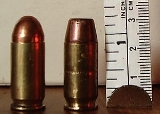
 (11.43x23mm Automatic Colt Pistol), also known as the .45 Auto by C.I.P., is a rimless
Rim (firearms)

A rim is an external flange that is machined, cast, molded, stamped or pressed around the bottom of a firearms cartridge . The rim may serve a number of purposes, the most common being as place for the Extractor to engage....
 pistol cartridge designed by John Browning
John Browning

John Moses Browning , born in Ogden, Utah, was an United States firearms designer who developed many varieties of firearms, Cartridge , and gun mechanisms, many of which are still in use around the world....
 in 1904, for use in his prototype Colt semi-automatic .45 pistol and eventually the M1911 pistol adopted by the U.S. Army
United States Army

The United States Army is the branch of the United States Armed Forces responsible for Army operations. It is the largest and oldest established branch of the U.S....
 in 1911.

The .45 ACP has become one of the most successful cartridges of all time, among both military and civilian users.


Discussion
Ask a question about '.45 ACP'
Start a new discussion about '.45 ACP'
Answer questions from other users
Full Discussion Forum


Recent Posts


Encyclopedia


The .45 ACP
ACP (ammunition)

ACP is an acronym that stands for Automatic Colt Pistol. It was used by various John Browning cartridge designs primarily used in Colt and FN pistols....
 (11.43x23mm Automatic Colt Pistol), also known as the .45 Auto by C.I.P., is a rimless
Rim (firearms)

A rim is an external flange that is machined, cast, molded, stamped or pressed around the bottom of a firearms cartridge . The rim may serve a number of purposes, the most common being as place for the Extractor to engage....
 pistol cartridge designed by John Browning
John Browning

John Moses Browning , born in Ogden, Utah, was an United States firearms designer who developed many varieties of firearms, Cartridge , and gun mechanisms, many of which are still in use around the world....
 in 1904, for use in his prototype Colt semi-automatic .45 pistol and eventually the M1911 pistol adopted by the U.S. Army
United States Army

The United States Army is the branch of the United States Armed Forces responsible for Army operations. It is the largest and oldest established branch of the U.S....
 in 1911.

The .45 ACP has become one of the most successful cartridges of all time, among both military and civilian users. It has been used in innumerable handguns and submachine guns since its introduction.

Design and history

The US Cavalry
United States Cavalry

U.S. Army cavalry units are a mounted force of the United States Army that originated in 1776, during the Revolutionary War. The role of the cavalry is reconnaissance, security and mounted assault, and the cavalry has served as a part of the Army force in every war the United States has participated in....
 had been buying and testing various handguns in the late 1890s and early 1900s. The .45 Colt Single Action Army
Colt Single Action Army handgun

The Colt Single Action Army handgun is a single action revolver with a revolving Cylinder holding six rounds. It was designed for the US government service revolver trials of 1873 by Colt's Manufacturing Company and adopted as the standard military service revolver....
 had largely been replaced, even by some double action versions of the same. The Cavalry had fielded some double action revolvers in .38 Long Colt
.38 Long Colt

The .38 Long Colt is a Cartridge introduced by Colt's Manufacturing Company in 1875. It is slightly more potent than its predecessor, the .38 Short Colt, or .38 SC....
, and they determined that the .38 caliber round was significantly less effective against determined opponents, such as those encountered in the Moro Rebellion
Moro Rebellion

The term Moro Rebellion refers to United States military operations in Moroland, Philippines, from the declared end of the Spanish-American War to the hand-over of control of the Moro Province to American civil authorities in 1913 with the actual end of the extended Spanish-American War hostilities....
 warriors they were fighting at the time of the Philippine-American war, than the .45 Colt
.45 Colt

The .45 Colt cartridge was a joint development between Colt's Patent Firearms Manufacturing Company, of Hartford, Connecticut, and the Union Metallic Cartridge Company of Bridgeport, Conn....
. The current issue rifle at the time, the .30-40 Krag
.30-40 Krag

The .30-40 Krag/.30 U.S./.30 Army/.30 Government was a round of ammunition developed in the early 1890s to provide the US armed forces with a new, powerful round to fire from the rifle it was going to select in the 1892 trials....
, also had failed to stop Moro warriors; the British had similar issues switching to the .303 British
.303 British

.303 British, or 7.7mmx56R, is a .311 inch calibre rifle and machine gun Cartridge first developed in United Kingdom in the 1880s as a blackpowder round, later adapted to use cordite and then smokeless powder propellant....
, which resulted in the development of the Dum-dum
Dum-dum

In the field of firearms, an expanding bullet is a bullet designed to expand on impact, increasing in diameter to limit penetration and/or produce a larger diameter wound....
 bullet. This experience, and the Thompson-LaGarde Tests
Thompson-LaGarde Tests

The Thompson-LaGarde Tests were a series of tests conducted in 1904 to determine which caliber should be used in new military handguns. The US Army's fighting men had considerable difficulty stopping the Moro warriors and other combatants with the .38 Long Colt, and the Army began to consider the problem....
 of 1904 led the Army and the Cavalry to decide that a minimum of .45 caliber was required in the replacement handgun.

Colt had been working with Browning on a .41 caliber cartridge in 1904, and in 1905 when the Cavalry asked for a .45 caliber equivalent Colt modified the pistol design to fire a .45 caliber version of the prototype .41 caliber round. The result from Colt was the Colt Model 1905 and the new .45 ACP. The original round that passed the testing fired a 200 grain (13 g) bullet at 900 ft/s (275 m/s), but after a number of rounds of revisions between Winchester Repeating Arms, Frankford Arsenal, and Union Metallic Cartridge, it ended up using a 230 grain (15 g) bullet at about 850 ft/s (260 m/s). The resulting .45 caliber cartridge, named the .45 ACP, is similar in performance to the .45 S&W cartridge, and only slightly less powerful (but significantly shorter) than the .45 Colt cartridges the Cavalry was using. The cartridge case shared the same head dimensions as the .30-03 and later .30-06 rifle cartridges in use by the military at the time.

By 1906 bids from 6 makers were submitted, among them Browning's design, submitted by Colt. Only DWM
Deutsche Waffen und Munitionsfabriken

Deutsche Waffen- und Munitionsfabriken Aktien-Gesellschaft , known as DWM, was an arms company in Imperial Germany created in 1896 when Ludwig Loewe & Company decided to unite it's weapons and ammunition production facilities within one company....
, Savage
Savage Arms

The Savage Arms Company is a firearms manufacturing company based in Westfield, Massachusetts. The company makes a variety of rimfire and centerfire rifles, as well as marketing the Stevens single-shot rifles and shotguns....
, and Colt made the first cut. DWM, which submitted two Luger pistol
Luger pistol

The Parabellum-Pistole , popularly known as the Luger, is a toggle locked, Recoil operation#Short recoil operation, semi-automatic pistol....
s adapted to the .45 ACP cartridge, withdrew from testing after the first round of tests, for unspecified reasons. One of the DWM pistols, serial number 1, was destroyed in testing; the remaining instance, serial number 2, is considered one of the most desirable collectors handguns in existence.

In the second round of testing in 1910, the Colt design passed the extensive testing with no failures, while the Savage design suffered 37 stoppages or parts failures. The resulting Colt design was adopted as the Model 1911.

Cartridge dimensions

The .45 ACP has 1.62 ml
Litre

The litre or liter is a unit of volume. There are two official symbols: the Latin letter L in lower and upper case . The lower case L is often written as a cursive l to avoid confusion with the number 1 in antiqua fonts....
 (25 grains
Grain (measure)

In many cultures, a grain is a Physical unit of measurement of mass that is based upon the mass of a single seed of a typical cereal. Historically, in Europe, the average masses of wheat and barley grain were used to define units of mass....
 H2O) cartridge case capacity.

.45 ACP maximum C.I.P. cartridge dimensions. All sizes in millimeters (mm).

The common rifling
Rifling

Rifling is the helix-shaped pattern in the Gun barrel of a gun or firearm, which imparts a spin to a projectile around its long axis. This spin serves to gyroscope stabilize the projectile, improving its Aerodynamics stability and accuracy....
 twist rate for this cartridge is 406 mm (1 in 16 in), 6 grooves, Ø lands = 11.23 mm, Ø grooves = 11.43 mm, land width = 3.73 mm and the primer type
Percussion cap

The percussion cap, introduced around 1830, was the crucial invention that enabled Muzzleloader firearms to fire reliably in any weather. Before this development, firearms used flintlock ignition systems which produced flint-on-steel sparks to ignite a pan of priming powder and thereby fire the gun's main powder charge....
 is large pistol.

According to the official C.I.P. (Commission Internationale Permanente Pour L'Epreuve Des Armes A Feu Portative) guidelines the .45 ACP case can handle up to 130 MPa (18,885 psi) piezo pressure. In C.I.P. regulated countries every pistol cartridge combo has to be proofed at 130% of this maximum C.I.P. pressure to certify for sale to consumers.
The SAAMI
Saami

Saami or SAAMI can stand for:*Sami people*Sami languages*Sporting Arms and Ammunition Manufacturers' Institute...
 pressure limit for the .45 ACP is set at 144.79 MPa (21,000 psi
Pounds per square inch

The pound per square inch or, more accurately, pound-force per square inch is a unit of pressure or of stress based on avoirdupois units....
), piezo pressure.
The SAAMI
Saami

Saami or SAAMI can stand for:*Sami people*Sami languages*Sporting Arms and Ammunition Manufacturers' Institute...
 pressure limit for the .45 ACP +P
Overpressure ammunition

Overpressure ammunition, commonly designated as +P or +P+, is small arms ammunition that has been loaded to a higher internal pressure than is standard for ammunition of its caliber , but less than the pressures generated by a proof shot....
 is set at 158.58 MPa (23,000 psi
Pounds per square inch

The pound per square inch or, more accurately, pound-force per square inch is a unit of pressure or of stress based on avoirdupois units....
), piezo pressure.

Performance

The result is one of the world's more effective combat pistol cartridges, one that combines very good accuracy and stopping power
Stopping power

Stopping power is a colloquial term used to describe the ability of a firearm or other weapon to cause a penetrating ballistic injury to a target human or animal, an injury sufficient to incapacitate the target where it stands....
 for use against human targets. The cartridge also has relatively low muzzle blast and flash, as well as moderate recoil
Recoil

Recoil, in common everyday language, is considered the backward kick or force produced by a gun when it is fired. In more precise scientific terms, this force is equal to the time derivative of the backward momentum resulting when a gun is fired....
. The .45ACP also operates at a relatively low maximum chamber pressure rating of 21,000 psi (145 MPa) (compared to 35,000 psi/240 MPa for 9mmP and .40S&W, 37,500 psi/260 MPa for 10mmAuto, 40,000 psi/280 MPa for .357SIG), which helps extend service life of weapons it is fired in.

Like many pistol cartridges, it is a low-velocity round, and thus not particularly effective against body armor. Another drawback for large scale military operations is the cartridge's large size, weight, the increased material cost of manufacture compared to the smaller 9x19mm Parabellum cartridge, and lack of compliance with Standardization Agreements pertaining to handgun ammunition currently enacted between the US and many of its allies.

Even in its non-expanding full metal jacket
Full metal jacket bullet

A full metal jacket is a bullet encased in a shell of copper alloy or a steel-alloy shell. This shell can extend around all of the bullet, or often just the front and sides with the rear left as exposed lead....
 (FMJ) version, the .45 ACP cartridge has a reputation for effectiveness against human targets because its large diameter creates a deep and substantial permanent wound channel which lowers blood pressure more rapidly. However, some writers, such as the published work of Marshall and Sanow, have cast the reputation of .45 ACP as being the "best" at this task into debate. Marshall & Sanow's work, while receiving heavy criticism from Dr. Fackler and others, show the .45 ACP, loaded with the best hollowpoint bullets and fired from a 5" barrel to be a good "one shot stopper", somewhat better than the 9x19mm, equal with the .40 S&W, and only a few percentage points behind the "King" of the Marshall and Sanow study - the .357 Magnum fired from a 4" barrel. Nevertheless, the .45 ACP remains one of the top handgun cartridges for stopping power, when figures are compiled accurately.

Being a moderate-powered cartridge, the wide diameter of the .45 ACP bullets produces a decreased tendency to overpenetrate, which reduces the projectile's possibility of passing through the intended target with enough velocity to injure another person. The combination of stopping power and controlled penetration makes the .45 ACP practical for police use, although numerous issues, including the resulting decrease in magazine capacity and the larger size and weight of pistols chambered in this caliber, have led more police departments in the USA to adopt sidearms in 9x19mm, .40 S&W
.40 S&W

The .40 S&W is a Rim pistol Cartridge developed jointly by U.S. Repeating Arms Company and Smith & Wesson, two famous American firearms manufacturers....
, and .357 SIG
.357 SIG

The .357 SIG pistol Cartridge is the product of Switzerland firearms manufacturer Schweizerische Industrie Gesellschaft, in cooperation with the United States ammunition manufacturer Federal Cartridge....
. Many US tactical police units still utilize the .45 pistol round, including the FBI's Hostage Rescue Team. While high capacity firearms are available in .45 ACP, the greater length and diameter of the .45 ACP means that the grip of the pistol must be longer and wider than the grip of a comparable pistol of a smaller caliber; this increase in grip size can make the pistol difficult to use for shooters with smaller hands.

Today most NATO
NATO

The North Atlantic Treaty Organization , also called the Atlantic Alliance, is a military alliance established by the signing of the North Atlantic Treaty on 4 April 1949....
 militaries use sidearms chambered for the 9x19mm Parabellum cartridge, but the effectiveness of the .45 ACP cartridge has ensured its continued popularity with large caliber sport shooters, especially in the United States
United States

The United States of America is a Federal government constitutional republic comprising U.S. state and a federal district. The country is situated mostly in central North America, where its Contiguous United States and Washington, D.C., the Capital districts and territories, lie between the Pacific Ocean and Atlantic Oceans, Borders of the U...
. In addition, select military and police units around the world still utilize firearms firing the .45 ACP.

Because all standard .45 ACP rounds fired from handguns or short barreled "submachine" guns are inherently subsonic, it is one of the most powerful pistol calibers available for use in suppressed weapons
Suppressor

A suppressor, sound suppressor, sound moderator, or silencer is a device either attached to or part of the Gun barrel of a firearm to reduce the amount of noise and muzzle flash generated by firing the weapon....
 since subsonic rounds are quieter than supersonic rounds. The latter inevitably produce a highly compressed shockwave, audible as a loud "crack", literally a small sonic boom, while they travel through the air. Suppressors reduce the audible "report" by slowing and channeling the high speed gas generated by the burning/expanding gunpowder before it exits the muzzle resulting in a muffled "cough". Suppressors of course can't act on a supersonic shockwave generated by the bullet breaking the sound barrier as this happens after it exits the barrel. The downside to the use of .45ACP in suppressed weapons is that increasing the diameter of the passage through a suppressor decreases its efficiency - thus, while .45ACP is among the most powerful suppressed pistol rounds, it is also one of the loudest. Most .45 suppressors must be fired "wet" (with an ablative medium, usually water) to bring sound levels down to "hearing-safe" (under 140dB, generally).

Load variants

Several manufacturers market preloaded .45 ACP rounds in sizes ranging from 117 to 250 grains (8 g to 16 g), with the most popular commercial load being the standard military loading of a 230-grain (15 g) FMJ bullet at around 850 ft/s (260 m/s). Specialty rounds are available in weights under 100 grains (6.5 g) and over 260 grains (16.8 g); popular rounds among reloaders and target shooters include 185-and 230-grain (12 g and 15 g) bullets. Hollow-point rounds intended for maximum effectiveness against live targets are designed to expand upon impact with soft tissue, increasing the size of the permanent cavity left by the bullet as it passes through the target.

Most ammunition manufacturers also market what are termed "+P" loadings in pistol ammunition, including the .45 ACP. This means the cartridge is loaded to a higher maximum pressure level than the original SAAMI
Sporting Arms and Ammunition Manufacturers' Institute

The United States Sporting Arms and Ammunition Manufacturers' Institute is an association of American firearms and ammunition manufacturers. SAAMI publishes various industry standards related to the field, including fire code, ammunition and chamber specifications, and acceptable chamber pressure....
 cartridge standard, generating higher velocity and more muzzle energy. In the case of the 45 ACP, the standard cartridge pressure is 21,000 PSI and the SAAMI 45 ACP +P standard is 23,000 PSI. This is a common practice for updating older cartridges to match the better quality of materials and workmanship in modern firearms.

The terminology is generally given as ".45 ACP +P", and appears on the headstamp
Headstamp

A headstamp is the markings on the bottom on a Cartridge case designed for a firearm. It usually tells who manufactured the case. If it is a civilian case it often also tells the caliber, if it is military, the year of manufacture is often added....
. It is important to note that +P cartridges are dimensionally identical to standard-pressure cartridges and will chamber and fire in all firearms designed for the standard-pressure loadings. However, if +P loadings are used in firearms not specifically designed for them they may cause damage to the weapon and injuries to the operator.

Popular derivative versions of the .45 ACP are the .45 Super
.45 Super

The .45 Super is a smokeless powder center fire metallic firearm Cartridge developed in 1988 by Dean Grennell, a well known writer in the firearms field as well as managing editor of Gun World magazine....
 and .460 Rowland
.460 Rowland

The .460 Rowland is a proprietary cartridge intended to attain .44 Magnum level performance with a M1911-pattern semi-automatic pistol. The cartridge concept originated with Johnny Rowland, the host of "The Shooting Show"....
. The Super is dimensionally identical to the .45 ACP, however, the cartridge carries a developer established pressure of 28,500 PSI and requires minor modification of quality firearms for use. The Rowland case is 0.057" longer specifically to prevent it from being chambered in standard .45 ACP firearms. The Rowland operates at a developer established 40,000 c.u.p. and may only be used within a select group of firearms significantly modified for this purpose. Brass cases for each of these cartridges carry the applicable name within the headstamp. The Super provides approximately 20% greater velocity than the .45 ACP +P; the Rowland approximately 40% greater velocity than the .45 ACP +P.

Timeline

  • 1899/1900 self-loading pistols test: Colt M1900
    Colt M1900

    The Colt Model 1900 was a self-loading semi-automatic .38 caliber handgun introduced by Colt's Manufacturing Company at the turn of the century....
     of .38 caliber entered
  • 1904 Thompson-LaGarde Tests
    Thompson-LaGarde Tests

    The Thompson-LaGarde Tests were a series of tests conducted in 1904 to determine which caliber should be used in new military handguns. The US Army's fighting men had considerable difficulty stopping the Moro warriors and other combatants with the .38 Long Colt, and the Army began to consider the problem....
    : Caliber of new handgun should be at least .45
  • 1906–1907 handgun trials: Colt enters with .45 ACP design
  • 1910 final tests: Colt pistol (designed by John Browning) out-performs Savage
  • On March 29 1911, the Colt pistol is officially adopted as the Model 1911 - and with it, the .45 ACP cartridge.


Synonyms

  • .45 Auto
  • 11.43x23mm


Related rounds

  • .38/.45 Clerke
  • .400 Corbon
    .400 Corbon

    The .400 Corbon is an semi-automatic firearm pistol cartridge developed by Cor-Bon in 1997. It was created to mimic the ballistics of the powerful 10 mm Auto cartridge in a .45 ACP form factor....
  • .45 G.A.P.
    .45 GAP

    The .45 G.A.P. pistol Cartridge was designed by Ernest Durham, an engineer with CCI/Speer, at the request of firearms manufacturer Glock to provide a cartridge that would equal the power of the .45 ACP but was shorter to fit in a more compact handgun, and with a stronger case head to reduce the possibility of case neck blowouts....
  • .45 Super
    .45 Super

    The .45 Super is a smokeless powder center fire metallic firearm Cartridge developed in 1988 by Dean Grennell, a well known writer in the firearms field as well as managing editor of Gun World magazine....
  • .460 Rowland
    .460 Rowland

    The .460 Rowland is a proprietary cartridge intended to attain .44 Magnum level performance with a M1911-pattern semi-automatic pistol. The cartridge concept originated with Johnny Rowland, the host of "The Shooting Show"....
  • .45 Remington-Thompson
  • .45 Winchester Magnum
  • .45 Peters-Thompson shot cartridge


External links