

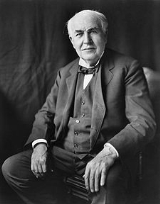

1869 Thomas Edison receives a patent for his electric voting machine.
1876 Thomas Edison receives a patent for his mimeograph.
1877 Thomas Edison announces his invention of the phonograph, a machine that can record and play sound.
1877 Thomas Edison demonstrates his phonograph for the first time.
1877 Thomas Edison, first human voice recorded, {Mary had a little lamb.}
1878 Thomas Edison patents the phonograph.
1879 Using a filament of carbonized thread, Thomas Edison tests the first practical electric incandescent light bulb (it lasted 13½ hours before burning out).
1879 Thomas Edison demonstrates incandescent lighting to the public for the first time.
1880 Thomas Edison observes the Edison effect.
1880 In Menlo Park, New Jersey, Thomas Edison performs the first test of his electric railway.
1880 First electric lamp factory is opened by Thomas Edison.
1881 Thomas Edison and Alexander Graham Bell form the Oriental Telephone Company.
1883 The first electric lighting system employing overhead wires, built by Thomas Edison, begins service at Roselle, New Jersey.
1888 A recording of English composer Arthur Sullivan's The Lost Chord, one of the first recordings of music ever made, is played during a press conference introducing Thomas Edison's phonograph in London.
1888 Thomas Edison files a patent for the Optical Phonograph (the first movie).
1889 Thomas Edison shows his first motion picture.
1891 History of cinema: The first public display of Thomas Edison's prototype kinetoscope.
1891 Thomas Edison patents the motion picture camera.
1892 Thomas Edison receives a patent for a two-way telegraph.
1897 Thomas Edison patents the Kinetoscope, the first movie projector.
1903 Topsy, an elephant, is electrocuted by Thomas Edison during the War of Currents campaign.
1904 Kaiser Wilhelm II of Germany becomes the first person to make a sound recording of a political document, using Thomas Edison's phonograph cylinder.
1931 Thomas Edison submits his last patent application.