

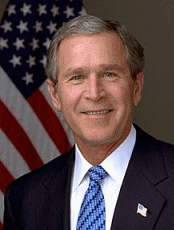

2001 US President George W. Bush announces his support for federal funding of limited research on embryonic stem cells.
2001 In an address to a joint session of Congress and the American people, U.S. President George W. Bush declares a "war on terror".
2001 U.S. President George W. Bush announces the establishment of the Office of Homeland Security.
2001 War on Terrorism: In the first such act since World War II, US President George W. Bush signs an executive order allowing military tribunals against foreigners suspected of connections to terrorist acts or planned acts on the United States.
2001 In Washington, D.C., U.S. President George W. Bush dedicates the United States Department of Justice headquarters building as the Robert F. Kennedy Justice Building, honoring the late Robert F. Kennedy on what would have been his 76th birthday.
2002 President George W. Bush signs into law the No Child Left Behind Act.
2002 In his State of the Union Address, President George W. Bush describes "regimes that sponsor terror" as an ''Axis of Evil'', in which he includes Iraq, Iran and North Korea.
2003 2003 invasion of Iraq: In what becomes known as the "Mission Accomplished" speech, on board the {{USS|Abraham Lincoln|CVN-72|6}} (off the coast of California), U.S. President George W. Bush declares that "major combat operations in Iraq have ended".
2003 From the flight deck of the USS Abraham Lincoln, US President George W. Bush announced in a nationally televised address in front of a "Mission Accomplished" banner that major combat operations in Iraq had ended.
2003 President George W. Bush signs the CAN-SPAM Act of 2003 into law. The law establishes the United States' first national standards for the sending of commercial e-mail and requires the Federal Trade Commission to enforce its provisions.
2004 Dick Cheney and George W. Bush testify before the 9/11 Commission in a closed, unrecorded hearing in the Oval Office.
2005 In Slovakia, a two-day meeting dubbed "Slovakia Summit 2005" takes place between U.S. President George W. Bush and Russian President Vladimir Putin. This occasion marks the first visit of a sitting American President to the Slovak Republic since its establishment in 1993.
2005 A hand grenade thrown by Vladimir Arutinian lands about 65 feet (20 metres) from U.S. President George W. Bush while he is giving a speech to a crowd in Tbilisi, Georgia, but it malfunctions and does not detonate.
2006 ''Hamdan v. Rumsfeld'': The U.S. Supreme Court rules that President George W. Bush's plan to try Guantanamo Bay detainees in military tribunals violates U.S. and international law.
2008 The Emergency Economic Stabilization Act of 2008 for the US financial system is signed by President Bush.