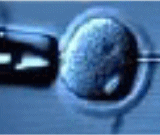
Advocates of human cloning claim that it could be of incredible medical benefit to patients with diabetes, heart disease and cancer. Advocated suggest that human cloning could help provide organs for those in need of transplants.
replied to: hanso
Replied to: Advocates of human cloning claim that it could be of incredible...
Some scientists believe that human cloning might lead to ways to slow or stop the aging process, though how this might be brought about remains unclear.
replied to: hanso
Replied to: Advocates of human cloning claim that it could be of incredible...
THIS IMPLYS THAT THE CLONED HUMAOIDS WOULD BE KILLED FOR THEIR BODY PARTS. THE VERY THOUGHT OT IT SENDS COLD CHILLS UP MY SPINE. THANK GOD I WON'T BE AROUND TO SEE IT HAPPEN. I KNOW THAT THE ARGUEMENTS FOE DECIDING ISSUES BETWEEN SCIENCE AND MORAL GROUNDS
ARE VERY BIG RIGHT NOW, HOWEVER I STAND ON THE SIDE OF MAKING MORAL JUDGEMENTS.
replied to: hanso
Replied to: Advocates of human cloning claim that it could be of incredible...
Human, or any other cloning is bad for one big reason- it reduces genetic diversity. On a very small scale it may be useful for preserving a species that has only two or three individuals still existing. As regards human cloning,taking the cells of a dying loved one to create a new life is borderline defensible. Cloning embryos for research is also borderline until the heart starts to beat. After that it is a life.
There is a lot of nonsense talked about clones. They are not soulless zombies. If brought to term they are as viable as any other living organism. The only difference is that a set of clones are all geneticaly the same, and therefore, if a disease is introduced they will all live or all die. The 'all live' part of it is nice, but the 'all die' part is not something we want to happen to any population.
replied to: hanso
Replied to: Advocates of human cloning claim that it could be of incredible...
Human, or any other cloning is bad for one big reason- it reduces genetic diversity. On a very small scale it may be useful for preserving a species that has only two or three individuals still existing. As regards human cloning,taking the cells of a dying loved one to create a new life is borderline defensible. Cloning embryos for research is also borderline until the heart starts to beat. After that it is a life.
There is a lot of nonsense talked about clones. They are not soulless zombies. If brought to term they are as viable as any other living organism. The only difference is that a set of clones are all geneticaly the same, and therefore, if a disease is introduced they will all live or all die. The 'all live' part of it is nice, but the 'all die' part is not something we want to happen to any population.
replied to: hanso
Replied to: Advocates of human cloning claim that it could be of incredible...
If all this time and resource has gone into the research already and; what is now possible from this research...it would be extemely counter productive and therefore uneconomical, for any production resulting from it, failing. then it must be the extent and usefulness of the capabilities of this end to be the most important factor...from a non-sceince background I think if handled in the correct context it may not all be such bad idea.
replied to: hanso
Replied to: Advocates of human cloning claim that it could be of incredible...
I'm sorry, but I wholeheartedly disagree with this on an ethical level. Yes, it is a possibility, but it is wrong. Just because a clone has not been naturally conceived does not make it inhuman or even sub-human; it is still a human lifeform.
Preserving a clone for medical means is just as wrong as keeping a fully developed adult alive for the same reasons. A clone would still have the same genetic structure as any other human being and would thus be able to feel emotions, think and act on their morals.
The medical benefits are great, but it breaks the boundaries of ethics
replied to: hmsenterpris
Replied to: THIS IMPLYS THAT THE CLONED HUMAOIDS WOULD BE KILLED FOR THEIR...
I sympathise with your cold chills, but really, you have not done your homework!
I cannot go into all the aspects of the matters that you have raised, but biologically and ethically (morally if you like) what you have said simply is meaningless. How do you suppose your body mends a wound? it does it by repairing it with cloned cells! Each of those cells contains everything needed to make an entire new human. Do your cold chills drive you to kill yourself out of sheer guilt for the cloned megadeaths that result every time you accidentally bite your lip?
And if you do not know what a moral judgement is, as seems clear from what you have said, I suggest that you read some simple book that explains such matters, such as "The language of morals" by R,M, Hare. it is only one such book of many, but very good. Or alternatively you might find some simple and helpful free material on the Internet. Try googling say, "ethical moral philosophy". Then try to find some helpful material on cloning and the associated biological principles. Before you have done that you simply cannot make any sense of the matter. One consequence is that you bring the moral standards that you revere into disrespect. Including your own disrespect for it. It deserves better study than you have given it so far.
Enjoy your reading.
Jon
replied to: animartco
Replied to: Human, or any other cloning is bad for one big reason-...
Concerning diversity, sorry no coconut.
Firstly, consider the statistics. Suppose I perfected cloning tomorrow. Suppose I am very reasonably assumed that the world were in desperate need of lots of copies of myself. If one is good, then 1 million must be 1 million times better, right? Or why not 100 million? Okay so now you have the equivalent of the population of the British Isles in the form of glorious copies of me! Lucky Lucky everybody!
And?
What has the effect on genetic diversity been?
Trivial!
It would take some really really really dramatic effect for me (or anyone) to propagate clones on anything like such a scale. But you would have had to add a lot more reallies to get anywhere near seriously damaging human genetic diversity.
And remember that in nature very many species, including thousands of plants and insects (among many other groups) actually do very well by alternately cloning generations and reproducing sexually. That strategy permits plenty of diversity, combined with a good leg up for any novel and superior genotype.
Now if only cloning were half as much fun as sex...
Cheers,
Jon
replied to: Turnkey
Replied to: I'm sorry, but I wholeheartedly disagree with this on an ethical...
The ethics are simply a matter of what you do with it and how. killing human life forms is no sin or crime; you do it by the billion every time you go out into the sun. You have killed your identical twins, genetically speaking, over and over millions of times in your daily growth of skin and mucous membrane. Try to imagine one of your cells under your epidermis, about to split. One of the daughter cells is doomed. It contains every bit of the genetic materialthat one of your heart, or brain, or genital stem cells does. That genetic material has descended almost unchanged from your forerunners for generation after generation. It has controlled the minds and bodies of saints, sinners, and creators of fine and valuable things. And what are you going to do with it? You are going to smother it to death in keratin to form an invisibly small blob of horn in yur skin, to be shed unappreciated just days later!
Murderer! Parasite! How COULD you??? id you even check to see which of the two cells you would choose for sacrifice, and which for life?
Mmmm... Well, of course, how could you not? What options did you have? Anyway, did the cell care? Did it have a brain? Well, no; cells don't have brains,; brains have cells.
Well, then the problem is not whether we grow cloned cells for tissue repair, but whether we grow brains to care. No brain, no care!
But you still feel it is evil?
Then how evil is it NOT to do so? By using the cloned tissues we can replace a heart without having to wait for a traffic accident, maybe? And how many cells from the other clone (the patient, remember?) will die if we don't use the cloned heart? And the brain of the patient of course; that too would die; unlike the clone, the patient does have a brain and the brain and its family do care, right?
Tricky stuff ethics; It depends so deeply on the facts of the matter.
And the facts are tricky too.
And it is deeply, deeply unethical, immoral, to ignore them before sounding off, don't you think?
But it certainly is fun, I must admt...
Cheers,
Jon